Yu Haibin from SUPCON Technology: AI, The Next Stop Driving the Process Industry | 36Kr 2026 Industrial Future Conference
In 2026, industrial investment has entered a deep-water zone, where capital, technology and industry are accelerating their integration. Old investment logic no longer applies, and new consensus is taking shape. The 2026 Industrial Future Conference focuses on opportunities in the new cycle, and jointly explores the future of the industry and the birth of the "Light of China". From September 9 to 10, the 2026 Industrial Future Conference hosted by 36Kr, themed "Above Deep Waters, Resonate for New Birth", was held in Yizhuang, Beijing. Participants from state-owned capital platforms, industrial investment funds, corporate CVCs, innovative enterprises, and experts and scholars gathered to focus on the industrialization of future industries such as quantum technology. The conference conducted in-depth discussions on current cutting-edge technologies and industrial perspectives, showcased breakthroughs in technical routes including superconductivity, optical quantum, and ion trap, and shared a large number of specific industrial scenarios, industrial system construction, and the prospects of heterogeneous computing, to jointly explore the future of technology industry investment.
The following is the speech content, organized and edited by 36Kr:
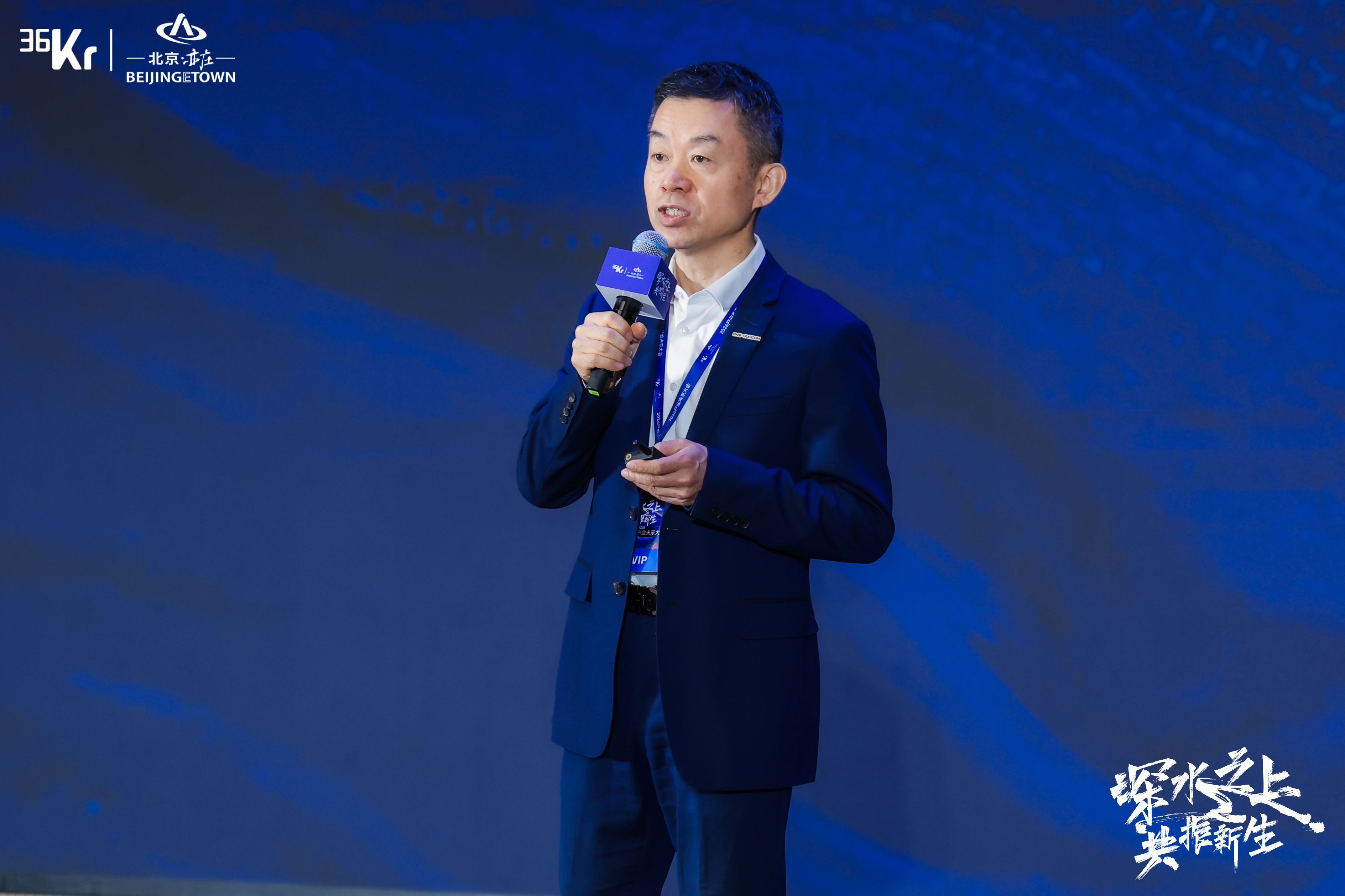
Speaker: Yu Haibin, Deputy Director of the Strategic Committee and President-level Strategic Advisor of Supcon Technology
Distinguished guests, friends from the industry, good day to all of you! I am Yu Haibin from Supcon Technology, and thank 36Kr for the invitation. The theme of today's conference is "Above Deep Waters, Resonate for New Birth".
For those of us working in the industrial sector, the "deep water" concept is very concrete: process industries such as chemical and petrochemical production feature high temperature, high pressure, flammable and explosive working conditions. In recent years, capital expenditure has shrunk, and the whole industry is at the bottom of the cycle.
Where does the direction of "new birth" lie? I would like to summarize today's sharing in one sentence: Let factories move from automatic control to autonomous operation. This is also the theme of my speech: AI, driving the next stage of the process industry.
Today's sharing is divided into three parts: industrial opportunities, the Supcon path, and value creation. Finally, I will answer a question with real cases: Has industrial AI actually been implemented on the ground?
First, a basic judgment: AI is becoming the core variable for manufacturing upgrading, and all industries have the possibility of being "rebuilt from scratch". But one point needs to be clarified: AI does not add extra functions to automation, as automation has long been widely applied. AI empowers factories to shift from "following instructions" to "thinking on their own". The new birth of advanced manufacturing does not lie in replacing machines, but in replacing the "brain". Data also confirms this judgment: In 2025, the scale of China's industrial AI market reached 1.287 trillion yuan, a year-on-year increase of 26.3%, far exceeding the growth rate of the overall AI market. Industrial AI has entered the volume release period from the concept stage.
Policy signals are equally clear. In the first three months of 2026, four national-level policies were intensively introduced, covering the foundation of industrial data, the integration of industrial internet and AI, the special action of "AI + Manufacturing" jointly launched by eight government departments, and the guiding opinions on zero-carbon factories issued by five government departments, paving the way comprehensively from four dimensions: data, technology, scenarios and green development.
In a word, industrial intelligence is changing from an "optional question" to a "must-answer question".
So where is the main battlefield of AI? It is the process industry. The total revenue of China's industry is 140 trillion yuan, of which the process industry accounts for 60 trillion yuan, covering 55,000 enterprises above designated size in sectors including petrochemicals, chemicals, electric power, and metallurgy.
More critically, in terms of carbon emissions: China's annual carbon emissions reach 13 billion tons, 80% of which come from the process industry. Under the dual carbon goals, the pressure of emission reduction is the driving force for transformation. The 60 trillion yuan stock market, coupled with the rigid demand for dual carbon emission reduction, constitutes the historic opportunity window for industrial AI.
However, factories today are far from being ready. The form of factories has gone through four stages.
The first stage is the traditional factory, which is driven by people and limited by people.
Working conditions change every day during startup and shutdown, load adjustment, and raw material replacement. To maximize the yield and minimize the unit consumption, we rely on "veteran technicians", thousands of operators who monitor the system, adjust parameters and handle emergencies based on experience.
However, in the face of dense alarms, an operator can only effectively handle more than ten of them per hour. Experience is locked in the human mind, veteran technicians are facing a generational gap, and even the most senior engineers cannot ensure that every decision is optimal.
The second stage is the lights-out factory under the Industry 4.0 framework, which pushes automation to the extreme, but it is "unmanned" rather than "autonomous". Machines only execute preset programs, and can do nothing when encountering situations beyond the preset range, which means they are "well-developed in limbs but simple in mind".
The third stage: The EU's Industry 5.0 tries to make up for the loopholes, but on the foundation of industrial hollowing-out, it is more like a value declaration rather than a practical technical architecture.
The fourth stage is the autonomous operation that China is leading, which enables the real industry to have "autonomous consciousness" for the first time: The TPT large model is the brain of industrial AI, the control system is the neural network, and perception, decision-making and execution form a complete closed loop, realizing the transformation from "machine replacing human" to "machine autonomy".
The limit of the lights-out factory is "unmanned", and the goal of autonomous operation is "autonomy", which is the real paradigm leap.
Why is autonomous operation most likely to take the lead in emerging in China? It requires four necessary conditions: physical factory entities, industrial data, industrial large models, and autonomous and controllable control systems. Overseas markets happen to lack this foundation: The proportion of EU manufacturing in GDP has dropped from 30% in the 1980s to 14.3% in 2024, with about 5 million jobs lost, Industry 4.0 model factories closed down, and the industrial system facing discontinuity.
China is the only super test field in the world that has all four conditions in place:
Blood: 8.53 ZB of industrial data was generated in 2025, ranking first in the world. Body: China is the only country in the world that covers all 41 major industrial categories, and the revenue of industries above designated size in the Yangtze River Delta exceeds 40 trillion yuan, surpassing the sum of that of the UK and France. Nerve: The control system is autonomous and controllable after more than 30 years of development. Brain: China's industrial large model accounts for 23.9% of the global market, with a growth rate of 51.3%. Over the past hundred years, industrial standards have been formulated by Europe and the United States;
China can define this paradigm leap from automation to autonomous operation.
The second part talks about Supcon itself: more than 30 years, three leaps following industrial upgrading.
The development history of Supcon is the epitome of China's process industry upgrading. In the 1990s, we started from the domestic substitution of DCS, broke the monopoly of Honeywell and Emerson, and realized "product equality". Today, the domestic market share of our DCS exceeds 45.1%, ranking first in the industry for 15 consecutive years.
In 2024, Supcon Technology announced that it would go all in on AI, releasing TPT (Time-series Pre-trained Transformer), the first time-series large model for the process industry, and UCS (Universal Control System), to build the AOP (Autonomous Operating Plant) system for autonomous operation factories.
Some people may ask: There are many players in the industrial AI track, why can Supcon Technology succeed? The answer is very simple: Data is the food of AI, and data needs to be accumulated over years.
With 33 years of experience, coverage of more than 50 sub-sectors, more than 100,000 sets of control systems, and more than 40,000 customers, a large part of the core production data of China's process industry flows through our control systems. High-quality industrial datasets cannot be bought with money. Today, TPT has hundreds of benchmark applications, with more than 10,000 enterprises deployed on the cloud.
The 30 years of accumulation is also reflected in hard power: We have won the first prize of the National Science and Technology Progress Award, the second prize of the National Technology Invention Award, and the first prize of the China Standard Innovation Contribution Award. We have taken the lead and participated in the formulation of 8 international standards and 111 national standards.
In particular, I would like to share the latest progress: In August this year, three national standards for industrial artificial intelligence that Supcon Technology deeply participated in compiling were officially released and implemented. The industrial AI standard system is being led and established by Chinese enterprises.
Next, we will answer a key question: How to measure the autonomous operation level of a factory? Referring to the classification logic of automotive autonomous driving, we have launched a L0 to L5 classification framework for factory autonomous operation.
L0 to L2 are the traditional automation stages, similar to the cruise control function of automobiles. L3 supports black-screen operation, and people can take over when necessary, which is similar to the "advanced assisted driving" of automobiles, and marks the beginning of the move towards autonomous operation, just as FSD enables cars to "drive on their own", which is the key direction that Supcon Technology's AOP is currently tackling. L5, which realizes complete autonomy, is the ultimate form of industrial AI.
What is the essential difference between autonomous operation and automation?
There are three levels of leaps: First, from multi-person on-duty to machine autonomy - the system perceives anomalies, assesses risks, makes decisions and executes 24/7 non-stop. Second, from maintaining stable operation to pursuing optimal status - in the past, "safe and stable operation without unplanned shutdown" was the goal, but now we need to "always operate on the optimal curve" to dynamically find the real-time optimal solution. Third, from passive protection to active immunity - build a digital immune system for the factory, predict risks in advance with an accuracy rate of over 98%, and eliminate unplanned shutdowns before they happen.
Please note: This is not to overthrow the traditional control technology, but to install an "AI brain" for traditional control. At present, the process industry is in a ten-year window of leaping from L2 to L3 and L4. Supcon Technology's AOP has realized L3-level implementation in Hubei Xingrui.
FSD enables a car to run autonomously, and AOP enables a factory to run autonomously. Moreover, I have to say that factory autonomous operation is far more difficult than that of automobiles: A car only has one "driver", while a chemical plant is equivalent to thousands of "drivers" driving at the same time.
The more critical difference lies in safety guarantee: When a car breaks down, people still have the chance to take over. But in a factory, when the reactor is out of control, explodes, or toxic medium leaks, people have no time to intervene at all. Therefore, the safety redundancy design of AOP is much stricter than that of FSD. We do not pin our safety on "people taking over at any time", but eliminate the scenarios that require human takeover from the architecture level.
How does AOP achieve this goal? The core is the two-wheel drive of TPT and UCS. First, a judgment: The bottleneck of industrial AI is not computing power, which is widely available, but the algorithm. It is not feasible to directly apply the general large language model to factories. The industrial site is full of time-series data such as temperature, pressure and flow, so we must use the time-series large model for modeling. The time-series large model TPT is the brain of the factory.
It is specially built for the time-series data in the process industry, deeply understands the process, perceives the status in real time, accurately predicts the trend, and makes autonomous decisions and executions. Because it follows the laws of physics, it fundamentally avoids the "hallucination" problem of general large models, which is the safety bottom line rather than a bonus point in chemical plants. It is also an agent generation platform, which can generate a dedicated Agent to solve specific production problems with one sentence of demand.
The general control system UCS is the nerve center of the factory. The minimalist architecture composed of the control data center and the all-optical network enables on-site data to be transmitted in parallel 100 times faster than the traditional method, providing real-time and complete "data food" for TPT. TPT plus UCS, brain plus nerve - this is the complete technical path from the human control era to the autonomous operation era.
The third part is value creation. The keynote of this conference is to put aside empty concepts and check the actual implementation results, so we will speak with data.
First, let's look back at what Supcon Technology did in the DCS era. In 1975, Honeywell launched the world's first DCS. For more than ten years after that, China's high-end market was monopolized by foreign brands. In the past 30 years, Supcon has done two things: First, break the monopoly - the price of imported DCS has dropped significantly, saving Chinese enterprises a lot of equipment funds. Moreover, we have ranked first in market share in the Chinese market for 15 consecutive years, and the gap with other competitors is constantly widening.
Second, full-stack autonomy - from the underlying controller and real-time operating system to the industrial AI large model, the whole link is autonomous and controllable, fundamentally eliminating the "stuck neck" risk. This is the past of Supcon Technology, and also the foundation for moving to the AOP era.
If the DCS era solves the problem of "whether we have the technology", the AOP era solves the problem of "whether the technology is good enough". AOP creates real value in four dimensions: Safety - intelligent early warning eliminates human misoperation, realizing the transformation from passive response to active immunity. Quality - AI accurately controls process parameters, eliminating differences caused by human experience. Low carbon - TPT accurately optimizes the energy consumption curve, UCS reduces 90% of the cabinet space, 80% of the cables, and 50% of the delivery cycle, cutting carbon footprint from the source. Efficiency - less human participation or even autonomous operation, tapping incremental value for the 60 trillion yuan market.
According to calculations, from 2019 to 2025, Supcon Technology has helped customers avoid a total of 382 million tons of carbon emissions - equivalent to the annual CO2 absorption of 20.9 billion mature subtropical broad-leaved trees. This is the real value of industrial AI: it is not a concept, but tangible emission reduction, efficiency improvement and safety guarantee.
These capabilities have been verified by the market: more than 40,000 users, more than 5,000 intelligent manufacturing projects, covering leading enterprises such as PetroChina, Sinopec, China PipeChina, and Wanhua Chemical, and have also been recognized by international customers such as Saudi Aramco and Mitsubishi Chemical.
What is more noteworthy is the speed: In 2026 alone, our AI product applications have expanded from 3 industries to 13 - industrial AI is entering the fast lane of large-scale replication from scattered pilot projects.
Let's look at two AOP benchmarks. The first one is the world's first autonomous operation factory demonstration project - Hubei Xingrui Silicon Materials under Xingfa Group, a leading domestic organic silicon enterprise. The project has achieved remarkable results: construction cost reduced by 60%, personnel efficiency increased by 69%, the number of alarms dropped by 98.55%, operation frequency decreased from 25,000 times to more than 1,400 times, with an annual direct economic benefit of nearly 30 million yuan.
The second one is a central SOE - Qinghai Salt Lake Magnesium Industry under China Minmetals, which carried out intelligent upgrading for its 300,000-ton ethylene process PVC plant: It is estimated that the number of monitoring points per capita will exceed 1000, the automatic control rate will be increased to over 95%, and the human efficiency will be increased by more than 100%.
From the private enterprise Xingfa to the central SOE Salt Lake, AOP has proved with real data that AI-driven process industry is not a concept, but quantifiable cost reduction and efficiency improvement. AI has also been deployed on more industrial plants.
Safety - in Guangxi Huayi, the early warning accuracy of key parameters reaches 95%, and the efficiency of AI hazard identification increases by 95%;
Quality - for a refinery enterprise under Sin