Just now, the winners of ECCV Best Paper Awards have been announced, and Li Feifei has received the Test of Time Award.
A few hours ago, ECCV announced this year's awards including the Best Paper Award.

ECCV (European Conference on Computer Vision) is one of the three top global conferences in the field of Computer Vision (CV), enjoying extremely high academic reputation and influence across the AI and computer science communities. This year's event is held in Malmö, Sweden from September 8 to 12.
This year, ECCV received 10473 valid paper submissions in total, among which 2834 papers were accepted, with an acceptance rate of 27.1%. 163 papers were selected for oral presentations, accounting for 1.6% of all submissions.
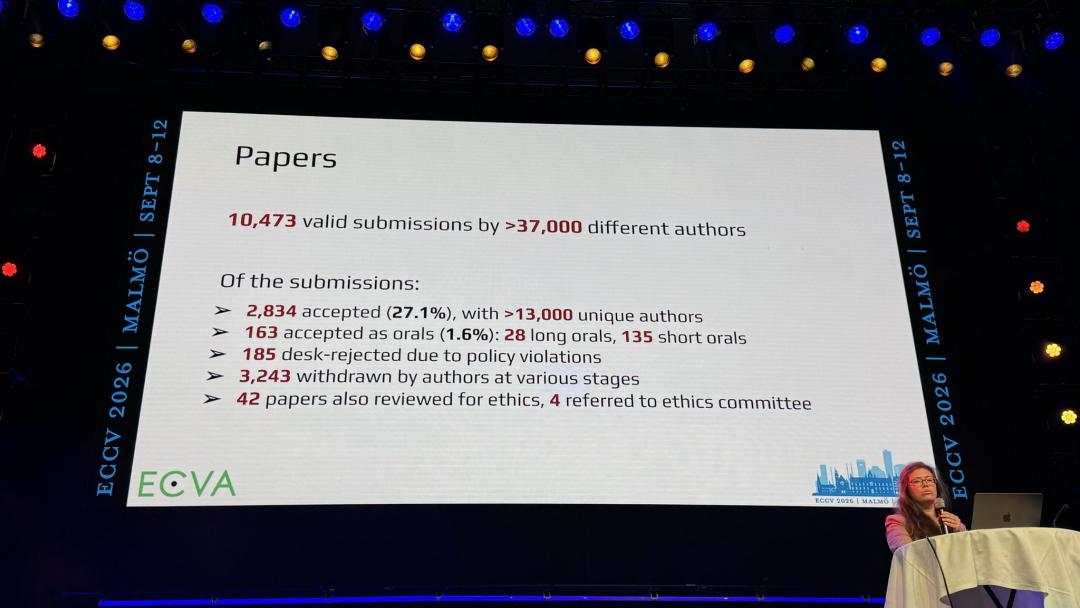
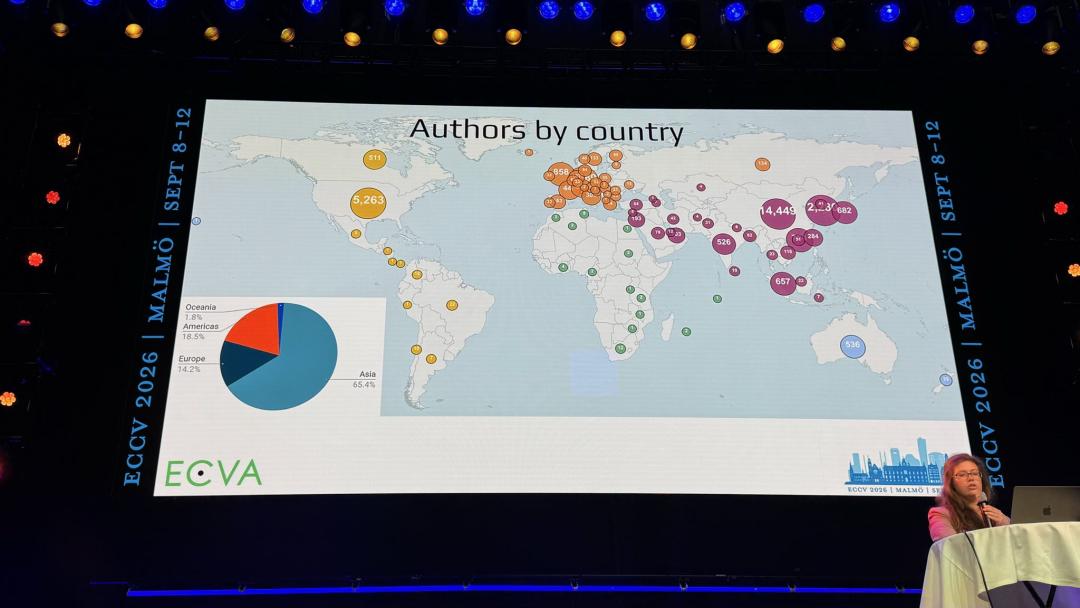
In addition, according to statistics, authors from China have become the largest contributor group of ECCV.
However, the most noteworthy part is those highly recognized research works.
Best Paper Award
This year's Best Paper Award is presented to the paper titled Heat Kernel Textures -- the Geodesic Gaussians That Do Not Splat from Imperial College London. The two co-first authors, Simone Foti and Caner Korkmaz, are a postdoctoral researcher and a doctoral student at the institution respectively.
Award citation: "In recognition of its concise and novel contribution to surface texture representation: replacing standard UV mapping and Gaussian splatting with heat diffusion-based geodesic Gaussians on non-Euclidean manifolds. The review committee pointed out that this solution is elegant, and its potential goes far beyond the scope of the paper itself."
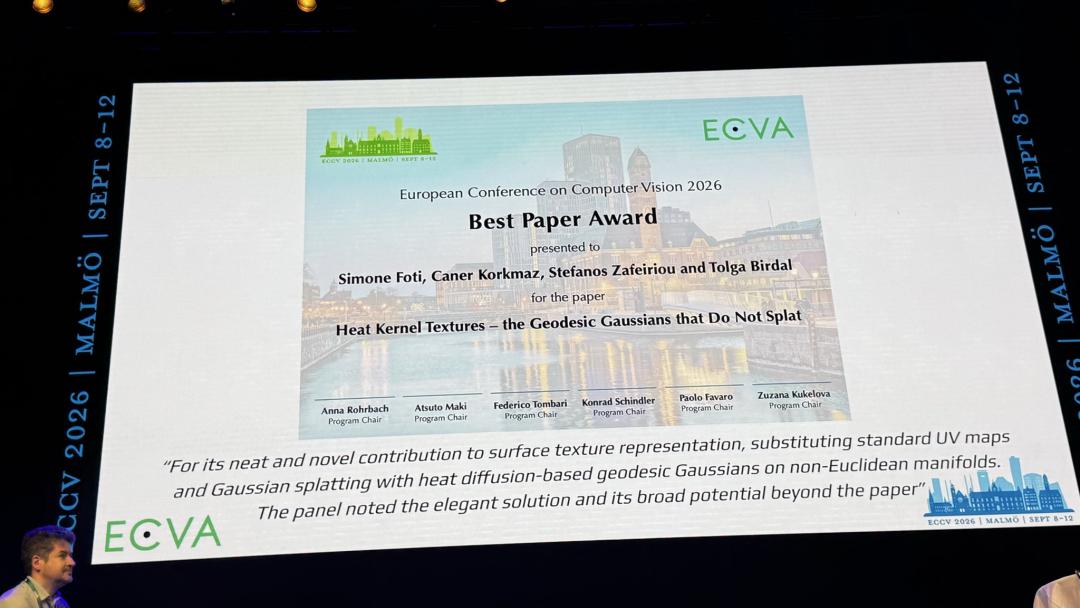
Paper title: Heat Kernel Textures -- the Geodesic Gaussians That Do Not Splat
Paper link: https://eccv.ecva.net/virtual/2026/poster/3652
Author team: Simone Foti ⋅ Caner Korkmaz ⋅ Stefanos Zafeiriou ⋅ Tolga Birdal
This research proposes a novel 3D texture representation method named Heat Kernel Textures, abbreviated as HKTex. It draws on the idea of 3D Gaussian Splatting that uses a large number of Gaussians to represent visual information, but instead of placing Gaussians in the 3D Euclidean space, it directly pastes Gaussian-like "heat kernels" on the Mesh surface of objects.
Traditional 3D models usually use UV Mapping to apply textures, which means flattening a 3D surface into a 2D map first, and then storing color information on this map. This method has been used for decades, but it has several long-standing problems: the unwrapping process will cause distortion, seams, inconsistent resolution in different regions, and there will be a large number of blank areas on the UV map, which wastes video memory and storage space. Complex models even need to duplicate vertices at the seams.
The approach of HKTex is to completely eliminate the UV Map.
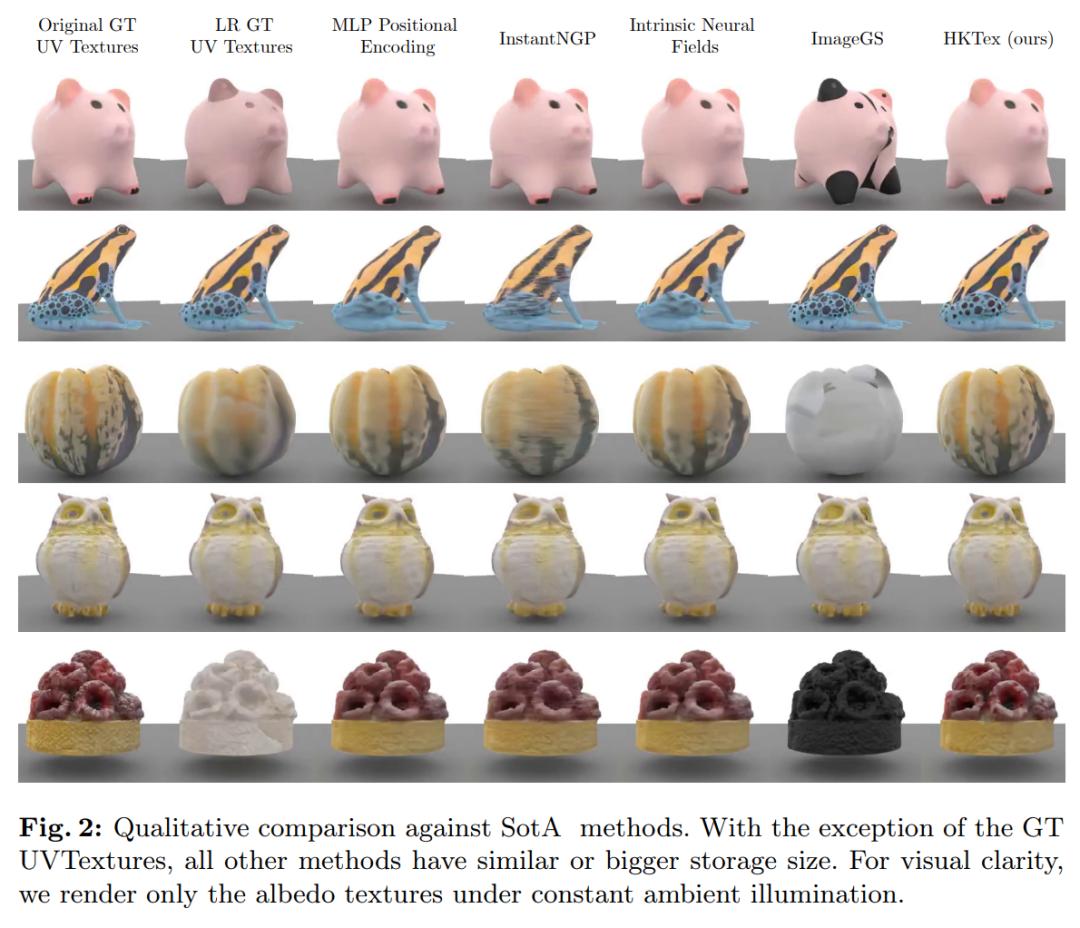
You can imagine it as placing thousands of "color spots" on the model surface, each spot is similar to a Gaussian that spreads along the geodesic line of the curved surface. Mathematically, the authors use anisotropic heat kernel, which can be regarded as "Gaussian in the surface space". Therefore, even if the surface is bent, this texture primitive will naturally bend along with the surface, instead of floating outside the model like ordinary 3D Gaussians.
Although the method is inspired by Gaussian Splatting, it does not actually perform splatting. During rendering, the ray intersects with the Mesh first, and then dynamically calculates the contribution of nearby heat kernels to the texture color at the intersection point, so it can be directly integrated into the differentiable physically based rendering / ray tracing pipeline.
These heat kernels are not fixed. During the training process, their position, orientation, shape, scale and color can all be optimized, and the movement of the kernels is strictly limited to the Mesh surface. The system will also automatically add kernels in areas with complex textures and reduce kernels in simple areas, similar to the densification operation of 3DGS.
Therefore, it can be applied to two scenarios: one is to compress the existing UV Texture into HKTex; the other is to directly infer the object surface texture from multi-view photos through inverse rendering, without generating UV in advance.
The experimental results demonstrate the appeal of this idea. In the texture fitting experiment of 313 Objaverse models, the authors stated that HKTex significantly reduces the texture storage volume while maintaining high image quality. The authors noted in the appendix of the paper that its texture storage space can be reduced by about an order of magnitude compared with the original GT UV texture. In the experiment of restoring textures from multi-view images, HKTex only occupies an average of about 78.7 KB, and its PSNR, LPIPS, SSIM, MS-SSIM and MSE are all better than several neural texture / vertex texture baselines compared by the authors.
Best Paper Honorable Mention
Two other papers received Best Paper Honorable Mention of ECCV 2026, whose authors are from institutions including Meta and Stony Brook University, State University of New York.
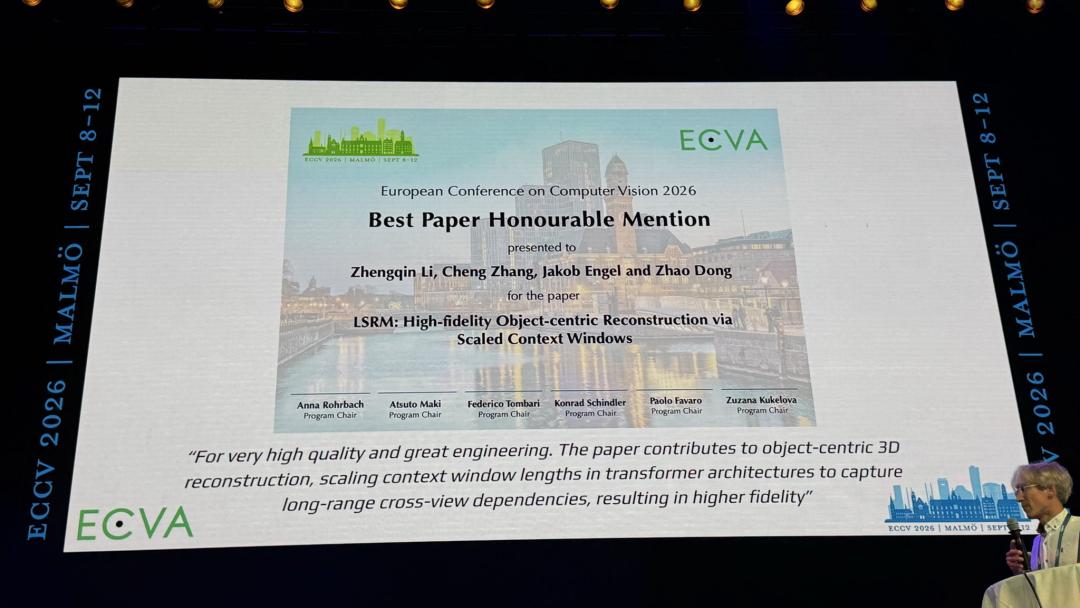
Paper title: LSRM: High-fidelty Object-centric Rsconstruction via Scaled Context Windows
Paper link: https://eccv.ecva.net/virtual/2026/poster/4770
Author team: Zhengqin Li、Cheng Zhang、Jakob Engel、Zhao Dong
Award citation: In recognition of its extremely high quality and excellent engineering implementation. This paper contributes to object-centric 3D reconstruction, which achieves higher fidelity by expanding the length of the context window in the Transformer architecture to capture long-distance cross-view dependencies.
This work comes from Meta Reality Labs Research, which proposes a large sparse reconstruction model called LSRM (Large Sparse Reconstruction Model). It answers the question: can expanding the context window of Transformer improve the quality of feed-forward 3D reconstruction?
The starting point of the authors is: although the recent object-centric feed-forward reconstruction methods are robust and fast, they still lag behind the dense view schemes optimized per scene in fine texture and appearance restoration.
They judged that this gap largely comes from the token budget: as long as the number of object tokens and image tokens involved in the calculation is significantly increased to expand the context window, the feed-forward method can also achieve high-fidelity 3D object reconstruction and inverse rendering.
In order to make this expansion feasible in engineering, LSRM migrates native sparse attention to the 3D reconstruction scenario, and makes three modifications:
A coarse-to-fine pipeline, which concentrates computing power on information-rich areas by predicting sparse high-resolution residuals;
A 3D-aware spatial routing mechanism, which uses explicit geometric distance instead of conventional attention scores to establish the correspondence between 2D and 3D;
A sequence parallel strategy for block structure, combined with the All-gather-KV communication protocol, to balance the dynamic and sparse computing load across multiple GPUs.
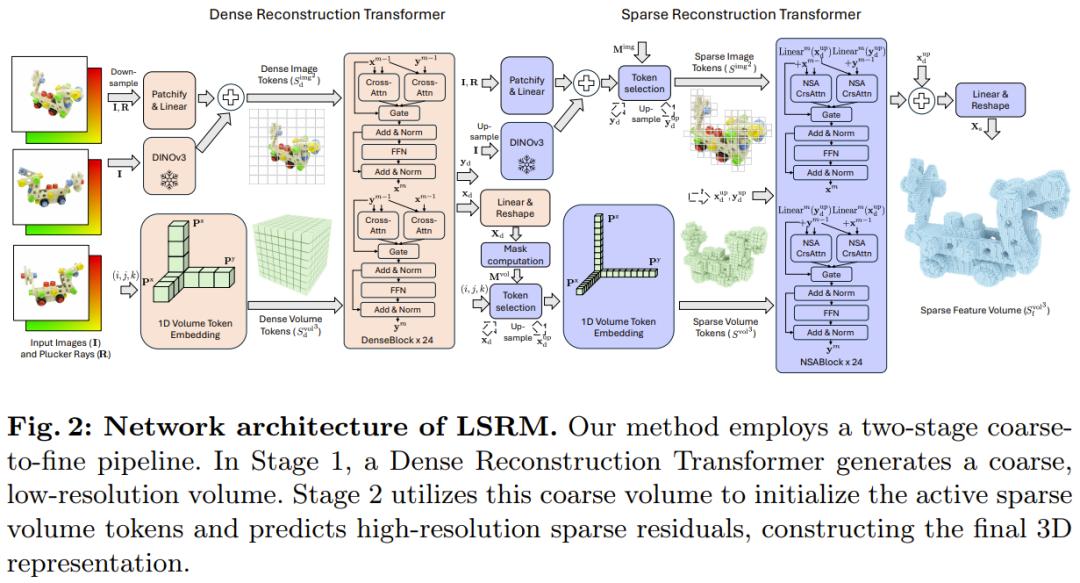
With the combination of the three optimizations above, the number of object tokens that LSRM can process reaches 20 times that of the previous SOTA method, and the number of image tokens also exceeds 2 times.
According to the data given in the paper, on the standard novel view synthesis benchmark, LSRM achieves a PSNR improvement of more than 2.4 dB and an LPIPS reduction of more than 40% compared with the current SOTA; after further extending to the inverse rendering task, the texture and geometric details on the commonly used benchmarks are also consistently improved, and the LPIPS index has caught up with or even exceeded the methods based on dense view optimization.
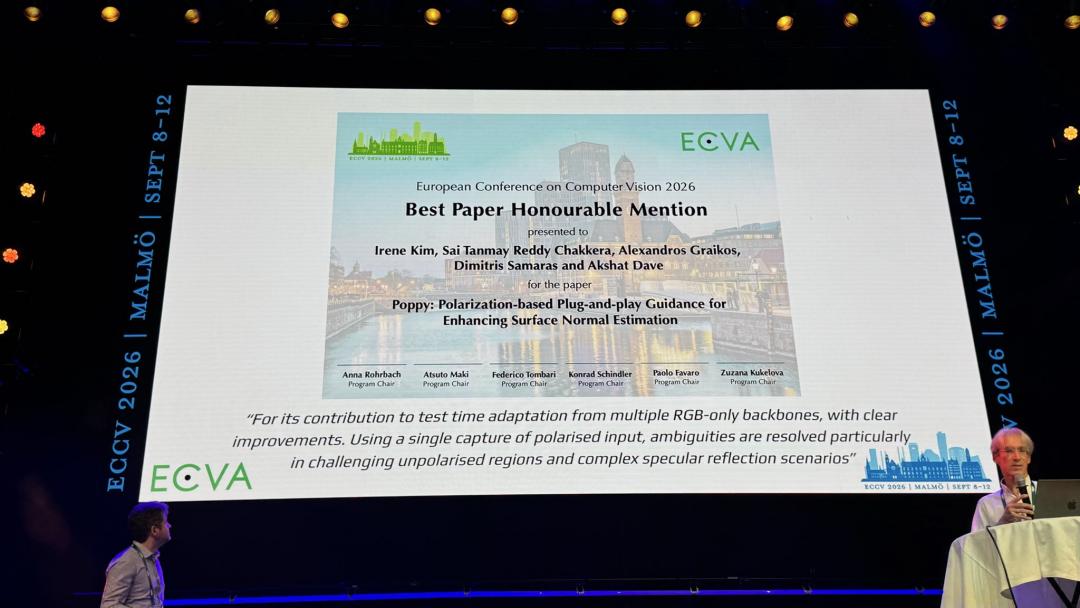
Paper title: Poppy: Polarization-Based Plug-and-Play Guidance for Enhancing Surface Normal Estimation
Paper link: https://eccv.ecva.net/virtual/2026/oral/6004
Project page: https://irnkim.github.io/poppy/
Author team: Irene Kim ⋅ Sai Tanmay Reddy Chakkera ⋅ Alexandros Graikos ⋅ Dimitris Samaras ⋅ Akshat Dave
Award citation: In recognition of its contribution to test-time adaptation based on multiple pure RGB backbones with significant improvement. With only a single polarization input acquisition, it can eliminate ambiguities, especially in challenging non-polarized regions and complex specular reflection scenarios.
This paper comes from Stony Brook University, State University of New York, focusing on a type of stubborn failure scenario of monocular surface normal estimation.
Estimators trained on large-scale RGB-normal data often perform poorly when encountering reflective, textureless and dark surfaces, because such regions lack the visual cues that the network can rely on.
The authors propose to introduce polarization information as a supplement at the physical level. The polarization signal encodes the surface orientation, which is independent of texture and albedo, and exactly covers the weakest part of the RGB method. However, existing polarization schemes either require multi-view acquisition or rely on special training data, leading to limited generalization ability.
They propose Poppy: a training-free framework that uses the polarization measurement captured in a single shot at the test stage to optimize the normals output by any frozen RGB backbone network.
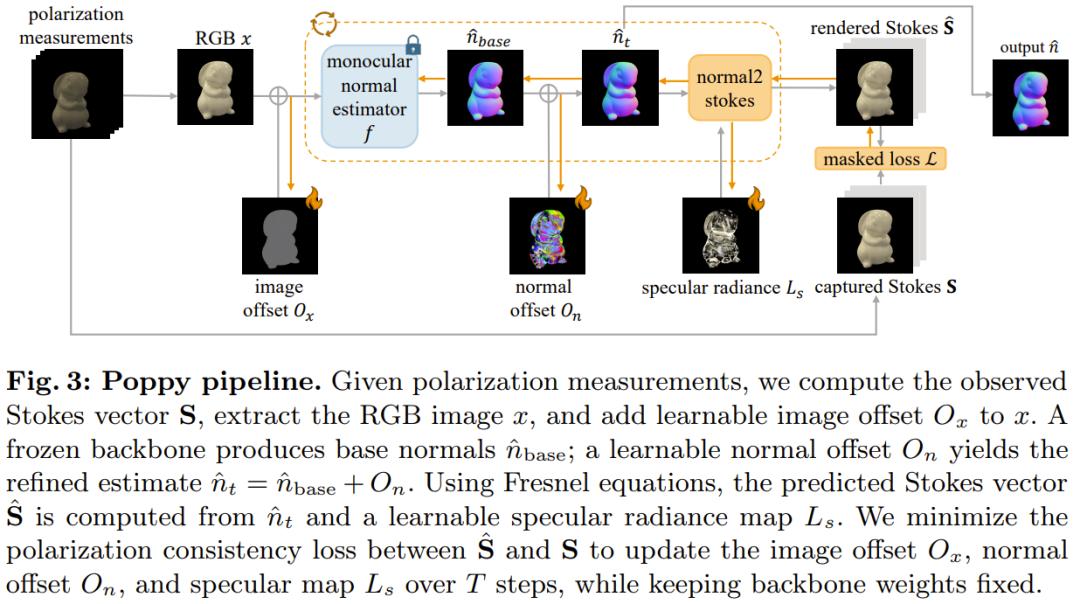
In terms of method design, the backbone weights are frozen throughout the process. What Poppy optimizes is the pixel-wise offset, and it jointly learns a set of reflectance decomposition at the same time. The key component is a differentiable rendering layer, which converts the corrected normals into polarization predictions, then compares them with the actually observed polarization signal, and uses the inconsistency between the two as a penalty term to drive the optimization. In other words, the physical observation acts as the supervision signal during testing, rather than the data source during training, which is the premise that it can be mounted on any off-the-shelf backbone.
The evaluation covers seven benchmarks and three types of backbone architectures, namely diffusion model, flow model and feed-forward model. The results show that Poppy reduces the average angular error by 23%–26% on synthetic data and 6%–16% on real data. The authors thus believe that using polarization cues to guide the existing RGB normal estimator at the test stage can improve the normal quality on difficult surfaces without retraining.
In addition to the three papers above, ECCV also announced 10 shortlisted papers that entered the final round of selection:

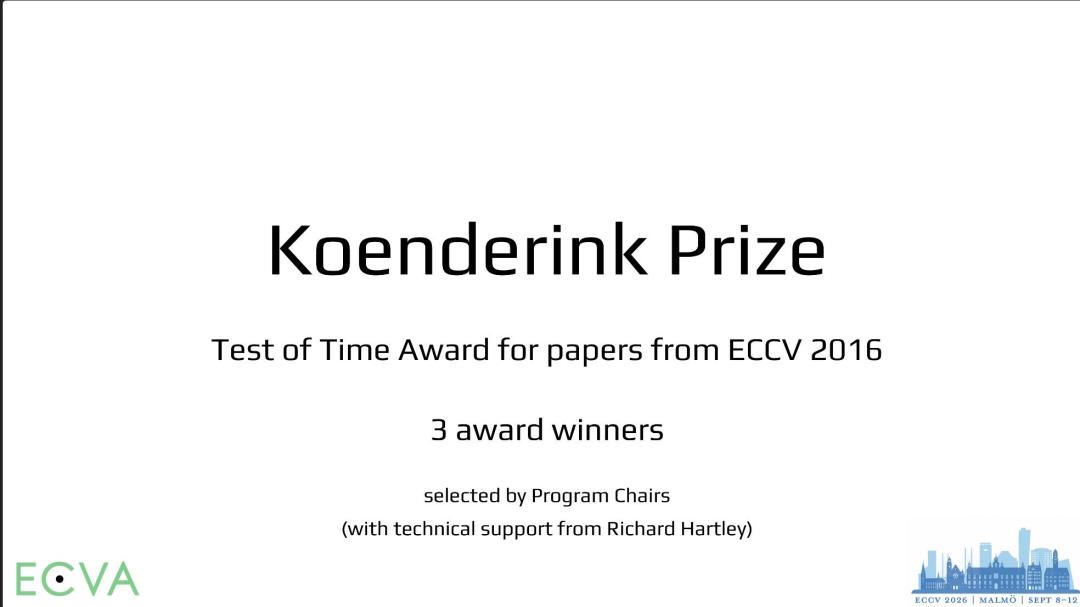
Test of Time Award
This year, three papers published ten years ago received the Test of Time Award.
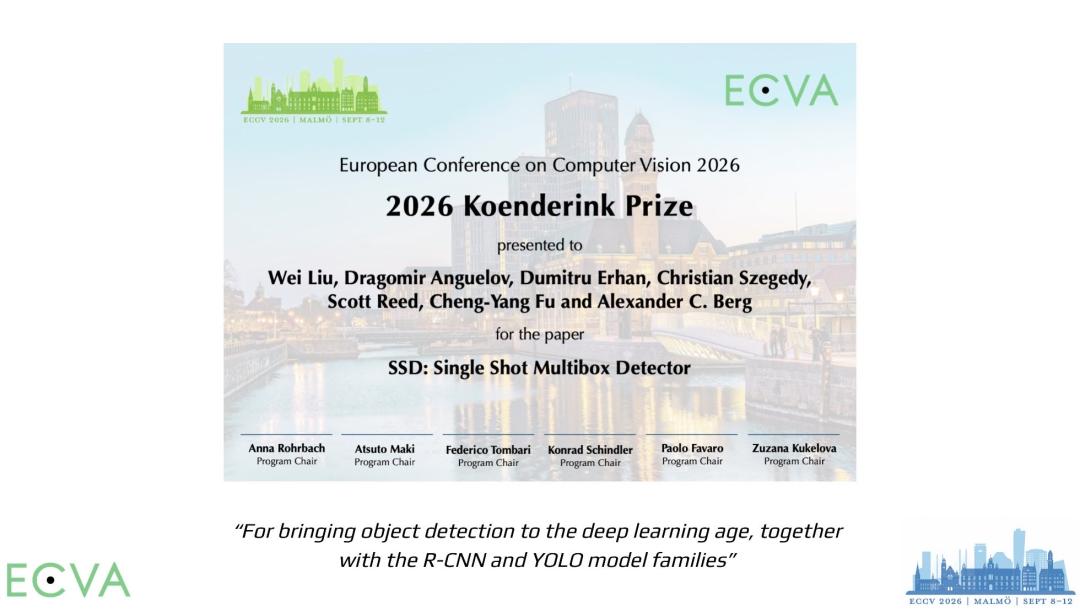
Paper title: SSD: Single Shot MultiBox Detector
Paper link: https://arxiv.org/abs/1512.02325
Author team: Wei Liu, Dragomir Anguelov, Dumitru Erhan, Christian Szegedy, Scott Reed, Cheng-Yang Fu, Alexander C. Berg
Award citation: In recognition of its work that, together with the R-CNN and YOLO model series, brought object detection into the deep learning era.