When Embodied Intelligence Enters the Home: A Contest Between "Brain" and "Scenario"
When we talk about embodied intelligence and home scenarios today, we are still discussing a specific picture.
A robot performing tasks within the household scope.
This seems like a logical commercial path and technical end point, but in the complex system of embodied intelligence, behind this picture lie two completely distinct development tracks.
"Base Model Companies" and "Scenario-Focused Companies".
To be more specific, the former refers to enterprises aiming at building general embodied intelligence foundation models, while the latter refers to enterprises targeting the household scenario. For base model companies, their ultimate goal is to develop the embodied brain, and the home is not their only scenario, but the best verification of their model capabilities. They are trying to break through from the model capability side, and enable robots to obtain broader task capabilities from limited training experience by continuously improving generalization ability and data efficiency.
On the other hand, some robot manufacturers choose to take the home as their core battlefield. They tend to let robots enter the home scenario first through relatively controllable environments such as hotels, retail, and elderly care, accumulate real task data, engineering experience and user feedback while realizing commercialization, and then in turn promote the iteration of models, robot bodies and products.
However, this division is not completely clear-cut.
In fact, "brain companies" are also actively entering real scenarios, because model capabilities ultimately need to be verified in the physical world. Home robot companies are also increasing investment in technologies such as VLA and world models, because simply increasing deployment volume cannot automatically bring stronger generalization capabilities. The two tracks are constantly moving closer to each other.
The real difference is not so much "who develops the model and who collects the data" as who starts to build their own capability closed loop from which link. Eventually, both tracks must reach the same destination: the model enters the real world, the real world generates data, and the data in turn promotes model evolution.
In the end, the ones that can cross the threshold of the home scenario will not be purely technical companies, nor will they be purely companies that excel in scenario operation, but those that can integrate model capabilities, engineering capabilities and product insight.
It does not matter which track they start from. What matters is whether they can fill in the missing piece of the puzzle before reaching the end point.
This competition between "brain" and "scenario" is ultimately not about who has a higher starting point, but about who learns faster.
The Ambition of Base Model Companies Goes Beyond the Home Scenario
The performance of embodied brain enterprises in the home scenario is unexpected yet reasonable.
At this year's WRC site, the home tasks demonstrated by various players look highly similar: fetching, storing, folding clothes, washing clothes, pouring water, and organizing desktops. But what really creates the gap is no longer just what actions the robot can perform, but whether it can still work when the object or position is changed, and whether the same model can support enough types of tasks. When answering these questions, embodied model companies often deliver more impressive results.
The exhibition area of Xinghaitu covers commercial retail, carton packing, and home tasks such as clothes folding and water pouring, all of which are realized by the G0.5 model. The staff said that for the popular clothes folding task, compared with other exhibition booths, Xinghaitu performs better in terms of task completion rate and speed.
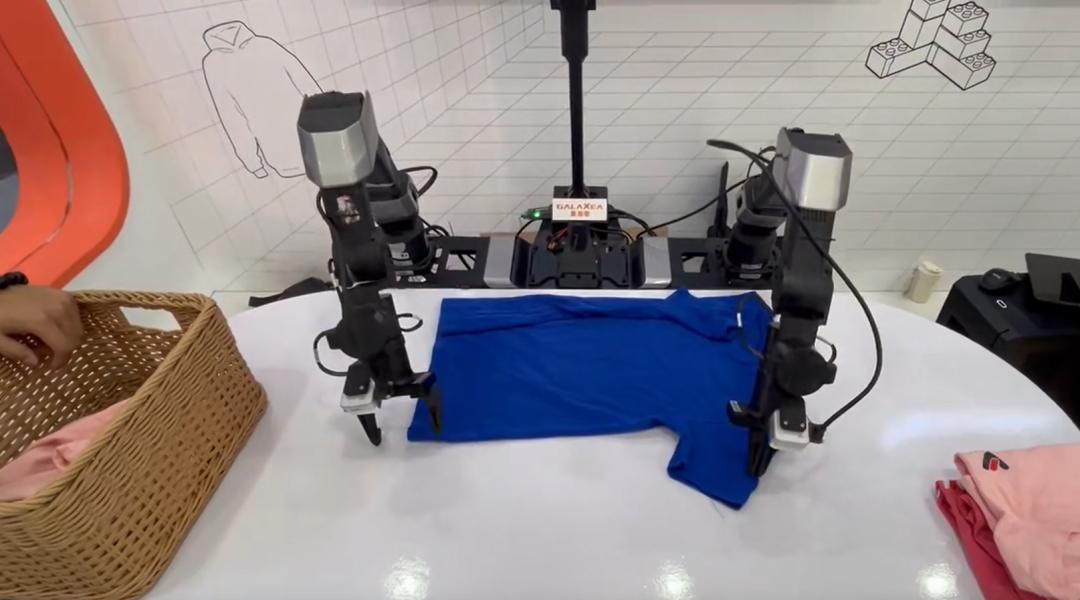
The preference for home scenarios in the exhibition area of another embodied brain company is equally obvious. The capability demonstration covers tasks such as item storage, item fetching, and using a dishwasher. The staff introduced that the robot will independently adjust its strategy according to the environment when completing the task, and "explore" the method to achieve the task. Taking the task of grabbing a glass of water as an example, if grabbing from the side is too slippery, the robot will choose to grab it from above, which makes the robot look more like a human thinking.
The generalization ability, less sample dependency, and long-horizon task processing capability pursued by base model companies exactly fit the underlying logic of home robots, because one thing that distinguishes the home scenario from other scenarios is that it is not a simple collection of tasks, but an open world with infinitely many objects and task variations.
At the same time, compared with home robot companies, base model companies often make more aggressive investments in data, with more diverse data sources and types. They try to use large-scale and diverse data to let the model learn not only a specific action, but also more universal correlations between objects, environments, actions and tasks.
These advantages have also made base model companies potential competitors in the home robot track.
Although the tasks that current robots can complete are still relatively simple and limited in variety, compared with companies that specialize in developing home robots, the foundation models of these embodied brain enterprises often show better cross-environment and cross-body capabilities in tasks, and also have strong robustness. In many cases, even if a task fails once, the robot can find the correct implementation method through continuous attempts and exploration.
But being able to do something does not mean that you have to prioritize doing it. For current base model companies, they are particularly cautious about the commercial implementation of home scenarios, and the priority landing scenarios at present are fields with clearer demand and higher feasibility such as industry and logistics.
In the process of communicating with technical personnel, a noteworthy phenomenon also emerged. As a currently widely concerned technical route, the world model is being explored by all parties, but the basic models that have actually been deployed on robots are still dominated by VLA and its related architectures. The world model is also more used for data generation in model training, and its direct participation in the reasoning and planning of real robots is still in the exploratory stage.
For robots, what is really important is still whether they can understand the space and objects in front of them and continuously complete tasks in the real world. The importance of achieving these goals is often underestimated at the moment.
The Circuitous Path of Home Robot Companies
If base model companies are trying to break downwards from the model side, then another group of home robot companies are moving in the opposite direction.
From the end of 2025 to the present, a number of home robot companies have emerged in the market. These companies aim at the final outcome of robots entering homes as soon as they start, and often receive large amounts of financing. Most of the home robots exhibited at this WRC are from manufacturers that already have landing applications.
At this WRC, the Weilai Bu Yuan F2 robot demonstrated capabilities such as folding clothes, washing clothes, playing chess, and cooking pasta. Weilai Bu Yuan has chosen a relatively aggressive commercialization route. Starting from pilot entry into homes, to launching online leasing, more than 500 robots have entered real homes so far, and it plans to start mass production and open for sale next year. This active home-entry route can obtain first-hand home scenario data, which continuously feeds back the iteration of models and hardware.
The Fourier GR-3 robot can independently generate solutions according to natural language, move to a designated position in the home space to complete tasks such as fetching items, and also has companion attributes. The booth also demonstrated the capability of item storage based on brain-computer interface, providing a new robot interaction method for people with disabilities with limited mobility.
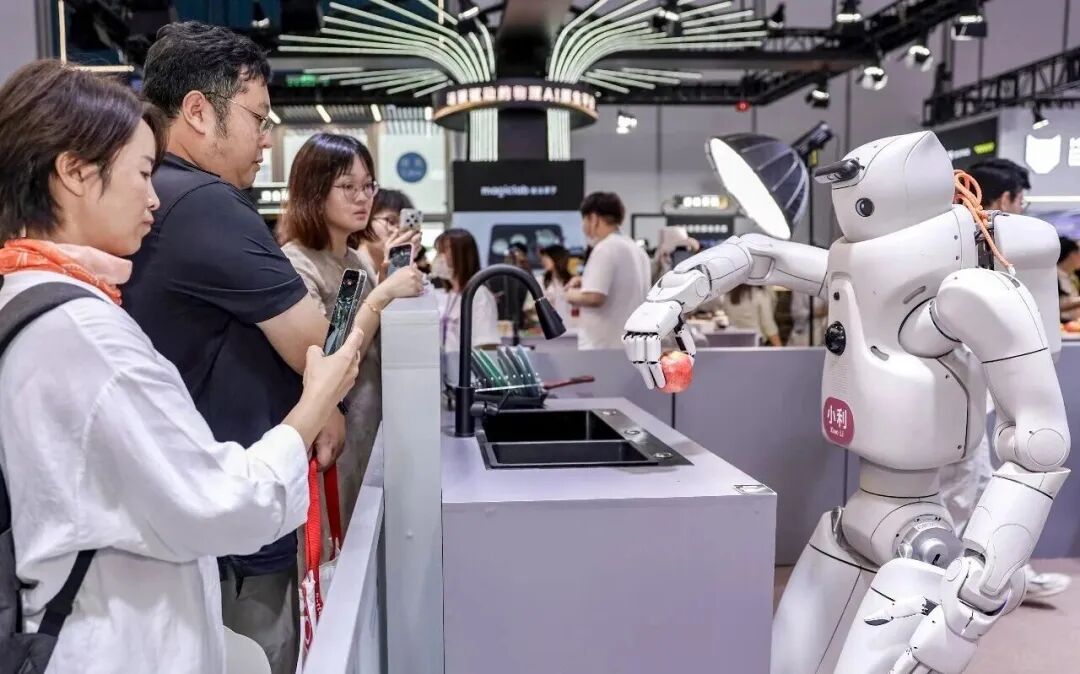
Deeppu Intelligent demonstrated the scenarios of Simbot doing laundry, storing items, and playing with toys at home, as well as the capabilities of hotel welcome and fetching items according to natural language. A single task can be trained with only one hour of no-body data.
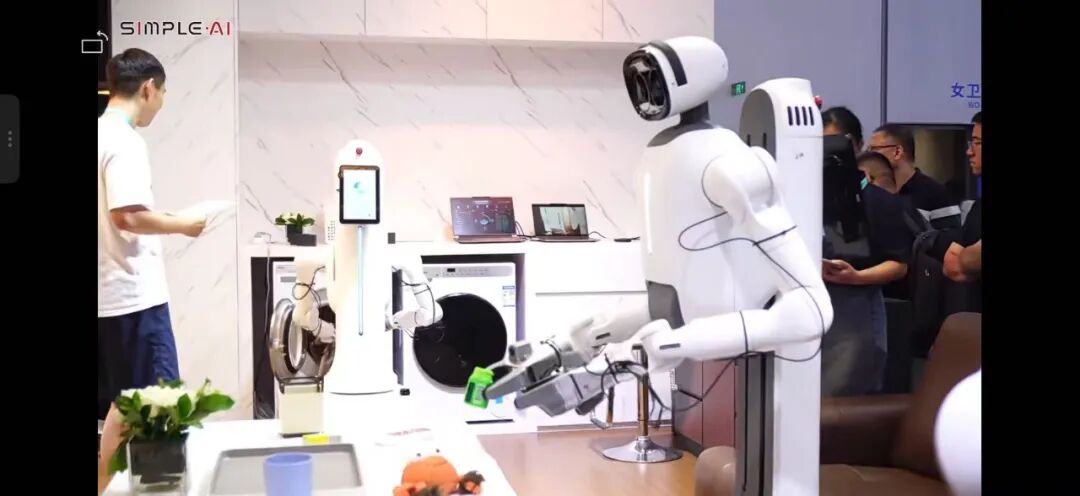
Moji Intelligence, which was established less than half a year ago, made its first systematic capability demonstration in front of the public. A 15-minute continuous task on site, from cleaning the living room and restocking the refrigerator to drying and folding clothes, connects a complete set of home workflows. For desktop cleaning and item classification alone, on the basis of 30,000 hours of pre-trained data, an additional dozens of hours of training can enable the robot to acquire this capability.
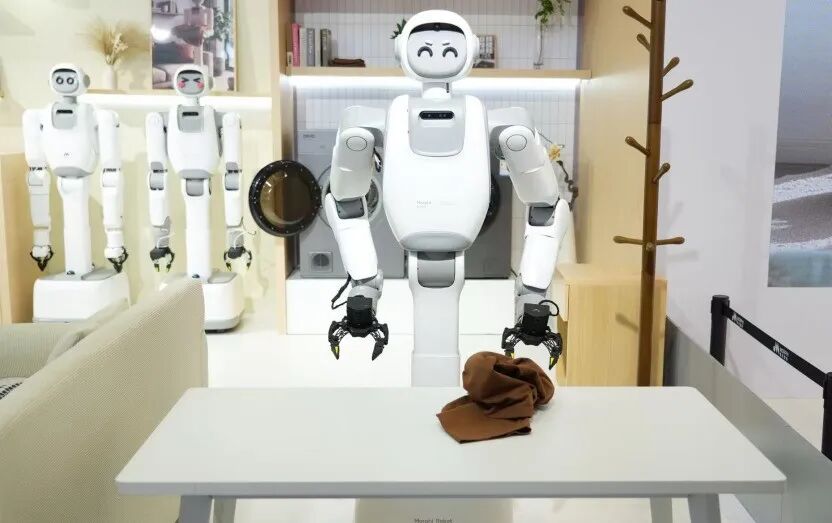
The issues that these home robot manufacturers focus on are somewhat different from those of base model companies. Base model companies care more about whether capabilities can be migrated, while home robot companies care more about whether products can actually work.
Base model companies often train models on a large number of different tasks and expect generalization capabilities to emerge from scale. Home robot companies often expect to make a certain type of task more reliable and better adapted to the real environment.
Behind this phenomenon is the pursuit of home robot companies for landing. In the face of the current lack of mature robot brains, home robot companies often choose to land one step earlier, continuously polish their capabilities in real scenarios, and feed back the evolution of models and hardware, which to a certain extent makes up for the current deficiencies in models.
In the process of landing, a very interesting phenomenon is happening. More and more home robot companies do not directly take the home as the first landing point, but choose the hotel scenario.
The reason is simple. The hotel scenario shares many task spaces with the home scenario, such as bedrooms, bathrooms, desktops, and beds, with high task similarity. It can be regarded as a "low-profile version" of the home scenario. It provides a data field that is easier to control than the home and close enough to the home. Robots can continuously contact different people, objects and tasks, accumulate operation data in the real environment, hone their understanding of space and objects, and continuously realize productization and engineering iteration, even bringing a certain amount of capital return.
However, from the perspective of actual application today, hotels are still far from realizing large-scale robotization. For complex tasks, robots are mostly still in the pilot stage, with limited work that can be carried out stably, and some applications even play more of a role in attracting traffic and demonstration.
The experience gained in hotels also needs to be further abstracted into a general understanding of objects, spaces, tasks and people, so that the hotel springboard can truly send robots to homes.
Three-Tier Industrial Chain: The Future of Home Robots
At the moment, home robots may still be in the stage of "waiting for the wind to come", waiting for the technology to mature and standards to be established, so that robots can take off in this most complex ultimate scenario.
When this moment really comes, will the technology of base model companies annex the scenarios, or will home robot companies catch up in technology through scenarios?
Base model companies are exploring the upper limit of models, while home robot companies are laying the foundation for the lower limit of products. Both the upper limit and the lower limit are indispensable for home robots. Without generalization ability, robots can only become machines with accumulated functions. Without product capability, no matter how powerful the model is, it can only stay in the demo.
The final answer may not be black and white, but a state of coexistence.
First of all, for the home scenario, the market space is large enough and the demand is diverse enough, so it is difficult for only a few players or a certain faction to survive. Moreover, when robots truly become consumer goods, the selection factors may not only be models and functions, but the overall productization capability. The key lies not only in who has stronger technology, but also in who can make a good product. Therefore, the home scenario seems to be full of smoke now, but in fact the war has not yet begun, and products have not really come to consumers for inspection.
Base model companies are starting from models and moving closer to robot bodies and scenarios, while home robot companies are starting from products and continuously supplementing data and models. The routes of the two are constantly converging. Eventually, base model companies, as platforms, and vertical scenario manufacturers will form a delicate balance of competing and leveraging each other, and gradually open the closed loop of models entering the real world, the real world generating data, and data promoting model evolution in the process of continuous approaching and game.
For all sub-category robot companies, more or less will face this problem, that is, whether there will be a general humanoid robot that annexes the market. General special-purpose robots will choose humanoid robots, or even task scenarios that are difficult for humans to achieve, to accumulate know-how in depth.
The special feature of the home is that its "specialty" is "generalization", and the unique feature exclusive to this scenario is the generalization of infinite tasks, which adds uncertainty to the answer of the question. But the gravity of reality is huge. Robots need to face the chaos and unpredictability of life in the home. This requires products not only to have strong learning and generalization capabilities, but also to continuously experience feedback, trial and error and iteration in real life, so as to cross the final threshold of entering the home.
The industrial chain of home robots will eventually be divided into three clear value layers:
The first layer is the foundation model layer. This layer is dominated by base model companies, which provide general embodied intelligence capabilities: perception, reasoning, planning, and operation. The core competitiveness of this layer is data scale, model architecture and generalization ability, with strong scale effect and network effect, and may eventually converge to a few platform-level players. The ultimate form of base model companies does not directly make terminals, but defines the upper limit of terminal capabilities.
The second layer is the robot body and system integration layer. This layer is dominated by companies with hardware design, system engineering and supply chain capabilities. Based on the foundation model, they carry out body design, system integration and product definition for specific scenarios. The core competitiveness of this layer is engineering capability, cost control and product experience. The number of players will be more than that of the foundation layer, but there is still a certain degree of concentration.
The third layer is the scenario application and service layer. This layer is the most decentralized with the largest number of players, including operators and service providers in vertical scenarios such as home services, elderly care companionship, hotel services, and commercial retail. Based on standardized robot bodies and models, they provide scenario-based solutions and continuous services. The core competitiveness of this layer is scenario understanding, channel operation and customer relationship. The profit margin may be the lowest, but the market space is the largest.
In this hierarchical structure, the relationship between base model companies and home robot companies is not "who annexes whom", but "which layer each occupies".
Base model companies are infiltrating downwards from the first layer. They make robot bodies and develop scenarios not to become terminal companies, but to verify model capabilities, build developer ecosystems, and define interface standards. Just as Google makes Pixel phones not to become the largest mobile phone manufacturer, but to define the capability boundary of Android.
Home robot companies are climbing upwards from the third layer. They develop models and collect data not to become base model companies, but to occupy a higher position in the value chain and avoid being dragged into price wars by pure hardware competition. Just as Tesla develops autonomous driving not to become an AI company, but to make its automotive products have irreplaceable differentiated capabilities.
The two routes are converging, but the end point of convergence is not "everyone becomes the same type of company", but "everyone finds their own position in the value chain".
Finally, let's broaden our horizons.
What stage are home robots in now? If we use the history of consumer electronics as an analogy, it is roughly equivalent to the 2005 smartphone market, where Palm, Windows Mobile, and Symbian each occupied a share, feature phones were still the mainstream, and everyone was groping for "what a smartphone should look like".
The emergence of iPhone was not due to a single technological breakthrough, but due to the simultaneous maturity of a whole set of capabilities: multi-touch screen, mobile Internet, App Store ecosystem, powerful enough processor, and Steve Jobs' genius insight into product definition.
The "iPhone moment" of home robots also requires a whole set of conditions to mature at the same time.