Just now, the new DeepSeek model was launched, and the hard disk occupancy of long-text cache has plummeted by 88%.
ZheDongXi reports on September 10 that DeepSeek has just officially released DeepSeek V4.1 Flash. Built with a brand-new architecture, this 552B-parameter MoE model is the smallest member of DeepSeek's new model architecture family, outperforming a host of flagship models including DeepSeek V4 Pro in terms of performance.
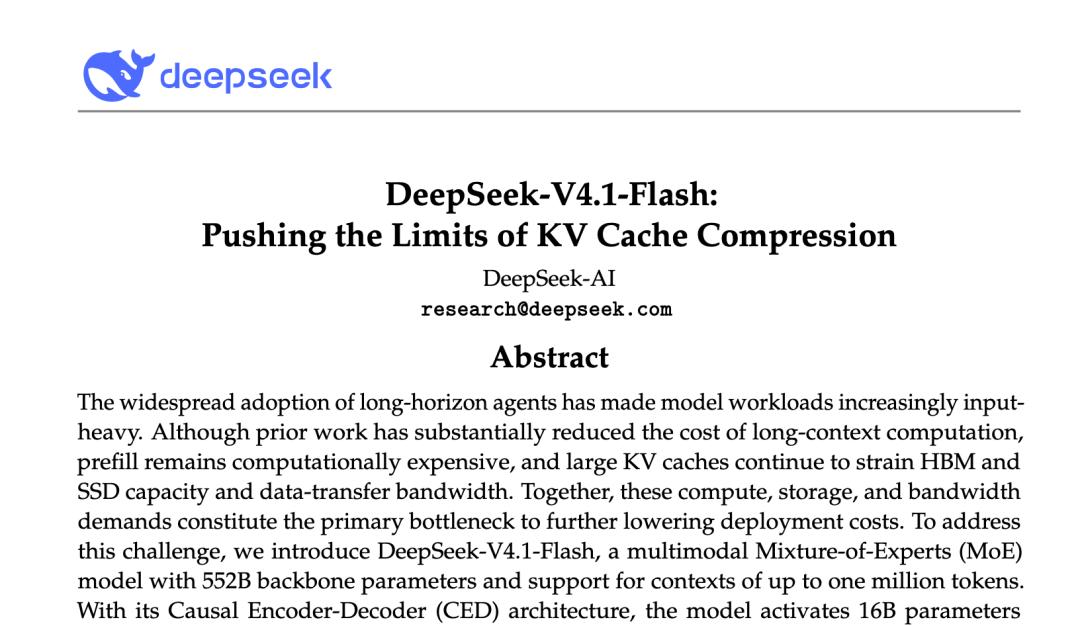
- Open source address of the model: https://huggingface.co/deepseek-ai/DeepSeek-V4.1-Flash
- Paper link: https://huggingface.co/deepseek-ai/DeepSeek-V4.1-Flash/blob/main/DeepSeek_V41_Tech_Report.pdf
Meanwhile, the DeepSeek App has completed a full new upgrade, integrating Fast Mode, Expert Mode and Visual Recognition Mode, with the new model launched. The web version is also expected to be updated synchronously.

01. Full Performance Surpasses Flagship Models, Pricing Reduced
In terms of pricing, thanks to innovations in model architecture, DeepSeek has lowered the pricing of V4.1 Flash compared with DeepSeek V4 Flash. The peak-valley pricing mechanism is retained, with off-peak prices being half of peak-hour prices. The official encourages users to adjust their task schedules according to actual usage scenarios.
The new pricing is as follows: during off-peak hours, input (cache hit) costs 0.02, cache miss costs 1.0, and output costs 4.0; during peak hours, input (cache hit) costs 0.04, cache miss costs 2.0, and output costs 8.0. The new pricing has officially taken effect at 12:00 on September 10, 2026.
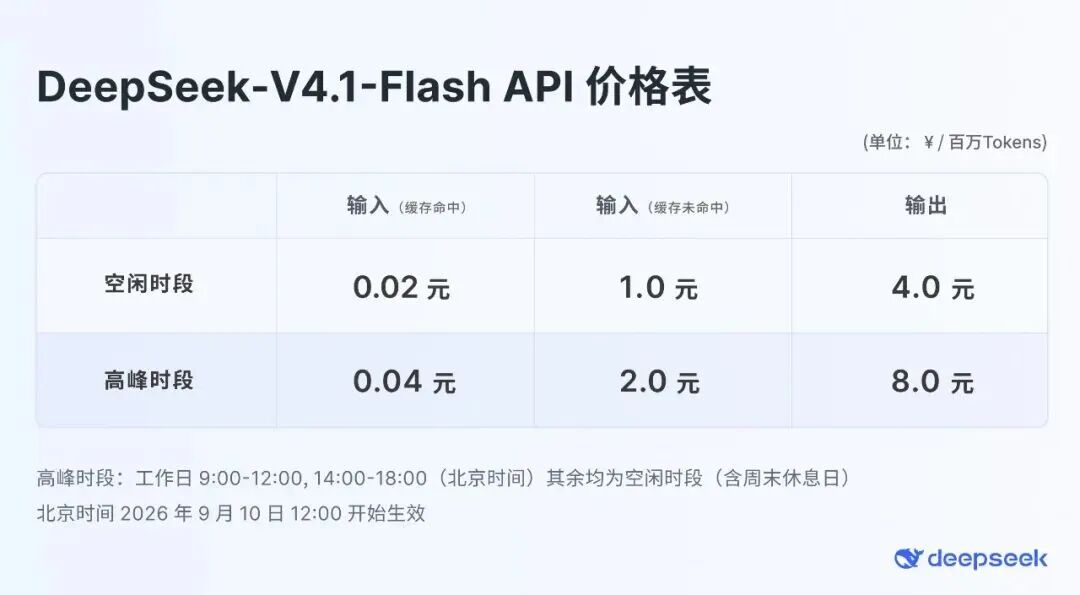
▲DeepSeek V4.1 Flash Pricing Table (Source: DeepSeek)
This model features native multi-modal visual understanding capability, adopting the brand-new Causal-Encoder-Decoder architecture with asymmetric input and output. It only has 8B activated parameters for input and 16B activated parameters for output, with significantly lower costs than existing models of the same size.
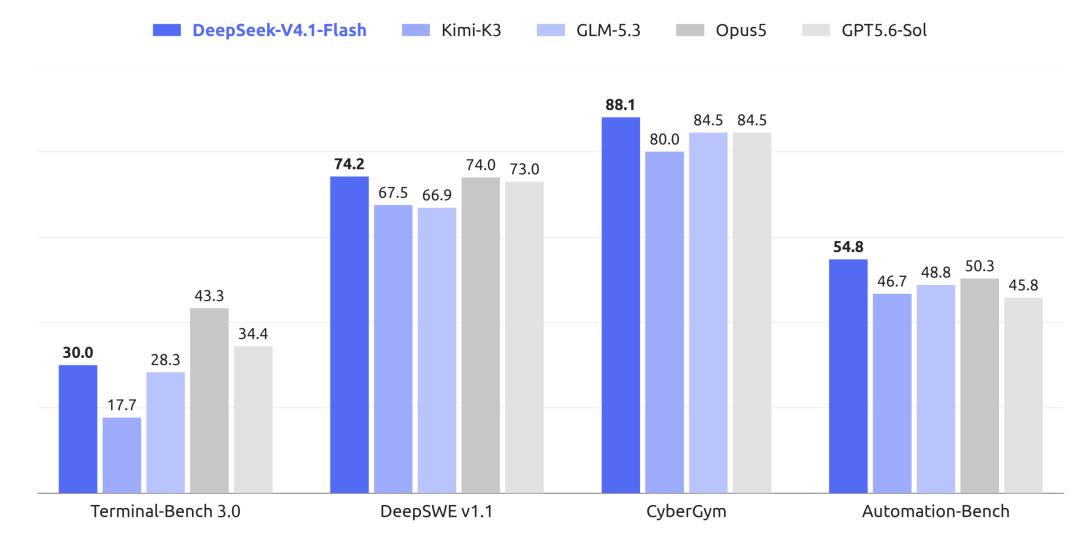
▲Performance Comparison Between DeepSeek-V4.1-Flash and Mainstream Cutting-edge Models on Agentic Benchmark (Source: DeepSeek)
Meanwhile, supported by new pre-training methods and post-training with larger-scale reinforcement learning, this smaller-sized model outperforms multiple cutting-edge flagship models including DeepSeek V4 Pro, GLM5.3 and Kimi-K3 in benchmark tests such as Agentic Benchmark.
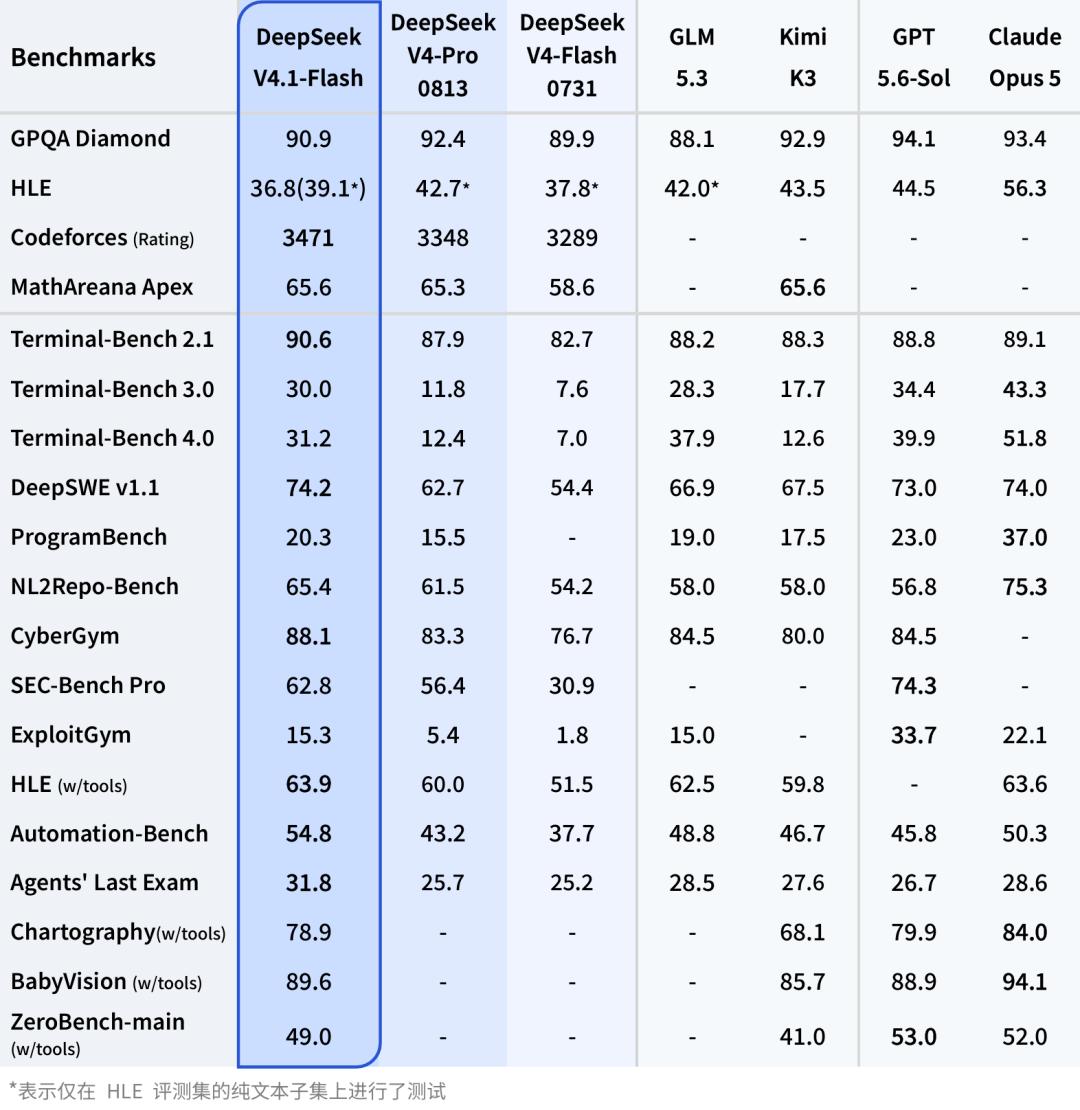
▲Performance Comparison Between DeepSeek-V4.1-Flash and Mainstream Cutting-edge Models on Agentic Benchmark (Source: DeepSeek)
The official states the original intention for the design of the new model architecture in the announcement: higher upper limit of capability, faster inference speed, larger throughput, and the potential to scale up to models with larger parameter sizes.
02. Cache Compressed Significantly, DeepSeek V4 Pro to be Phased Out Soon
The new generation model has greatly improved KV Cache efficiency. Compared with DeepSeek V4 Flash, V4.1 Flash reduces HBM demand to 1/4 and SSD demand to 1/8. DeepSeek official says that the KV Cache of the first-generation model DeepSeek V1 is 437 times that of DeepSeek V4.1 Flash.
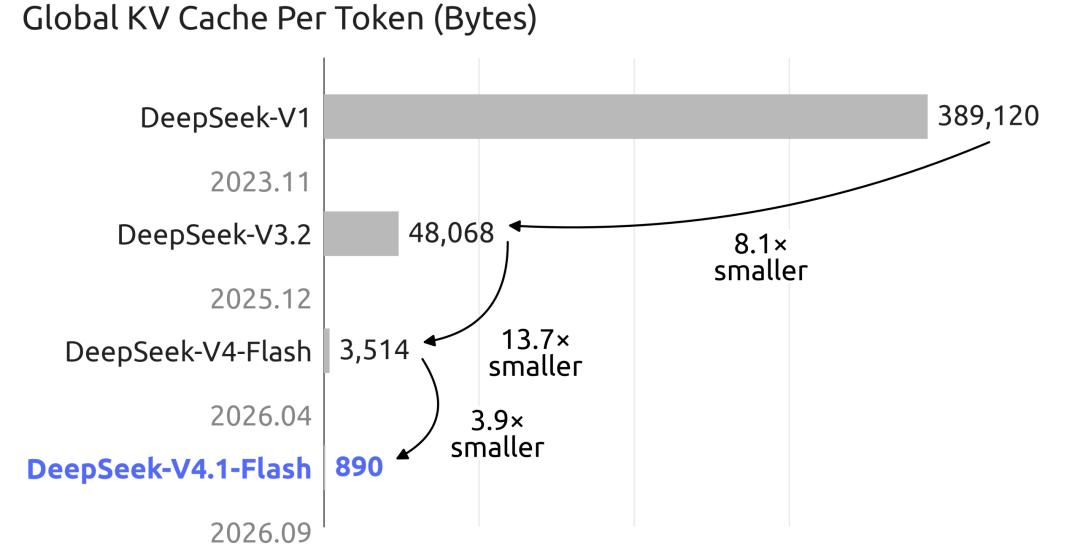
▲DeepSeek's Continuous Progress in Reducing Context Storage (Source: DeepSeek)
This round of compression is achieved through the synergy of architecture, cache precision and deployment strategy. In terms of architecture, the new model adopts the CSA2 (Compressed Sparse Attention 2) mechanism, which reuses global KV Cache and Top-K indexes across layers. Each layer only retains its own query vectors and local attention cache, so repeated storage is greatly eliminated.
In terms of cache precision, the model directly stores global KV Cache in FP4 format from the training stage, and the official says the performance loss is almost negligible. On the deployment side, the bounded SWA replay mechanism is newly added, which only needs to replay the latest n tokens to approximately reconstruct the state required by sliding window attention (SWA). As a result, SWA cache no longer needs to be written to SSD, and the persistent cache footprint is further reduced to 1/8 of that of V4 Flash.
With all these designs combined, when the context length is extended from 4K to 1M, the FLOPs for single token decoding only increase by about a quarter, and the decoding cost hardly grows with the extension of context length.
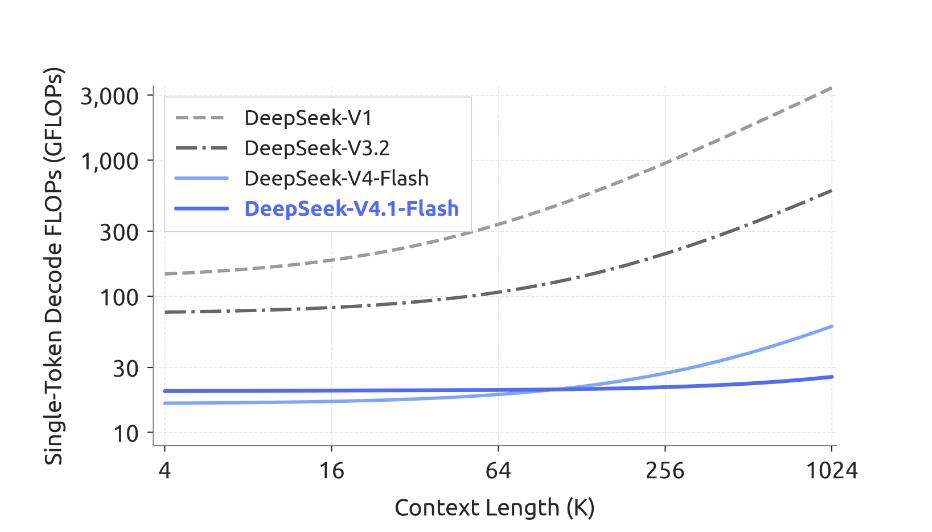
▲Comparison of Context Length Between DeepSeek-V4.1-Flash and Previous Generation Models (Source: DeepSeek)
This figure is directly related to users' bills. In Agent usage scenarios, the cost of cache hits usually accounts for a high proportion. The compression of KV Cache greatly reduces the usage cost of Agent-type tasks. For Agent workflows that require long context and multiple rounds of calls, the same budget can support more tasks.
At present, DeepSeek V4.1 Flash has been synchronously launched on DeepSeek API. Users can call V4.1 Flash by changing the model name to deepseek-flash. The old versions of models V4 Flash and V4 Flash Vision Exp have been offline now, and the model names deepseek-v4-flash and deepseek-v4-flash-vision-exp will be temporarily routed to V4.1 Flash.
Yesterday, DeepSeek announced that since DeepSeek V4.1 Flash has comprehensively outperformed DeepSeek V4 Pro in multiple tests, DeepSeek will start to phase out V4 Pro in an orderly manner from 12:00 Beijing Time on September 14, all requests for deepseek-v4-pro will be routed to the new model and billed at the unit price of V4.1 Flash.
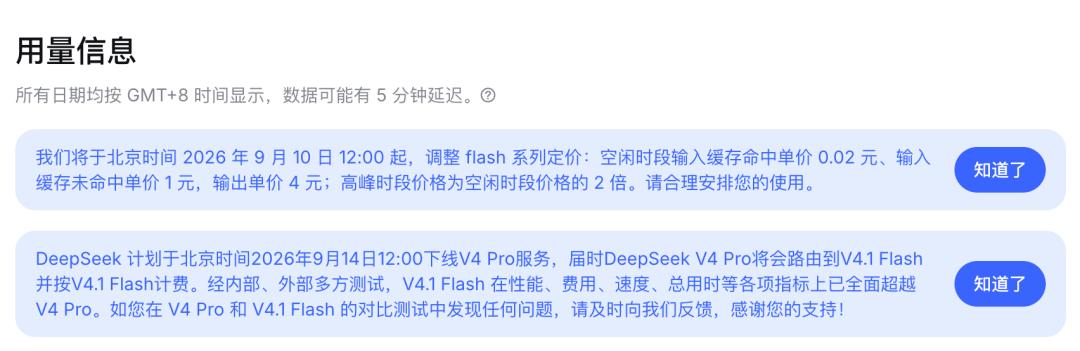
▲DeepSeek Model Adjustment Announcement (Source: DeepSeek)
03. Full Support for Open Source, Full Access of WorkBuddy and OpenCode
Apart from model capabilities, DeepSeek has also launched a series of initiatives in open source and ecosystem construction.
DeepSeek announced today that it will fully support the open source community in inference adaptation for the new model, and try to expand the deployment scope through various means. If users have large-scale deployment demands and corresponding resources (2000 GPUs, storage clusters), they can contact DeepSeek.
Meanwhile, DeepSeek Harness v0.1.5 has been launched synchronously. The DeepSeek V4.1 Flash model has undergone special training and optimization for DeepSeek Harness. When users use the DeepSeek V4.1 Flash model, the new version of DeepSeek Harness also supports updating system prompts while retaining the existing KV Cache.
On the ecosystem side, Tencent (WorkBuddy, CodeBuddy, etc.) and OpenCode, as official partners, have now fully accessed DeepSeek V4.1 Flash, and the OpenCode Go package provides 4 times the usage quota.
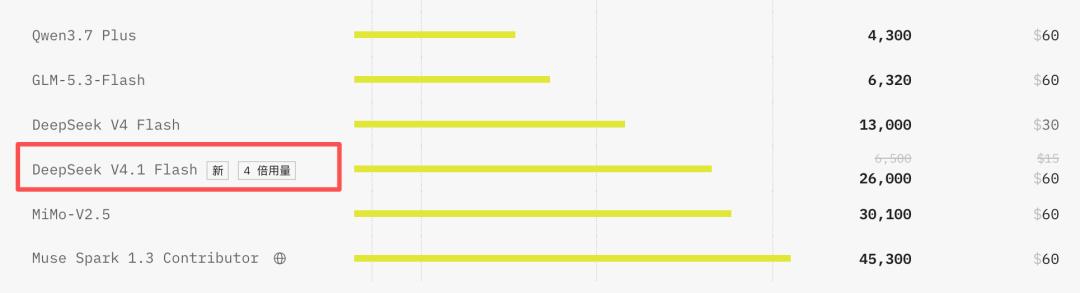
▲OpenCode Model Usage Quota Table (Source: OpenCode)
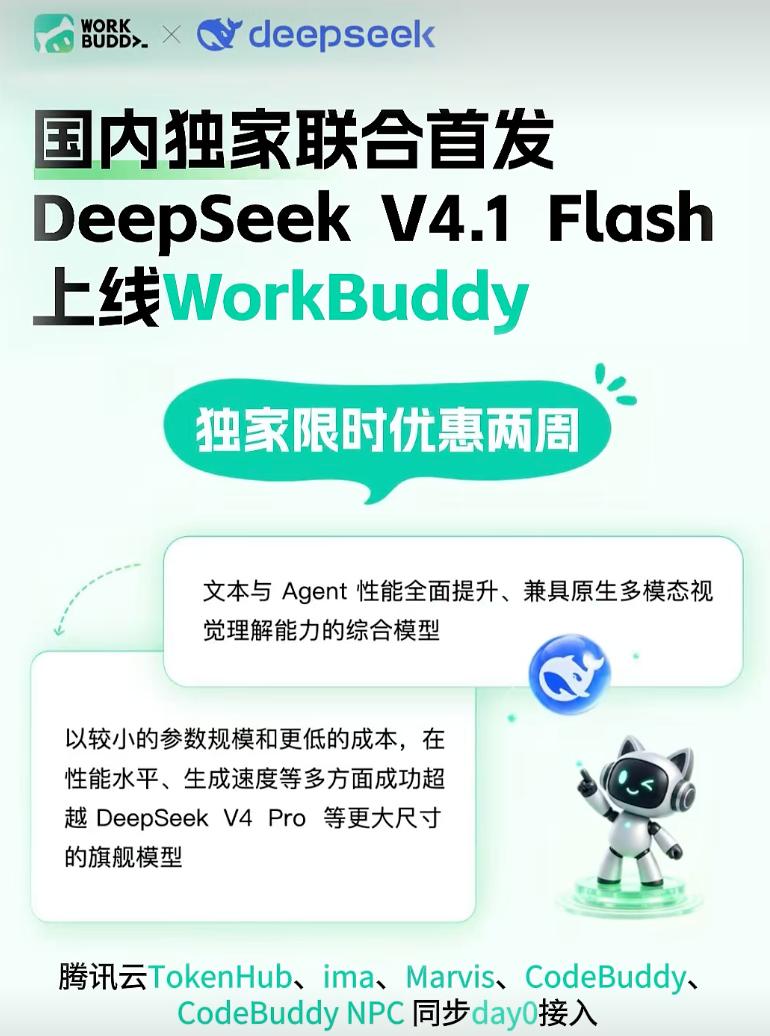
WorkBuddy also provides an exclusive limited-time offer for two weeks, and Tencent Cloud TokenHub, ima, Marvis and CodeBuddy have synchronously accessed DeepSeek V4.1 Flash. In the previous Reuters report on DeepSeek's financing, Tencent is one of DeepSeek's investors.
Also open sourced at the same time is DeepJIT, a lightweight xPU kernel JIT compilation library that supports both NVIDIA CUDA GPU and Huawei Ascend NPU backends, providing a unified interface for kernel compilation on the inference side and cross-node shared cache capability.
04. Conclusion: The Smallest Model Outperforms Flagship, Inference Costs Keep Falling
The DeepSeek V4.1 Flash model uses a brand-new architecture to lower costs, while applying larger-scale reinforcement learning to improve intelligence level. With a smaller size, it has achieved a comprehensive surpass over the flagship model in DeepSeek's product line.
For users who frequently use Agent, the superposition of cache compression and price reduction will bring more obvious changes to their actual bills than the improvement of benchmark scores.
From a longer-term perspective, the official claims that the new architecture can be extended to models with larger parameters, so we may look forward to the upcoming new DeepSeek flagship model.
It can be seen that DeepSeek's product line is being rearranged around the new architecture. The orderly phase-out of V4 Pro is just the beginning of this iteration. To what extent the subsequent larger-parameter models can push the cost-effectiveness of cutting-edge models is worth anticipating.
This article is from the WeChat official account "ZheDongXi" (ID: zhidxcpm), written by Bi Weihao, and published with authorization from 36Kr.