DeepSeek V4.1 Flash is launched, delivering Pro-level capabilities at the price of the Flash version.

Image generated by AI
On September 10, DeepSeek officially released V4.1 Flash, simultaneously lowered its API prices, and announced that it will discontinue the V4 Pro service at 12:00 Beijing Time on September 14, with all related requests to be processed by the new model afterwards.
According to DeepSeek's official statement, V4.1 Flash has fully outperformed V4 Pro across metrics including performance, cost, speed, and total task completion time. This model, built with a new architecture and natively supporting visual understanding, has taken over the position of the previous generation Pro model.
The core of this update thus lies in three interlinked changes: the new architecture improves capability and efficiency, visual understanding is integrated into the flagship main model, and lower prices allow developers to offload more workloads to Flash.
01. 552 Billion Parameters, Different Computing Scales for Input and Output
The upgrade of V4.1 Flash goes deep into the model structure.
The official V4 Flash version released on July 31 retained the model structure and size of the preview version, with its main focus on redoing post-training. This time, V4.1 Flash adopts a brand-new Causal-Encoder-Decoder structure, which is a Mixture-of-Experts (MoE) model with a total of 552 billion parameters.
The feature of this architecture is the asymmetry between input and output: it activates 8 billion parameters when processing inputs, and 16 billion parameters when generating outputs. The model has a large total parameter scale, but only calls a part of them for each calculation, and allocates different computing scales for information reading and content generation. DeepSeek states that its cost is significantly lower than that of known models of the same size.
This design is highly relevant to the working mode of Agents. When processing code repositories, long documents and historical conversations, the model needs to read a large amount of information before generating relatively limited judgments, code or operation instructions. Reducing the computing overhead in the input phase is expected to improve the overall efficiency of such tasks.
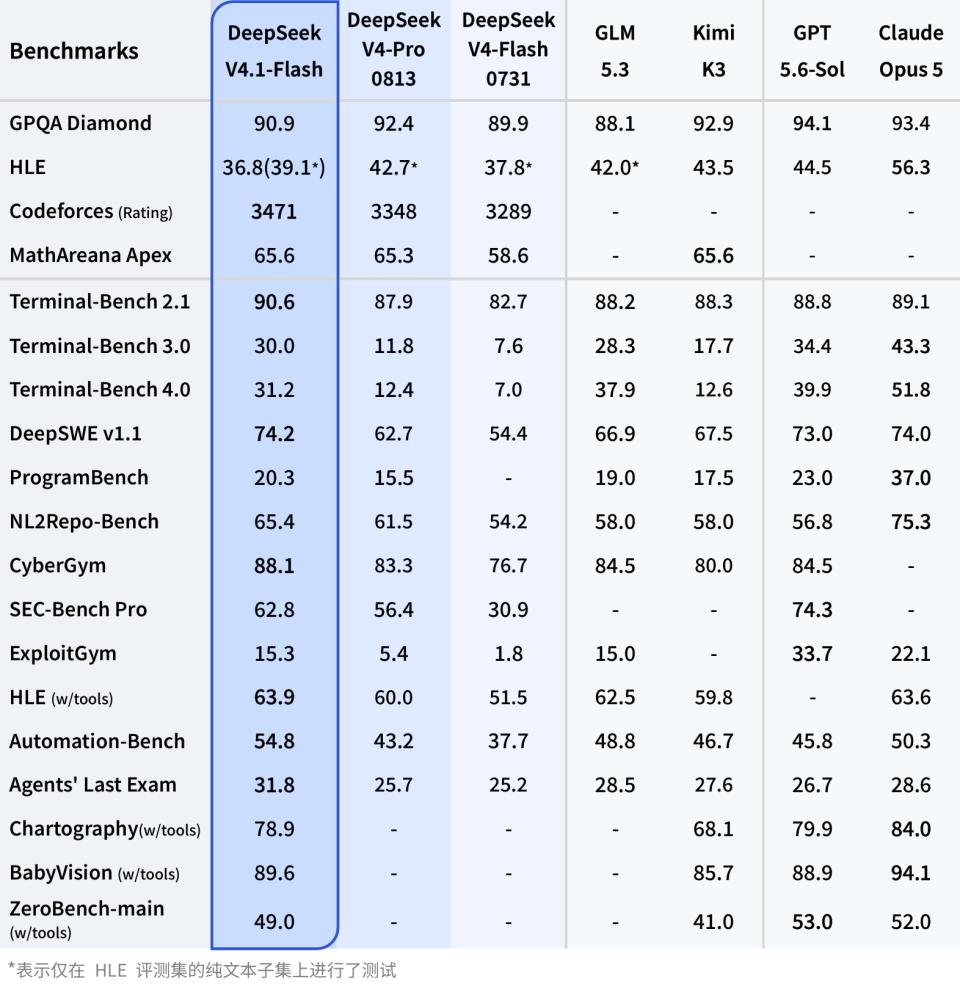
Beyond the architecture, V4.1 Flash also uses a new pre-training method and has undergone larger-scale reinforcement learning post-training. DeepSeek claims that the new model outperforms multiple flagship models including V4 Pro in benchmark tests.
According to the officially published results, V4.1 Flash scores 90.9 in the scientific Q&A test GPQA Diamond, gets a Codeforces competitive programming rating of 3471, and scores 65.6 in MathArena Apex. On Terminal-Bench 2.1 which evaluates end-to-end task execution, the new model scores 90.6; it scores 88.1 on the cybersecurity test CyberGym, while the corresponding previously announced scores of V4 Pro were 87.9 and 83.3 respectively.
V4.1 Flash is the smallest model in the new architecture series. According to DeepSeek's introduction, this structure also supports scaling up to larger parameter sizes, laying a foundation for subsequent larger models.
02. Visual Understanding Integrated into the Main Model
Another change of V4.1 Flash is its native support for multi-modal visual understanding.
Previously, DeepSeek provided experimental visual capabilities through V4 Flash Vision Exp. After this release, the old V4 Flash and the experimental visual version have been taken offline, and requests for the two original model names are now handled by V4.1 Flash, meaning text and image processing are integrated into the same main API model.
According to the latest image understanding documentation, developers can ask the model to describe images, recognize text in screenshots, and analyze charts. Images can be passed in via public links, submitted directly after encoding, or referenced after being uploaded through the Files API.
This has practical significance for Agents processing real-world materials. Descriptions and charts in business documents, code and interface screenshots often need to be understood in combination. A unified model entry can reduce the work for developers to allocate and switch tasks between different models.
In terms of basic specifications, V4.1 Flash supports a 1 million-token context window, a maximum 384K output, as well as features including JSON Output, tool calling, and the Responses API. The model provides both thinking and non-thinking modes, with thinking enabled by default. The thinking intensity supports three levels: low, high and max, which developers can configure according to task complexity.
03. Cached Input Price Cut by 60%, Lower Cost for Continuous Work
The new pricing for V4.1 Flash takes effect at 12:00 Beijing Time on September 10, and continues to use peak-valley pricing. Calculated per million tokens, the price for cache-hit input in off-peak hours is 0.02 yuan, cache-miss input is 1 yuan, and output is 4 yuan; the prices for peak hours are 0.04 yuan, 2 yuan and 8 yuan respectively.
Peak hours are 9:00-12:00 and 14:00-18:00 from Monday to Friday Beijing Time, and the rest are off-peak hours.
Compared with the prices of V4 Flash in the same period earlier, the cache-hit input price is reduced by 60%, the cache-miss input price is reduced by about 33.3%, and the output price is reduced by about 11.1%.
Tasks that require repeated reading of large amounts of context will benefit more significantly. When an Agent works continuously, it often inputs historical conversations, tool descriptions and code multiple times, and the drop in cache prices can reduce this part of repeated overhead. For tasks focused on generating new content, the cost saving margin is relatively limited.
Calculated based on fixed usage: if a task consumes 1 million cache-hit input tokens, 100,000 cache-miss input tokens and 10,000 output tokens, the cost in off-peak hours will drop from 0.245 yuan to 0.16 yuan, a decrease of about 34.7%. The actual bill also depends on the model's thinking length, number of tool calling rounds, and number of failed retries.
deepseek-v4-pro will redirect to the new Flash model after 12:00 on September 14, and be billed at Flash's price until the future V4.1 Pro is launched.
04. Model Trained Together with Harness to Enhance Continuous Work Capability
Updated in tandem with V4.1 Flash is DeepSeek Harness v0.1.5. This upgrade further integrates model training with the Agent runtime framework: V4.1 Flash has undergone special training and optimization for Harness's standard mode, Programmatic Tool Calling (PTC) mode, and minimalist mode.
This means the training now covers different environments where the model actually works. When an Agent completes a task, it needs to keep cycling between tool calling, result reading and next-step decision making. Training for different runtime modes helps the model adapt to tool organization and calling methods, reducing connection issues during execution.
A notable detail is that when using V4.1 Flash, the new version of Harness supports updating the system prompt while retaining the existing KV Cache. For long tasks that require adjusting work rules, this enables reusing previous calculation results and reducing repeated processing, which echoes the cached input price cut in this update.
File processing capabilities have also been improved accordingly. The web interface supports uploading images, PDFs and other files, which the model reads on demand through file tools; the right sidebar allows users to browse the workspace file tree and preview Markdown, HTML, PDF, code and images. Combined with V4.1 Flash's native visual understanding, users can hand over materials to the Agent and directly view the files it generates.
Multi-Agent collaboration has also taken a step forward. Parent Agents and child Agents support two-way communication, and can supplement information and adjust direction during execution; the main Agent can also select models and reasoning intensity for child Agents. The newly added experimental feature Agent Teams allows the main Agent to create multiple members, assign and track work through a shared task list, where members can send messages to each other, and finally the main Agent summarizes the results. This feature is disabled by default, and will increase token consumption after being enabled.
In addition, the new version of Harness provides standardized interface entrances for plug-ins on the left and right sidebars, and optimizes long session loading, recovery and memory usage. DeepSeek plans to continue adding a built-in plug-in management panel to expand the "everything is a plug-in" design.
From this update, it can be seen that DeepSeek is optimizing both model capabilities and the runtime environment together. The new architecture solves computing efficiency, special training improves tool usage, and Harness handles files, sessions and task collaboration. All these links jointly affect whether an Agent can stably complete a task.
05. How to Use
Developers can create an API Key on the DeepSeek Open Platform, set the model name to deepseek-flash to call the new version. The base_url for the OpenAI-compatible interface is https://api.deepseek.com, and the Anthropic-compatible interface is https://api.deepseek.com/anthropic.
Ordinary users can use DeepSeek products through the DeepSeek web version and official App. The old model names deepseek-v4-flash and deepseek-v4-flash-vision-exp are still callable, but their underlying implementations have been switched to V4.1 Flash.
In addition, Tencent WorkBuddy has accessed DeepSeek V4.1 Flash, and users can select this model on the client to experience office tasks such as file processing and content generation.
Apart from model updates, DeepSeek has also recently been reported to be preparing for a public listing. According to previous public reports, the company has advanced its listing preparation on the Sci-Tech Innovation Board (STAR Market), and has contacted a number of leading securities firms including CITIC Securities for listing counseling cooperation; several people close to the relevant capital market operations stated that the company's latest valuation is 500 billion RMB. CITIC Securities has not responded to this for the time being, and the specific listing arrangements are yet to be further disclosed.
V4.1 Flash is pushing up the capability boundary of low-cost models, and also sets a higher starting point for the upcoming V4.1 Pro: if Flash can handle more complex work, the larger model will need to deliver more convincing capability improvements.
This article is from the WeChat Official Account "Tencent Tech", written by Xiao Jing, and published with authorization from 36Kr.