Huawei, Apple and Xiaomi are staging a fierce three-way rivalry in the foldable screen market.
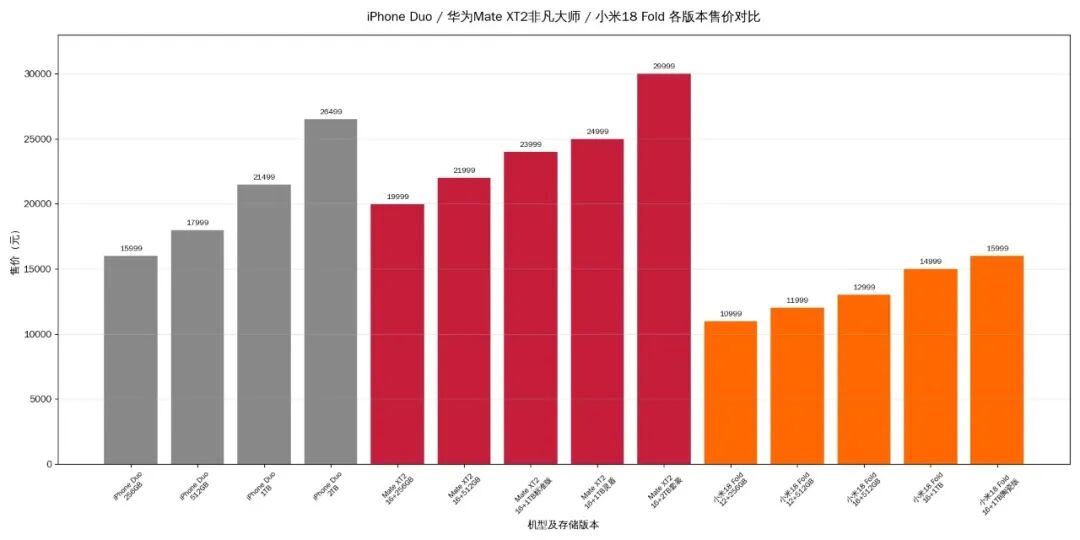
On September 9 local time, Apple released its first foldable iPhone, the iPhone Duo. This horizontal book-style inward-folding model is scheduled to open pre-orders on October 16 and go on official sale on October 23. The 256GB version is priced at 15,999 yuan, and the top-tier 2TB version is priced at 26,499 yuan, making it the highest-priced mobile product in Apple's history.
The highly anticipated debut of the iPhone Duo marks Apple's official entry into the foldable smartphone track, 7 years later than the first foldable phones launched by Huawei and Samsung.
When unfolded, the iPhone Duo is equipped with a 7.6-inch inner screen, the largest screen ever on an iPhone; when folded, it has a 5.4-inch outer screen with a screen area approximately 90% that of the iPhone 18 Pro. The device is made of grade 5 titanium metal and is powered by the A20 Pro chip. Apple states that the phone supports dual-screen multitasking, and is equipped with a 48MP Fusion main camera and an ultra-wide-angle camera.
This month, the foldable phone track has seen a wave of intensive new product launches from tech giants.
On September 7, Huawei's new wing-style tri-fold phone, the Huawei Mate XT 2 Ultimate Design, was officially released. The new device runs HarmonyOS 7, is equipped with the 3rd generation Maple Image System, ECG electrocardiogram analysis, and the industry-first Spirit Shield privacy-protecting screen. It comes in three color options: Obsidian Black, Glacier White, and Brocade Purple, with multiple memory configurations including 16GB+256GB, 16GB+512GB, 16GB+1TB, and 16GB+1TB with the Spirit Shield privacy screen. The Brocade Purple variant offers a 16GB+2TB stylus bundle, with pricing starting at 19,999 yuan.
At 19:00 the same day, Xiaomi held its autumn flagship new product launch event, officially releasing the Xiaomi 18 Fold foldable phone with pricing starting at 10,999 yuan. The new device is powered by the Xuanjie O3 AI flagship processor, equipped with a 6000mAh Xiaomi Jinshajiang battery, with a single-side thickness of only 5.02mm and a weight of 219g. It supports up to six split screens and will go on sale on September 10.
Apple's entry has directly pushed the domestic high-end foldable phone market into a brand new competitive landscape of three-way rivalry among Apple, Huawei and Xiaomi.
In terms of pricing, the three new devices form a clear price tier, while building differentiated layouts in form factor, screen and chip.
The most prominent features of the Apple iPhone Duo are the integrated software and hardware foldable ecosystem and the creaseless screen solution: both the inner and outer screens maintain an identical 4:3 aspect ratio, with content scaled proportionally without visual fragmentation; paired with a self-developed variable torque hinge, its crease control performance after hundreds of thousands of folds is better than the industry average; the customized iOS 27 supports dual-app split screen, cross-window drag and drop, and seamless content transfer between the inner and outer screens.
The Huawei Mate XT 2 Ultimate Design adopts a G-shaped left-right wing-spread dual-axis structure, with a total unfolded thickness of only 3.5mm; the Spirit Shield dual-pixel privacy screen can enable privacy protection separately for office software; HarmonyOS 7 supports three apps running on the same screen, PC-level desktop windows, and native PC-version applications, delivering full-scenario office capabilities tailored for business users.
The Xiaomi 18 Fold weighs only 219g, making it the most portable model among the three large foldable devices; it is equipped with a 6000mAh large-capacity Jinshajiang battery, balancing light weight and long battery life; it is the first to feature the self-developed Xuanjie O3 flagship chip, supporting full ecological content transfer across Xiaomi's mobile, vehicle and home scenarios.
In terms of pricing, the Xiaomi 18 Fold is also Xiaomi's first "10,000-yuan phone", balancing high-end brand positioning and mass shipment demands through a clear price gradient.
Regarding the starting price of 19,999 yuan for the Mate XT 2 Ultimate Design tri-fold phone, Yu Chengdong, Executive Director of Huawei, Director of the Product Investment Review Committee, and Chairman of the Terminal BG, stated at the launch event that with the cost of memory rising by more than 2,000 yuan, "this price is a very sincere offer".
In the long run, this high-end foldable phone "three-way showdown" between Apple, Huawei and Xiaomi will see its competitive focus shift from hardware parameters to software and hardware ecosystems. With Apple's official entry, the foldable phone market has also entered a new stage of multi-player competition. The competition in product pricing, form factor and user experience will further push foldable devices from niche flagship products to the mass high-end market.
Market research firm Counterpoint Research forecasts that global foldable phone shipments will grow by 21% year on year in 2026; since the commercialization of foldable phones in 2019, the cumulative shipment of this category is expected to exceed the 100 million unit mark by the end of 2026. Apple's first foldable model, the iPhone Duo, can reach a maximum shipment of 6 million units this year, which is expected to capture 25% of the global foldable market share, ranking second globally, only behind Samsung's 38%, while Huawei is expected to rank third with a 22% share.
In the domestic market, Huawei previously captured more than 70% of the market share with its full product matrix. After the launch of the Apple iPhone Duo, it will divert a large number of high-end Apple users, and jointly divide the domestic foldable phone market above 10,000 yuan with Huawei and Xiaomi. Currently, foldable phones only account for 2% of the overall smartphone market, which is still in the blue ocean growth stage.
This article is from the WeChat Official Account "Jiemian News", written by Shen Xiaoge, and published by 36Kr with authorization.