All large language models are consummate performers. The correct approach to AI teaching is to train 60 digital students with real data.
AI tutors are already capable of completing many single teaching tasks.
When given a math problem, it can break down the solving steps; when given an English essay, it can point out grammatical issues; when given a chess game, it can also explain the ideas for the next move. In many scenarios, the output of the model is sufficiently similar to that of a patient teaching assistant.
However, teaching effectiveness cannot be judged solely from the teacher's side. Whether students correct their mistakes after listening, whether they only follow the prompts, and whether the same explanation produces different effects on different students, all these phenomena occur on the student side.
If AI tutors want to learn personalized guidance, they also need to repeatedly observe students' reactions.
In reality, these reactions mainly come from human studies. Each time the teaching strategy is adjusted, students need to be organized to participate, interactions are collected, and then manual evaluation is carried out.
AI models can be updated quickly, but the speed of obtaining educational feedback is limited by the experimental cycle of human studies.
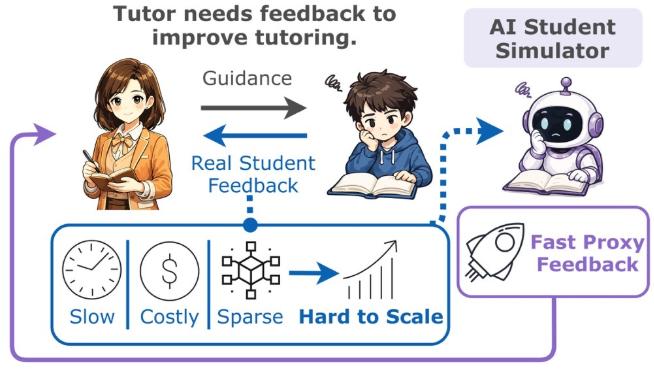
AI tutors need student feedback to improve teaching, but the cost of collecting real feedback is relatively high. StudentSim hopes to convert real student records into proxy feedback that can be called repeatedly during the training phase.
Recent research on StudentSim starts from this contradiction.
The research team hopes to improve AI tutors so that they can understand students' strengths and weaknesses and provide appropriate guidance to different students. In the advancement process, the team focused on the student simulator: can we train an evaluable and reusable AI student with real student data, so that AI tutors can get more feedback during the training phase.
Paper link: https://arxiv.org/abs/2609.01591
Code link: https://github.com/microsoft/StudentSim
Huggingface Paper Homepage: https://huggingface.co/papers/2609.01591
This is not an isolated case in current AI agent research. User simulators are becoming a popular research direction, entering scenarios such as customer service, e-commerce, medical consultation, and web operation. Researchers will construct simulated users to let agents experience more interactions before going online, testing their strategies, wording and robustness.
User simulation in educational scenarios is more complex. Students have relatively stable knowledge boundaries, error habits and learning trajectories. For the same problem, some people miscalculate symbols, some misunderstand concepts, some can deduce the answer by themselves after listening to the prompts, and some need more direct guidance.
The recently discussed digital twin of human students is also developed around such demands.
Modeling students is not a new topic
From Bayesian Knowledge Tracing in 1995, to Deep Knowledge Tracing, and then to Attention-based Knowledge Tracing, this direction has been explored by predecessors for nearly 30 years, and it is quite mature in fitting student behaviors.
Their common gap is that the models only accept structured inputs such as questions, states, and ability values, and do not have an entrance to receive natural language guidance. No matter what the teacher says, such models cannot interact to change their performance like real students.
If you directly let a large model play the role of a student, it seems very convenient. Write it a sentence "You are an elementary school student with weak math fundamentals", the model can immediately switch to the tone of a young student, and can also show hesitation and uncertainty.
However, the character tone and cognitive level are not synchronized.
A model can answer "I don't quite understand" in the tone of an elementary school student, but the next sentence gives reasoning at the calculus level. It seems to be playing the role of a student, but the actual feedback is still affected by the model's own knowledge reserve, which may be far higher than the knowledge level it is restricted to have.
When used for AI tutor training, this cognitive level deviation will cause problems. What the Tutor gets is not the reaction of a certain student under the current ability boundary, but the reaction of a high-capability model packaged with a persona.
It is precisely because of this that only using a paragraph of ability description as a condition is a very fragile condition channel for large models. This route has been widely applied to educational scenarios in the past two years, including conversational tutoring corpora, multi-agent classrooms, and learner data generation; at the same time, a number of studies specifically testing its validity have also emerged, raising questions from three perspectives: architecture, fidelity benchmarks, and teacher user experience.
In pedagogy, to evaluate whether a guidance is effective, usually we cannot only look at the student's performance when answering independently, but also see how far the student can go after receiving help.
The zone of proximal development proposed by Vygotsky is exactly discussing this matter: The gap between what students can currently complete independently and what they can complete with the support of teachers reflects the space where teaching can intervene.
This idea was later implemented as an operable measurement procedure by dynamic assessment: not only record whether the student answers correctly, but also observe how his performance changes after giving prompts.
Applied to the student simulator, this idea corresponds to two types of capabilities.
First, the simulator must be able to reproduce the student's state when answering independently, including ability boundaries, error habits and common choices. Second, the simulator must be able to produce corresponding changes after reading the teacher's guidance, showing the updates that this student may have with the help of guidance.
StudentSim
StudentSim defines these two types of capabilities as behavioral fidelity and guidance responsiveness respectively, and trains and evaluates personalized student simulators accordingly.
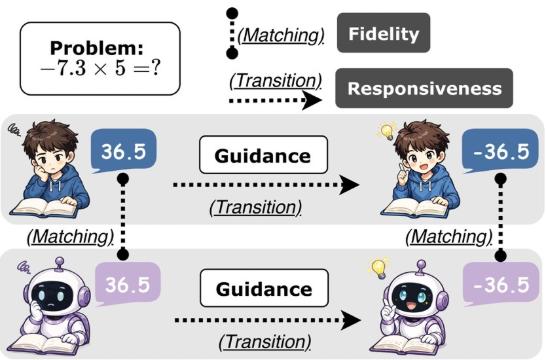
The student simulator needs to answer two questions at the same time: whether it behaves like the target student when answering independently, and whether it produces corresponding changes after receiving teacher guidance.
The training process is divided into two steps.
The first step is to aggregate the records of multiple students in a field to train a general student behavior model. At this stage, it learns common errors, answer formats, and correction paths after receiving guidance.
The second step is to use the individual student's own records to continue training to get a personalized simulator. The records of a single student are few, and direct training is prone to overfitting; learning the group rules first and then adapting to personal data can more stably obtain the simulator corresponding to each student.
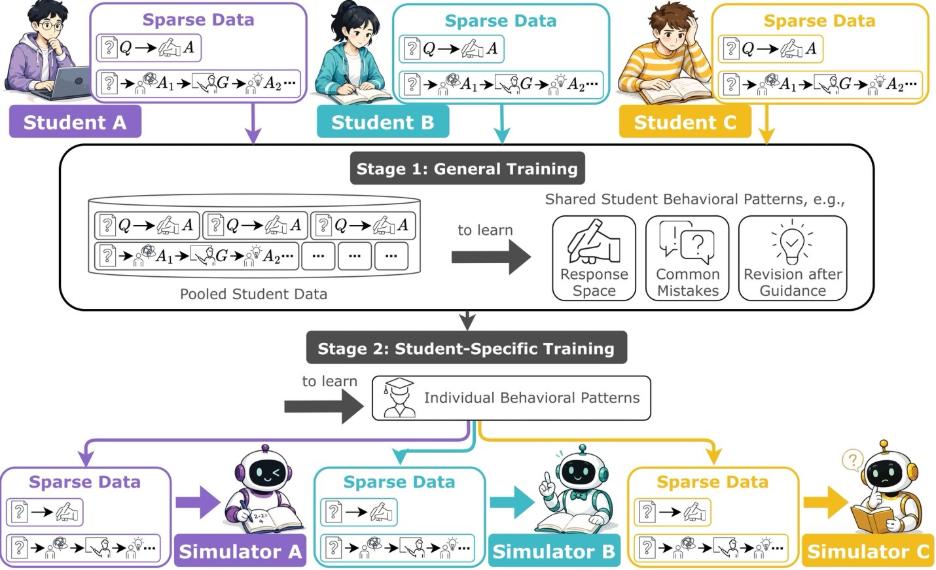
Training process
The research team also constructed StudentSimEval at the same time. The evaluation covers 60 real students from three scenarios: chess, second language English writing and basic mathematics.
In the chess scenario, the simulator needs to predict a certain player's moves in the chess game and change the moves after receiving coach guidance. In the second language writing scenario, the simulator needs to generate essays that conform to the learner's error patterns and rewrite fragments according to the teacher's corrections. In the mathematics scenario, the simulator needs to predict the student's answer and make corrections after the explanation.
These tasks are very different on the surface, but the evaluation goals remain consistent: first check whether the simulator is like the student himself, and then check whether it can respond to guidance. All methods get the same set of student records and are compared on the same held-out test records.
In the chess results, the F value of StudentSim is 0.5150, and the R value is 0.9067; GPT-5.4 is 0.2316 and 0.7186 respectively; Maia2 is 0.4535 and 0.2721 respectively. In the second language writing and mathematics experiments, StudentSim also outperforms the corresponding baselines in the two indicators.
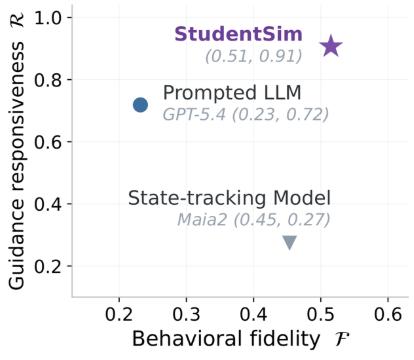
Two-dimensional results in chess evaluation. GPT-5.4 responds well to guidance, but has low behavioral fidelity; Maia2 is closer to the player's moves, but lacks the natural language guidance entrance; StudentSim is at the position where both indicators are high at the same time.
This set of results shows a clear division of labor. GPT-5.4 can read guidance, but its fidelity is insufficient when simulating specific students. Maia2 is closer to the moves of human chess players, but cannot absorb natural language coach prompts. StudentSim is trained on real learning records and adapted to each student, achieving simultaneous improvements in both individual behavior and guidance responsiveness.
However, the student simulator itself is not the end goal. The end point is that its functions need to be implemented in the real world and can be used to improve the tutor model.
In the past, when training AI tutors, the reward signal in some works came from high-quality tutoring dialogues labeled by experts, and in other works from a general large model referee using a rating scale. Some works have also tried to connect rewards to simulated students, but they all used role-playing LLM students with unfaithful cognitive levels, rather than simulators trained on real learner data. StudentSim proposes a different approach at this point.
The paper further integrates StudentSim into the AI tutor reinforcement learning process.
The experimental scenario is chess. The system first takes out the wrong moves made by real students, the AI tutor generates guidance, and StudentSim gives corrected moves after reading the guidance.
Stockfish is used to calculate the quality change of the corrected moves relative to the original wrong moves, and this score is fed back to the tutor as the RL signal. The control group includes a tutor without RL, and a tutor using GPT-5.4 as the student simulator reward.
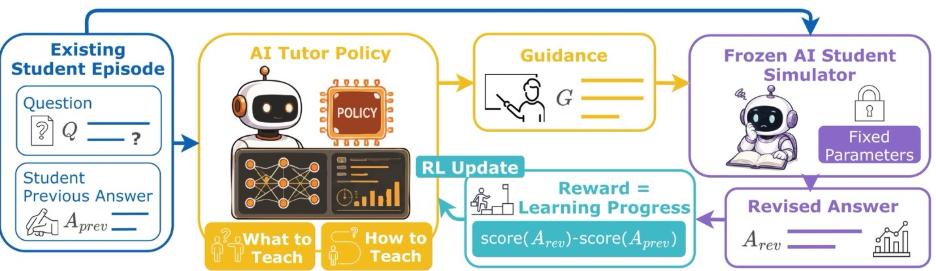
The Tutor generates guidance, the frozen AI student simulator gives the corrected answer, and the system updates the tutor according to the quality change before and after the correction.
The three groups of tutors use the same base model, SFT starting point and GRPO settings, with different reward sources.
After blind evaluation by chess evaluators, the tutor trained with StudentSim reward ranks first in accuracy, guidance quality and personalized score.
Experts conduct blind evaluation on three dimensions under the condition of disrupting the presentation order: accuracy refers to the proportion of answers with "no misleading factual errors", and guidance quality and personalization are scored from 1 to 5 respectively. The tutor trained with StudentSim reward ranks first in all three dimensions.
What is more noteworthy is a set of experiments with reversed results: the tutor trained with GPT-5.4 as the student simulator not only loses to StudentSim in accuracy, but also is lower than the baseline without RL at all. The reason for dragging down the performance is the significantly higher severe factual error rate. If the simulator is not faithful, it will push the tutor in the wrong direction: a simulator whose cognitive level does not match real students but has super understanding ability can deduce some kind of answer by itself after reading even absurd guidance, so it gives random rewards to wrong guidance, and RL will optimize towards a chaotic (even wrong) direction.
StudentSim does not replace real student experiments from educational research. It converts real student records into simulated feedback that can be called repeatedly during the training phase, enabling AI tutors to complete more rounds of screening and optimization before entering human studies.
For AI tutor systems that require personalized feedback, this type of student simulator follows the ideological context of the recently popular user simulator (everyone can be simulated, build a digital twin of human beings), and provides a subversive engineering path:
Learn how students make mistakes, learn how students change under guidance, and provide feedback signals at the machine learning time scale for the reinforcement learning of tutor models.
Reference material: https://arxiv.org/abs/2609.01591
This article is from the WeChat public account "AI Era", author: AI Era; editor: LRST, 36Kr is published with authorization.