Terence Tao posted an angry statement: AI is killing the century-old open tradition of mathematics
Today, the entire internet is buzzing with this huge breaking story about OpenAI.
Last night, OpenAI officially announced that the Navier-Stokes equations, one of the Millennium Prize Problems, have been formally solved by its internal model.
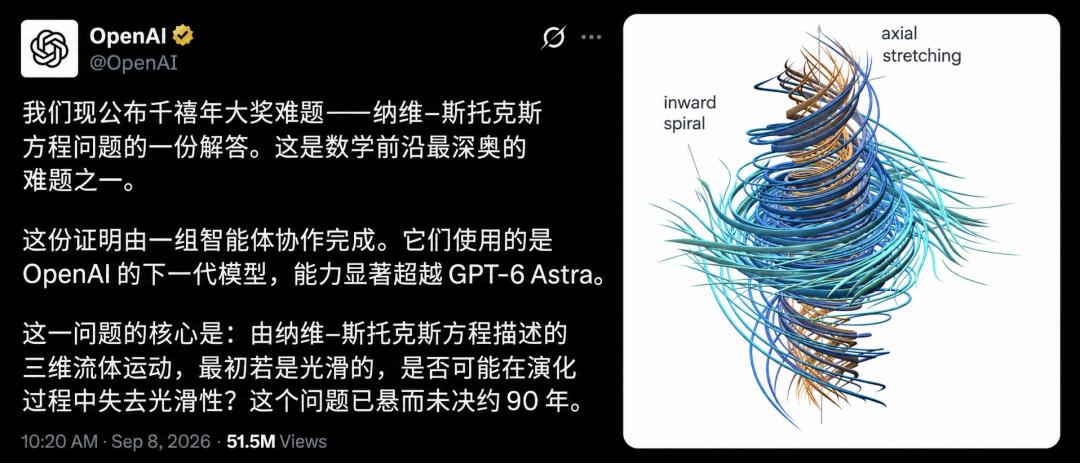
However, behind this, things are far from being that simple.
Some people have leaked a claim that mathematicians at New York University, who have been painstakingly searching for inspiration, have just found a path to solve the "Millennium Prize Problem".
As a result, the tech giant OpenAI acted immediately, directly mobilizing massive computing power to "brutally intercept" the achievement. It not only attempted to rush to publish the paper first, but also used its advantage to bully the team, forcing them to remove the names of employees from the competing company from the author list.
No one can tell for sure yet whether this claim is true or not.
But Terence Tao, a Fields Medal winner, posted a long article a few hours ago to strongly criticize: AI is killing the centuries-old tradition of open science!
He put forward a terrifying point of view — the violent intervention of AI is fundamentally destroying the centuries-old tradition of "open science".
Mathematicians in the future will no longer dare to make their research directions public.
OpenAI's "Gang-style" Rush to Publish?
The trigger of the story is the holy grail in the field of fluid mechanics — the Navier-Stokes equations.
As one of the seven "Millennium Prize Problems" offered by the Clay Mathematics Institute, it has plagued humanity for more than a century.
A few months ago, mathematicians Tristan Buckmaster and Leven Alpöge from New York University formed a team, trying to use AI to break through multiple important problems in fluid mechanics.
After months of exploration, they finally made substantial progress and found a highly promising path to solve the problem.
However, the nightmare also came soon after.
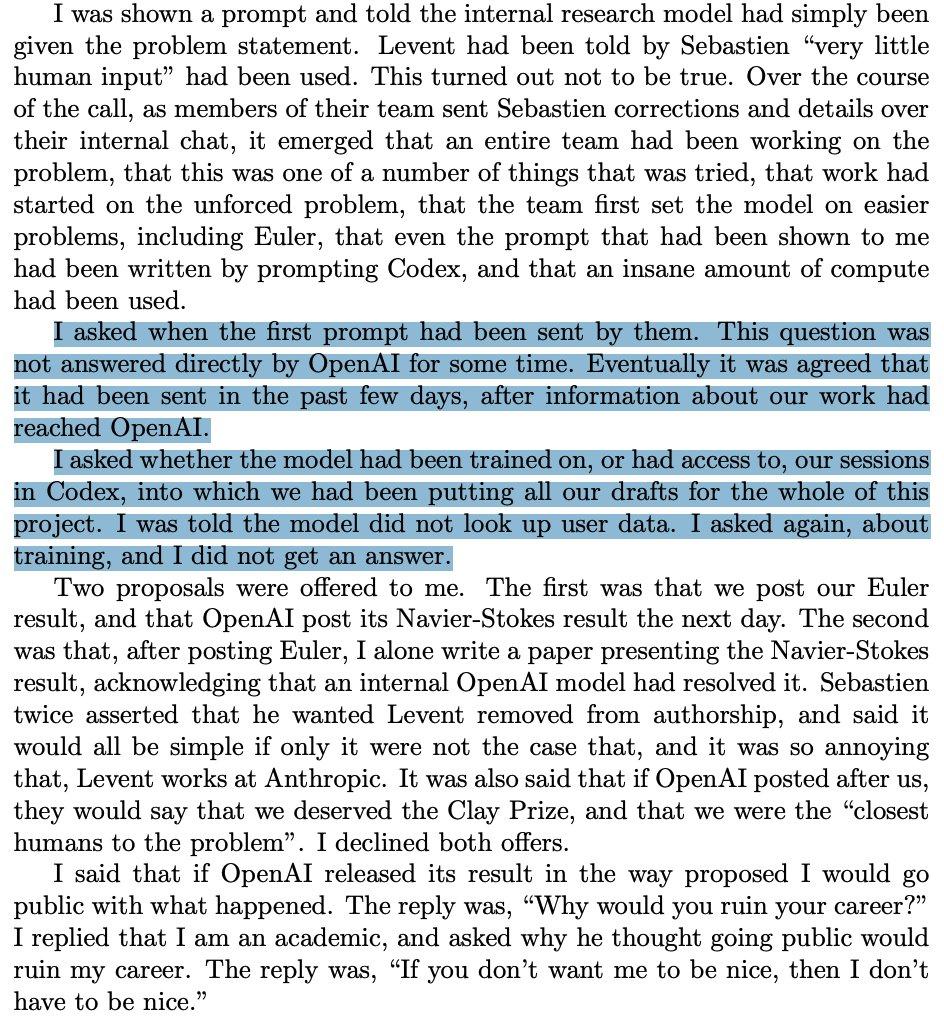
According to Buckmaster's public accusation, OpenAI heard about this matter through some channel in "the last few days".
Learning that human mathematicians had already paved a way, OpenAI immediately let its latest model follow the effective direction they found, using its overwhelming computing power to conduct brute-force exhaustive search.
What is even more outrageous is the subsequent "public relations operation".
When OpenAI came to the NYU team with the results solved by AI, it not only tried to control the external release of the research results, but even put forward this condition: it's okay to publish together, but you must kick the collaborators from Anthropic out of the author list!
As soon as this statement came out, the academic community exploded instantly.
Thom Wolf, the founder of Hugging Face, directly swore on X: "What the hell is this way of handling mathematicians' work and scientific communication? It's sad that you stole other people's achievements and even proposed to publish them together!"
Although OpenAI researcher Sebastien Bubeck urgently published an article to clarify that this is a "false accusation", the anger of public opinion has been completely ignited.
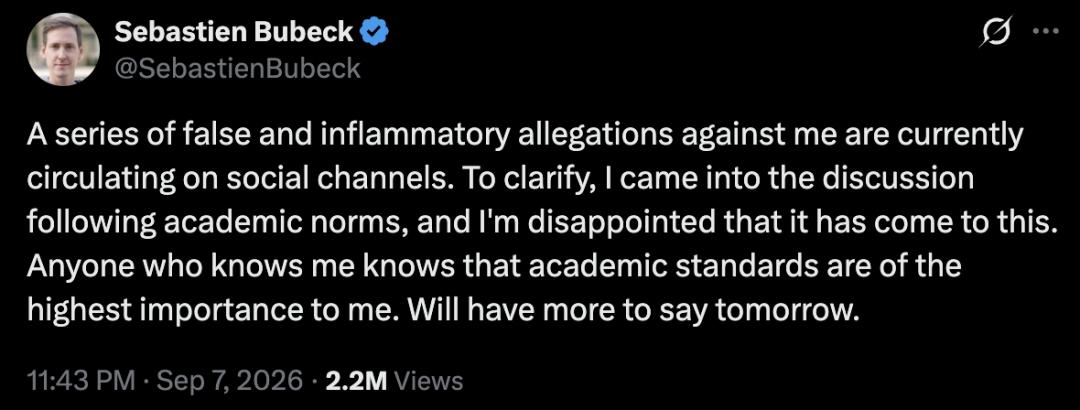
At present, the situation that is closest to the truth is probably that Buckmaster did not succeed in his attempt, but OpenAI did, and the method used by OpenAI may not be invented by itself.
Behind this farce, a deeper crisis has been exposed.
Terence Tao's Warning — AI Is Flattening Mathematics to the Ground
Previously, Terence Tao had always been a big fan of AI-assisted mathematical research. But this time, he felt deep concern.
In his long article, he put forward this metaphor.
"A country may face a severe shortage of drinking water at the same time, but it is surrounded by a vast ocean."
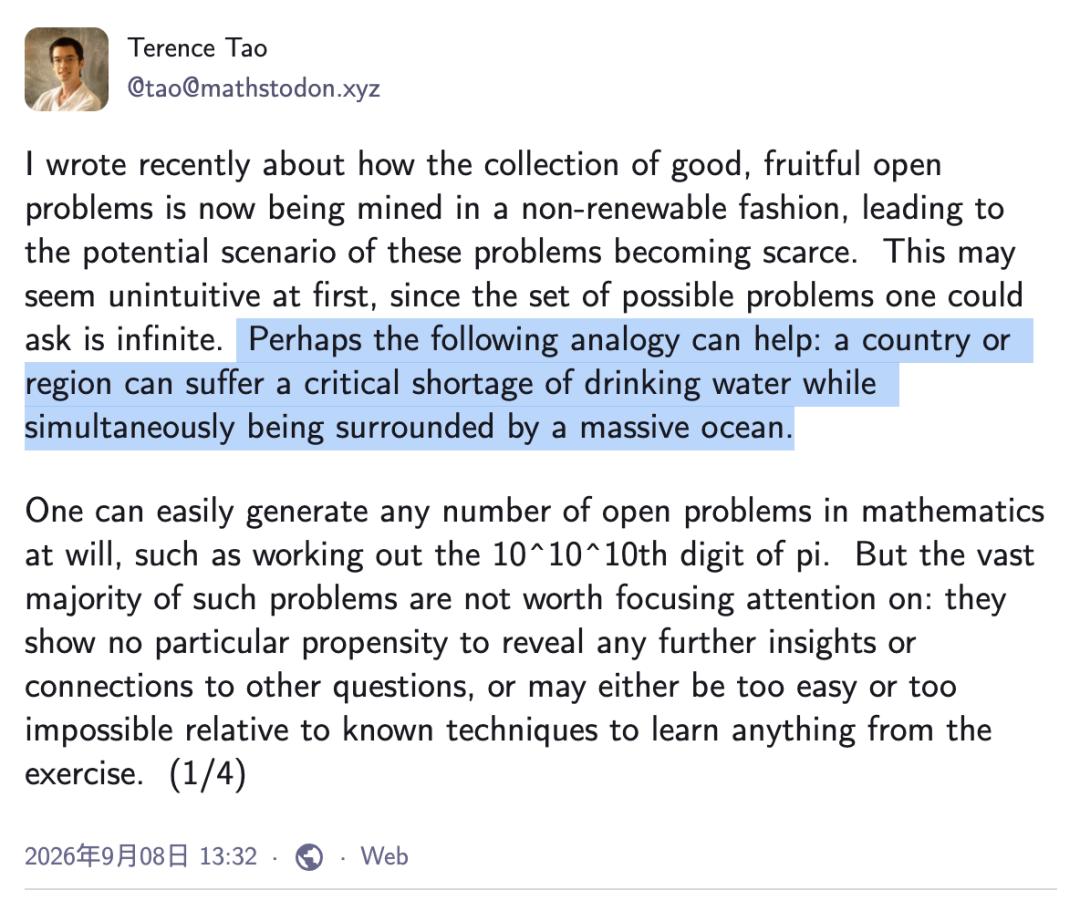
Terence Tao pointed out that the mathematical community never lacks "problems". You can easily come up with the problem of calculating the 10^10^10th digit of pi, but these problems are like seawater, which are completely unfit for drinking.
Judging whether a mathematical problem is "worth studying" is a long, cautious and subjective process.
In traditional mathematical research, there is a "difficulty terrain". Some problems are like plains, which can be easily solved with existing tools; some are like high mountains, which require great efforts; some are insurmountable abysses.
It is this undulating terrain that constitutes the beauty of mathematics, guiding mathematicians to explore and establish profound connections between different fields.
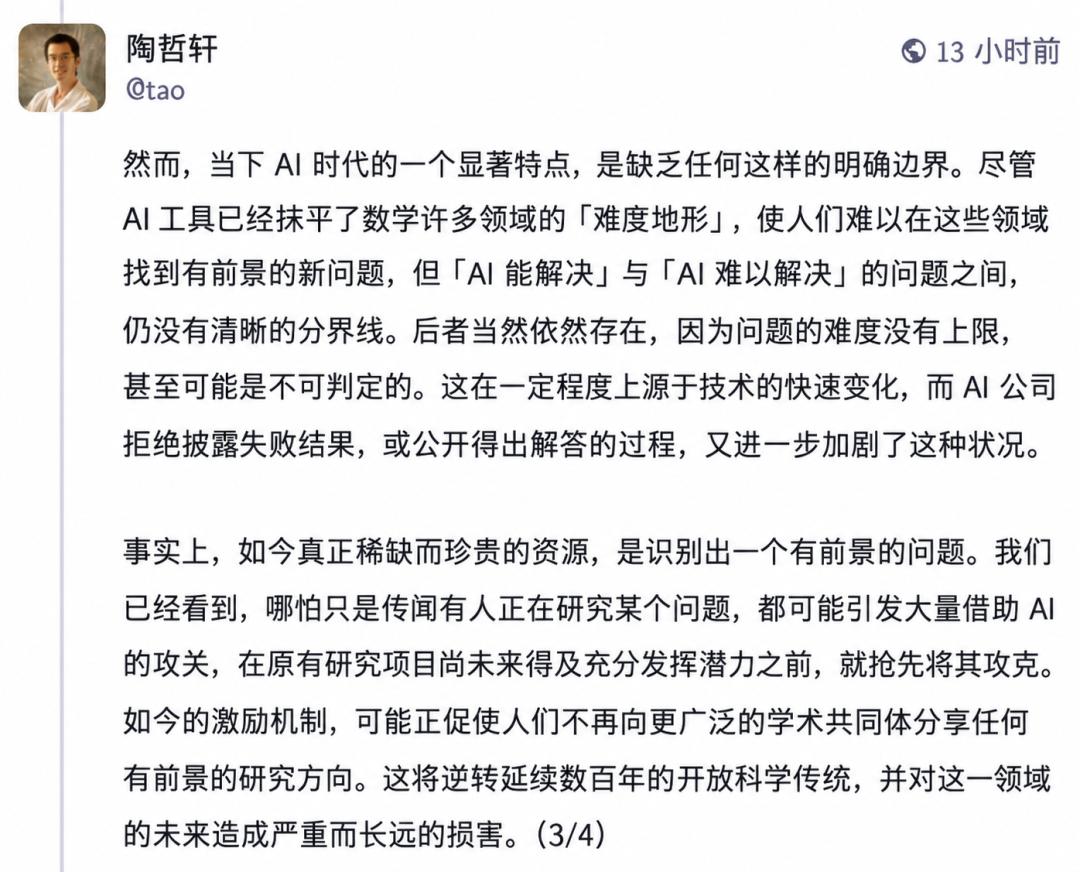
"However, the feature of the AI era is that it lacks any clear boundaries," Terence Tao keenly pointed out.
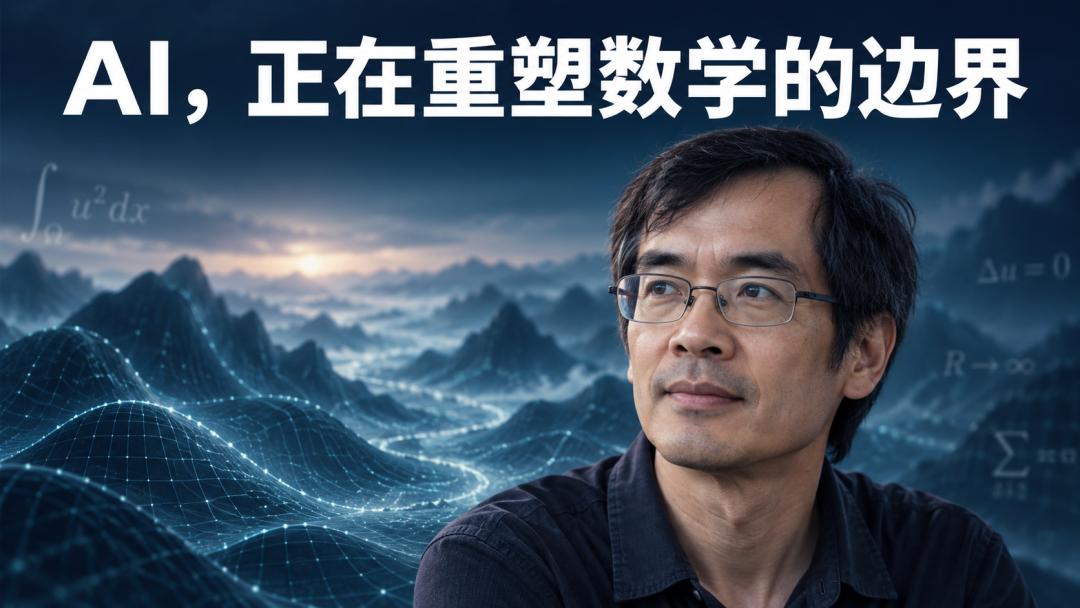
When powerful AI tools (especially those black-box models with opaque operating mechanisms) flood into the mathematical community without distinction, they are like a huge steam bulldozer that completely flattens the original undulating "difficulty terrain".
People can no longer recognize the geometric structure of this discipline, nor do they know which problems are promising and which are dead ends.
More fatally, finding a "promising problem" is the scarcest and most valuable resource in today's scientific community.
In the past, once mathematicians found a potential research direction, they would often excitedly share it at academic conferences, or exchange ideas with peers in seminars, which is the cornerstone of "open science".
Everyone exchanges information and makes up for each other's shortcomings, jointly pushing the boundary of human cognition forward.
But in the AI era, this kind of sharing has become suicidal.
Whoever Speaks Up Will Be Taken Down by the Computing Power Sniper
Terence Tao wrote such a warning in his article:
We have already seen that even the rumor that someone is working on a certain problem can trigger massive AI-driven efforts to flatten the original research project before it can fully realize its potential.
Imagine a human mathematician excitedly saying to his peer in a cafe: "I'm recently working on a new entry point for the Navier-Stokes equations, and the idea is like this..."
Walls have ears. A few hours later, the server cluster of a Silicon Valley giant starts running frantically. Thousands of H100 graphics cards follow the idea casually mentioned by this mathematician, conducting millions of inferences and trial and error.
A week later, this giant rushed to release a preprint paper, announcing that its AI model had solved the problem.
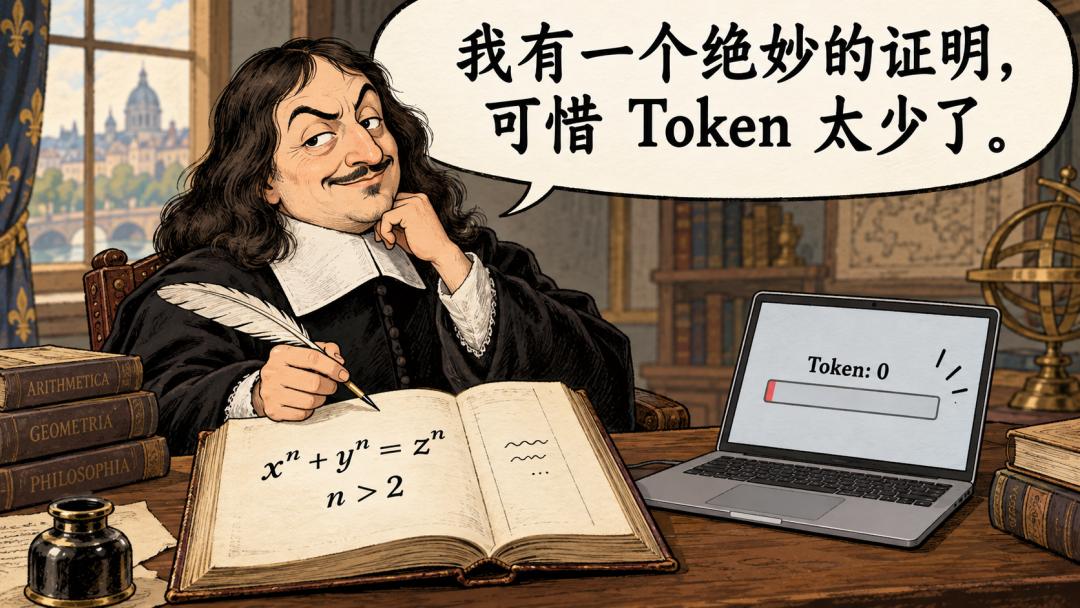
The intuition that human mathematicians spent months or even years building, and the direction they searched for, were instantly wiped out under the brute force of massive AI computing power. AI not only snatched the answer, but also snatched the process of finding the answer.
Facing this kind of dimensionality reduction strike, what is the only self-protection method for human scientists?
They can only keep silent.
Terence Tao pessimistically predicted: "The current incentive mechanism is evolving towards the trend of 'no longer sharing any promising research directions with the wider academic community'. This will reverse the centuries-old tradition of open science and cause serious long-term damage to the future of this field."
If every researcher hides their inspiration; if all discussions go underground; if academic conferences no longer have real collisions of ideas, only result presentations after papers are published...
Then the scientific community will cease to exist in any meaningful sense.
Do We Want Answers, or Wisdom?
Terence Tao's appeal immediately received collective support from the AI community. Many big names such as François Chollet and Gary Marcus reposted it one after another.
Gary Marcus strongly supported Terence Tao: "AI companies should compete on who can bring new scientific insights, not rush to use their computing power advantage to announce that they have solved the problem!"
This leads to the most essential question in scientific research: are we doing scientific research ultimately to get that final answer, or to extract wisdom in this process?
In basic disciplines such as physics and mathematics, the "answer" is often not the most important part. The process of proving Fermat's Last Theorem gave birth to many important tools of modern algebraic geometry; the journey of exploring the Poincaré conjecture greatly promoted the development of topology.
As a netizen commented under Terence Tao's post: "No one has ever said that the answer is the most important part. We need to focus on exploring why they were so difficult in the first place."
However, current AI giants are turning science into a "marketing game".
They use black-box models to piece together answers, do not disclose negative results, and do not reveal the problem-solving process, just to show off at the press conference: "Look, our model has solved the Millennium Prize Problem!"
Terence Tao criticized unceremoniously: "Indiscriminate use of powerful problem-solving tools can achieve the short-term goal of solving immediate problems, but at the cost of the ecosystem that nurtures the next wave of progress."
"Raw solutions" that lack detailed analysis and do not extract new insights have little value for the long-term development of human science, and may even cause negative pollution.
Hold the Bottom Line of Human Science
The controversy triggered by the "rush to publish the fluid mechanics problem" has not subsided so far.
Apart from the truth and falsehood, it has already torn open a wound about AI ethics.
We are now at a crossroads.
To the left, AI becomes a powerful assistant for all human scientists, who use it to jointly explore the unknown universe, and continue and prosper the open science ecosystem.
To the right, several tech giants with monopolistic computing power turn into greedy "bounty hunters". They not only extract the last residual value of human data, but even start to plunder the sparks of inspiration in human scientists' minds.
At the end of the article, Terence Tao put forward an initiative. He believes that we must establish new social norms, and the academic community should reject those answers that lack profound insights and are only pieced together by black-box brute force.
"This is like modern food donation activities no longer accept any arbitrary donations (even if they are really edible), but must maintain a standard that is widely accepted by society."
If mathematicians no longer have the courage to openly discuss "where we should go", then even if AI calculates the ultimate formula of the universe, human beings will eventually become beggars in the spiritual world.
Reference: https://mathstodon.xyz/@tao/117237320796901560
This article is from the WeChat Official Account "New Zhiyuan" (ID: AI_era), author: ASI Revelation; editor: Aeneas, published with authorization from 36Kr.