An IT empire built on toothpicks: everyone is piling bricks on top of it, and no one ever glances at the foundation.
Author: Assembly Monk
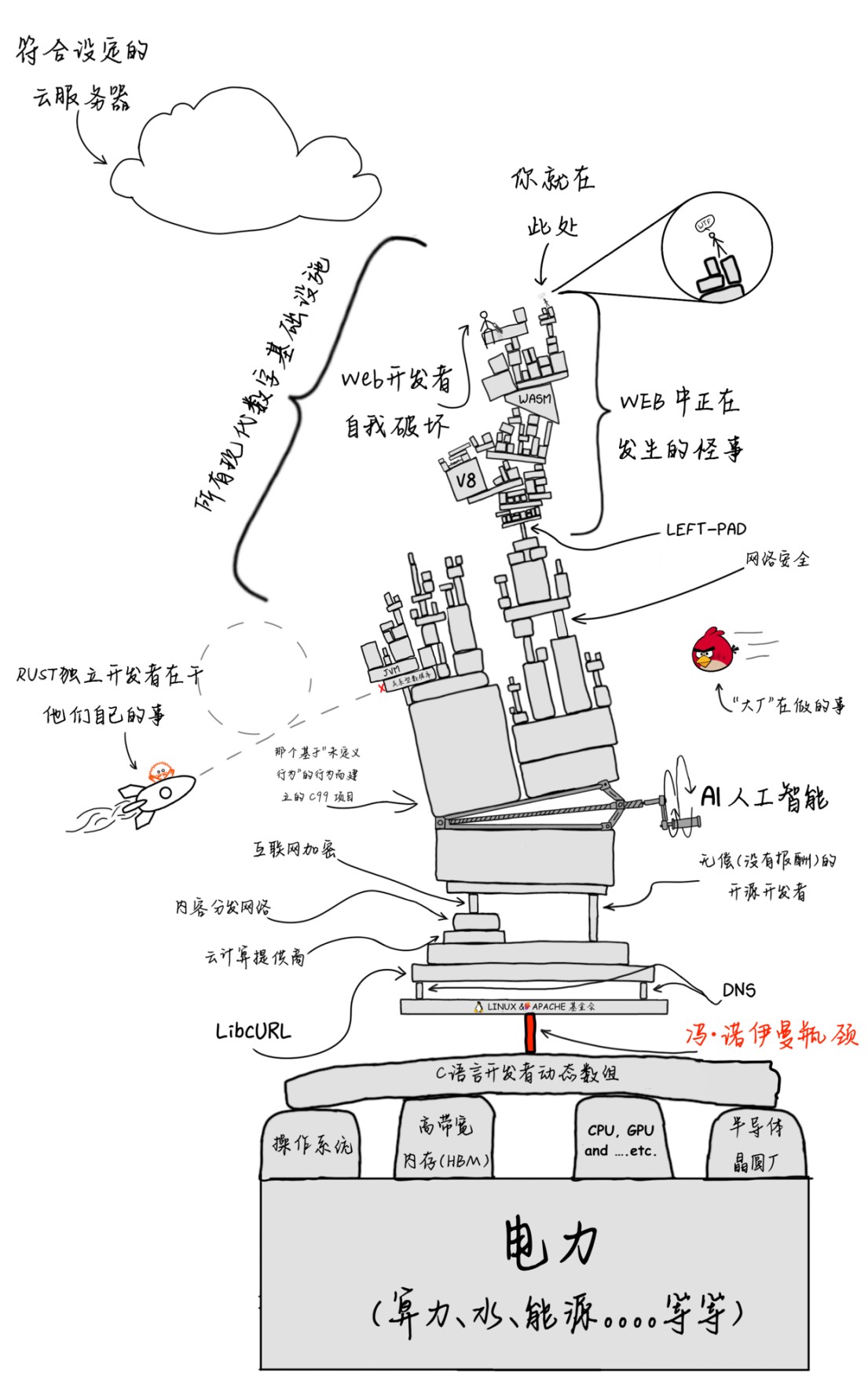
Have you ever thought about how many layers of tech stack the article you are scrolling through right now has gone through?
Mobile operating system, browser kernel, JavaScript engine, WebAssembly, CDN, DNS, cloud server, Linux kernel, C standard library, CPU instruction set, semiconductor wafer... all the way down to a silicon slice that is consuming power right now.
Every layer sounds rock-solid. Every layer has whitepapers, certifications, and big tech vendor endorsements.
But when you stack all of them together, you get a disturbing picture: a wobbly Tower of Babel, propping up everything at the very bottom is a ridiculously thin red pillar.
Its name is: the von Neumann bottleneck.
And you, standing at the top of the tower, are holding your phone, thinking everything is perfectly normal.
01 The red pillar no one wants to look at
John von Neumann, the father of modern computers. The von Neumann architecture is the underlying design of almost all modern computers. The CPU is responsible for computing, the memory is responsible for storage, and the two transport data back and forth via a bus. This design has been in use since 1945, survived the mainframe era, PC era, Internet era, and mobile era, and is now supporting the development of artificial intelligence.
But it has two inherent flaws: 1) CPUs are getting faster and faster, while memory and buses cannot keep up. Data transportation has become the ceiling of the entire system - the CPU does not spend most of its time computing, but waiting for data. 2) The high processing performance of the CPU relies on the capacity of the cache, which has natural physical limitations and cannot be expanded horizontally like memory. Driven by modern high-level programming languages that emphasize human readability, increasingly bloated programs and complex heterogeneous data have long exceeded the upper limit of cache capacity, which further increases the frequency and traffic of data transmission between memory and CPU, making computers run slower, stutter more, and crash more easily. This is the "von Neumann bottleneck".
Ironically, this bottleneck is the most underlying, core, and unavoidable problem in the entire IT industry, yet it is also the most neglected one.
Why? Because solving it is too difficult and not profitable enough.
Big tech companies prefer to stack more layers on top - faster GPUs, larger video memory, more complex cache hierarchies, smarter scheduling algorithms. Every layer can be written into PPTs, every layer can be monetized, and every layer is bypassing that red pillar instead of facing the problem head-on and solving it.
It's like a building that keeps adding floors upwards, while the cracks in the foundation are covered with thicker and thicker wallpaper.
If you ask the people living inside if it is safe, they will say: Don't worry, we just replaced the latest smart door lock and bought the most expensive disaster insurance.
02 Every brick is perfectly square, but they get crooked when stacked together
Looking at this diagram, you will find an interesting phenomenon: every layer, when taken out alone, looks like a carefully designed block.
The operating system has a rigorous kernel architecture. High-bandwidth memory (HBM) has a precise stacking process. CPUs and GPUs have a sophisticated design with billions of transistors. Semiconductor fabs are the crown of human industry.
The Linux & Apache Foundation maintains the world's most reliable open source infrastructure. LibcURL is called by almost all programs that require network access. The DNS system enables the global Internet to find each other. Cloud computing providers promise 99.99% availability.
Every block is perfectly square, every block has papers, standards, and audits.
But when you stack them from the bottom up, the picture changes.
This is the truth of modern digital infrastructure: it is not a carefully designed whole, but a miracle stacked by countless temporary solutions.
It can run not because it is well designed, but because enough people have written enough patches in enough late nights.
You think you are using a grand mansion. In fact, you are standing on a pile of building blocks made of patches.
03 AI is not a savior, it is the last lever that breaks the camel's back
Look at the robotic arm sticking out from the side of the diagram, marked "AI Artificial Intelligence".
It is not supporting the tower, but acting as a lever to accelerate the collapse of the block-like facilities.
This is the most precise irony of the current AI boom.
Everyone is saying that AI is a productivity revolution, the next era, and the silver bullet that saves everything. But from the perspective of infrastructure, the first thing AI does is push the already wobbly system to a more dangerous edge.
Why? Because 1) AI is a computing power monster. The power consumed by one large model training is equivalent to the annual electricity consumption of a small city. Inference deployment requires a huge number of GPUs, and the underlying layer of GPUs still runs on the von Neumann architecture - that red pillar is under more pressure than ever before. 2) The pressure of violent retrieval by AI users on data infrastructure is more than 10,000 times that of human users, and the loop solution that is being hyped now will only further geometrically increase the frequency of data retrieval, query and operation of AI tasks.
What is even more ironic is the output of AI.
A large number of AI-generated codes are submitted to open source projects, with uneven quality and endless vulnerabilities. A large amount of AI-generated content floods the Internet, and search engine results are submerged by spam information. A large number of AI-generated "solutions" are packaged as products and sold to customers, and it is not until problems occur that people find the underlying layer is an illusion.
AI did not fix that red pillar, it just added another floor to the top of the tower, and then told everyone: Look, we are taller now.
As for whether it will collapse? That's a problem for the next quarter.
There is a joke that says it well: It took humans 70 years to develop computers from "fast computing" to "capable of talking nonsense", and then call this progress.
04 Big tech's Angry Birds: Not repairing the building, but demolishing it
On the right side of the diagram, an Angry Bird is crashing towards the tower. The note next to it says: What "big tech companies" are doing.
This metaphor is mean, but accurate.
Every once in a while, big tech companies release a "revolutionary" new product, new framework, new standard. The launch event is grand, the PPT is exquisite, and KOLs are all cheering.
But these products often do not repair or strengthen the existing industrial structure, but destroy it.
When a new framework comes out, the ecosystem of the old framework dies. When a new standard comes out, all devices compatible with the old standard become "backward products". Big tech companies are not unaware that there is a cost to doing this. But for them, the cost of destroying the ecosystem is borne by developers and users, while the growth and valuation brought by new products belong to themselves.
05 Independent developers: Rockets flying their own way and fragments all over the ground
On the left side of the diagram, a Rust independent developer flies away on a rocket, with the note saying: "Rust independent developers are doing their own thing".
This is another kind of irony.
Independent developers are the most dynamic group in the IT ecosystem. They are not bound by the KPI of big tech companies, can quickly try errors, and can make high-quality applications that big companies cannot make.
But the output of independent developers also has another side
- Messy. For the same function, ten independent developers have made ten versions, each different, each with its own design philosophy, and each only maintained until the author loses interest.
- Disordered. There are no unified standards, no compatibility commitments, no upgrade roadmaps. It works today, and the author may delete the repository tomorrow.
- Imprecise. Many independent projects have no tests, no documentation, no security audits. The author thinks "it just needs to run", and then this project is depended on by ten thousand other projects.
These problems are not big when viewed individually, but when stacked together, they become another kind of damage to the market. Users choose from countless semi-finished products, developers step into pits in countless abandoned frameworks, and the trust cost of the entire ecosystem is getting higher and higher.
And those truly excellent independent developers are like the Rust developer flying away on a rocket in the diagram - they are doing their own things, doing it very well, but have nothing to do with this wobbly tower.
The tower will not become more stable because of them, nor will they stop because of the tower.
Everyone is busy with their own business, and everyone collapses in their own way.
06 One diagram, an absurd history of the IT industry
Let's look through this complete diagram from beginning to end.
At the very bottom, there is a large gray square marked "Electric Power (Computing Power, Water, Energy... etc.)". This is the starting point of everything - no electricity, no computing. But in the narrative of the IT industry, electric power is the most neglected layer. Everyone discusses cloud native, microservices, and large models, but few people discuss: where does the electricity consumed by these things come from? How much does it cost? What impact does it have on the environment?
Above the power layer are four cornerstones: Operating System, High Bandwidth Memory (HBM), CPU/GPU, and Semiconductor Fab. This is the hardware layer, the truly "perfectly square" part. Each of them represents the top level of human industry. But note that they are four separate stones, not a whole foundation - there are gaps in the connection between them.
Further up, there is a wobbly long plate marked "Dynamic Array by C Language Developers". This plate spans across the four cornerstones and is unstable itself. Right in the middle of it, a thin red pillar supports all the weight above - the von Neumann bottleneck. The weight of the entire IT world is ultimately pressing on this pillar.
Further up, the style begins to get out of control. A "C99 project based on undefined behavior" undertakes critical functions. Under the JVM, the relational database is crossed out. A robotic arm sticks out from the side, marked "AI Artificial Intelligence", pushing the tower.
Continuing upwards are the V8 engine, left-pad, network security, WebAssembly - these are the Web layer. The large characters next to it read "Web Developers Self-Sabotage" and "Weird Things Happening in the Web".
At the very top, a tiny stick figure representing the user stands on the wobbly top of the tower, with the note next to it "You Are Right Here". Zoom in and you can see that this little figure is holding a mobile phone - he is using this tower, which could collapse at any time.
On the left of the tower, a Rust independent developer flies away on a rocket to do his own thing. On the right of the tower, an Angry Bird (big tech company) is crashing into the tower. Above the tower, a cloud floats alone, marked "Qualified Cloud Server" - it has no connection with the tower, as if it is just a concept.
There is no redundant word in the whole diagram. Every mark is a thorn, piercing the place that the IT industry is most unwilling to be touched.
It is not predicting anything. It is describing the present.
Final Notes
When this article is written here, some people may say: You are too pessimistic, isn't the IT industry operating well?
Yes, it is operating.
But "operating" and "stable" are two different things. A person can walk, which does not mean there are no cracks in his bones. A bridge can carry vehicles, which does not mean its load-bearing capacity does not exceed the limit.
The scary thing about the IT industry is that every layer is iterating at high speed, but the most underlying problem has never been truly solved. The von Neumann bottleneck still exists, big tech companies are still demolishing buildings, AI is still generating garbage, and independent developers are still fighting their own battles.
Everyone is building floors upwards, no one is willing to look down.
Because if you look down, you will find that the foundation is a toothpick. And the toothpick will not be able to support the weight one day.
Perhaps only when that day comes, we who are standing at the top of the tower holding our phones may ask that question for the first time: How on earth was the foundation of this building built?