Apple's new foldable still takes the old approach.
"One More Thing."
On September 9 US time, at the Steve Jobs Theater in Cupertino, after Apple's new CEO John Ternus finished introducing the updates for iPhone, Apple Watch and AirPods, he added this line.
"One More Thing" was Steve Jobs' iconic catchphrase during product launches. On many occasions near the end of keynotes, Jobs would coolly drop a "One More Thing" before bringing far bigger surprises, in a low-key tone tinted with a hint of understated pride.
This line has long been a signature setup for new products at Apple events. In 2014, it ushered in the Apple Watch; in 2015, the Apple Music; in 2017 and 2023, it led to the iPhone X and Vision Pro respectively. In 2020, Apple even used "One more thing" as the theme of the entire keynote, unveiling the M1 chip and the first batch of Mac models equipped with it.
This time, the device in question is an iPhone that can be folded in the middle — the iPhone Duo.
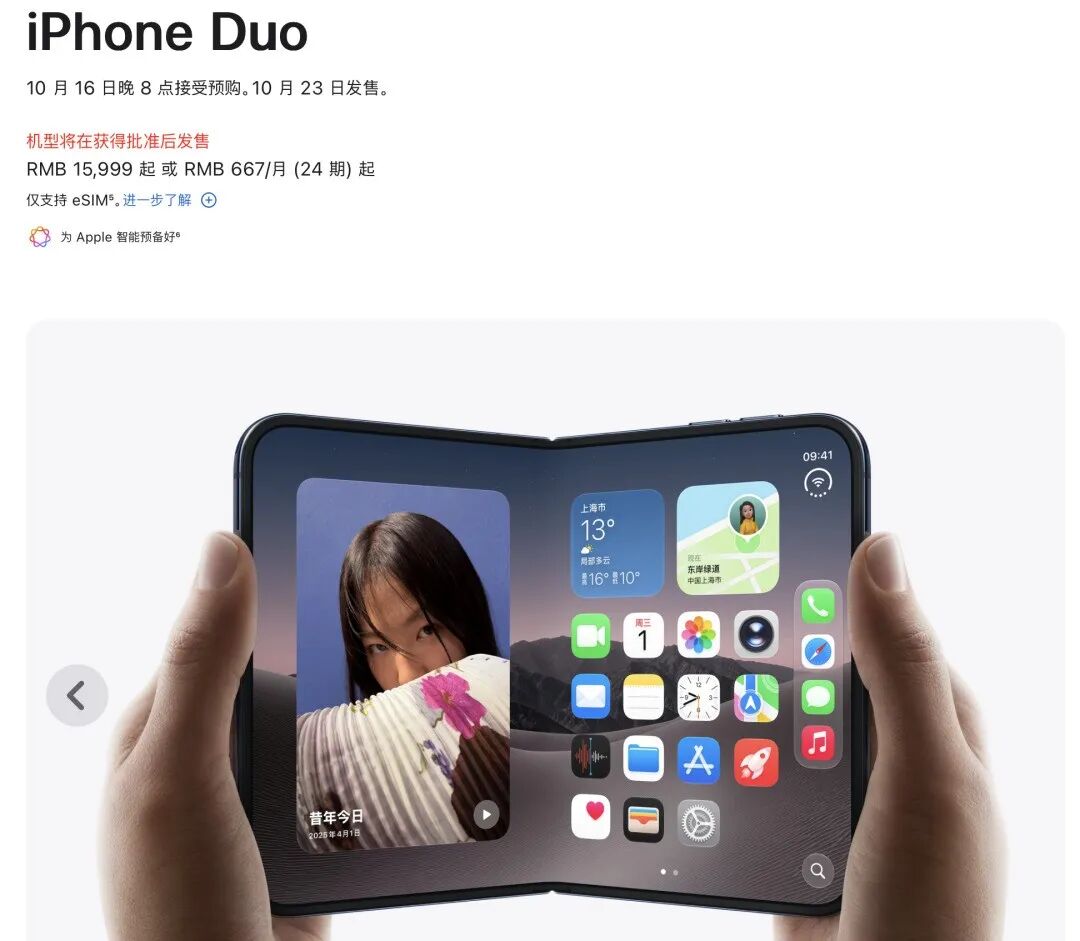
The starting price listed on Apple's official China website is 15,999 yuan. Pre-orders open at 8 p.m. on October 16, with sales kicking off on October 23. The page also notes that "the device will be available for sale upon regulatory approval". More than a month separates the unveiling from the planned delivery date.
Screenshot of Apple China's product purchase page
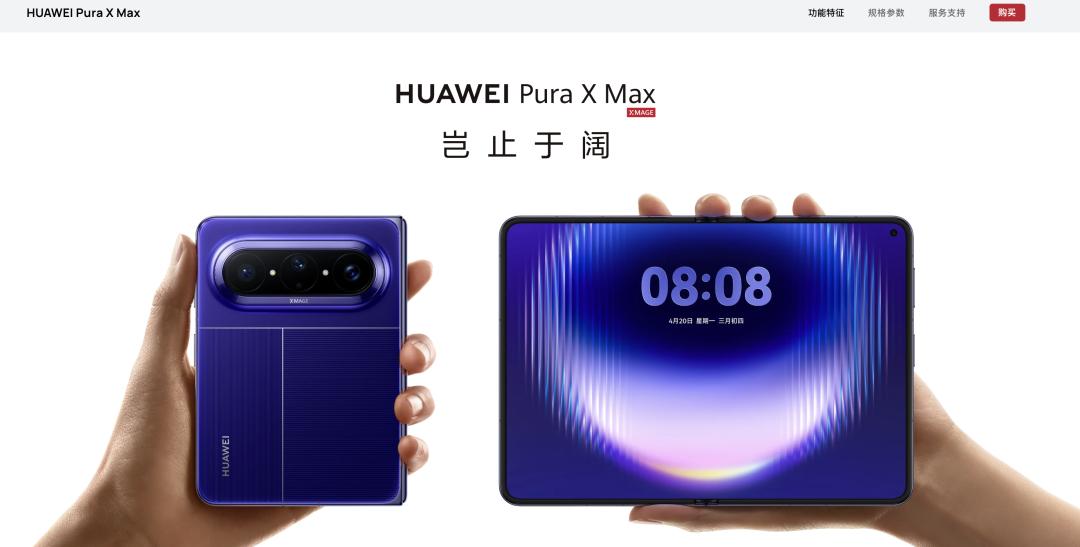
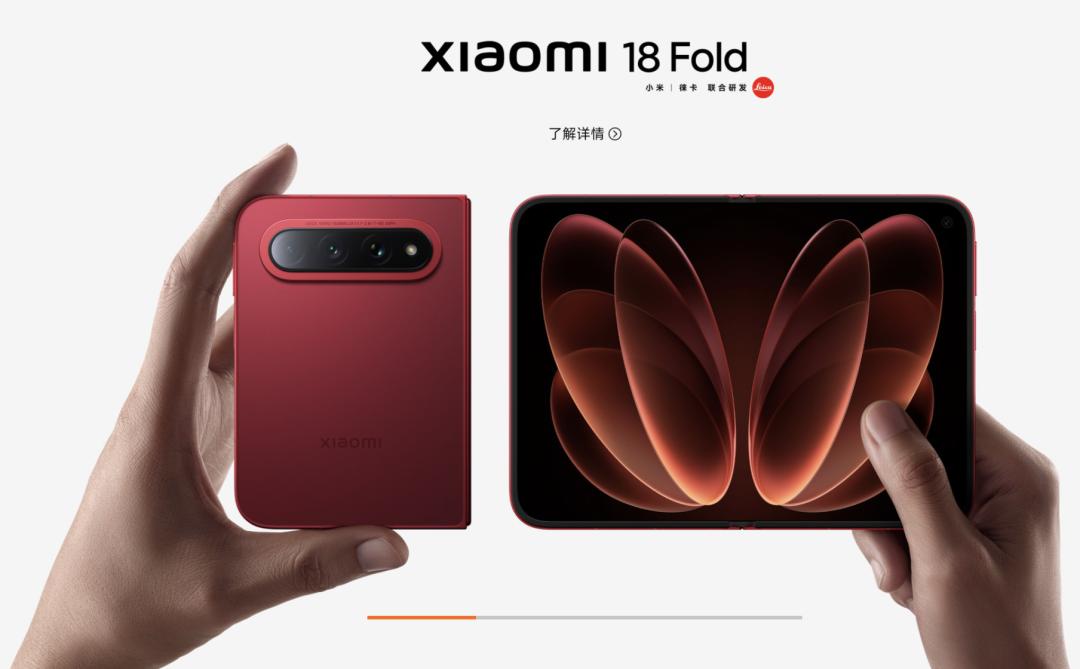
However, before Apple stepped onto the scene, domestic manufacturers had already rolled out different foldable solutions. The Huawei Pura X Max also features a large external display, while the already launched OPPO Find N6 has a folded thickness of less than 9 mm. On the evening of September 7, Xiaomi released its first "mid-sized foldable" phone, the 18 Fold, with sales set to start at 10 a.m. on September 10.
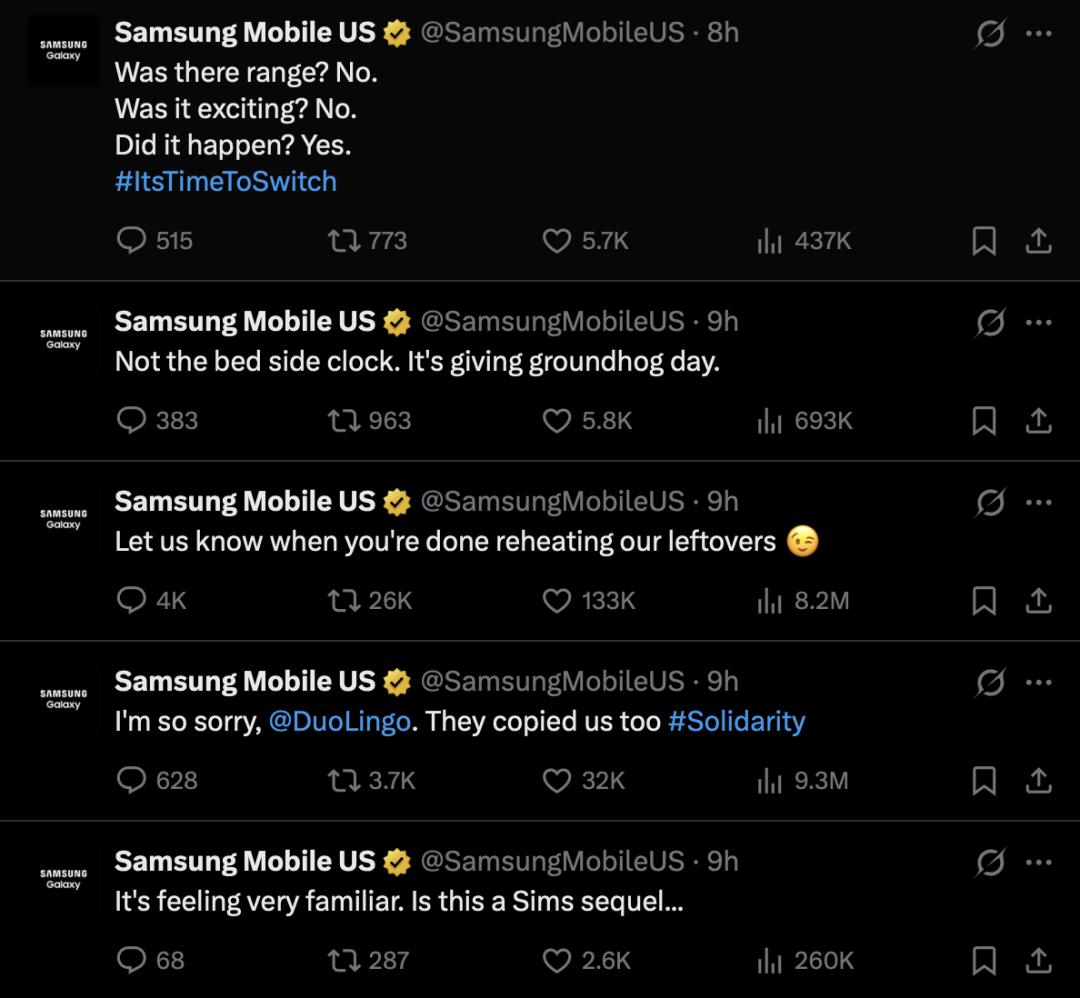
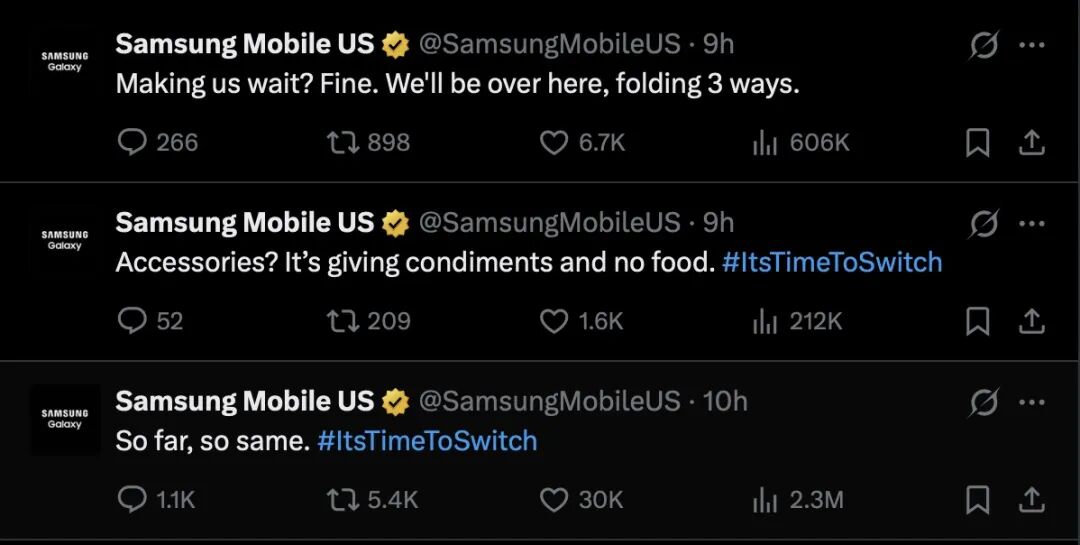
After the launch, Samsung's official social media accounts publicly trolled Apple over product innovation, body weight, thickness and other aspects. Samsung commented that "So far, so same" and that Apple was "reheating our leftovers", implying that all these features had long been realized on Samsung's foldable phones, and Apple's foldable offering is somewhat behind the curve.
Apple's new product this time is entering a mature category that its peers have iterated on for multiple rounds. A Counterpoint report released on September 7 points out that this type of device only accounts for about 2% of the global smartphone market.
1
The iPhone that made the final appearance at the keynote
Before the Duo made its debut, most of the updates at this event still revolved around familiar devices. The iPhone 18 Pro and Pro Max are equipped with the A20 Pro chip, have a smaller Dynamic Island, and get an updated cooling system; the Apple Watch Series 12 and Ultra 4 introduce a new health sensing system; the AirPods are updated to the 5th generation, with further improvements to the sound quality and active noise cancellation of open-ear headphones.
The Duo, which took the final bow, brought the iPhone into the foldable form factor.
However, several of its core features are highly consistent with previously leaked information. Back in March 2025, analyst Ming-Chi Kuo predicted that Apple's first foldable phone would adopt a book-style design, use side-mounted Touch ID to replace Face ID, and be equipped with dual rear cameras.
Now all three predictions have been confirmed on the Duo.
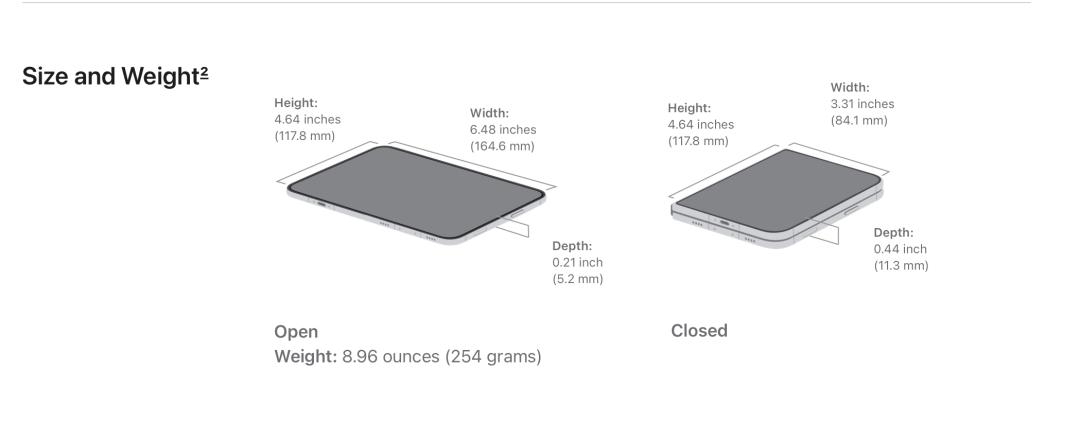
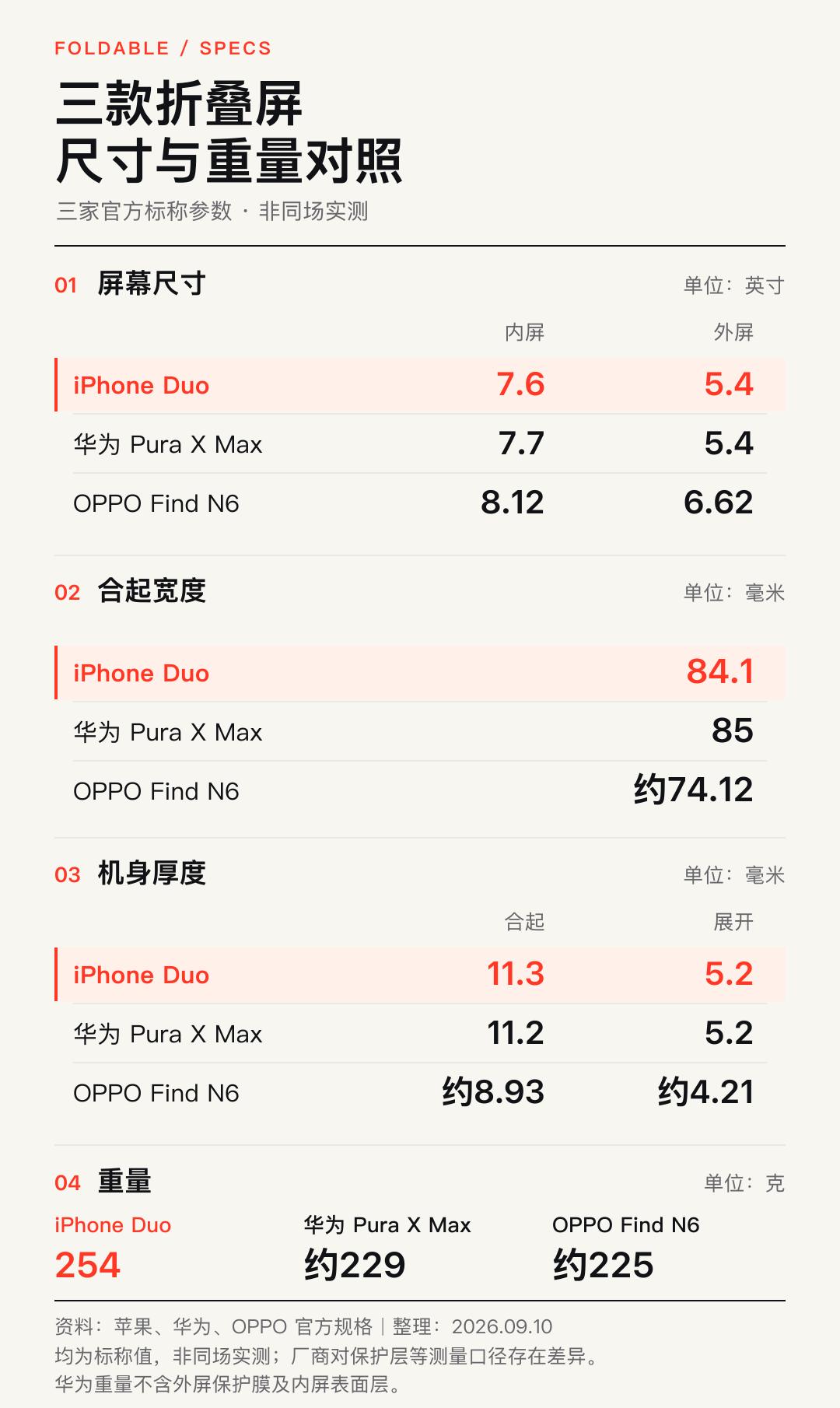
According to the information released on the official website, it adopts a horizontal inward folding design, measuring 84.1 mm in width and 117.8 mm in height when closed, close to a small booklet. The external display is 5.4 inches, and the internal display reaches 7.6 inches when unfolded. The device is 11.3 mm thick when closed, 5.2 mm thick when unfolded, and weighs 254 grams.
The body thickness is not as aggressive as early predictions. The figures given by Ming-Chi Kuo at the time were 9 to 9.5 mm when closed and 4.5 to 4.8 mm when unfolded, both lower than the final announced nominal values.
According to Apple's introduction, the Duo is still powered by a single A20 Pro chip. Apple placed two batteries on both sides of the body, coordinated by the system to work. Different from the bar-type iPhone, this device needs to handle the switching between two screens, and arrange the cooling system and batteries in the space separated by the hinge.
During the hands-on session after the launch, Lance Ulanoff, a reporter from TechRadar, could feel the crease with his finger, but could not see it under the conditions at the time. He attributed this visual effect to the dispersion of reflected light by the nano-texture coating. The hands-on record from Gizmodo mentioned that the crease is still visible at certain angles.
Looking away from the middle of the screen, another feature that is easier to compare is its width.
The 5.4-inch external display does not sound large, but it cannot be imagined based on the familiar small-screen iPhones. With similar diagonal screen sizes, different aspect ratios lead to different distances the hand needs to stretch across. The Huawei Pura X Max also has a 5.4-inch external display, with a width of 85 mm when closed, only 0.9 mm wider than the Duo's 84.1 mm.
According to the official nominal values, the thickness of the two phones is also very close: the Duo is 11.3 mm thick when closed, and the Huawei is 11.2 mm; when unfolded, both are 5.2 mm thick. The difference in nominal weight is more obvious: the Duo weighs 254 grams, while the Huawei weighs about 229 grams, a difference of about 25 grams. However, Huawei notes that this weight does not include the external screen protective film and the inner screen surface layer, so it cannot be directly regarded as the weight difference of the whole device under the same measurement conditions.
The OPPO Find N6 serves as another reference: it is about 74.12 mm wide when closed, about 10 mm narrower than the Duo; it is about 8.93 mm thick when closed and 4.21 mm thick when unfolded, both thinner than the Duo; it weighs about 225 grams, about 29 grams lighter than the Duo. Among the three devices, the Duo and Huawei are similar in width and thickness, but the Duo is heavier; compared with OPPO, the Duo is larger in width, thickness and weight at the same time.
Produced by Hefan Finance
Note: The above dimensions and weights are all nominal values from manufacturers, not measured on site under the same conditions; different manufacturers have different measurement standards for items such as protective layers, screen bezels and camera protrusions.
Trade-offs are also made in the configuration.
The Duo adopts side-mounted Touch ID, and is equipped with two 48-megapixel rear cameras, serving as the main camera and ultra-wide-angle lens respectively. The 2x "optical quality" framing mentioned by Apple is provided by the main camera, without a third independent telephoto lens. Apple also announced that the Duo will support the USB-C version of Apple Pencil later this year, when both the inner and outer screens can be used for writing and marking.
A wide display needs to balance grip comfort, a thin body needs to fit in the batteries, and the center of the screen has to withstand repeated opening and closing — yet Apple's peers have been solving these exact problems for years.
2
Foldable screens have been around for nearly 8 years before Apple entered the market
The origin of foldable smartphones dates back even earlier. On October 31, 2018, Royole released the FlexPai, claiming to be the world's first commercial flexible display foldable smartphone, aiming to combine a mobile phone and a tablet into a single device. In February 2019, Huawei released the Mate X in Barcelona, adopting the outward folding route, reaching 8 inches when unfolded.
Early products quickly ran into real-world problems.
On April 22, 2019, Samsung announced to postpone the launch of the Galaxy Fold. Its preliminary inspection found that some display failures might be related to impacts on the exposed areas at the upper and lower ends of the hinge, as well as foreign objects entering the body and affecting the display. Samsung said it would strengthen screen protection.
From demonstrating a bendable screen to handing it over to people who open and close their phones every day, there is a long process of catching up in materials, structure and manufacturing.
Today, foldable phones have different routes such as inward folding and outward folding, and wider bodies and tri-fold products have also emerged. The Counterpoint report on September 7 predicts that by the end of 2026, the cumulative global shipments of foldable smartphones over the years will exceed 100 million units.
Naturally, the factories that support these products have accumulated a lot of experience through rounds of iterations. In February 2020, Samsung Display announced that it would use ultra-thin glass about 30 microns thick for the Galaxy Z Flip. This material, called UTG, serves as the cover glass of the foldable display. Samsung revealed that its commercialization cooperation with another South Korean company began back in 2013.
Panel manufacturers are also involved in the overall device design.
On January 10, 2022, Honor released its first Magic V in Shenzhen. According to the introduction, BOE provided the flexible OLED display, and co-developed a light and thin folding solution with Honor, adopting a water-drop shaped folding design. How the screen bends and how much space it takes when folded requires joint design between the panel and the phone.
Looking further behind the screen, the supporting components are also being updated.
In the semi-annual report disclosed by Lingyi iTech in August this year, a timeline is listed: a R&D team for supporting components was established in 2019, realizing mass production of ultra-thin stainless steel stamping; in 2022, ultra-thin titanium alloy and carbon fiber production lines were introduced; in 2024, tri-fold carbon fiber support plates began mass shipment.
On September 16, 2019, then Apple Chief Operating Officer Jeff Williams visited Corning's plant in Harrodsburg, Kentucky, USA. He held up the iPhone 11 in front of the employees, introducing the back cover processed from a whole piece of Corning glass.
The next day, Apple announced an additional $250 million investment from its Advanced Manufacturing Fund to Corning. As early as 2017, Apple had already provided $200 million in fund support to Corning.
The funds were invested in glass processing technology, equipment and material R&D. Corning already had glass manufacturing technology, and Apple's continuous investment allowed the processing capacity required for new phones to grow at the supplier's end. The management of the supply chain thus extended from purchasing parts to materials and equipment.
In the structure announced for the Duo, high-strength glass is placed on both the top and bottom of the display panel, special adhesive allows different layers to slide relative to each other, and a titanium metal plate is equipped at the bottom. The hinge, composed of more than 100 components, is designed to support the center of the screen when unfolded.
3
How will Apple rethink an existing mature category
Based on existing technologies, making a foldable phone is no longer a barrier. For Apple, the hard part is making a foldable phone that carries the signature "Apple experience".
The first old approach is to rearrange the hardware and operations around familiar usage scenarios. In other words, users still do the same things as before, but the process of completing them can be more effortless.
The evolution of the iPod happened all around the act of listening to music. On July 17, 2002, at the Macworld New York, the new generation of iPod was released. Steve Jobs emphasized that the biggest news was bringing the iPod to Windows users.
A detail that is easily overlooked is that the software bundled with this batch of Windows versions of iPod is called Musicmatch Jukebox, from another company. At that time, the Windows version of iTunes had not yet come out, so Apple first used this software to allow songs and playlists in the computer to be automatically synced to the player.
In fact, portable MP3 players had already existed long before. For example, the Rio PMP300 released in 1998 used 32MB of flash memory to store about an hour of music. The first-generation iPod launched in 2001 increased the capacity to 5GB, and at the same time integrated automatic syncing with iTunes on Mac into the product.
After expanding support for Windows, Apple continued to solve the problem of "where the songs come from". In April 2003, the iTunes Music Store went online, securing content from the five major record labels, with each song priced at 99 cents. In October of the same year, iTunes was made available for Windows. By April 2007, Apple announced that a total of 100 million iPods had been sold.