$1 billion is just the beginning, and OpenAI wants to be the "child" of Google and Meta
OpenAI CFO Sarah Friar used to talk a lot about fundraising, but recently she has been discussing far more about how to generate revenue.
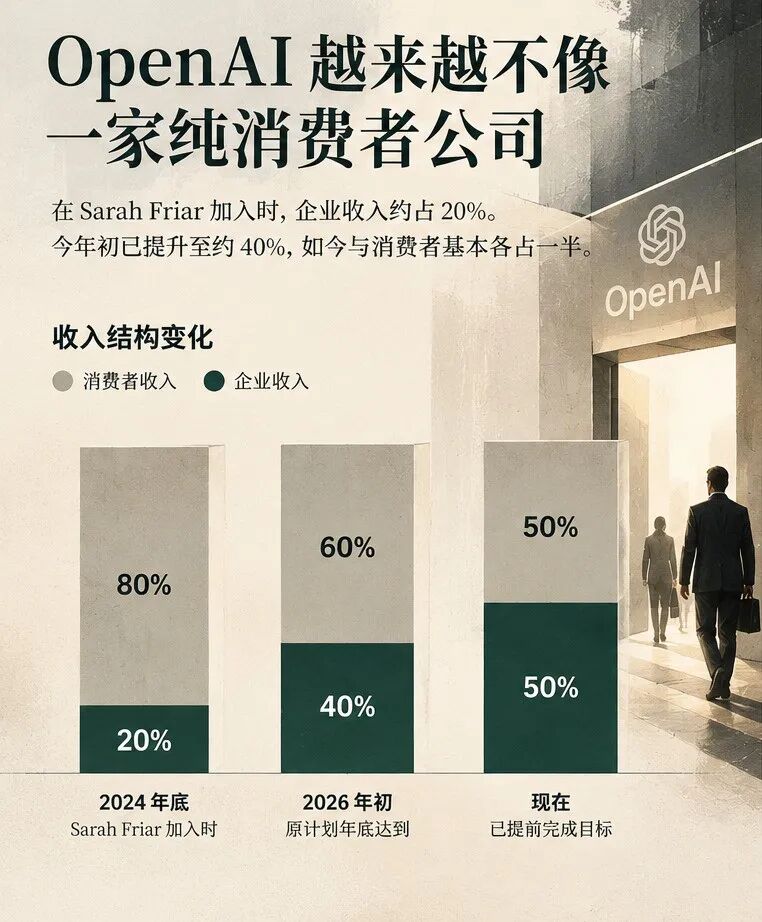
At Goldman Sachs' Communacopia + Technology Conference held on September 7, Sarah Friar noted that the company's enterprise business has been on a tear. At the beginning of this year, OpenAI's revenue structure was roughly 60% from consumers and 40% from enterprise clients. The original plan was to reach a 50/50 split by the end of the year, but this target has now been fulfilled ahead of schedule.
From June to July alone, the company's annualized revenue grew by about 20%, with enterprise revenue rising by 32% on a base that is already considerable.
In her speech, she did not focus on how to sell more subscriptions, but talked about chip design, life sciences, financial services, and new billing models: in some professional fields in the future, OpenAI may no longer charge by the number of users or tokens, and is likely to set prices based on the actual business value created by AI.
OpenAI is rolling out more and more revenue interfaces: enterprise revenue has caught up with consumer revenue, its advertising business has reached an annualized revenue run rate of about $1 billion within seven months, ChatGPT has started to participate in commodity transactions, and higher-value segments are piloting outcome-based pricing.
Advertising Performance Takes Off
Friar used a vivid metaphor to introduce the advertising business. She said that if Google and Meta had a child, it would be ChatGPT.
On ChatGPT, users are very unlikely to only search for running shoes. They may tell ChatGPT that they run three times a week, have an old knee injury, are preparing for a half marathon, want better cushioning, and have a budget of 1500 yuan. For advertisers, this kind of conversation is extremely valuable, as it contains purchase intent, usage scenarios, budget, and personal preferences.
Sarah Friar disclosed that less than 200 days after ChatGPT Ads was launched, its annual recurring revenue (ARR) exceeded $1 billion. The advertising business has expanded from the United States to more than 40 countries, with tens of thousands of advertisers including retail and consumer brands such as Best Buy, Lowe’s, Newegg, and VistaPrint.
OpenAI does not position this business as merely an additional revenue stream. ChatGPT has more than 1 billion weekly active users, a large share of whom are non-paying users. The advertising business is playing a very practical role: it allows advertisers to cover part of the computing power cost for free users.
This is slightly different from traditional internet advertising. The advertising scenario described by OpenAI is not about users passively seeing ads when browsing content, but appearing in the process when users are searching, comparing, and making purchase decisions. When a user asks ChatGPT which computer to buy, which hotel to stay at, or how to choose a pair of running shoes, they are already very close to the final stage of consumption decision-making.
This is also why Friar repeatedly compared ChatGPT with Google and Meta. Google's most valuable asset is real-time user intent: a search term often directly reveals what the user wants to buy at the moment; Meta's advantage lies in its understanding of user interests, identities, and long-term behaviors. Theoretically, ChatGPT can have both types of information: it knows what problem the user is trying to solve at the moment, and also knows the preferences, budget, and usage background the user has provided earlier in the conversation.
It is worth noting that Friar believes the current ChatGPT Ads is not yet a truly mature AI-native advertising product. That means the $1 billion ARR was achieved when the ad format is still relatively early-stage, and the product has not been fully redesigned for AI interaction.
The $1 billion mark is a starting point, not the mature scale of this business. If OpenAI can eventually convert the intent, context in conversations, and information actively provided by users into a new ad matching mechanism, it will not only compete for the budget of traditional display ads, but also for the most valuable segment of Google's search ad revenue.
Two years ago, Sam Altman held a very cautious attitude towards AI advertising. Friar herself also warned at the end of 2024 that once advertisers start paying for the product, the company must be careful that the clients it actually serves will not change. Now, advertising has evolved from a values-related issue to a business model issue.
Pricing Units
On the surface, one signal from Friar's speech is that OpenAI has begun to take advertising seriously; there is another more important change: the management team is continuously refining OpenAI's pricing units.
When ChatGPT was first launched, the pricing unit was very simple: a Plus user paid $20 per month. After the API was introduced, the unit became token, and developers paid according to how much model capacity they used. When the business expanded to enterprise clients, the seat familiar to the software industry was added as a pricing unit.
Now the price list is more complex: advertisers can pay for the computing cost for free users, OpenAI can charge merchants after ChatGPT facilitates commodity transactions; after stepping into sectors including chip design, life sciences, and financial services, Friar has started to directly discuss billing based on business outcome.
At the Goldman Sachs conference, Friar cited a very interesting internal data point:
For the frontier enterprises defined by OpenAI, which are the group of clients with the deepest AI adoption, the number of tokens consumed per user per week is about 8 times that of ordinary enterprise clients, while the figure was only 3 times not long ago; the internal usage of OpenAI itself reaches about 33 times that of ordinary enterprise clients.
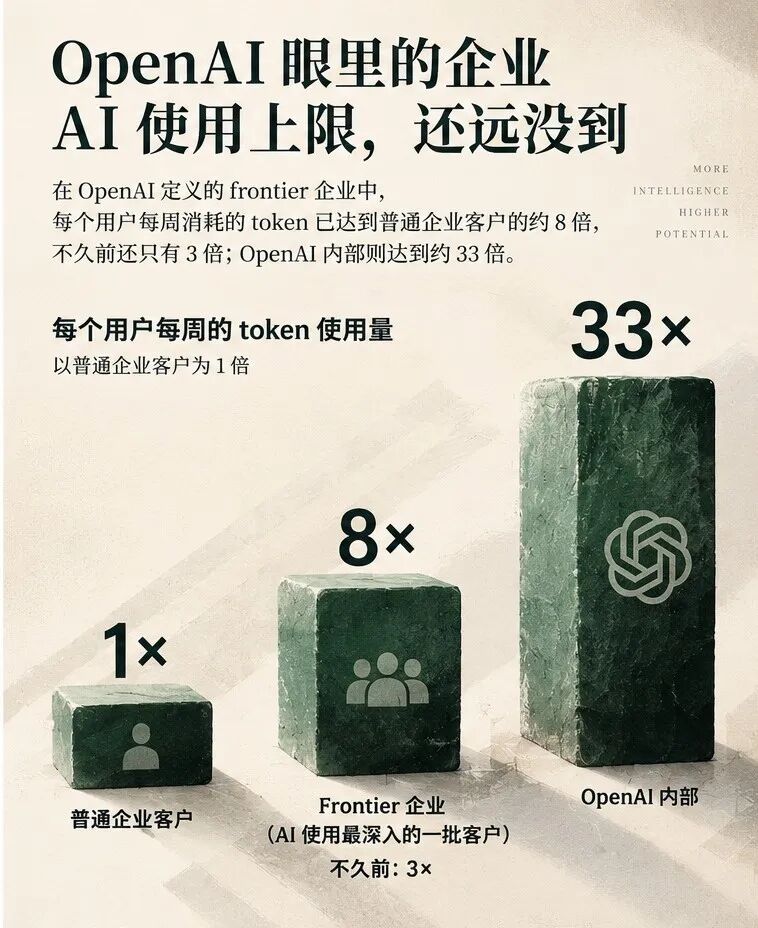
She took this data as a predictive benchmark: if enterprises truly embed AI into their workflows, the current seemingly high usage volume may just be the beginning.
Codex provides another example: it had only about 100,000 users at the beginning of the year, and the latest disclosed figure has reached about 25 million. Friar believes that programming is rapidly moving from AI-assisted development to automated coding. The enterprise transformation OpenAI is experiencing is not that employees open an extra chat window, but that AI has truly entered the production workflow.
Once a large number of companies follow this path, charging by token will no longer be the most appropriate approach.
Suppose a company uses OpenAI's model to complete a chip design task, the API revenue generated by model invocation may only be thousands or tens of thousands of dollars, but if the model shortens the design cycle by two months and saves one tape-out process, the economic value it creates may be several orders of magnitude higher.
Friar specifically mentioned OpenAI's own Jalapeno chip project this time. She said that the team used OpenAI's model to push the chip to the tape-out stage in only nine months. OpenAI hopes to provide similar capabilities to external chip companies. This is exactly why outcome-based pricing has been brought into discussion.
Friar has laid the groundwork for this change many times this year. She has repeatedly talked about successful tasks completed by AI and the amount of useful intelligence per dollar spent. For enterprises, the cheapest model may not really save the most money. If a more powerful model completes a task in one go and reduces rework and manual review, the total cost may be lower instead.
OpenAI also shared a more direct pricing experiment this time. Friar said the company recently cut the price of its low-cost Luna model by 80%, and the usage volume subsequently increased by about 10 times. The sharp price drop did not shrink this business, but stimulated more usage.
OpenAI's management has been increasingly talking about the Jevons paradox: after AI becomes cheaper, enterprises will not only use less money to complete their original work, but also start working on tasks that were impossible in the past. For example, previously they might only review the most important contracts, but in the future they can review all contracts; previously they might only let senior engineers run one simulation, but in the future they can test dozens of solutions at the same time.
As prices drop, users will let AI participate in more work, creating larger application scenarios.
This logic also explains why OpenAI is paying more and more attention to enterprise business. When Friar joined the company in 2024, enterprise revenue accounted for roughly 20% of total revenue. The figure reached about 40% at the beginning of this year, and now it is roughly at par with consumer revenue.
The consumer segment has not stopped growing either. Friar disclosed that for a new user, the average number of messages they send on ChatGPT will increase by about 60% within the first six months of use, and the number of usage scenarios will roughly double. The top-performing paid products this year are still Plus and Pro, and she summed up the change as users are moving from asking to doing.
If AI is only used to answer questions, the $20 per month plan and the pricing per million tokens are enough to support a clear price list. If AI starts writing code, processing insurance claims, designing chips, participating in drug research, and completing financial work, the focus will no longer be on usage volume, but on how much value these tasks are ultimately worth.
Maintaining Low Profit Margins
Sam Altman's vision for the company has become increasingly clear recently. He hopes OpenAI will become an infrastructure provider, making intelligence an accessible utility just like cloud computing and electricity. He even stated that as long as the company is large enough and grows fast enough, it is acceptable to maintain a relatively low profit margin for a long time.
Friar is responsible for the other half of this vision. OpenAI must continuously reduce the cost per unit of intelligence, while enabling it to enter higher-value work scenarios. Sectors including chip design, life sciences, and financial services provide such possibilities.
OpenAI has strong enough incentives to find new pricing units: in 2025, the company's revenue reached about $13 billion, while its total costs and expenses stood at around $34 billion. By 2026, computing resource spending alone may reach approximately $500 billion. The unique feature of frontier models is that every inference and agent task requires real GPUs, power supply, and data centers behind it.
Rapid revenue growth does not naturally translate to profit growth. In 2025, Friar said that due to insufficient computing resources, the company had to postpone product launches, restrict client usage, and even make some business decisions that they knew were not cost-effective.
Now, she is increasingly discussing the other side of the coin. OpenAI still needs more computing power, but as the CFO, she is considering how to recoup more revenue from every task completed by these computing resources, calculating the actual value of AI through per-user billing, per-token billing, per-seat billing, per-ad billing, per-transaction billing, per-task billing, or pricing based on the final outcome.
This article is from WeChat official account "Surge Business", author: Lin Geng, published with authorization from 36Kr.