2026 World Model Industry Research Report
As a core technology that enables AI to evolve from perceptual intelligence to cognitive decision-making intelligence, world models are leading the paradigm shift of artificial intelligence from "language interaction" to "physical world understanding". On the application side, humanoid robots and intelligent driving have become core landing scenarios, while the metaverse, climate prediction, medical simulation and other fields are seeing rapid penetration, with the dawn of commercialization emerging.
EqualOcean Intelligence releases the *2026 World Model Industry Research Report*, which systematically sorts out the world model technology pedigree, global player landscape, scenario screening logic, commercialization bottlenecks and medium- and long-term evolution paths. The report argues that world models are not equivalent to video generation tools, but are the underlying AI infrastructure oriented to the physical world; the current industry is breaking away from the pure academic prototype stage and entering a window period where technology verification and scenario implementation are advanced in parallel.
World Models Enable AI to "Understand the World, Predict the Future, and Take Actions"
A world model is an underlying technical framework that equips AI with the capabilities of environmental perception, deduction and decision-making. Its core goal is to enable AI, like humans, to imagine consequences and predict the future in its "mind" before taking actions, so as to make better choices.
Technically, a world model can be decomposed into "Vision-Memory-Controller": the vision module performs feature encoding on perceptual data, the memory module realizes dynamic environment deduction and future prediction, and the control module outputs decision instructions based on simulation results.
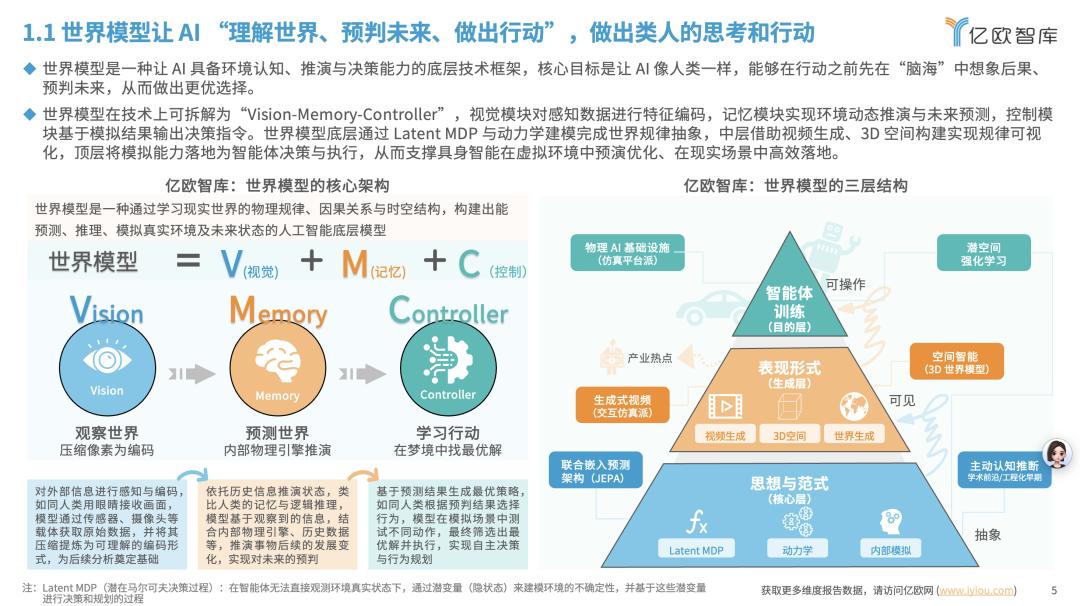
At the bottom layer, world models complete the abstraction of world laws through Latent MDP and dynamic modeling; at the middle layer, they realize the visualization of laws with the help of video generation and 3D space construction; at the top layer, they translate simulation capabilities into agent decision-making and execution, so as to support embodied intelligence to rehearse and optimize in virtual environments and land efficiently in real scenarios.
What world models fill is not just the product gap of "generating high-definition images", but the capability gap brought by AI's lack of physical deduction, virtual trial and error, and action planning capabilities. Its most important time value is that agents do not have to conduct all trial and error in the real world, but can complete massive deduction and trial-and-error planning in the internal virtual world, reducing the cost and risk of trial and error in the physical environment.
Multiple Technical Routes Develop in Parallel, with the Explicit Simulation School and Implicit Learning School Evolving Separately
At present, no unified optimal technical paradigm has been formed for world models, and six mainstream technical directions have emerged in the industry: JEPA architecture, AI-native physical simulation, 3D world models, video-generative world models, reinforcement learning-based world models, and world models oriented to counterfactual reasoning. They can be generally summarized into two major technical schools: explicit and implicit, and the choice of route directly determines the applicable scenarios.
The first category is the explicit physics school, whose representative projects include NVIDIA Cosmos, World Labs Marble, and Tencent Hunyuan 3D. This route prioritizes the accuracy of geometric and mechanical results, with simulation as the core. In the short term, it focuses on optimizing computing power efficiency, and in the medium and long term, it will move towards a "simulation + data" hybrid driving mode, which is more suitable for scenarios with high physical accuracy requirements such as intelligent driving and digital twins.
The other category is the implicit learning school, to which Meta V‑JEPA, Being‑H series and Dreamer series belong. Instead of hard-coding physical formulas, it learns the laws of physical operation from massive real-world data, making it more suitable for complex embodied tasks such as humanoid robots.
Different routes have their own advantages and disadvantages: the JEPA architecture does not pursue pixel-level image reconstruction, but focuses on learning world representation prediction; 3D world models build spatial geometric representation relying on NeRF and 3D Gaussian Splatting; Dreamer originates from model-based reinforcement learning and is natively oriented to robot control; the video generation route has outstanding image expressiveness, but still has shortcomings in object interaction and physical consistency.
No single route can be applied to all scenarios. The simulation-first solution has outstanding industrial value but high cost; the data-driven implicit route has strong generalization ability, but is prone to physical rule disorder. Industry participants need to select technologies according to their own scenarios, instead of simply chasing a certain type of hot technology.
Scenarios Are Booming, Domestic Technology Vendors Provide Engineering Solutions for Implementation Pain Points
The report summarizes the implementation scenarios of world models into four major directions: embodied humanoid robots, autonomous driving, metaverse digital world, and life science simulation. However, moving from prototype Demo to real business implementation, the industry still has to face a number of common engineering problems: the embodied intelligence field generally lacks a complete end-to-end technical base, and the cost of obtaining high-quality physical interaction data remains high; world model reasoning consumes a lot of computing power, making it difficult to migrate and deploy models to end-side hardware; the Sim2Real virtual-real transfer gap has existed for a long time, and it is difficult for simulation deduction results to be reproduced losslessly on real hardware; in the digital twin track, a large amount of historically accumulated 2D spatial data is difficult to be quickly converted into available 3D representation assets.
A number of domestic startups are outputting corresponding engineering solutions for the above pain points.
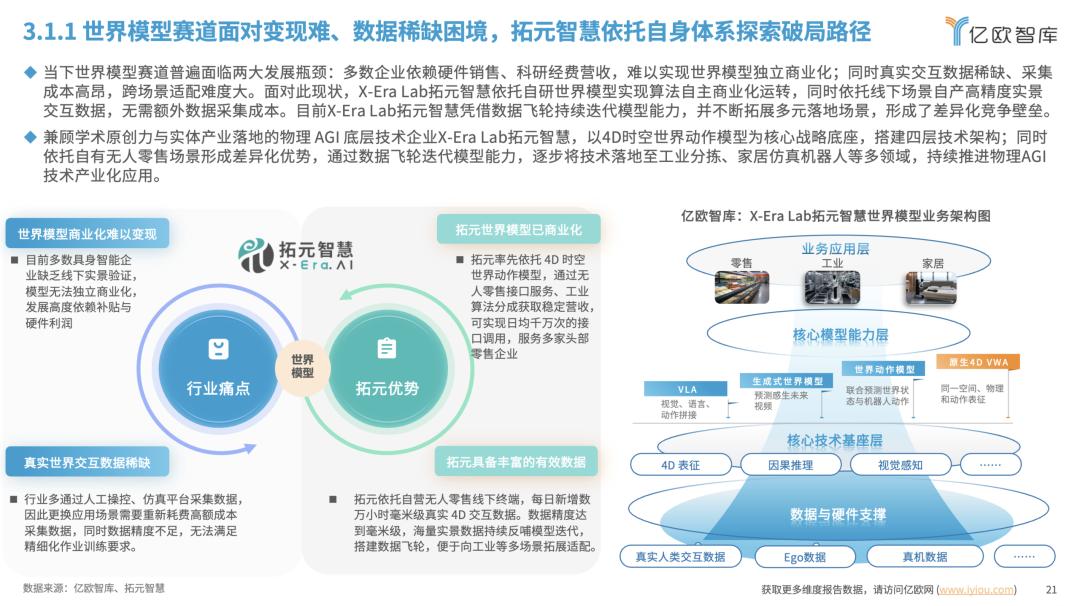
Aiming at the problems of missing embodied intelligence base and lack of interaction data, X-Era Lab has built a complete four-layer technology stack, self-developed 4D world action model, and built a data flywheel relying on its own business scenarios to alleviate the industry problem of insufficient high-quality interaction data supply.
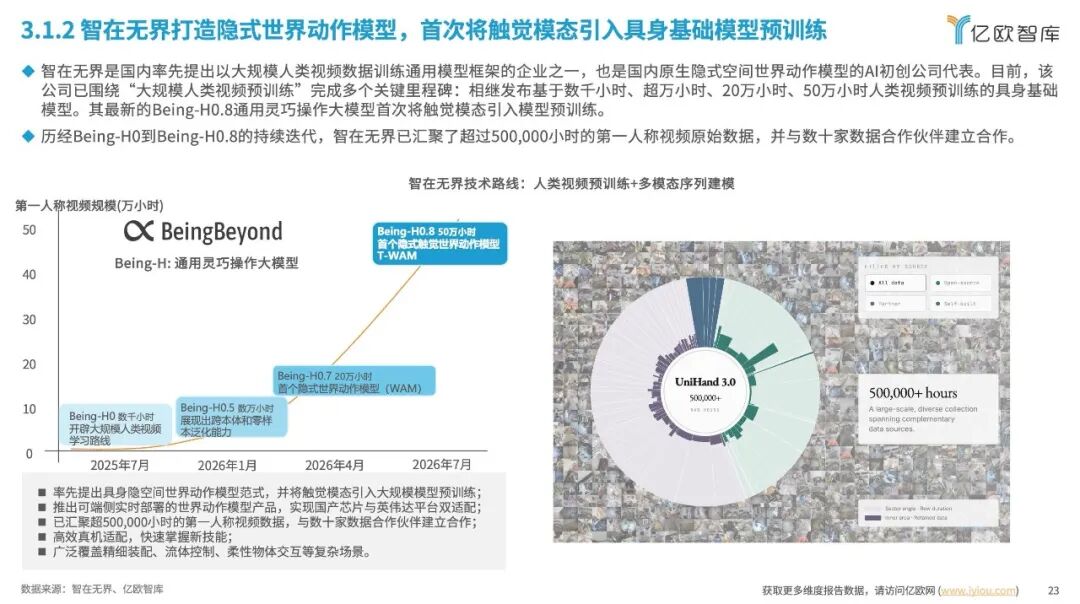
Facing the industry bottleneck of high deployment cost of world models on the end side, BeingBeyond completes pre-training of implicit world action models based on massive human videos, with cost far lower than that of explicit world models. The iterated Being-H-Flash version has completed special optimization for end-side reasoning, and is compatible with multiple domestic computing power hardware.
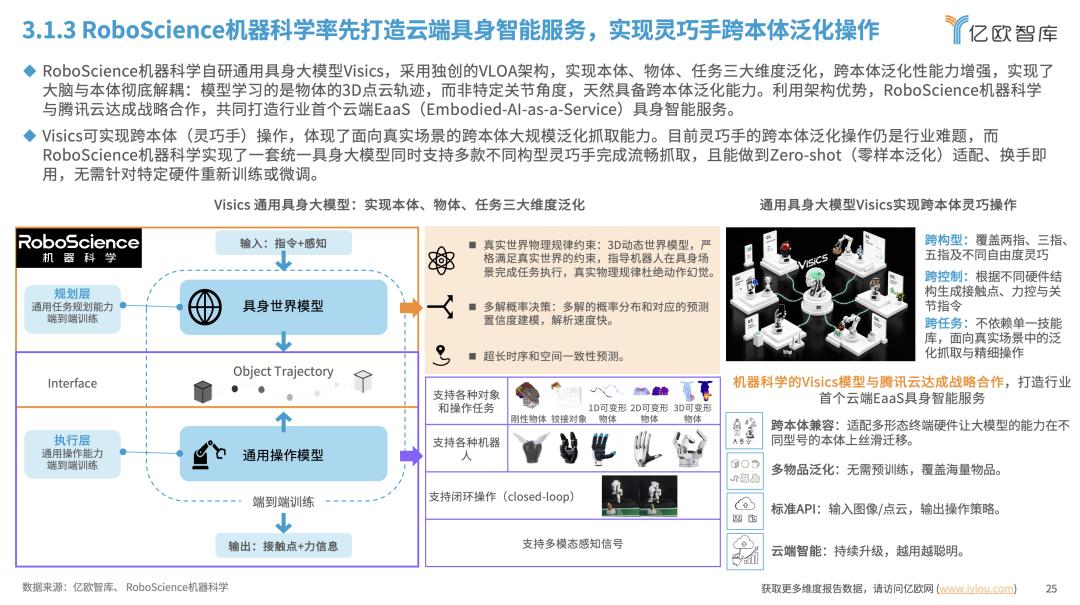
Focusing on the tricky Sim2Real virtual-real transfer problem in the industry, RoboScience has launched the full-stack self-developed RoboMirage physical simulation engine, implementing the EaaS (Embodied Intelligence as a Service) model to reduce the effect deviation between the simulation environment and the real physical world.
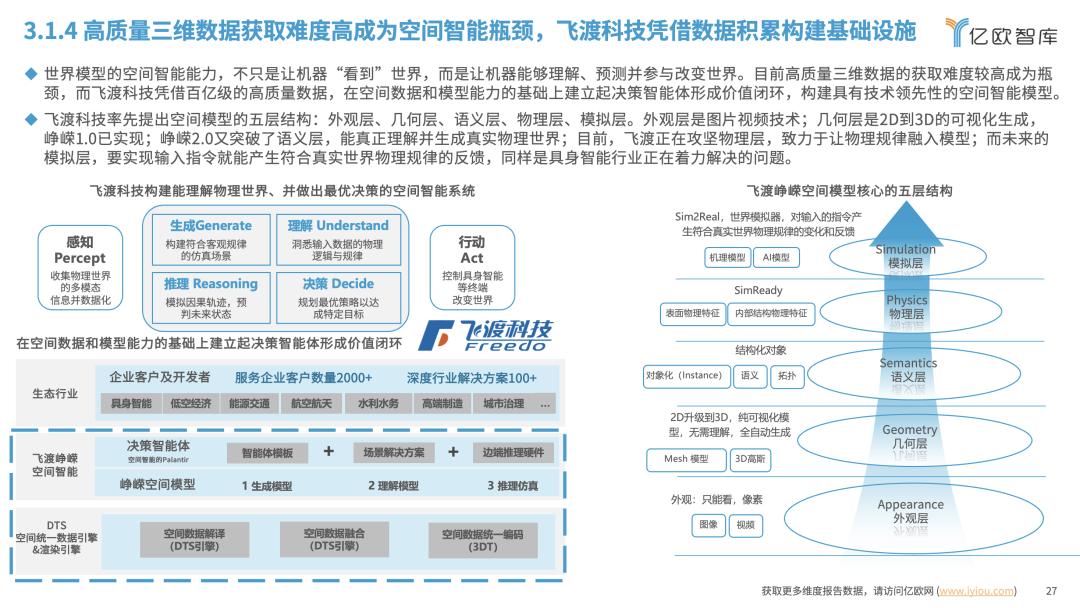
To meet the practical demand of transforming a large number of stock 2D data in urban and industrial digital twins, Fidu Technology relies on the Zhengrong large model and DTS spatial engine to realize automatic generation of structured 3D assets from original 2D data, serving embodied intelligence and high-end manufacturing scenarios.
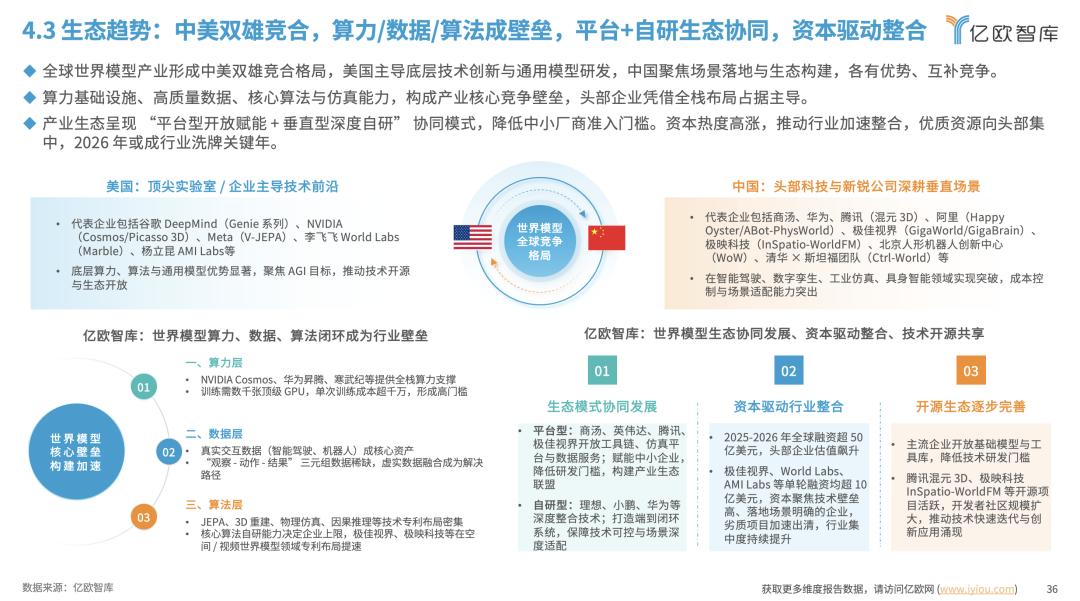
In the overseas camp, Meta V-JEPA, NVIDIA Cosmos, Google Genie, and World Labs Marble are benchmark projects representing different routes respectively.
EqualOcean Intelligence believes that not all businesses need a complete world model. High-value landing scenarios need to meet the following requirements: physical deduction is required, trial and error in virtual environment is allowed, and end-side real-time deduction can bring clear benefits. Therefore, humanoid robots are the current core main battlefield; intelligent driving uses world models to complete 4D environment prediction; the metaverse is used to generate evolvable NPCs and virtual scenarios; life science is used for simulation of human body and molecular behaviors.
Domestic Opportunities Go Far Beyond Replicating Overseas Achievements, Striving for the Right to Define World Model Products
Overseas enterprises started earlier in the field of basic research, but China has massive physical industry resources and robot implementation scenarios. The opportunities for local manufacturers are not limited to replicating overseas open source projects, and value opportunities are distributed in three layers: the base model layer, the simulation tool infrastructure layer, and the industry solution layer.
The advantage of the domestic supply chain lies in its proximity to the physical industry, with sufficient real scenarios for robots and industrial digital twins, as well as faster engineering iteration and localized response speed. However, it still faces obvious shortcomings: insufficient supply of high-quality physical interaction datasets, limited technical accumulation of underlying simulation engines, and high pressure on computing power costs for training and reasoning.
Three types of collaboration models are taking shape in the current industry: joint development by simulation engine vendors and large model enterprises; self-development of world action models by robot enterprises; and open source community-driven technology iteration. By comparison, overseas vendors focus more on outputting basic research and open source capabilities; domestic enterprises are more inclined to carry out engineering polishing for industry demands and quickly verify the implementation value.
For domestic participants, the truly critical point is not to catch up with the Demo effect of a certain overseas project, but to deeply participate in product definition, toolchain construction and industry standard formulation, so as to secure a stable position in the new industrial value chain of world models.
Impressive Demo Effect Does Not Equal Industrial Implementation, World Models Face Four Major Challenges
A large number of publicly demonstrated world prototypes have excellent performance, but they still face many obstacles before large-scale commercial implementation.
The first is the data threshold. High-quality physical interaction data is scarce, and ordinary video datasets cannot replace real physical data such as object interaction, collision, and force feedback;
The second is the Sim2Real gap. The behavior results deduced in the virtual simulation environment are difficult to migrate losslessly to real physical hardware, and the deviation between virtuality and reality has always been the biggest obstacle for embodied intelligence;
The third is the computing power cost threshold. 3D representation, large-scale world model training and reasoning consume huge resources, making it difficult to deploy on end-side devices, and the computing power cost will directly restrict the commercialization space;
The fourth is the commercial closed-loop threshold. Technical feasibility does not equal commercial viability. Enterprises need to clearly answer: what real customer pain points are solved, whether the cost-benefit ratio is reasonable, and how to divide the boundaries of safety and responsibility.
EqualOcean Intelligence believes that for world models, physical consistency has higher priority than picture clarity. Many industrial and robot scenarios do not require photorealistic rendering effects, but object interaction and causal laws must be accurate. Blindly pursuing high-definition visual effects will lead to a waste of computing power resources.
Short-term Prototype Optimization, Mid-term Industry Implementation, and Finally Becoming the Underlying AI Infrastructure
EqualOcean Intelligence gives a three-stage evolution judgment for the world model industry:
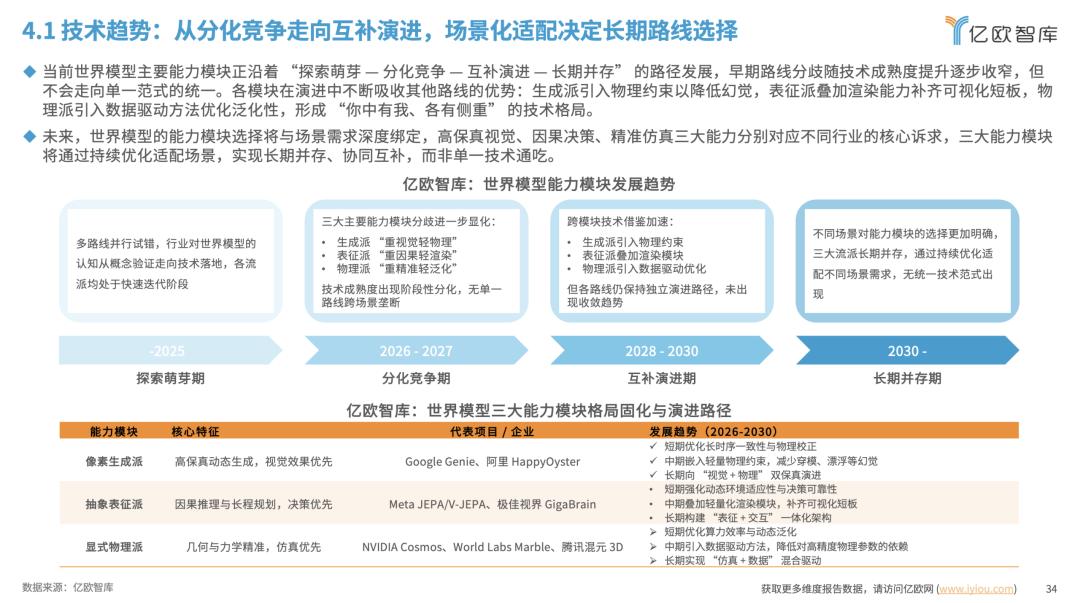
2026‑2027: The industry focuses on optimizing computing power efficiency and dynamic generalization capabilities. The explicit simulation route reduces dependence on high-precision physical parameters; the implicit learning route reinforces physical consistency; the overall focus is on prototype verification and technology polishing.
2028‑2030: Small-scale implementation in key industries, benchmark projects in the fields of humanoid robots and digital twins gradually emerge, and the open source tool ecosystem matures.
After 2030: The simulation-data hybrid driving mode matures, and world models will become the standard underlying capability of general AI.
Conclusion
World models are regarded by the industry as a key link to AGI, but there is still a long way to go for the industry to reach the real general "physical brain". EqualOcean Intelligence will continue to track the technology iteration and commercialization progress of the entire world model and embodied intelligence industry chain. For more industry information, please visit the official website of EqualOcean (www.iyiou.com)
This article is from the WeChat official account "EqualOcean Intelligence" (ID: EOintelligence2017), author: Li Haocheng, published with authorization from 36Kr.