OpenAI executives: Astra is seeing such overwhelming demand that the new Pro subscription may be forced to be suspended.
The release of GPT-6 Astra is triggering a crisis in computing power and capacity. Tibo, Head of Core Products at OpenAI, has publicly warned: The user demand for Astra has exceeded all historical experience, and the company may have to suspend new Pro subscriptions.
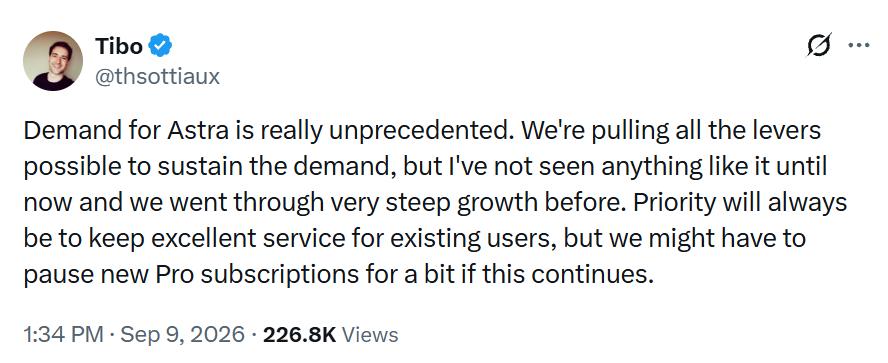
Tibo posted on X that "The demand for Astra is truly unprecedented. We are pulling every possible lever to maintain service, but I have never seen anything like this before — even though we have already experienced extremely steep growth in the past." He stated that the top priority is to ensure the service quality for existing users, but if demand continues, "we may have to temporarily suspend new Pro subscriptions". This is the first time an OpenAI executive has issued a public supply warning regarding the demand for a single model.
The market impact goes far beyond that. Morgan Stanley pointed out in its September 7 report that The significance of GPT-6 Astra lies in that it has shifted the bottleneck narrative of AI from "how much infrastructure is needed to meet known demand" to "as model intelligence improves, how many new workloads will become economically feasible" — the former is demand-side skepticism, while the latter is supply-side pressure. This has a direct impact on the pricing logic of the computing power, power and semiconductor industry chains.
01
Who Tibo is: From "Quota God" to the head of core products at OpenAI
Tibo's full name is Thibault Sottiaux, who joined OpenAI from Google DeepMind in 2024. During his six years at DeepMind, he participated in building the infrastructure supporting projects including AlphaGo and AlphaStar, and briefly led the human data team for Gemini before leaving.
After joining OpenAI, he quickly shifted from internal tool development to user-facing products. He led an initial team of only 30 to 40 people to build Codex, and publicly released it in May 2025. The number of active Codex users then grew at a rate of millions per day, reaching 8 million by July this year, far earlier than the previously predicted September milestone.
After OpenAI's major internal restructuring in May 2026, Tibo's responsibilities were further expanded — the three product lines of ChatGPT, Codex and Developer API were all merged, and he was fully responsible for their execution, with Greg Brockman in charge of the overall product strategy. This means he is in charge of a super application entry facing nearly 1 billion users.
Tibo is well known on X for frequently resetting Codex quotas for users, and is playfully called "Cyber Godfather" and "the God in charge of the Token faucet" by the developer community. There is even an unofficial website called TiboGPT that specifically tracks his reset activities. This highly transparent public interaction has become an integral part of the Codex product experience.
02
Astra's Capability Leap: From Answer Engine to AI Agent
The release of GPT-6 Astra marks a substantial expansion of capability boundaries. OpenAI clearly defines its capabilities as: operating computers, browsing web pages, using software, writing and running code, completing complex workflows, and executing long-horizon tasks in scientific, cybersecurity and professional fields.
In the OSWorld 2.0 test — which was proposed by teams including CMU and Stanford to evaluate the ability of AI Agents to complete complex tasks in digital environments and compare it with the human expert baseline — Astra scored 72.6%, higher than the 65.7% of GPT-5.6 Sol; the simulated time to complete tasks was reduced from about 75 minutes to about 40 minutes.
The core significance of this change is that: AI is moving from "answering better" to "successfully getting things done". AI's working mode has thus evolved from "Human → AI → Answer" to "Human → AI Agent → Task → Execution → Result". Tibo himself revealed in a public sharing that he assigns more than 100 complex tasks to Codex every day, including organizing resources, checking on-duty rotation, analyzing release plans, and using Codex to generate personalized daily work briefings.
03
Multiplier Effect of Token Demand: Work Capability Improvement is Proportional to Consumption
Astra's capability leap will fundamentally change the measurement logic of AI demand. In the era of Answer Engine, AI demand can be approximately measured by "number of users × ARPU"; but in the era of AI Agent, this formula is no longer valid.
The total Token demand can be roughly expressed as: Number of Agents × Number of Tasks per Agent × Token Consumption per Task. All three variables are under pressure of simultaneous expansion after the release of Astra.
The first is the increase in the number of Agents. One person may run multiple Agents at the same time for personal assistant, programming, research, finance and other scenarios, while on the enterprise side, the number of Agents may expand from dozens to thousands. The second is the rising complexity of tasks undertaken by a single Agent — the more capable the model is of completing complex tasks, the more users tend to assign heavier and longer work to Agents for execution. The third is that Agents change from "occasional invocation" to "continuous operation": the more complex the task, the longer the reasoning chain, the larger the context, the more tool invocations, and the greater the Token consumption.
This means it is entirely possible that the number of Agents increases by 20%, but the total Token demand increases by 300%. Tibo's warning about Astra's demand is highly consistent with this logic: capability improvement directly drives consumption amplification, and the two are positively correlated.
This article is from the WeChat official account "Hard AI", author: Hard AI focusing on technology research and production, editor: Hard AI, published with authorization from 36Kr.