After announcing "no AI", its downloads exceeded 1 million in just one week, and LibreOffice has become a hit: "Yes, having no AI has now become a feature."
While almost all office software is scrambling to stuff AI into their products, LibreOffice has taken the opposite approach: Not only do we have no AI, but we also make the "no AI" feature a core selling point of our product.
Interestingly, this decision that seemingly "lacks a feature" has instead attracted a huge number of users: LibreOffice 26.8, released at the end of August, recorded 1.031 million downloads in just one week — The Document Foundation (TDF) confirmed in its official blog that this is the highest first-week download volume in LibreOffice's history.

01
LibreOffice sets new download record, "no AI" becomes a highlight
For a brief introduction, LibreOffice is a free and open-source office suite, regarded by many users as an alternative to Microsoft Office/365. After nearly 20 years of development, it has been widely used in schools, hospitals, government agencies, law firms and various organizations.
On August 26, LibreOffice released its latest major version, 26.8.
This update does bring a number of tangible improvements: it focuses on enhancing professional typesetting and support for complex writing systems, for example, introducing the Paragraph Composer that can comprehensively balance the spacing of the entire paragraph, strengthening support for right-to-left languages and complex scripts such as Chinese, Japanese and Korean, while adding native support for OpenType variable fonts, calculated fields in Calc pivot tables, compatibility improvements for Microsoft Office chart types, and the feature that Impress/Draw supports multiple page sizes in a single document.
However, among all the new features, one "reverse update" is particularly eye-catching: LibreOffice 26.8 does not have generative AI.
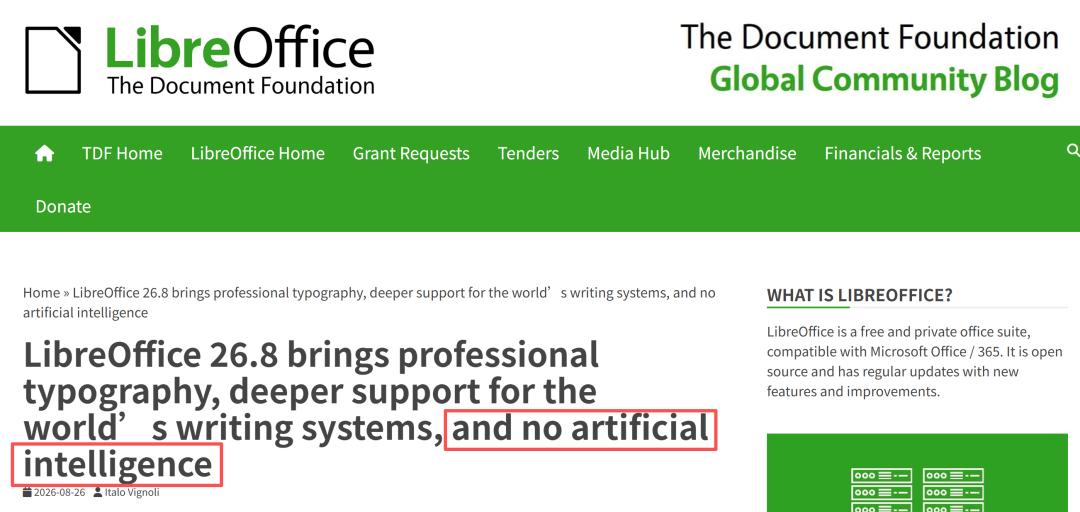
This is not because the LibreOffice development team "forgot to add it", but a deliberate choice — TDF clearly states that LibreOffice 26.8 does not contain any generative AI features, documents will not be sent to remote services for AI processing, and all data remains on the user's own device; in addition, no component in LibreOffice requires internet access to work.
This "anti-trend" statement quickly aroused widespread attention after its release. Some people joked: "I almost missed the word 'no' when I skimmed through it for the first time, and now I'm not used to seeing a product that 'has no AI'."
What's the result? Just one week after its release, the official download volume of LibreOffice 26.8 reached 1,031,162 times, breaking the first-week download record of all LibreOffice versions in history. What's more, this number is not the full picture: TDF counts the downloads from the official website, but in fact a large number of Linux users get updates directly through the distribution's software package repository, so the actual coverage is even higher.
Of course, we cannot simply attribute all these more than 1 million downloads to "no AI". The improvements in the features, performance and compatibility of the new LibreOffice version are also equally important. But one thing is certain: in today's era of rapid AI development, "no AI" has for the first time clearly become a product feature of a software.
02
TDF: We are not against AI, but we have a set of "entry thresholds"
After the release of LibreOffice 26.8, a user directly raised a question: "So, now 'no AI' is considered a feature?" In response to this, TDF published an article titled "Yes, no AI is now a feature" on September 3.
The article clarifies a key point at the beginning: TDF "does not completely reject AI". However, they believe that for an office software used by tens of millions of people every day, if AI is to be added to it by default, a series of basic principles must be met:
First, AI must be controlled by users. Users must be able to choose where the inference runs — on their local computer, on infrastructure under their own control, or on a service of their independent choice. Default silent redirection to a single provider is not a real choice.
Second, document content must not leave the user's computer without authorization. Document content is user property, and in many scenarios it is also sensitive material protected by law — medical records, case files, bidding documents, student data. Transmission must be based on the user's explicit decision, rather than an automatic behavior that happens in the software's background.
Third, no telemetry of any kind is allowed. LibreOffice does not collect any usage data, and AI features must also comply with this principle.
Fourth, there must be no binding to a single AI vendor. If an AI feature can only call the API of one company, in TDF's view, it is essentially a kind of vendor lock-in. Ideally, the AI interface should be open enough to be implemented by multiple backends.
Fifth, file formats must not be compromised. Content generated by AI should also follow the Open Document Format (ODF), and retain structure, styles and semantics. AI features must not further lock users into a certain proprietary format.
Sixth, AI must be completely optional. Not only ordinary users can choose not to use it, but enterprise administrators should also be able to completely disable or even remove relevant features when deploying LibreOffice on hundreds or thousands of computers.
The problem is that according to this set of standards, TDF has not yet found an AI solution that can meet all the requirements, be integrated by default and maintained for a long time.
However, this does not mean that LibreOffice users cannot use AI at all. The solution given by TDF is: users can access AI through third-party extensions by themselves. There are already community plugins that can integrate AI into LibreOffice, many of which can connect to locally running models, such as Ollama, LM Studio, or other local endpoints compatible with OpenAI API. The biggest advantage of this approach is that documents can always stay on the local computer.
But TDF also specially reminds that these extensions are not official components, but are maintained by their respective developers, and their maturity levels vary, so users and administrators need to assess the risks on their own.
In short, LibreOffice's idea is not that "AI cannot be used", but that: If you want to use it, you can decide by yourself; if you don't want to use it, the software should not make the decision for you.
03
Other vendors are frantically adding AI to their products, why is LibreOffice in no hurry?
In the past few years, the main theme of the software industry has almost been "adding AI to products": browsers add AI, search engines add AI, IDEs add AI, office software adds AI, and even some software that originally had nothing to do with AI has begun to launch AI assistants.
But a paragraph in TDF's article is quite sharp: the difference in their positions from mainstream office suite vendors "has almost nothing to do with the technology itself". TDF states frankly that for commercial office software that charges by subscription, AI assistants can not only improve product capabilities, but also serve as a reason to raise prices and keep users in their own cloud infrastructure.
But TDF behind LibreOffice is a non-profit organization with no subscription packages, no so-called "AI Pro" version, and no business model of monetizing user data. LibreOffice itself has no ads, no telemetry, does not require users to register accounts, and does not lock some core features behind paywalls. Its development mainly relies on donations and support from enterprises in the LibreOffice ecosystem.
Therefore, TDF does not have such strong commercial motivation to prove that "we must have AI", and instead can take its time: "This does not mean that we are wiser than others, but means we can spend more time judging whether something is really useful to users — because we are not under performance pressure."
However, this does not mean that the AI wave will recede, nor does it mean that all software should reject AI. TDF itself admits that local inference is becoming easier and easier, and the development speed of open source models has exceeded many people's expectations. If a solution that can meet the requirements of privacy, openness, user control and optionality appears in the future, TDF will still evaluate it carefully.
But at least for now, LibreOffice chooses to give the initiative back to users.
Reference links:
https://manualdousuario.net/en/libreoffice-download-record-no-ai/
This article is from the WeChat official account "CSDN", author: Zheng Liyuan, republished with authorization from 36Kr.