GPT cracks the Millennium Prize Problems within 88 hours, what will mathematicians do in the future?
What does it mean to clear a Millennium Prize Problem in 88 hours?
Earlier this morning, OpenAI dropped another major update. They claimed that a new internal model more powerful than Astra solved the famous existence and smoothness problem of the Navier–Stokes equations in only 88 hours.
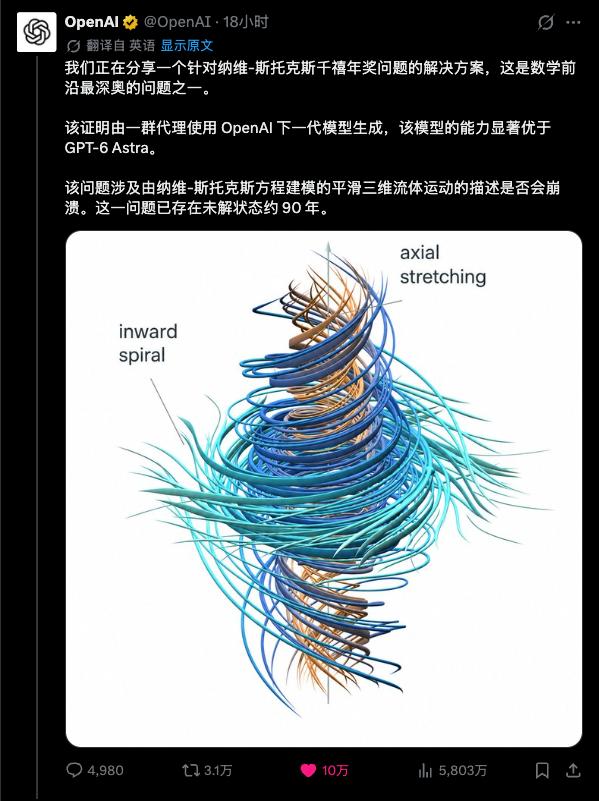
It doesn't matter if you don't understand it. All you need to know is that this problem, together with the Riemann Hypothesis, is one of the seven Millennium Prize Problems, and anyone who solves one of them will be awarded 1 million US dollars.
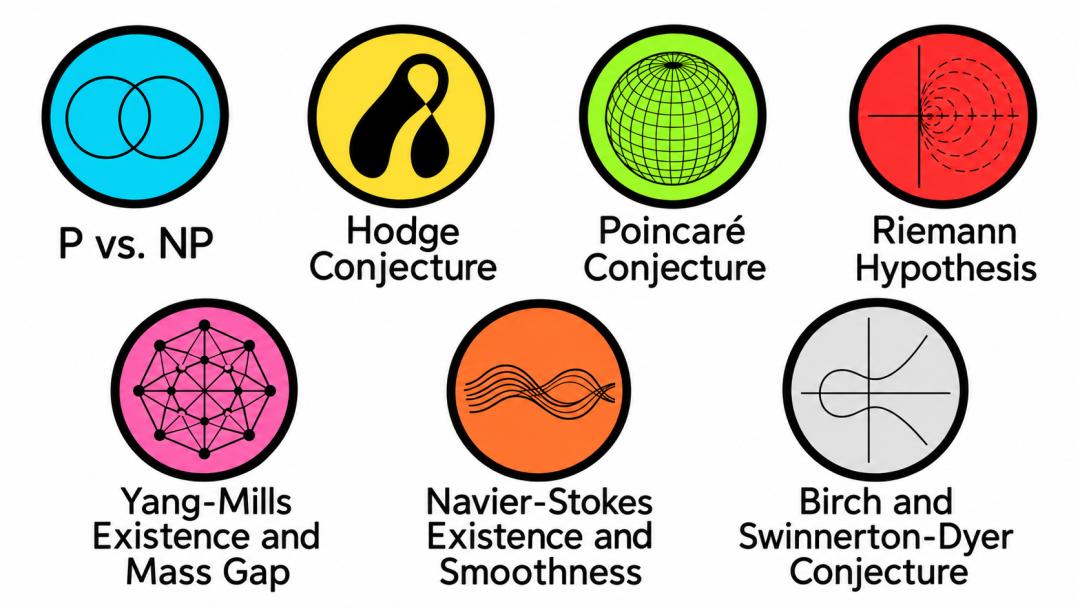
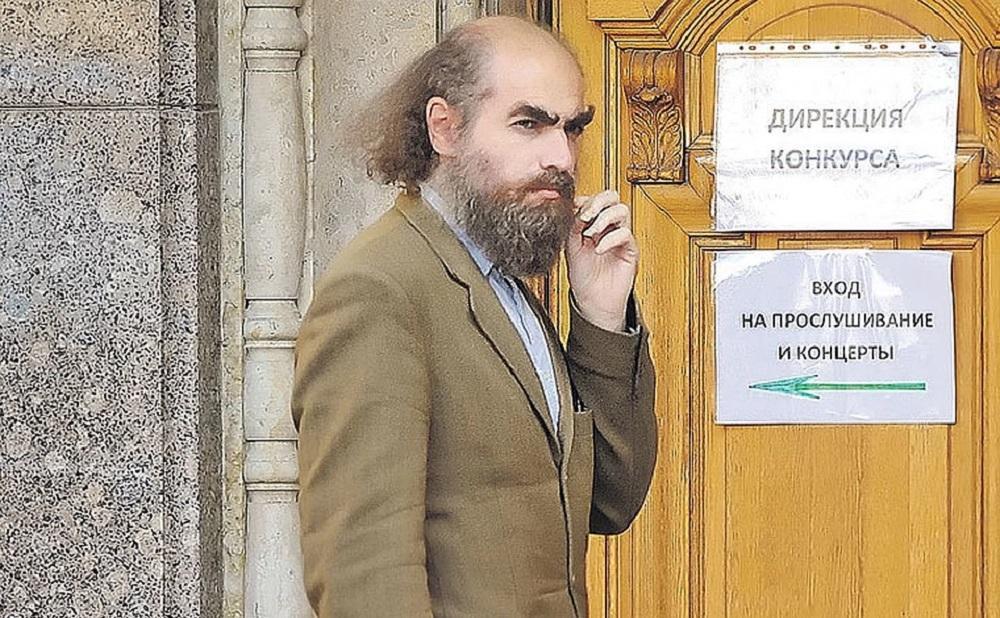
The only problem that has been solved so far is the Poincaré Conjecture, whose solver is the unorthodox Russian mathematician Perelman shown below, who later won the Fields Medal (though he did not attend the award ceremony).
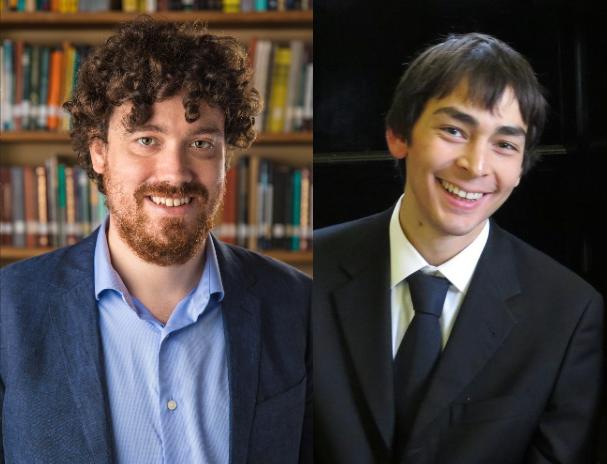
This would have been another shocking breakthrough that left people stunned, but two mathematicians, Buckmaster and Alpöge, stepped forward.
They suspect that OpenAI may have been influenced by their unreleased research direction in advance, and then invested massive computing resources to take the lead in completing the solution...
According to the leaked evidence, the two sides had a series of entanglements before the official release, which made this proof look far less straightforward than it seems.
Of course, we can still explain this in simple terms.
The Navier–Stokes equations (NS equations) are a set of rules used to describe how fluids move.
It is said that Heisenberg once complained: "When I meet God, I must ask him two questions: what is relativity, and what is turbulence? I believe he only has the answer to the first question." One of the core rules behind turbulent motion is exactly the NS equations.
When you stir a glass of water, where the flow is faster, where the pressure is higher, and how viscosity gradually dampens the motion can all be described by this set of equations. Air is also a fluid, so it is involved in scenarios such as aircraft flight and weather forecasting.

However, the problem that has plagued mathematicians for a century is: in the three-dimensional world, will a mass of originally smooth and normal fluid evolve according to this set of equations and suddenly produce infinitely drastic local changes in a finite period of time.
No one has proved that it will definitely not happen, and no one has proved that it will really happen. This is the so-called "existence and smoothness problem".
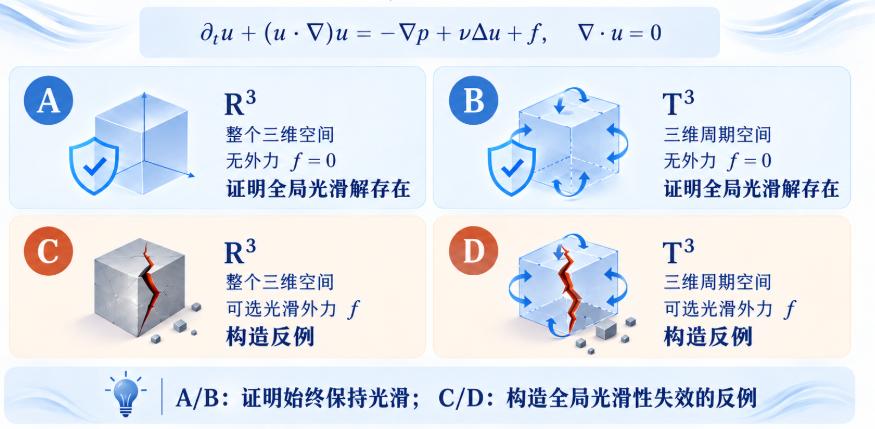
Therefore, the Clay Mathematics Institute, which launched the seven Millennium Prize Problems, gave four ways to solve it: either prove that it will never happen, namely solutions A and B; or construct a counterexample that will really lead to the blowup, namely solutions C and D.
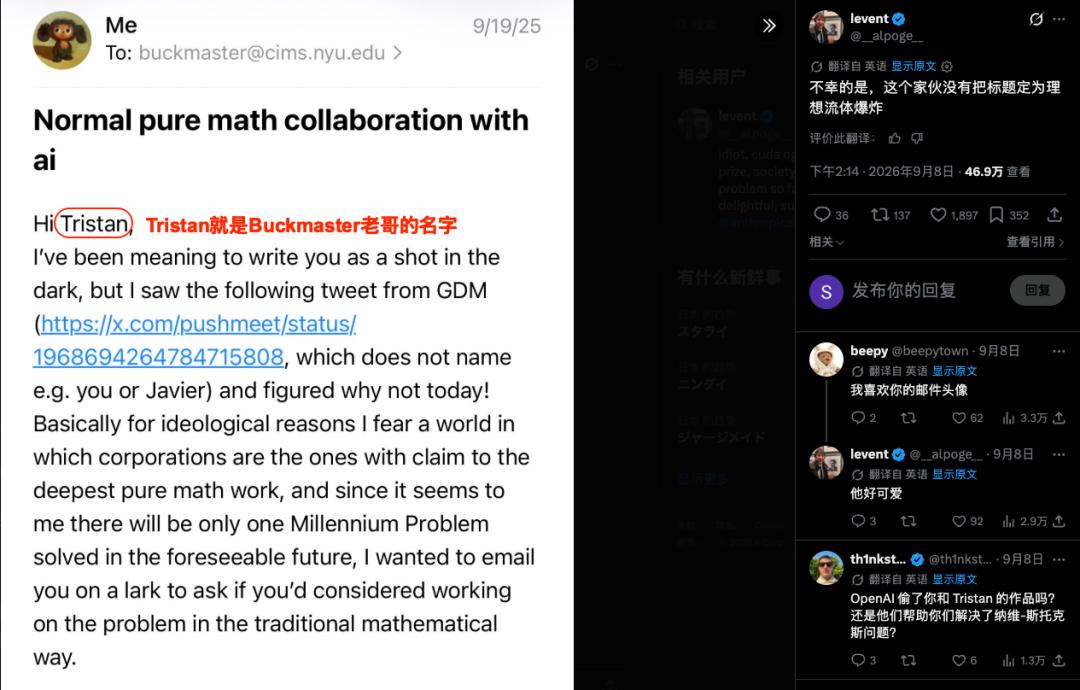
In September 2025, mathematician Alpöge, who was the one who came up with the counterexample to the Jacobian conjecture some time ago, took the initiative to email another mathematician Buckmaster, saying that he did not want to see the most important pure mathematics achievements in the future become the trophies of large companies, and asked if he wanted to work together on a major project.
The two hit it off immediately. They used Anthropic's Claude on one hand and OpenAI's Codex on the other, and slowly worked on the little-explored path of solutions C and D for the NS equations.
On August 15 this year, a breakthrough was made on the problem, and they obtained the forced blowup solutions for the Boussinesq equations and the 3D Euler equations.
In plain language, this means they passed the pre-level of the big boss NS equations, because roughly speaking, the NS equations = Euler equations + viscous dissipation term.
But they did not publish the results immediately, because they thought the proof output by AI was too ugly, and Buckmaster even bluntly said that the proof had too obvious AI traces. So they spent several more weeks organizing the massive content generated by AI into something understandable by humans.

Right at this moment, the news leaked out, and the situation began to change.
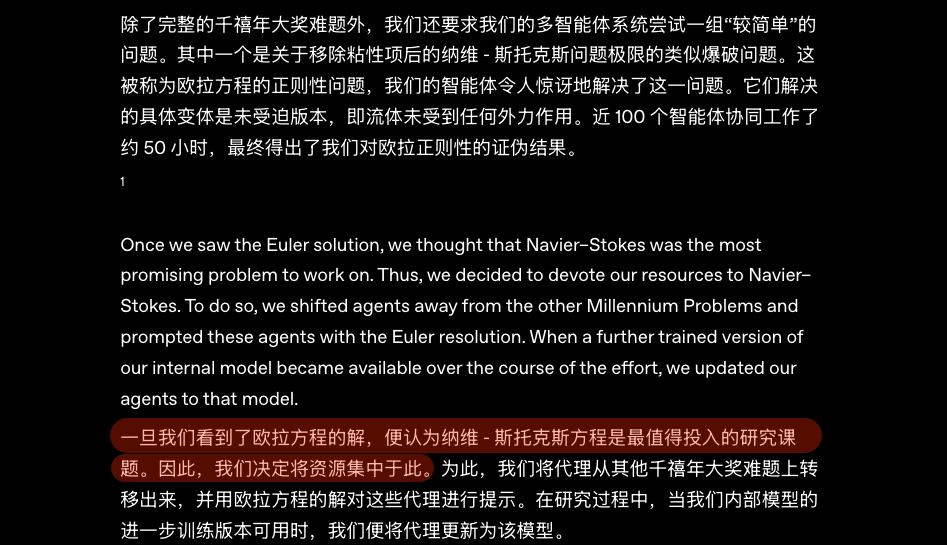
According to OpenAI's statement, on September 1, they heard the explosive rumor that Anthropic had solved two Millennium Prize Problems, so they took out their internal model more powerful than Astra and launched a full-scale attack on the remaining 6 problems, including the NS equations.
Then after about 50 hours, they also passed the pre-level of the 3D Euler equations, and obtained a more complete solution without external force. So they made up their minds to concentrate all resources to tackle the NS equations.
This rumor is not groundless, because Alpöge happens to work at Anthropic. Although this cooperation is carried out in a personal capacity and may have nothing to do with the company, public opinion can distort the facts.
Therefore, after Buckmaster learned about OpenAI's actions, he took the initiative to send an email to OpenAI on September 3, explaining that this was not an Anthropic project, and that Alpöge was cooperating with him in a personal capacity, hoping that OpenAI would not misunderstand. They had made some progress, but there was still a gap before solving the NS equations. The general idea was that they did not want their efforts to overlap and cause collisions.
In Buckmaster's statement, he also said that OpenAI's reply at that time was very friendly, saying that they could provide computing power support to avoid competition. The next day, OpenAI called again, but Buckmaster said they would talk about it the next week.
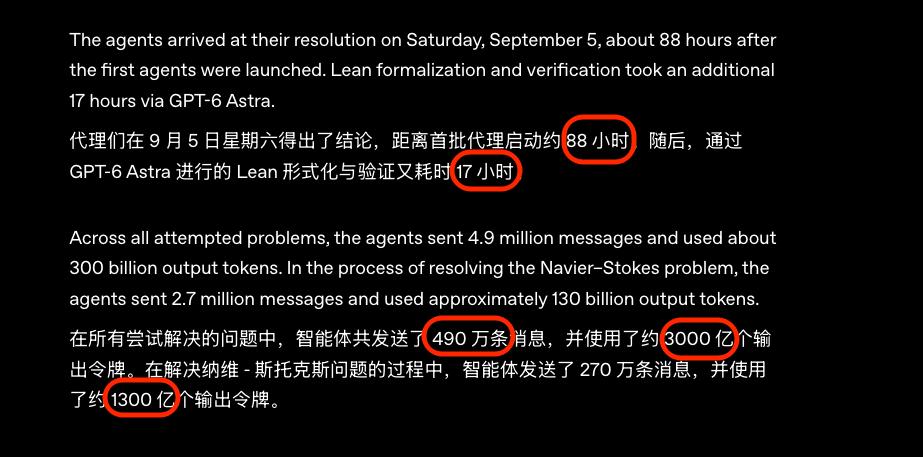
However, during this period, the new model did not stop working. Ten thousand agents worked frantically, and 88 hours later, they actually obtained solutions C and D for the NS equations problem, and even let GPT6 Astra run for 17 hours to verify the results.
It is estimated that when Buckmaster received the phone notification on the 6th, he was also completely confused.
Think about it, this path was almost untouched before. How come after we worked hard for a whole year, you suddenly got involved and took the fruit away?
He could only ask OpenAI how they completed the proof and whether they accessed the drafts the two of them put into Codex.
The reply he got was that the model would not access user data, but it was unclear whether these materials were used to train the new model.
Because the two obtained the blowup solution of the 3D Euler equations on August 15, and the new model did not start training until August 28. By the time they cracked the NS equations on the 5th, it was less than ten days. If we count from the start of problem solving on the 1st, it only took 4 days...
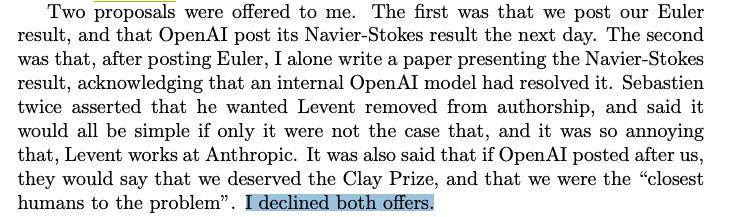
Later Buckmaster said OpenAI gave him two choices: one was that the two of them publish the results of the Euler equations first, and then OpenAI announces the solution to the NS equations the next day; the other was that after the two published the Euler equations results, Buckmaster alone wrote the proof process of OpenAI, without allowing Alpöge to be listed as a co-author.
It is obvious that OpenAI did not trust Alpöge, who works at Anthropic. Buckmaster did not want to do this, so the negotiation fell through.
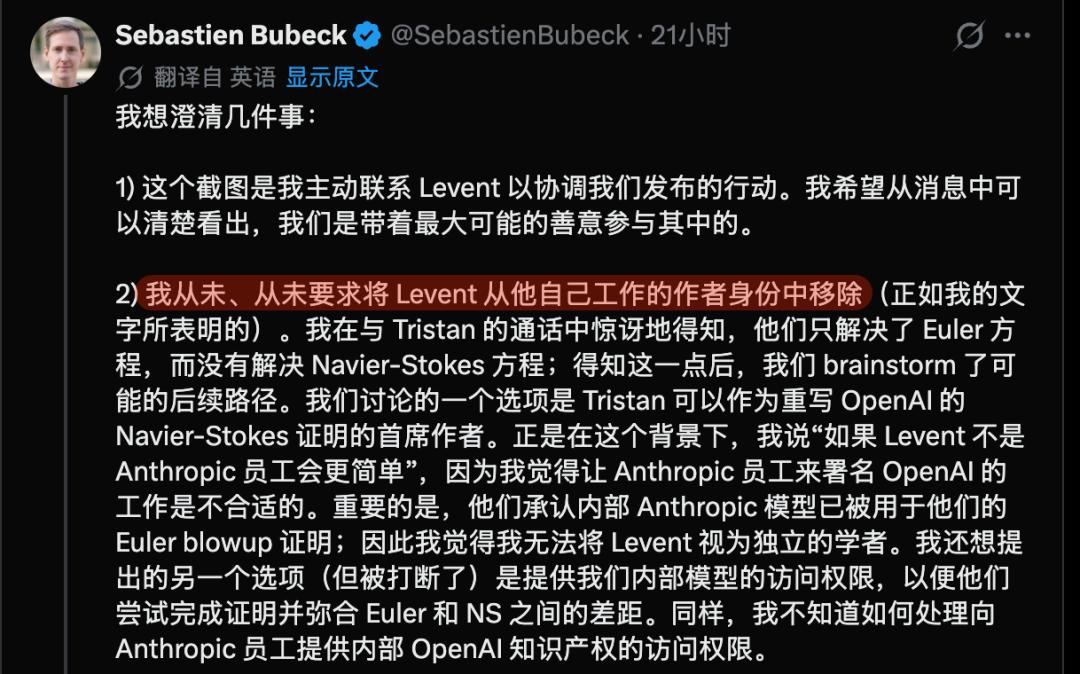
However, this incident was denied by OpenAI researcher Bubeck yesterday, who said they did not insist on excluding Alpöge, and the two sides are still holding different statements for now...
Then on the 7th, Buckmaster had a half-hour phone call with Terence Tao. After seeing the results of the two, Terence Tao was also very excited, saying that it looked "very feasible" to solve the NS equations based on their progress.
It is indeed feasible, even more than feasible.
The next day, on the 8th, as the two of them publicly released their results in advance and issued a statement, OpenAI also officially announced the blowup solution of the NS equations.
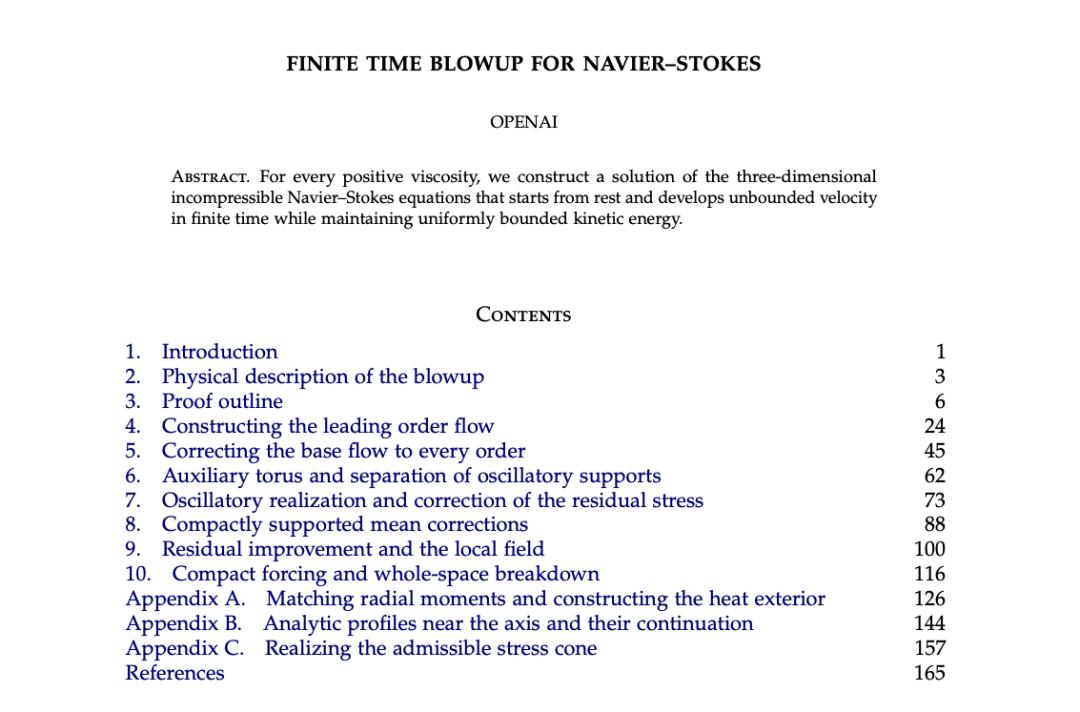
Of course, this matter has not been settled yet. No one can tell whether OpenAI has stolen the results, or what exactly counts as "stealing".
When AI mathematics just made achievements before, we interviewed many insiders, and their judgments at that time seem particularly interesting when viewed today.
For example, Professor Huang from the Department of Mathematics of Fuzhou University believes that AI is best at doing relatively "standardized" work, splicing some existing tools in ways that people did not think of before. This is valuable, but it can hardly be called "creation".
In the future, a large number of "researcher laborer" type of work may be eliminated, and the truly scarce things for mathematicians will become aesthetic judgment, topic selection and research direction.
Now it seems that this is indeed the case.
Tens of thousands of OpenAI agents worked together, burning 130 billion tokens in 88 hours.
The derivation and trial and error that human mathematicians can only advance through a whole year of hard work can only be lamented as unreachable in front of such a huge gap in resources.
This controversy also just confirms the second half of the judgment. The most subtle part of this controversy may not be whether OpenAI "copied the answers".
OpenAI said they did not access the research data of the two mathematicians, but they also admitted that they launched this round of intensive work after hearing the rumor that "someone might have solved a Millennium Prize Problem".
In other words, AI does not need to know the method, as long as it knows which path is likely to work, that is enough.
