Just now, Apple Watch has become Apple's latest AI hardware.
Once upon a time, Apple Watch and AirPods were defined by Apple as "accessory" products.
But this year, the critical year for Apple's AI transformation, these products are playing a more important role than ever before. That's right, it's not just the iPhone, even the former accessories have to evolve themselves to become "AI hardware".
At the just-concluded autumn new product launch, Apple brought Apple Watch S12 and Ultra 4, as well as the brand new AirPods 5.
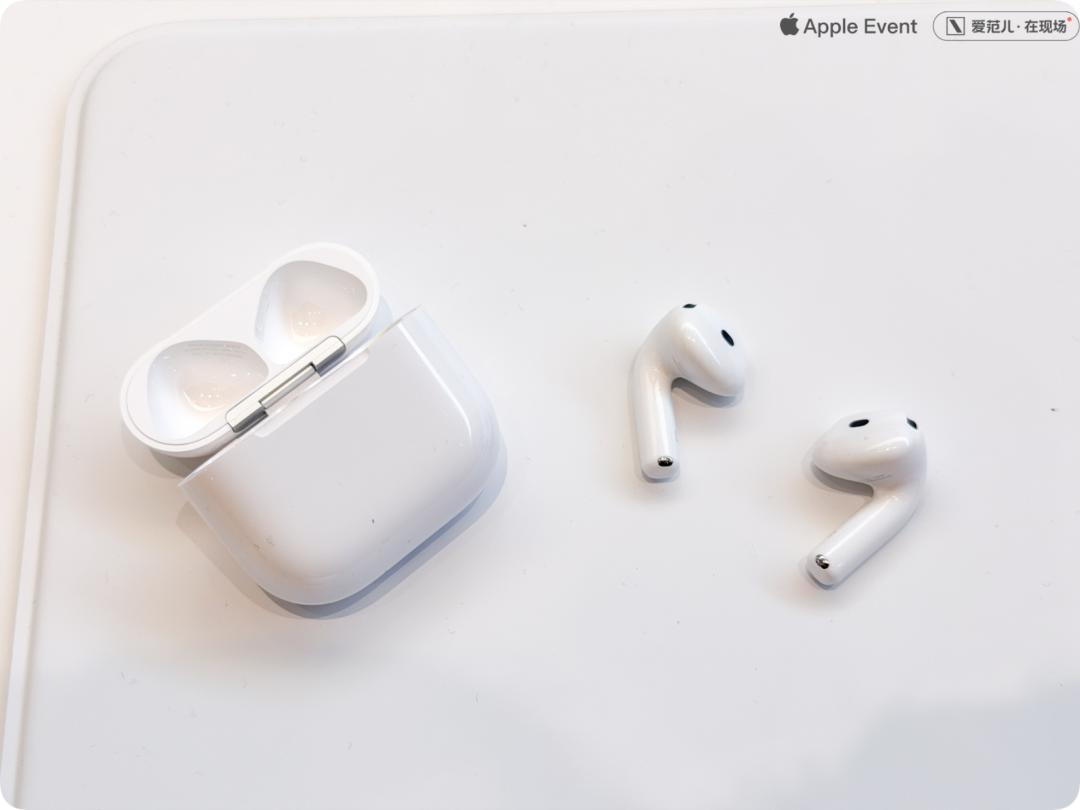
On this generation of Apple Watch, Apple defines the watch as a more intimate "personal smart hub" for users — even more intimate than the mobile phone. At the same time, Apple Watch has also become the device base for "Audio Intelligence", working with iPhone to form Apple's full-dimensional smart closed loop from audio to vision.
Watch: The vanguard of Apple's AI hardware
Let's first look at the new product of the Apple Watch digital series: Apple Watch Series 12.
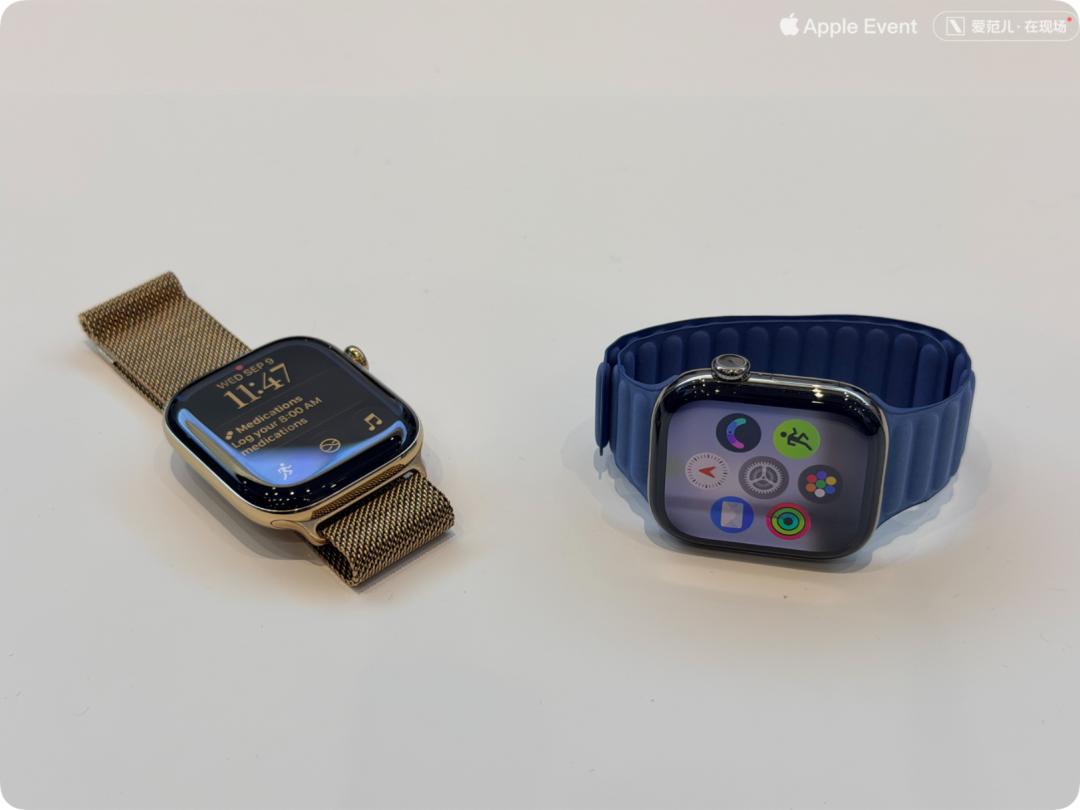
Series 12 still comes in two sizes: 42 mm and 46 mm. The aluminum metal case is available in Deep Bronze, Black, Light Gold and Space Gray; the titanium metal version comes in Shiny Gold and Natural Titanium finish.
The most surprising part is that the watch also has its own "One more thing" moment this time: Apple has brought back the ceramic case, which comes in two color options of Pearl White and Night Blue, with a starting price of 7499 yuan. The familiar "white ceramic watch" is finally back, making long-time fans extremely delighted!
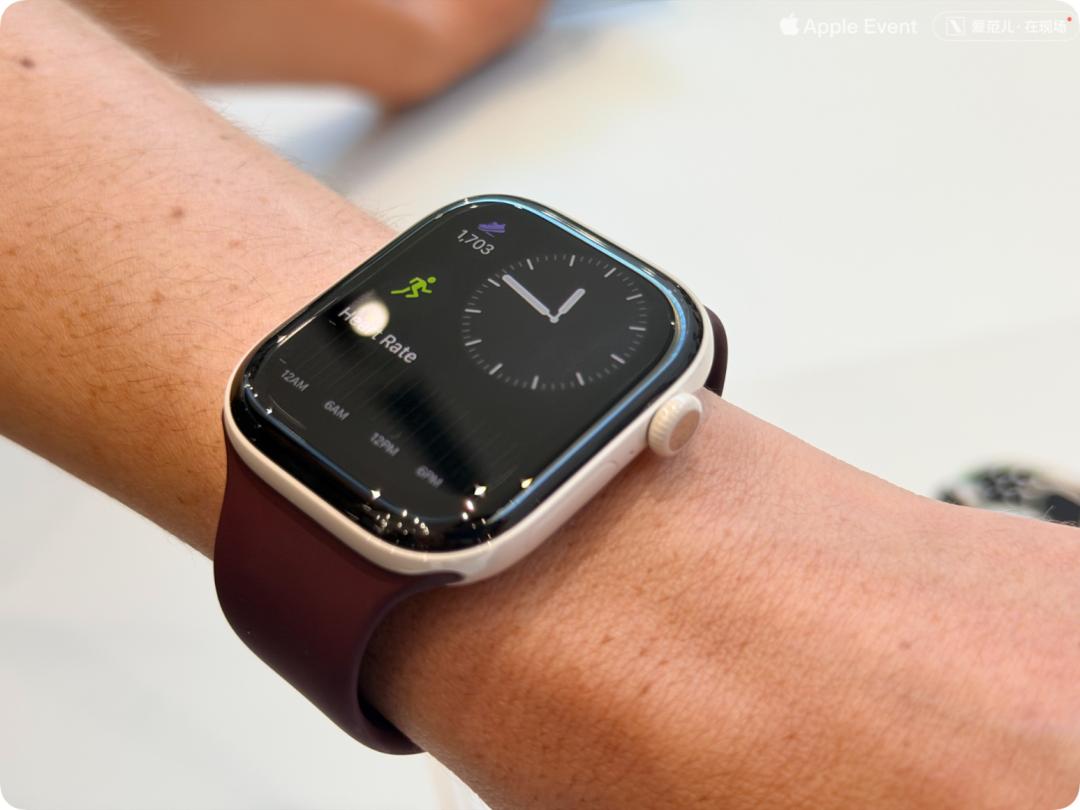
The screen is equipped with LTPO3 wide-view OLED All-Day Retina display, with a peak brightness of up to 2000 nits. The aluminum models are upgraded to the Sapphire Crystal Glass 2. According to Apple's test data, its damage resistance is 60% higher than the Ion-X glass of the Series 11.
The appearance largely follows the design of the previous generation, but the internal hardware has been greatly updated.
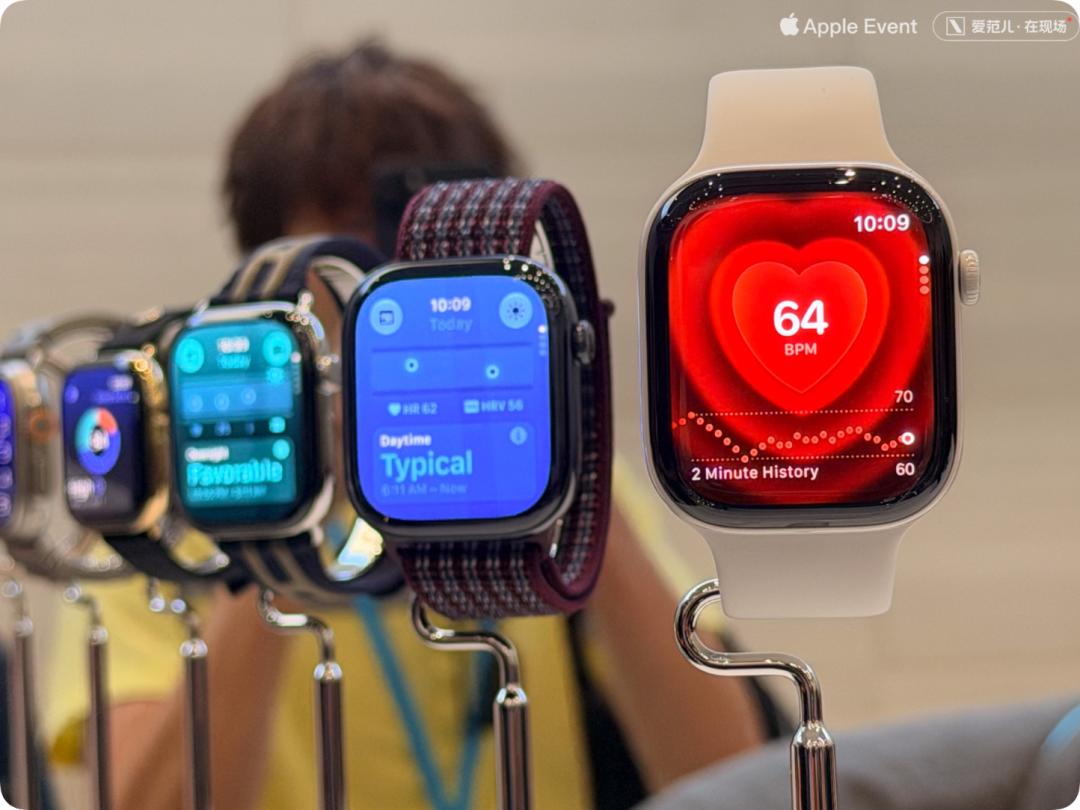
The Series 12 is equipped with the S11 chip, and the health sensing system is also reconstructed, with brand new optical and electrical heart rate sensors. The new generation of optical sensor is equipped with a larger area, more energy-efficient green LED, which supports heart rate collection every 5 seconds to achieve all-day continuous monitoring; the measurement frequency of Heart Rate Variability (HRV) is increased by up to 24 times, and two types of indicators are split out: the recovery HRV for assessing physical stress and recovery status, and the overall HRV that reflects the long-term health baseline.
From the traditional function of smart watches — sports and health management, the new generation of Apple Watch's most promoted new feature is called "Readiness".
In the past, when we only looked at the training volume, it was difficult to judge whether the body was suitable for continuing to exercise at the moment. "Readiness" will integrate recent activity volume, training load, various vital signs and sleep scores to generate an evaluation result of 0-10 points, and give four types of physical state references: "Take moderate rest", "Act within your limits", "Fully recharged and ready", "Go all out".
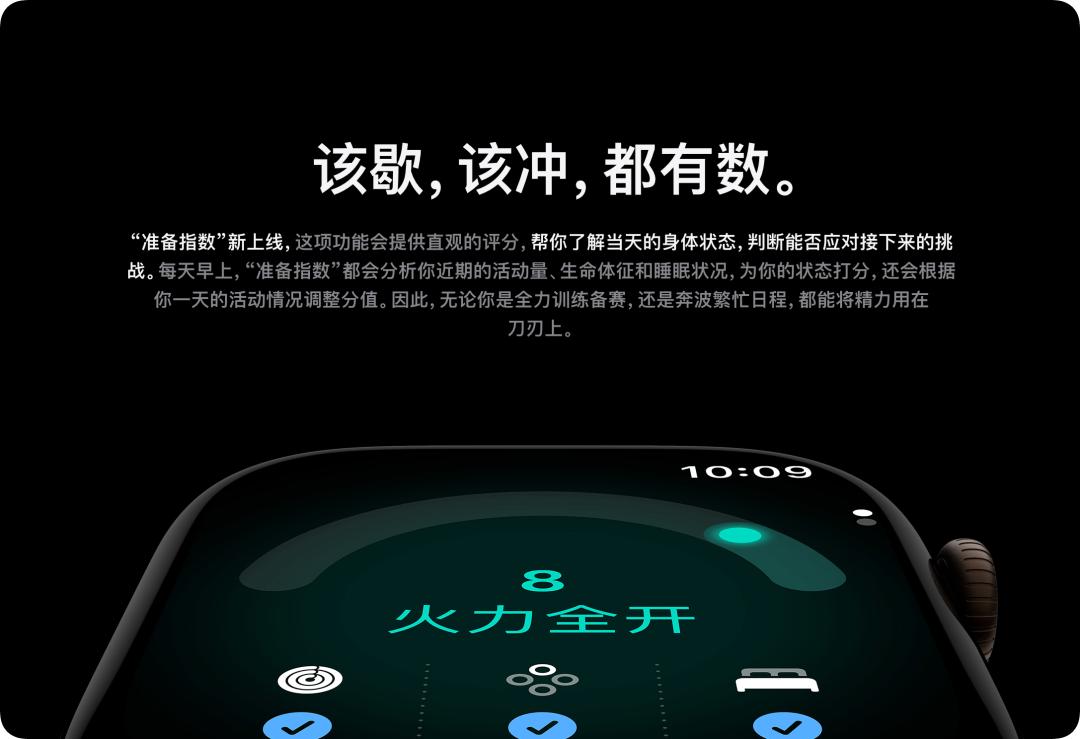
This is a more intelligent sports health management system. The Readiness score will also be updated in real time throughout the day. For example, when you complete high-intensity training or vital signs fluctuate, the score will change accordingly. If users are interested in the details of the score, they can also click the score to view various factors that affect the result. The Vital Signs app adds a new daytime view, and the nighttime records add the recovery HRV indicator, which can be compared with the personal historical baseline.
Apple specifically reminds that this feature is only for healthy living reference, and shall not be used as a basis for medical diagnosis.
There has also been a major upgrade in sports recording — relying on the S11 chip and new machine learning algorithms, Apple has reconstructed the step counting model to improve the accuracy of all-day step statistics, as well as the distance measurement of indoor walking and running training. In addition, the watch face also adds a new step complication, where you can view the real-time step count directly on the watch face.
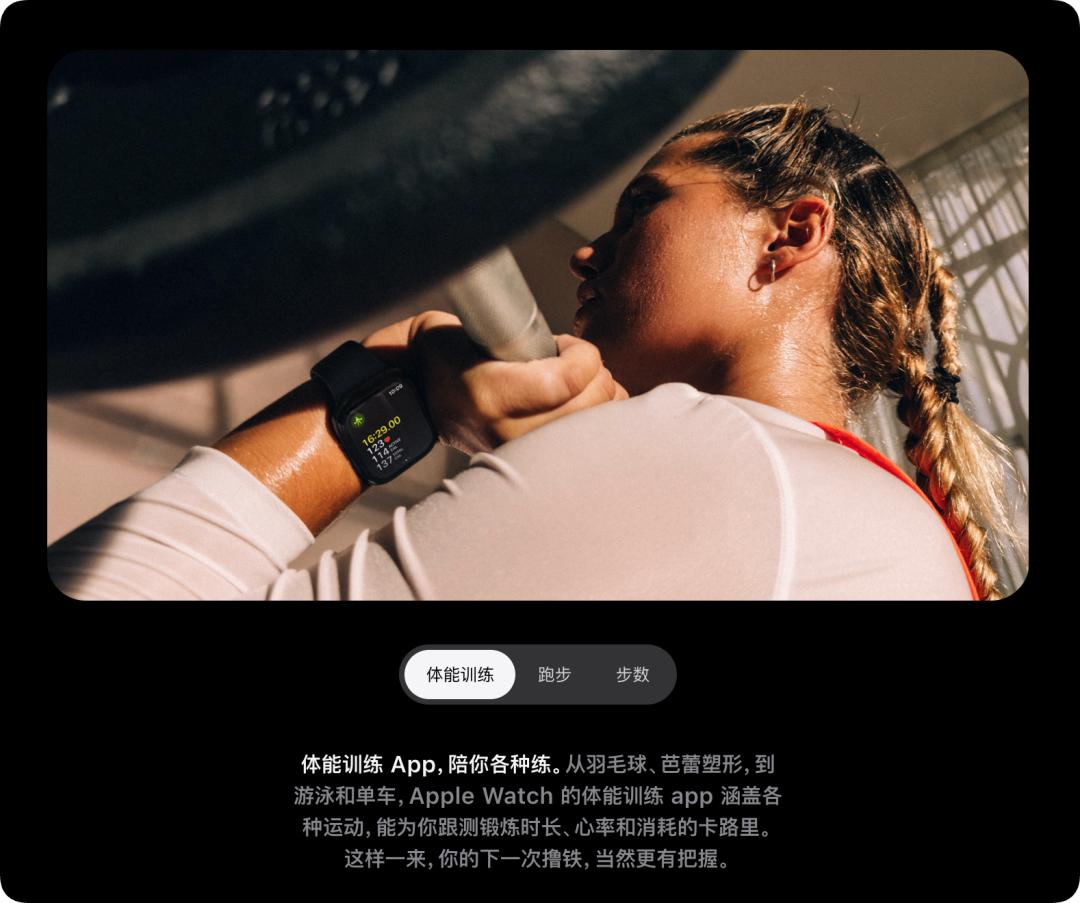

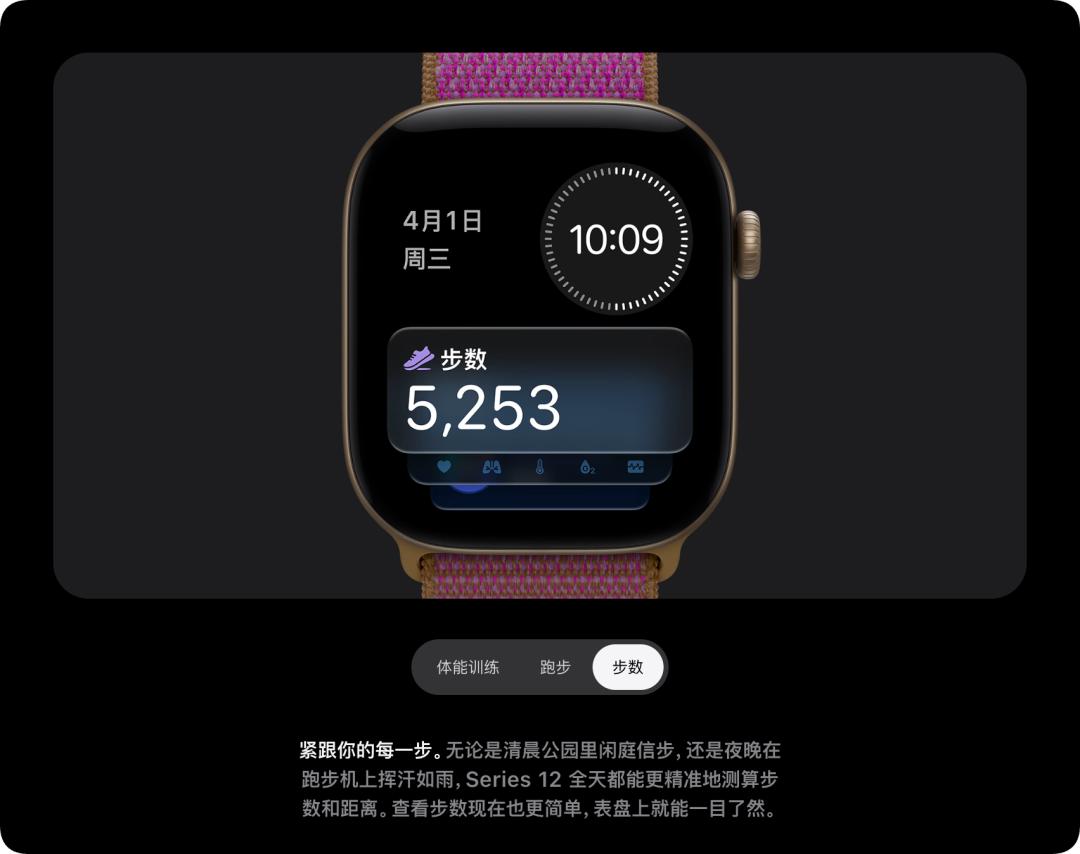
The new features brought by the S11 chip are not only focused on sports and health. Apple's overall product arrangement and technology layout are now fully shifting to Apple Intelligence, and Apple Watch will of course also undergo more profound changes.
The Siri AI that lands on Apple Watch this time can answer questions by combining a wider knowledge base and users' personal information, and supports continuous follow-up questions at the same time. If you are halfway through a conversation with Siri on iPhone, just raise your wrist to continue the conversation directly on the watch; the conversation history is synced across devices via iCloud, the chat content on the phone can still be viewed on the watch, text, images and other information will be retained, and conversations you consider important also support pinning.
If you only treat a smart watch as an "accessory", these features don't seem very convincing at first glance.
But from the perspective of the entire technology industry and the whole society, today's users' habits of using technology products have long shifted from pure GUI clicks to conversational interaction. More specifically, the most frequently used products for users have changed from specific functional applications to general-purpose AI conversation/Agent products, such as Doubao, DeepSeek, ChatGPT, Claude — and of course, Siri AI and Apple Intelligence are now added to the list.
So you can understand that by developing these features, Apple makes the operation mode of smart watches conform to the trend of the AI era, providing users with more long-term value beyond health management, notification push and traditional communication.
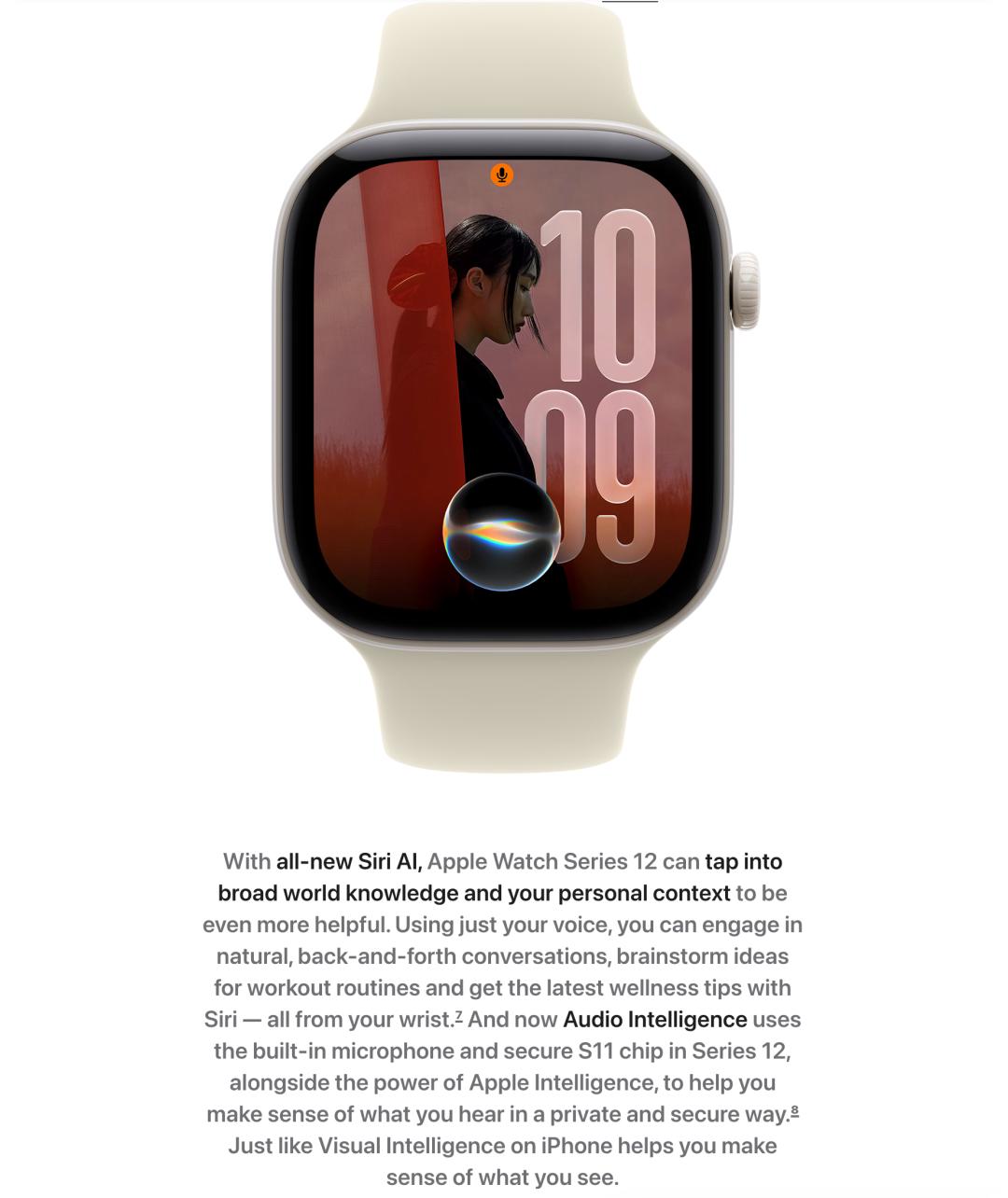
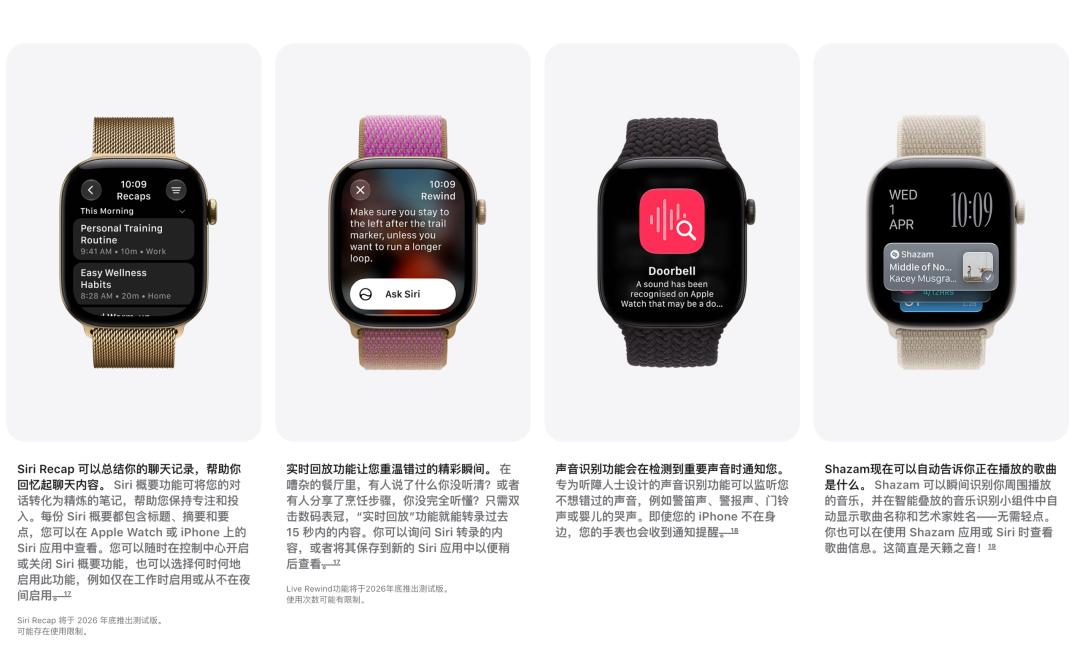
Making its debut at the same time as Siri AI is "Audio Intelligence". Relying on the built-in microphone of the watch, S11 chip and Apple Intelligence, it can not only identify the surrounding environmental sounds, but also help you trace back the conversations you just heard.
The sound recognition function can monitor doorbells, alarms, and baby cries, and can push reminders to hearing-impaired users even when the iPhone is not around; Shazam can identify music playing nearby, and display the song title and singer directly in the smart stack widget.
And the more remarkable features are Live Rewind and Siri Recap.
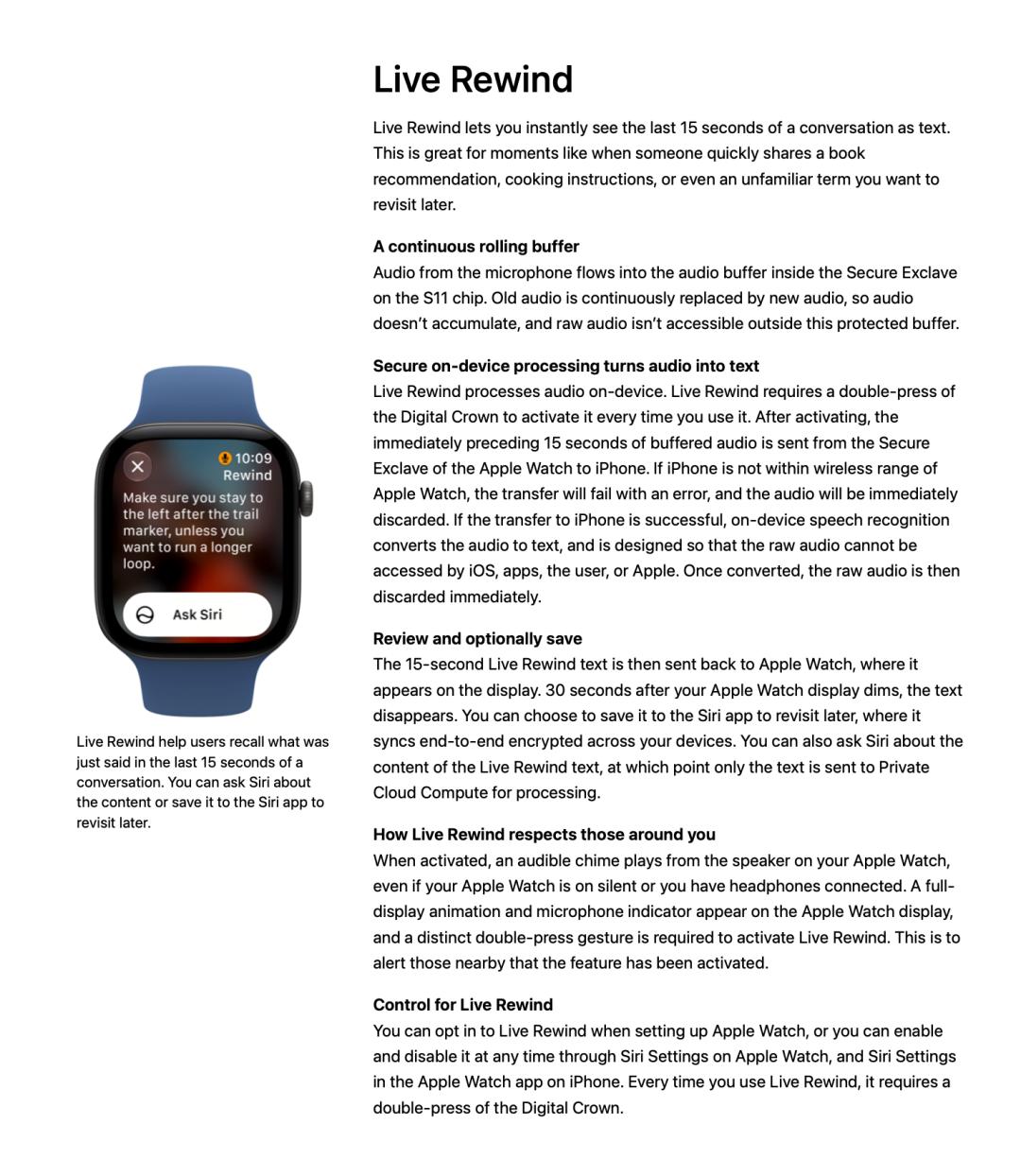
Just double-click the Digital Crown, and Live Rewind will transcribe the conversation of the past 15 seconds into text and display it on the watch screen; when you encounter content you don't understand, you can directly ask Siri to continue explaining, or save the text for later viewing. The interaction that could only be seen in movies in the past, now you just need to ask "What did you just say", and the watch will help you review the content.
Siri Recap is responsible for extracting the core information of the entire conversation:
After being enabled, it will generate notes with titles, summaries and key points, and save them in the Siri app on the watch or iPhone. You can customize the trigger time and scenarios, and turn off the function at any time through the Control Center.
Similarly, this set of features does not belong to the expectations that users had for a traditional smart watch in the past. But we should think this way: starting from iOS 27, iPhone supports "Visual Intelligence", and "Audio Intelligence" is the complementary audio part of it.
In the usage scenarios conceived by Apple, taking out the mobile phone is an experience that breaks the sense of immersion, or even to put it more dramatically, an "intrusive" experience. When you suddenly want to remember something for later traceability, you just press the watch naturally, or even don't need to do anything, the watch has already remembered it for you. This is the non-intrusive experience.
From resuming conversations to sorting out key points of discussions, it can be seen that Apple Watch has begun to have the characteristics of a close-fitting "personal smart hub".
However, the watch collects environmental sounds in real time, so the privacy issue cannot be avoided naturally. According to Apple's official description, Audio Intelligence will not generate playable or forwardable recording files. The original audio is processed in the Secure Exclave built into the S11 chip. This area is isolated from the rest of the system, and the original audio will be deleted immediately after the audio processing is completed. The system, apps, users and even Apple cannot directly access the original audio.
Among them, Siri Recap requires collaborative computing between the mobile phone and the cloud: the watch first transmits the encrypted audio to the secure enclave of the paired iPhone for decryption, transcription and compression, then uploads the streamlined encrypted text to Apple's private cloud to generate a summary. The final saved summary and Live Rewind text snippets are synced via iCloud with end-to-end encryption.

When Live Rewind is enabled, the watch will play a prompt tone, and pop up a full-screen animation with a microphone icon. Even if the watch is muted or connected to headphones, the prompt tone will still sound to inform people around that this feature is running.
"Apple also reminds at the same time that there may be omissions or deviations in understanding in the transcribed text and generated summaries, and important information still needs to be verified for a second time.
Unfortunately, Siri AI, Live Rewind and Siri Recap are not currently supported in Chinese Mainland, and only sound recognition and Shazam music recognition are currently on the feature page of Apple's official website for China.
Overseas updates will also be pushed in batches: Siri AI will launch the English Beta version on September 14 with watchOS 27; Live Rewind and Siri Recap will be available later this year, and the first batch will only support English as well.
The latter two features are only adapted to Apple Watch Series 12 and Ultra 4, and require an iPhone 16 or later compatible model with Apple Intelligence enabled, the iPhone 16e is not in the support list.
After talking about the digital series, let's take a look at Apple Watch Ultra 4. It also has all the aforementioned new features and characteristics, and can bring more to users.
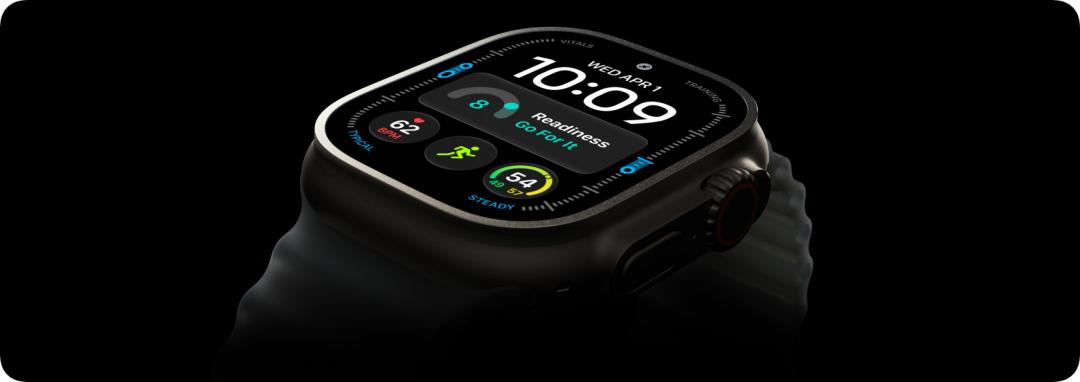
Apple Watch Ultra 4 adopts a 49mm titanium metal case, available in two color options of Natural Titanium and Black. It is also equipped with LTPO3 wide-view OLED All-Day Retina display, with a peak brightness of 3000 nits. It is still equipped with S11 chip, brand new health sensing system and "Readiness" feature, and