GPT-6 Astra × V2Fun: When large models start to "orchestrate" 3D generation, the paradigm of AI modeling is shifting
Imagine such a 3D modeling process.
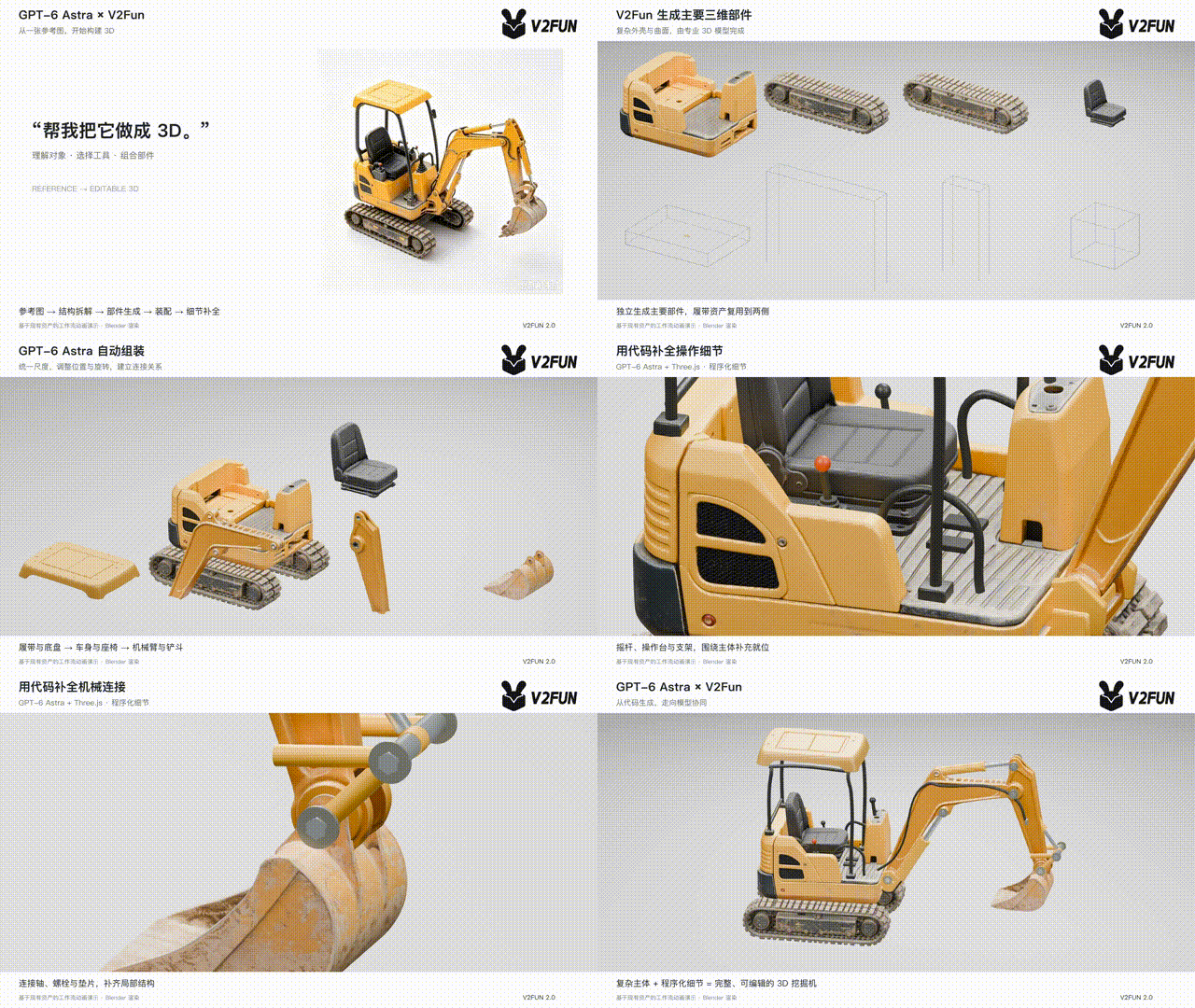
You give GPT-6 Astra a reference image of an excavator, and it first figures out what parts the machine consists of: cockpit, track, chassis, boom, arm, bucket...
Then these main components are sent to a professional 3D generation model respectively, and returned in the form of independent assets after dozens of seconds.
Next, GPT-6 Astra takes over.
It judges the scale and spatial relationship of each part, places the tracks on both sides of the chassis, connects the boom to the body, and then installs the arm and bucket in sequence; after the main structure is completed, it continues to use Three.js to add hydraulic pipes, screws, rotating shafts, and the control joystick in the cockpit.
Finally, a complete, structured and editable excavator appears in the 3D scene.
This is not a simple image-to-3D process, nor a simple code generation process.
Instead, the two AI capabilities begin to cooperate in a more natural way:
GPT-6 Astra is responsible for understanding, planning and construction, while the professional 3D Foundation Model handles complex geometry.
This is also a new workflow that V2Fun, under Vertex Lab, is currently experimenting with.
And a bigger change behind it is that 3D Agent is evolving from "generating everything by itself" to "knowing which model to call at what time".
TURNING POINT GPT-6 Astra has mastered 3D, what's next?
An important change brought by GPT-6 Astra is that large language models are truly stepping into the 3D world.
In the past, we were more accustomed to letting AI generate an image, a video or a piece of text. Now, relying on increasingly powerful multi-modal understanding, spatial reasoning and coding capabilities, GPT-6 Astra can already understand the structure of a 3D object, and then build it programmatically through tools like Three.js.
Take an industrial assembly line as an example.
GPT-6 Astra can identify the conveyor belts, rollers, support frames, motors and different working modules in it, and then gradually generate the corresponding geometric structures.
Such objects are especially suitable for procedural modeling, because they usually have clear mathematical relationships and repetitive structures. A support column can be represented by basic geometry, a roller can be duplicated dozens of times, and the length and position of a conveyor belt can be directly controlled by parameters.
More importantly, the result generated in this way is not a completely black-box Mesh.
All parts in the assembly line are still independent objects that can be moved, duplicated, deleted and modified.
From this perspective, GPT-6 Astra is no longer just "generating 3D content", but has begun to possess capabilities closer to a 3D engineer: understanding what an object is made of, and constructing it.
But when objects become more and more complex, a new problem emerges.
If we are not facing an assembly line, but a human face, creature, clothing, sculpture, or even an excavator with complex industrial curved surfaces — should we still let GPT-6 Astra write all the geometry through code?
The answer may not be an either-or choice, and this is exactly where V2Fun can be integrated into this workflow.
WHY V2FUN Why V2Fun?
V2Fun is not a 3D API temporarily accessed for this Demo.
It is the product-oriented entry for Vertex Lab's long-term R&D of AI 3D Foundation Model.
Founded in 2025, Vertex Lab has long focused on 3D generation, spatial intelligence, and longer-term world model infrastructure development.
Previously, V2Fun was unveiled at HDC 2026 as the first 3D large model AI native application on the HarmonyOS system, covering the full link from mass creation to professional 3D content production through mobile terminals and web workbenches.
Essentially, what it has been doing is figuring out how to turn a complex 3D object into a truly reusable 3D asset with lower thresholds and less time.
The upcoming V2Fun 2.0 will further upgrade these capabilities.
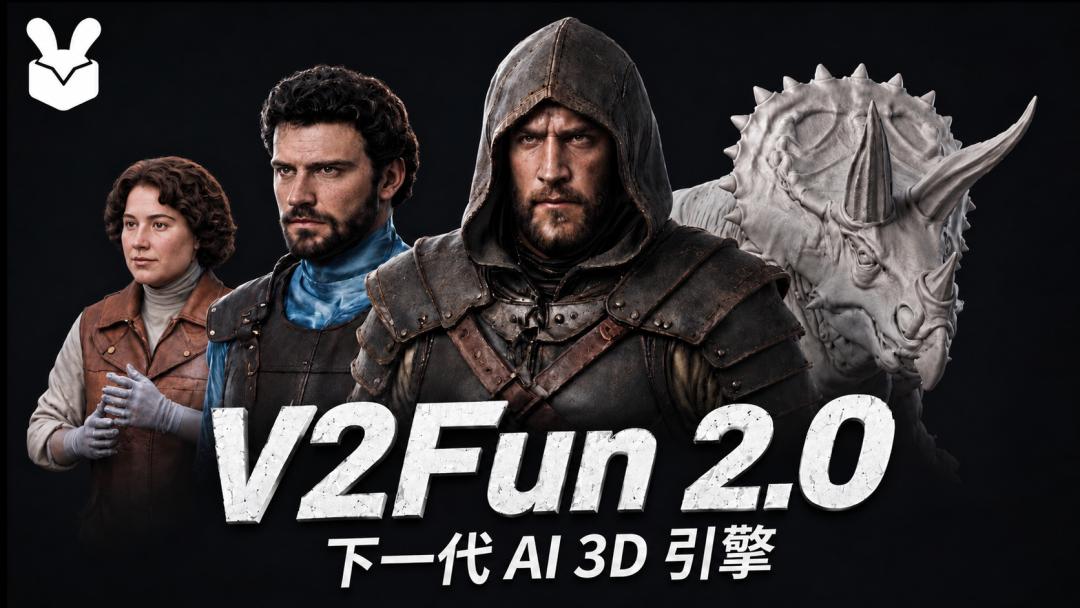
The new version will be equipped with the latest generation of 3D Foundation Model, support up to 8K level texture generation, and focus on improving the generation quality of complex geometry, characters, creatures, clothing, sculptures and other irregular curved surfaces.
This is also why the combination of V2Fun and GPT-6 Astra is not an accidental product linkage.
The problems the two sides are good at solving are complementary by nature. GPT-6 Astra excels at understanding, planning, spatial relationship processing, coding and Agent scheduling, while V2Fun is good at directly generating complex 3D geometry and high-quality surfaces.
One is better at answering: "How should this thing be constructed?"
The other is better at answering: "What should this complex part itself look like?"
When these two capabilities are combined, 3D generation no longer has only one path.
CHALLENGE Some content is suitable for coding, while some is more suitable for direct generation
Let's go back to the excavator example.
Structurally, it is very regular.
GPT-6 Astra can easily understand that an excavator consists of a chassis, left and right tracks, car body, cockpit, boom, arm and bucket, and can also understand how these parts should be connected.
But as we dig deeper, the situation becomes different.
The cockpit is not a simple cube, and the car body shell cannot be accurately represented by just splicing several Primitives. The bucket has continuous curved surfaces, the mechanical arm has complex contours, and the tracks and chassis themselves contain a large number of industrial design details.
Of course GPT-6 Astra can continue to approximate these structures through procedural code. But the more complex the geometry, the more code needs to be generated and modified, and the more iteration rounds will be required. For the Agent, this means that more and more Tokens are consumed in underlying geometric description.
So we tried a different approach.
GPT-6 Astra first "understands" the excavator. Then it hands over complex main parts such as the cockpit, tracks, mechanical arm and bucket to V2Fun 2.0 for generation respectively.
After the generation is completed, GPT-6 Astra takes over again to finish scale adjustment, rotation, position matching and overall assembly.
Here, V2Fun is leveraging the capabilities it has been accumulating:
Directly restoring complex 3D structures from visual input, instead of letting the large language model describe curved surfaces indirectly through a large amount of code.
This step seems to just reduce the amount of Three.js code written, but in fact it changes the entire calculation path.
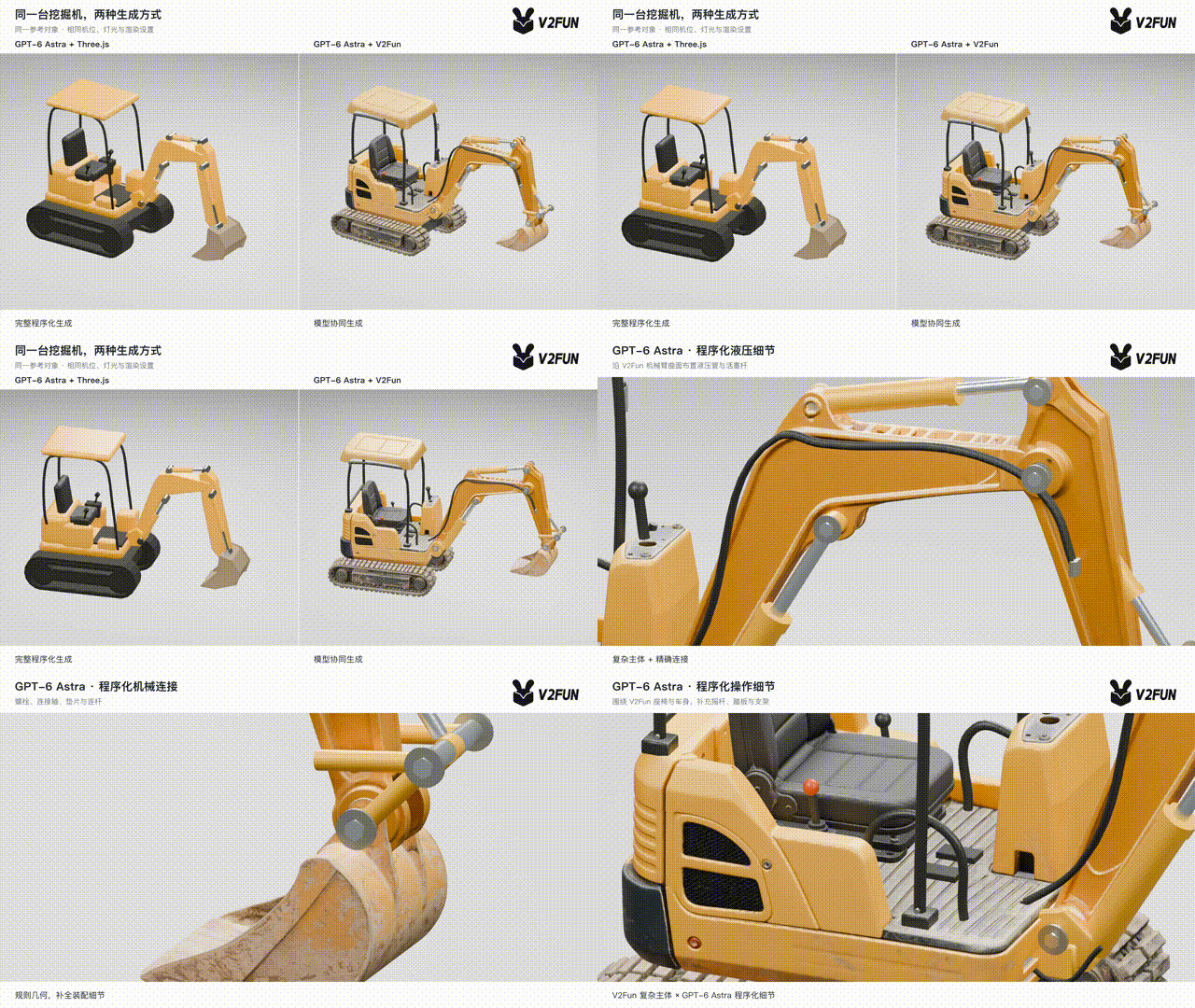
More interestingly, V2Fun does not replace Three.js. After the assembly is completed, GPT-6 Astra will still continue to generate many other elements.
For example, the hydraulic pipe is essentially a tubular structure connected along several key points, which is very suitable for procedural expression.
There are also screws, connecting shafts and joysticks. These objects have regular sizes, simple structures and large quantities. If you call the 3D Foundation Model separately for each of them, it will instead increase the cost and complexity of the entire process.
So the final excavator we see is actually a real Hybrid Asset: complex main parts are generated by V2Fun, regular details are completed by GPT-6 Astra + Three.js, and finally GPT-6 Astra organizes both into the same structured 3D object.
This is the really interesting part of this solution:
It is not an either-or choice between "code generation" and "3D large model", but letting the Agent decide which part is most suitable for which capability.
MORE COMPLEX When the object becomes a human, the value of V2Fun will be more obvious
An excavator is still a hard-surface oriented object. It is characters and complex organic curved surfaces that push the pure procedural route to the limit.
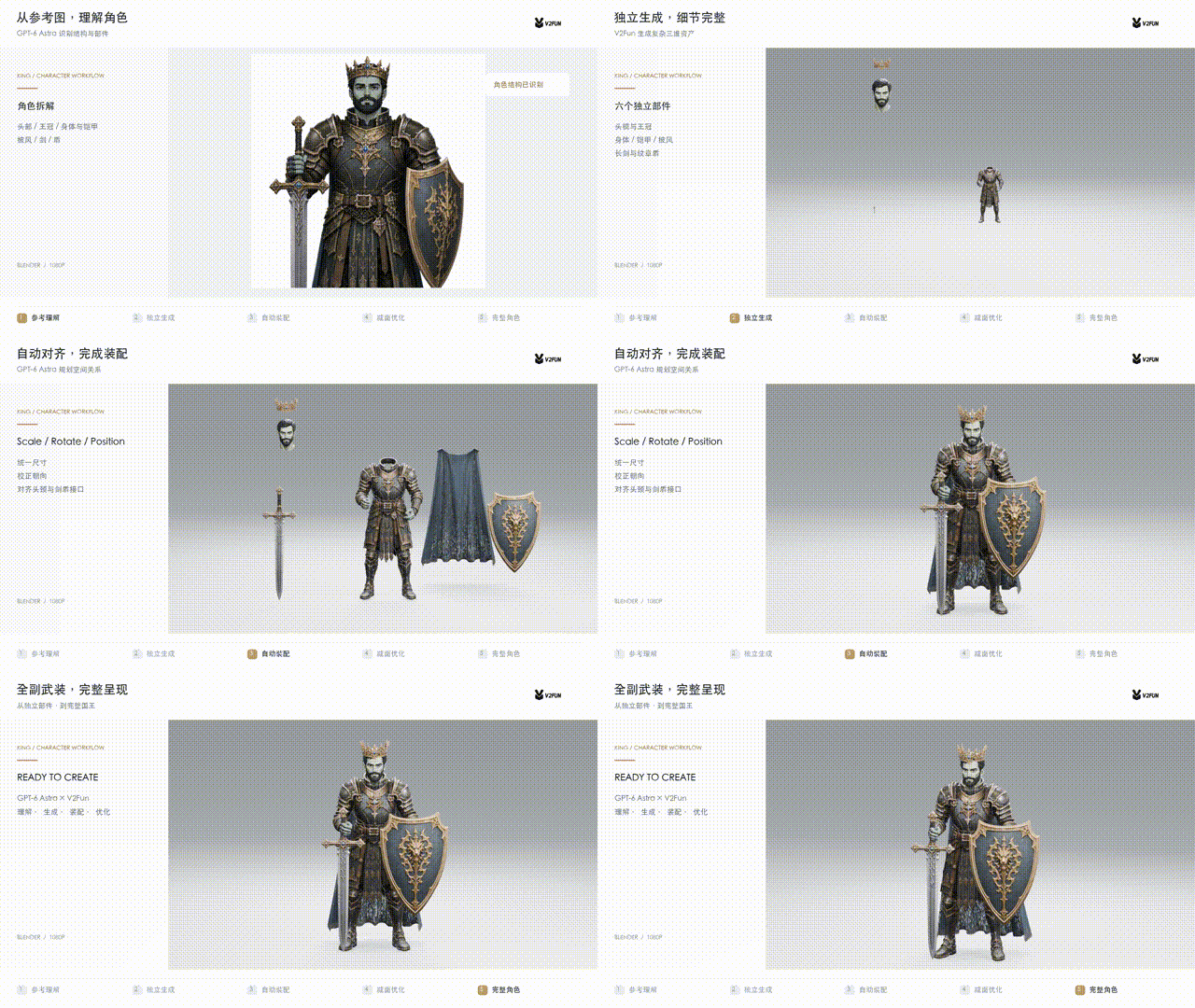
To this end, we made a more radical Demo: letting GPT-6 Astra build a fully armed king.
This character not only includes the human body itself, but also has complex armor, head, sword and shield. Compared with mechanical equipment, human characters are more difficult to represent with rules.
Whether a face looks "authentic" does not only depend on the correct approximate positions of the eyes, nose and mouth. The face shape, cheekbones, eye sockets, bridge of the nose, lips and the continuous and subtle curvature changes between these structures jointly determine the final image.
The same goes for armor. Although it belongs to hard surfaces, it is not a simple engineering part. A large number of reliefs, decorations, continuous curved surfaces and stylized shapes jointly form the visual features of the character.
This is exactly the type of object that V2Fun 2.0's new generation 3D Foundation Model is more suitable for processing.
In this Demo, GPT-6 Astra first understands the entire character, and disassembles it into several main parts: head model, body and armor, sword and shield. Then these complex parts are generated through V2Fun respectively.
GPT-6 Astra is then responsible for the following work:
Check whether the head scale is correct and how to connect it to the body; where the sword and shield should be placed; whether the proportions of all parts are coordinated; which models need to be decimated; and finally how to organize them into an editable and usable 3D Asset.
In other words, V2Fun solves the problem of "how complex geometry can appear quickly and with high quality", while GPT-6 Astra solves the problem of "how these geometries can form a complete object".
Why can V2Fun take on this layer of complex geometry processing?
The reason is not just that "it is also an image-to-3D model". The core R&D work of Vertex Lab in the past period has always focused on two most basic issues: how to represent geometry more accurately, and how to keep high-resolution textures consistent on 3D surfaces.
On the geometry side, the team continues to iterate 3D representation and generation architecture, aiming to reduce invalid geometric representation and focus model capabilities on high-curvature, thin structures and complex areas.
On the texture side, it focuses on solving the common problems of texture misalignment, tearing and detail loss during multi-view, high-resolution generation.
This is the foundation for V2Fun 2.0 to further achieve 8K level high-quality textures.
For an Agent, this type of capability is very important. Because what it calls is not a visual generation tool that "looks like 3D", but a professional model that truly outputs 3D assets.
The generated assets will continue to be combined, decimated and modified by GPT-6 Astra, and even enter subsequent animation, game, 3D printing or other 3D workflows.
This is exactly the product problem that V2Fun has been solving all the time: making AI generate not just a result, but a 3D Asset that can truly continue to work.
EFFICIENCY Higher quality is only part of the gain, another change is reflected in Token
This workflow also has a very direct benefit: Token efficiency.
When GPT-6 Astra describes a simple structure with Three.js, the Token usage efficiency is very high.
A cylinder, a hydraulic pipe, a few screws only require a small amount of code.
But if you use the same method to approximate human faces, clothing folds or high-complexity industrial curved surfaces, the geometric code that needs to be output and modified will increase rapidly.
As a result, a large number of Tokens are spent on:
"How to make this curved surface closer to the target."
"How to continue adjusting this contour."
"How much geometric detail should be added to this part."
When complex parts are directly handed over to V2Fun, these underlying processes are compressed into one professional model call.
GPT-6 Astra can put more reasoning resources on places that really require reasoning:
How to split the object; which parts should be generated separately; what is the spatial relationship between different components; how to assemble them in the end; where further modifications are needed.
This is why what V2Fun 2.0 brings is not just "the model looks better".
It also has the opportunity to reduce both the Token consumption of GPT-6 Astra in complex 3D tasks and the overall modeling time.
The original process might be:
Understand → Write geometry → Modify → Rewrite geometry → Re-modify
Now it becomes:
Understand → Split → Parallel generation → Assembly → Local supplement
When multiple complex parts can be generated at the same time, this efficiency difference will be further amplified.
CLOSING From "generating a model" to "becoming the 3D basic capability of Agent"
In the past few years, the core problem of AI 3D has always been: how to generate a better model?
But as models like GPT-6 Astra have increasingly powerful multi-modal understanding, coding and Agent capabilities, this problem is changing.
In the future, AI does not necessarily need to complete all 3D work with one technology.
For simple structures, you can write code directly.
For complex curved surfaces, you can call V2Fun.
For existing assets, you can reuse them directly.
If you need to decimate, combine and adjust structures, you can hand it over to the Agent for further execution.
This is consistent with the ongoing change in the 3D generation industry from "single generation tool" to "Agent-enabled productivity". The reference article also summarizes this trend as: 3D generation is evolving from a stage similar to the early Chatbot to a productivity stage based on Agent mode.
For Vertex Lab, this direction is actually consistent with its long-term technical judgment.
From the very beginning, the company did not define V2Fun only as an "image-to-3D website".
From lowering the threshold of 3D creation on the mobile end, to entering professional asset production on the web end, to 3D models, animations, motions, and longer-term spatial intelligence and world model directions, what Vertex Lab has been striving for is always the infrastructure for 3D content generation and spatial intelligence.
The rise of Agent may provide a new entry point for this goal.
In the future, users do not necessarily need to know exactly which model to call, which code to write, and which modeling method to choose.
They only need to say: "Turn this into 3D."
GPT-6 Astra is responsible for understanding this requirement and deciding how to complete it. And V2Fun 2.0 hopes to become its professional basic capability in the complex 3D world.
GPT-6 Astra is responsible for understanding, planning and construction.
V2Fun is responsible for turning complex 3D imagination into real assets.
GPT-6 Astra × V2Fun: From code generation to model collaboration.
Vertex Lab is a technology company focused on AI 3D content generation and spatial intelligent application, committed to reducing the threshold of 3D content production through generative AI, and improving the overall efficiency from creative generation, model production