Gas Turbines: Explosive Catalysis Driven by the Surging AI Power Demand in the United States
Recently, AI computing power has been a hot topic among many people, but few have dug deeper into the lower reaches of the industrial chain — behind the explosion of computing power, the power gap is becoming the biggest constraint, and the gas turbine, a previously relatively niche track, is quietly ushering in a historic explosion in demand.
After attending an in-depth industry conference call this week, I gained a more profound understanding of the long-term logic that AI computing power is forcing the upgrading of power infrastructure and bringing opportunities to gas turbines.
The bottleneck on the supply side of gas turbines is more rigid than imagined, and the substitution opportunities for domestic manufacturers are also greater than expected.
First, let's talk about the core catalyst: AI data centers are pushing the U.S. power grid to its limit, making self-owned power supplies a must-have rather than an optional choice.
The root cause of this wave of demand surge is very simple: the power consumption of computing chips is rising too fast.
According to estimates, from 2025 to 2028, the power consumption of computing chips in U.S. data centers will soar from 4.9GW to 55GW. Including the power consumption of cooling systems, the total power consumption will directly double.
The corresponding demand for gas turbines will grow from 4.5GW to 57.5GW, with year-on-year growth rates reaching 200%, 125% and 86% respectively for three consecutive years.
This increment is very staggering.
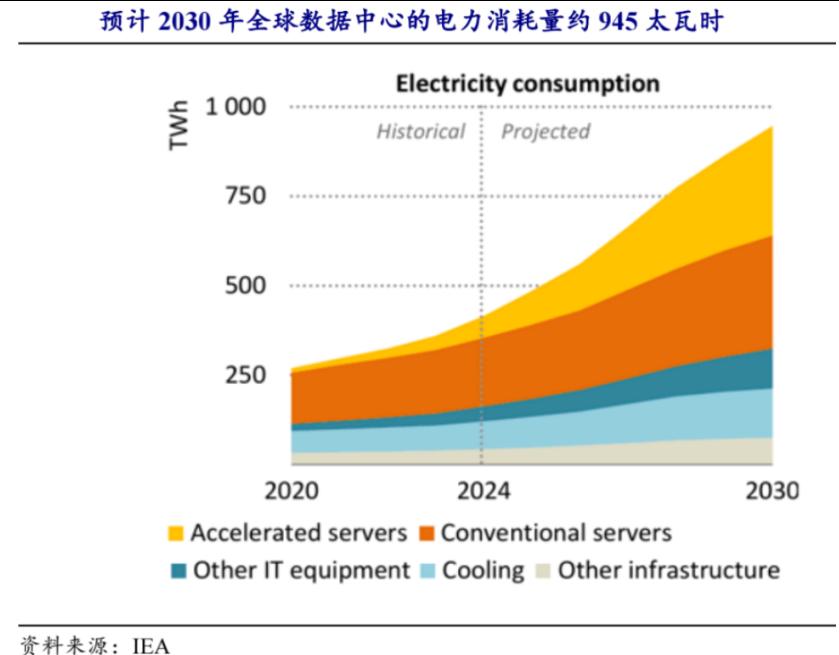
The IEA predicts that the global power consumption of data centers in 2030 will be about 945 TWh, accounting for about 3% of the total global power consumption in 2030, more than twice that of 2024, while the power consumption in 2024 accounts for about 1.5% of the global power demand.
It is estimated that from 2024 to 2030, the power consumption of data centers will grow by about 15% annually on average, which is more than four times the total power consumption growth rate of all other industries.
What is more worthy of vigilance is the change in the proportion of electricity consumption.
Last year, the power consumption of U.S. AIDCs accounted for only 2% of the total social electricity consumption, this year it has reached 6%, and it is expected to reach around 12% next year.
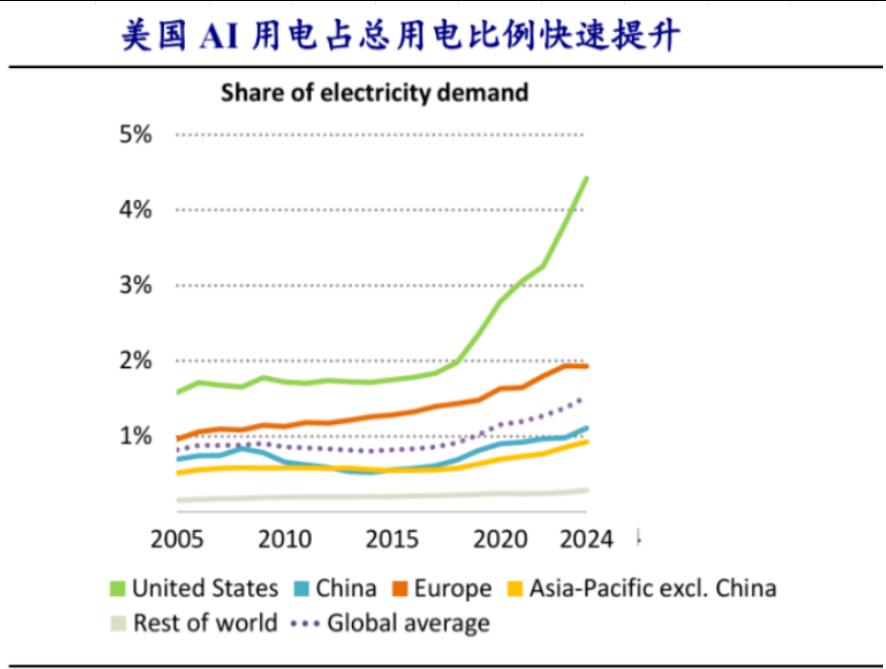
In addition, U.S. data centers are very concentrated, and the proportion of electricity consumption in northeastern regions such as Virginia and Pennsylvania will be even more staggering.
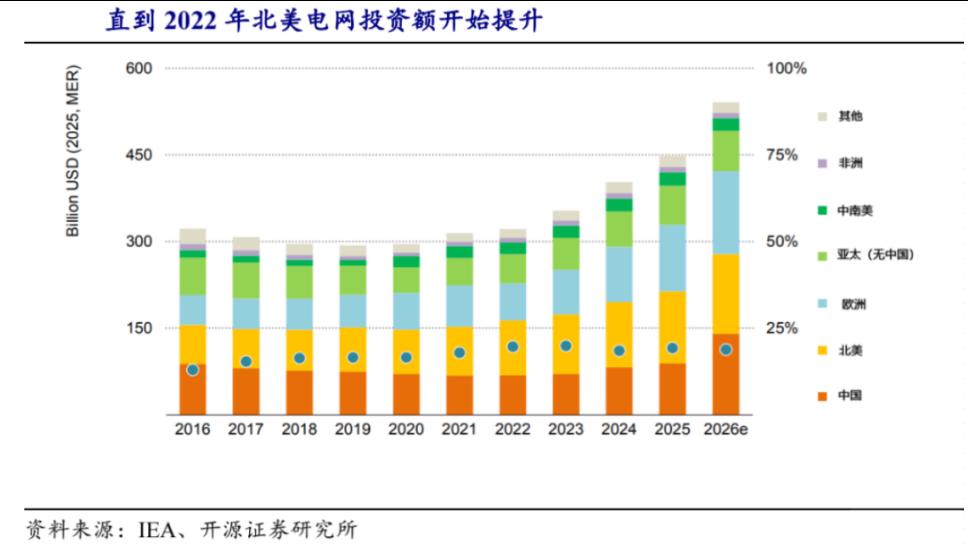
However, the U.S. power grid has long been aging: more than 70% of the transmission lines have been in use for more than 25 years, and most power plants also have a history of several decades, operating close to the limit all year round, and cannot withstand this sudden increment at all.
It was not until AI investment began to increase in 2022 that investment in the power grid grew accordingly.
Therefore, the shift in U.S. power policy is now very clear.
Trump twice this year asked tech giants such as Amazon, Google, and Microsoft to sign a letter of commitment to build their own power plants, and stop crowding out public grid resources to drive up residential electricity prices.
Amazon has taken the lead. The large-scale data center planned in Texas is directly equipped with a gas-fired power plant of more than 7GW to form an independent power system without accessing the public grid.
In the future, this trend will only become more and more common, and user-side self-owned power supplies will become the standard configuration for new data centers.
Many people will ask, there are so many power generation technology routes, why must it be gas turbines?
In fact, over the past 20 years, gas-fired power generation has always been the largest power generation method in the United States, and its proportion has risen to 45% in 2024, and will steadily rise to more than 50% in the future.
In the scenario of self-owned power supplies for data centers, the advantages of gas turbines are almost tailor-made: stable power generation, fast start-up speed, no need for additional energy storage, and low life-cycle cost.
Especially for data centers that have extremely high requirements for power supply reliability, the dominant position of gas turbines is difficult to replace.
Now the gas turbine orders of overseas leading enterprises have continued to boom.
The global gas turbine pattern is highly concentrated. The three giants GEV, Siemens, and Mitsubishi account for more than 80% of the market share. Together with Ansaldo, Baker Hughes, and Doosan Energy, the six companies account for more than 95% of the total market.
In the first half of this year, the new order growth rate of these three leading manufacturers was all above 50%, but the delivery could not keep up at all.
For example, GEV's orders have been scheduled to 2031, and the on-hand orders are enough to support production for five and a half years.
All main engine manufacturers are calling for capacity expansion, but the actual delivery growth rate is very limited, and the gap between supply and demand has continued to widen.
One of the most critical bottlenecks is the turbine blade, which is also the core of the industry's supply rigidity.
Many people think that the problem can be solved as long as main engine manufacturers expand production, but that is not the case.
Among the three major components of gas turbines, blades have the highest value proportion, reaching 35% — of which turbine blades account for 25% and compressor blades account for 10%.
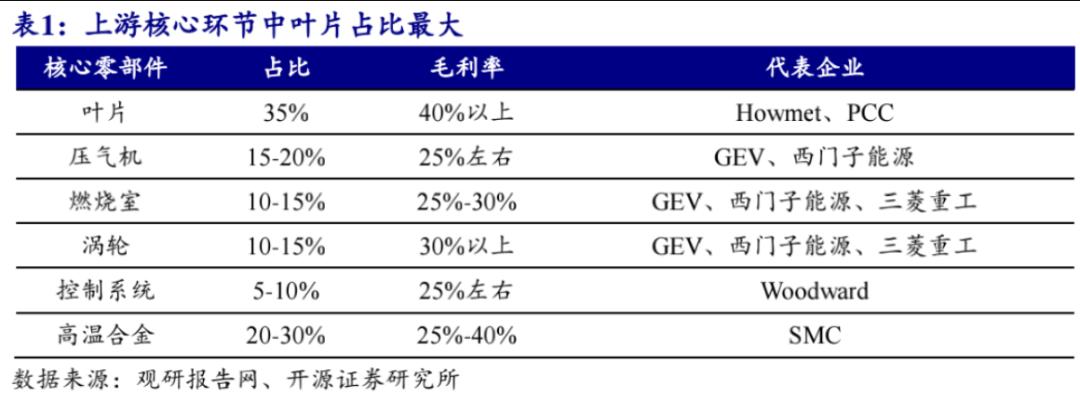
More critically, the high temperature resistance of turbine blades directly determines the performance of the whole unit. For every 40°C increase in inlet temperature, the efficiency of the whole unit can be increased by 1.5%, and the power can be increased by 10%.
It can be said that the upper limit of blade production capacity is the upper limit of the production capacity of the entire gas turbine industry.
However, the capacity expansion of this link is much more difficult than imagined. It is an industry that is capital-intensive, technology-intensive, and labor-intensive at the same time: the equipment is expensive, the requirements for skilled technical workers are extremely high, and the industry is non-standard, with thousands of models. The R&D cycle of each new model is more than one year, and it even takes three to five years to complete the development of brand new blades for heavy-duty gas turbines.
There are only two leading global players in the turbine blade field: PCC and Howmet, which together account for more than 50% of the global market share.
However, the capacity expansion of these two companies is extremely conservative. PCC's last capacity expansion was in 2015, almost 12 years ago, and it even laid off a large number of employees during the epidemic; Howmet also has no radical capacity planning, and its stated goal is to double the revenue of its gas turbine business by 2029, which will be achieved mainly by raising prices rather than increasing production volume.
In other words, no matter how many orders the main engine manufacturers sign, if the blades cannot be supplied, the whole unit cannot be delivered.
This bottleneck cannot be solved in the short term at all, and it is also the core reason why this boom of gas turbines can last for so long.
But as a result, domestic manufacturers have also ushered in huge opportunities, and clear leading players have emerged at present. There are two core directions most worthy of attention in this industrial chain:
The first is the core component link, such as Yingliu Co., Ltd., the absolute leader of aero-engine and gas turbine blades in China.
The company began to lay out aero-engine and gas turbine blades in 2014, and has invested a total of 2 billion yuan in the construction of production lines. It is one of the very few domestic manufacturers that can enter the supply chain of mainstream overseas main engine manufacturers.
Now the company is at a key node of accelerated capacity ramp-up: from May to July this year, three large furnaces will be put in place one after another, and they will be put into production from August to October respectively. The revenue growth rate will increase significantly starting from the third quarter, and the growth rate in the second half of the year is expected to reach more than 40%.
What has even more upside potential is customer expansion. The company's cooperation with Siemens has gradually transitioned from the R&D stage to mass production, and the delivery volume to Siemens is expected to increase tenfold within 2-3 years; the cooperation with GEV and Ansaldo is also advancing rapidly. Ansaldo's orders this year have directly increased tenfold, and the long-term agreement with Baker Hughes has even been signed until 2031.
According to the plan, the company is expected to achieve a revenue of 5 billion yuan in 2028, and impact the scale of 10 billion yuan in 2030.
The second is the whole unit integration link, such as Jereh Co., Ltd., the leading domestic gas turbine integrator.
The company has been deeply cultivating the North American market for nearly 20 years, is familiar with local environmental policies, power regulations and product certification systems, and has strong order-winning capabilities. Since October last year, it has won a total of 3.1 billion US dollars of orders in the data center field, with very rapid growth.
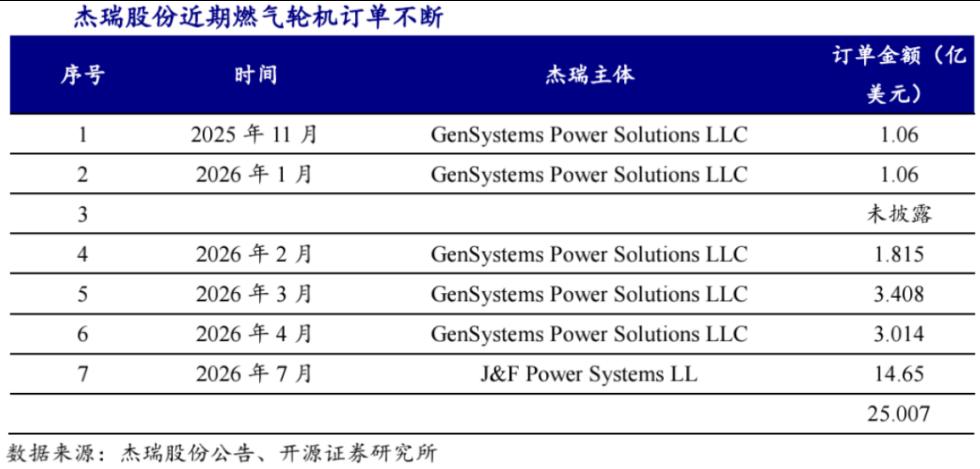
The biggest highlight is the joint venture established with FTI, the global leader in aero-engine maintenance, to carry out aero-derivative gas turbine business — transforming decommissioned aero-engines into gas turbines, which has low cost and fast delivery, and is very suitable for the demand of self-owned power supplies in data centers. The joint venture has just won a five-year large order of 1.465 billion US dollars, and the products will be delivered in batches before November next year.
In the future, large orders of this billion-dollar level will probably be landed one after another, and there is likely to be room for upward revision of next year's performance.
In addition, main engine manufacturers such as Shanghai Electric and Dongfang Electric, as well as related companies in sub-sectors such as forgings, cylinders, and waste heat boilers, will also benefit from this wave of industry prosperity to varying degrees.
In general, the essence of this wave of gas turbine market is that the demand for AI computing power is transmitted layer by layer along the industrial chain, and finally reaches the bottommost power infrastructure.
Unlike many concept-driven tracks, its demand is real, the supply bottleneck is also real, and the boom cycle will be very long — the orders of leading manufacturers have been scheduled to 2031, and this market trend cannot be completed in just one or two years.
Now the market's understanding of this sector is still insufficient. Many people still stay in the stereotype of "traditional energy equipment" and have not realized that AI has completely reconstructed the demand curve of this industry.
With the continuous landing of subsequent orders and the continuous advancement of domestic substitution, this track will probably gradually go out of an independent market trend, which is worthy of key tracking.
This article is from the WeChat official account "Gelonghui Mine Detection Zone" (ID: glh-tlq), the author is Value Evolution Theory, and 36Kr is published with authorization.