Even though universities have expanded their enrollment, why are there still schools that fail to fill their enrollment quotas?
It is the season for freshmen to register at colleges and universities every year.
Over the past month or more, the 2026 general college admission and enrollment process across various regions has been gradually coming to an end. However, judging from the supplementary enrollment plans released in Anhui, Guangdong, Jiangxi, Hubei and other regions, a noteworthy change has emerged in this year's enrollment market: some schools need to go through one, two or even multiple rounds of supplementary enrollment, and a large number of enrollment quotas for some majors still remain unfilled even after the qualification score for supplementary enrollment is lowered.
This pressure does not fall evenly on all colleges and universities. Top-tier universities and many high-quality public colleges still have sufficient student sources, while the first to feel the pressure are mostly concentrated in some private higher vocational colleges, major groups with high tuition fees, and a small number of private undergraduate colleges with insufficient attractiveness.
More notably, this "insufficient enrollment" does not occur against the backdrop of a general sharp reduction in enrollment quotas across colleges and universities. On the contrary, the overall higher education sector in 2026 is still in the stage of improving quality and expanding scale.
Thus, a new question arises: when the supply of university degrees is still increasing, why do students start to say "no" to some schools?
01
Enrollment quotas not fulfilled,
Which schools are most affected?
The most direct observation window is the supplementary enrollment plans released by each province. Taking Anhui as an example, according to the calculation of the 2026 supplementary enrollment data for the general higher vocational (junior college) batch, the quota fulfillment rate of some private higher vocational colleges after the first round of admission is not satisfactory.
Among them, the first-round quota fulfillment rates of Anhui Mining Vocational and Technical College and Suzhou Aeronautical Vocational College are both less than 40%; those of Bengbu Urban Rail Transit Vocational College and Wuhu Aeronautical Vocational College are only about 50%.
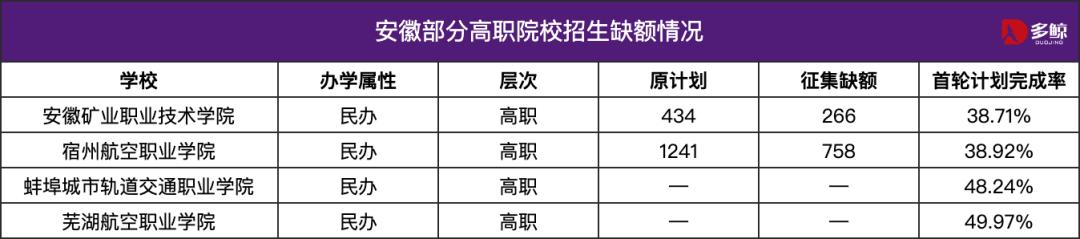
From the perspective of academic categories, the difference in this group of samples is also obvious: the overall quota fulfillment rate for the history stream is about 84.07%, and that for the physics stream is about 49.45%.
Of course, this cannot be simply interpreted as "no one applies for physics stream majors". Some aviation, engineering and equipment manufacturing colleges themselves allocate larger enrollment quotas for the physics stream, and the difference in base numbers will amplify the proportion of unfilled quotas. But at least from the results, some private higher vocational colleges with large enrollment scales have shown obvious pressure in enrolling enough students.
The situation in Guangdong is more intuitive. After the first round of supplementary enrollment for the junior college batch in Guangdong in 2026, there are still unfilled quotas for general majors, so the second and final round of supplementary enrollment was launched. The qualification scores for the second round of supplementary enrollment for both the history stream and the physics stream were reduced to 160 points. The Guangdong Provincial Enrollment Office also specially reminded in the notice that the institutions participating in this round of supplementary enrollment include "private colleges and universities with high tuition fees" and some Sino-foreign cooperative education majors.
Similar multiple rounds of supplementary enrollment also appeared in other provinces. After the first round of supplementary enrollment for the general higher vocational and junior college batch in Hubei, the second and final round of supplementary enrollment was carried out on August 20; after the first round of supplementary enrollment for the general undergraduate batch in Hubei, there were still some major groups of institutions that failed to fulfill their quotas, requiring the launch of the second round of supplementary enrollment.
A more intuitive case appeared in Jiangxi. During the second round of supplementary enrollment on August 10, Jiangxi Vocational College of Science and Technology still had 907 unfilled higher vocational junior college quotas.
However, "entering the supplementary enrollment process" is not exactly equivalent to "no one applied before". The Hubei Provincial Enrollment Office clearly explained that supplementary quotas may come not only from "insufficient student sources", but also from quotas vacated after candidates are withdrawn for failing to meet relevant requirements, additional quotas added by colleges and universities, and unfulfilled quotas transferred back by provincial colleges and universities from other provinces.
Therefore, what is really more noteworthy is the simultaneous emergence of three signals: a large number of remaining quotas, consecutive participation in multiple rounds of supplementary enrollment, and the need to continue supplementary enrollment even after lowering the admission threshold.
Another easily overlooked background this year is that the overall enrollment supply has not shrunk. The Ministry of Education clearly stated in the 2026 notice on the enrollment of general colleges and universities that it is necessary to "promote the improvement of quality and expansion of scale of higher education", expand the enrollment scale of high-quality undergraduate education, and continue to optimize the structure of enrollment majors.
The enrollment expansion is more obvious at the end of higher vocational and private colleges. Taking the 2026 spring college entrance examination in Guangdong as an example, the Guangzhou Daily sorted out and found that private colleges are generally in a state of enrollment expansion: the enrollment quota of Guangdong Country Garden Vocational College increased by 1000 year on year, that of Guangzhou Huaxia Vocational College increased by 425, and that of Guangdong Industrial and Commercial Vocational and Technical University increased by 280; at the same time, the number of undergraduate colleges recruiting secondary vocational school students has increased to 15, and the total enrollment scale is expected to exceed 1900.
This makes the enrollment differentiation this year more worthy of observation: it is not that colleges and universities have collectively started to reduce enrollment, but that while the scale is still expanding, some schools are finding it increasingly difficult to fill the newly added enrollment quotas.
02
Private colleges and high-tuition institutions
Why are they more prone to unfilled quotas?
If we further break down the supplementary enrollment, we will find a very obvious structural feature: "private" and "high tuition" are two keywords that repeatedly appear in this year's enrollment shortfalls.
The Guangdong Provincial Education Examination Authority even specially reminded candidates in the second supplementary enrollment notice to carefully choose private colleges and universities with high tuition fees and Sino-foreign cooperative education majors according to their family economic status. Almost the same reminder also appeared in the supplementary enrollment announcements for undergraduate and higher vocational programs in Hubei.
Looking at the specific quotas for the second round of supplementary enrollment in Guangdong, this correlation becomes clearer.
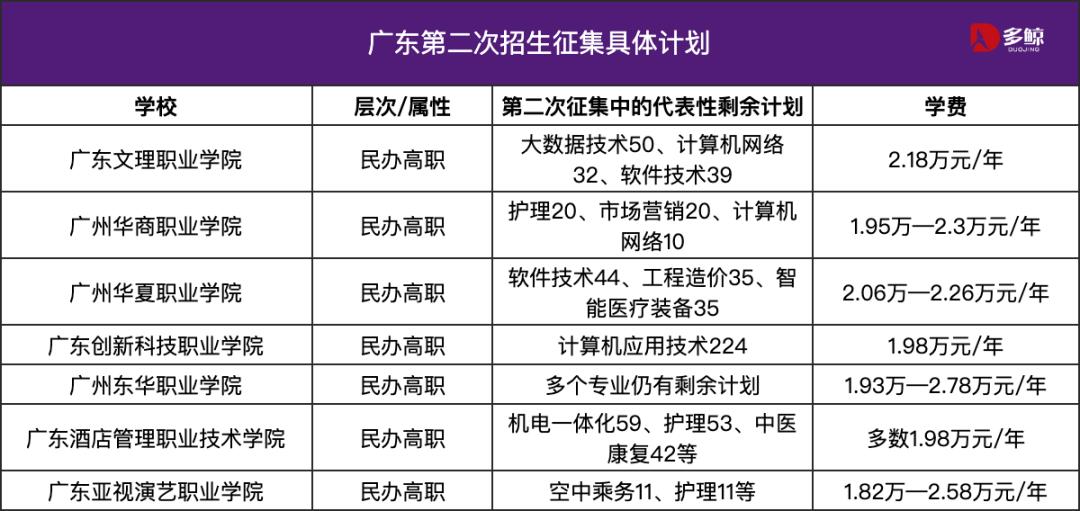
A more typical example is Guangdong College of Arts and Sciences. In addition to ordinary computer and big data majors that still need the second round of supplementary enrollment, the tuition fee of some mutual credit recognition programs reaches 25,800 to 36,000 yuan per year; the tuition fee of a Sino-foreign cooperative digital media technology major in Guangzhou Donghua Vocational College is 27,800 yuan per year, which also entered the second round of supplementary enrollment.
Behind this is an account that families are increasingly able to calculate clearly. With an annual tuition fee of about 20,000 yuan, plus accommodation and living costs, the total investment for three years of higher vocational education can easily exceed 100,000 yuan; if the annual tuition fee further rises at the undergraduate stage, the total cost for four years may reach more than 100,000 yuan or even 200,000 yuan.
When the gap in employment expectations does not widen synchronously, the combination of "academic level + school brand + city + major + tuition fee" will be re-evaluated.
But this also cannot lead to the conclusion that "private colleges can no longer attract students". Jiangxi University of Technology disclosed that in 2025, all its undergraduate enrollment quotas were fulfilled at one time, and the freshman registration rate for undergraduate programs reached 94%; at the same time, the school increased the enrollment quotas for science, engineering and medical majors by 1161, raising their proportion from 37% to 54%.
What is really happening is not simply "public colleges are popular while private colleges are cold", but the differentiation within private colleges is accelerating.
Schools with strong enough brands, geographical advantages, major settings and employment capabilities can still complete enrollment expansion; for colleges and universities lacking differentiated advantages, once they face both high tuition fees and large-scale enrollment quotas, the pressure will be amplified rapidly.
03
Even popular majors can have unfilled quotas,
What is the problem?
Looking at majors, there is another more noteworthy change in this year's supplementary enrollment. In the past, when people mentioned cold enrollment, they would easily think of traditional "unpopular majors" such as civil engineering, tourism management, hotel management, marketing and foreign languages.
These majors do still frequently appear in the supplementary enrollment list. But the data of 2026 shows that the label of "popular major" can no longer guarantee sufficient enrollment.
In the second round of supplementary enrollment in Guangdong, a group of majors appeared as follows:
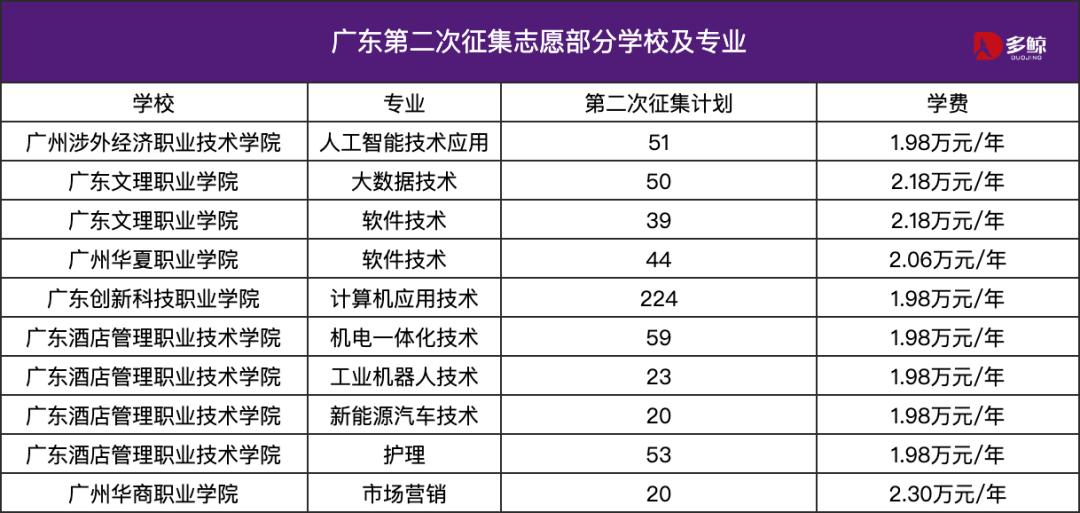
Artificial intelligence, big data, software technology, industrial robots, new energy vehicles, nursing — these are not "unpopular majors" in the usual sense, but they still entered the second round of supplementary enrollment.
This shows that when discussing "which majors cannot be fully enrolled" today, it is easy to make misjudgments if we only look at the names of majors.
What students really choose is not a "computer major" in the abstract, but the computer major in a specific school; nor do they simply choose "artificial intelligence", but judge what kind of training quality, internship opportunities and employment prospects this school can provide, and whether all of this is worth the tuition fee of nearly 20,000 yuan or even higher per year.
Therefore, it is not that "no one wants to study AI majors". The popularity of a major is increasingly unable to offset the impact of school level, education quality and cost alone.
The computer major in a top university, the computer major in a public higher vocational college with rich industrial resources, and the computer major in an ordinary private higher vocational college with an annual tuition fee of more than 20,000 yuan are obviously not the same choice in the eyes of students.
The basic unit of enrollment competition is changing from "major" to: school + major + city + tuition fee + employment.
04
After admission,
A number of students still choose not to register
Supplementary enrollment answers the question of "whether the admission is completed". When the school opening season comes, we need to continue to look at the second indicator: whether the students actually come after being admitted. Because "the number of admitted students" and "the number of actually registered students" are never the same thing.
As of September 9, the 2026 freshmen are still registering one after another. From the disclosed data, the gap between different schools can be clearly seen.
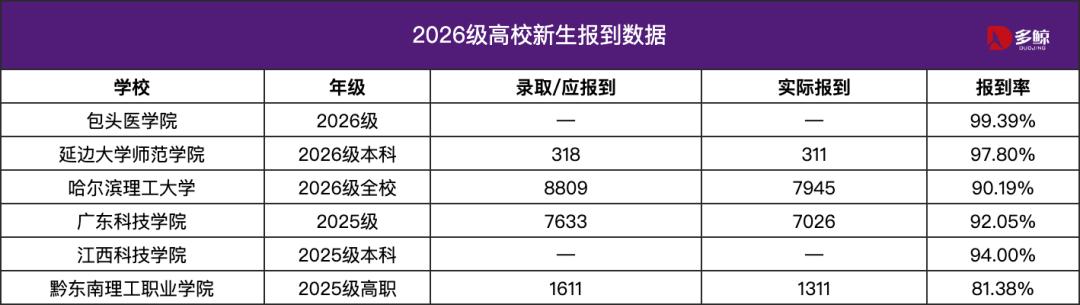
Baotou Medical College disclosed that as of August 30, the registration rate of 2026 freshmen reached 99.39%; the Normal College of Yanbian University admitted 318 undergraduate freshmen, 311 of whom actually registered, with a registration rate of 97.8%. As of September 7, Harbin University of Science and Technology should have 8809 registered students, and 7945 actually registered, with an overall registration rate of 90.19%.
If we go back one year, famous universities also have the phenomenon of "admitted but not registered", but the scale and nature are often different.
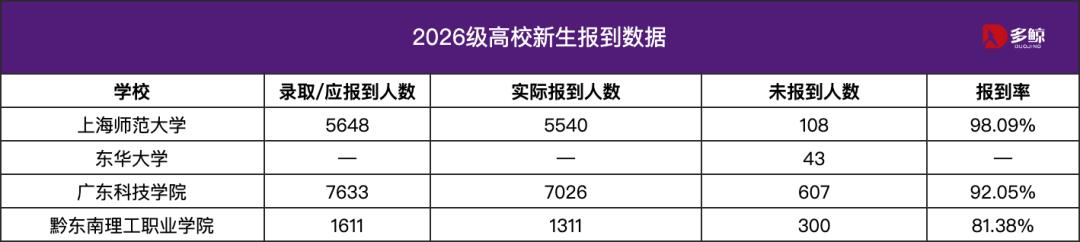
But even for famous universities, the phenomenon of "not registering after admission" will not disappear completely. Retaking the college entrance examination, going abroad, changes in further study plans, etc., may all cause a certain proportion of natural attrition.
But the key to judging enrollment pressure still lies in which level the attrition occurs at. In 2025, Guangdong University of Science and Technology planned to enroll 7650 students, and finally admitted 7633 students, with an enrollment quota fulfillment rate as high as 99.78%, but only 7026 students actually registered, with a registration rate of 92.05%. This belongs to the situation of "basically full enrollment, but about 8% of admitted students are lost after admission".
Qiandongnan Polytechnic Vocational College presents another situation. In 2025, the school planned to enroll 2090 students, and actually admitted 1611 students, with a total quota fulfillment rate of 77.08%; among them, the quota fulfillment rate for the general college entrance examination was only 56.77%. Among the 1611 students who had been admitted, only 1311 finally registered, with a registration rate of 81.38%.
This is the more alarming "double attrition": the first round is that the enrollment quota itself is not fulfilled; the second round is that the students who have already received the admission notice finally do not come.
For colleges and universities, the impact of the two situations is completely different. A small number of candidates giving up a top university does not mean that the school lacks student sources, and the vacated quotas may even come from personal choices under extremely high competition.
However, if a school has gone through multiple rounds of supplementary enrollment and still has a low quota fulfillment rate, followed by a low registration rate of admitted students, then the enrollment pressure will evolve from a one-time voluntary application problem to a long-term attractiveness problem of the school.
05
Behind the differentiation of student sources,
Colleges and universities have entered the era of value competition
If we want to draw a conclusion for the 2026 college enrollment, the statement that "no one wants to go to university" is obviously inaccurate. The Ministry of Education is still promoting the improvement of quality and expansion of scale of higher education, and a number of colleges and universities are still increasing their enrollment quotas; many private higher vocational colleges and vocational undergraduate colleges in Guangdong also chose to expand enrollment this year. On the other hand, Shandong University, Ocean University of China and other colleges and universities still have stable student sources, and some private colleges can also