The maximum proxy purchasing fee reaches 1,000 yuan, and the Apple iPhone 18 series and foldable screen products have been widely hyped even before their official release.

Image source: Jiemian Gallery
Apple's autumn new product launch event is around the corner, and the proxy queuing service for the iPhone 18 series and the brand's first foldable smartphone has become extremely popular.
On September 9, Jiemian News checked on second-hand trading platforms and found that the proxy queuing fee for the iPhone 18 series ranges from 199 yuan to 499 yuan, and the fee for the foldable model is about 200 yuan to 600 yuan. The proxy queuing fee for the Hong Kong version of the iPhone 18 series is even higher, reaching 1000 yuan to 1500 yuan.
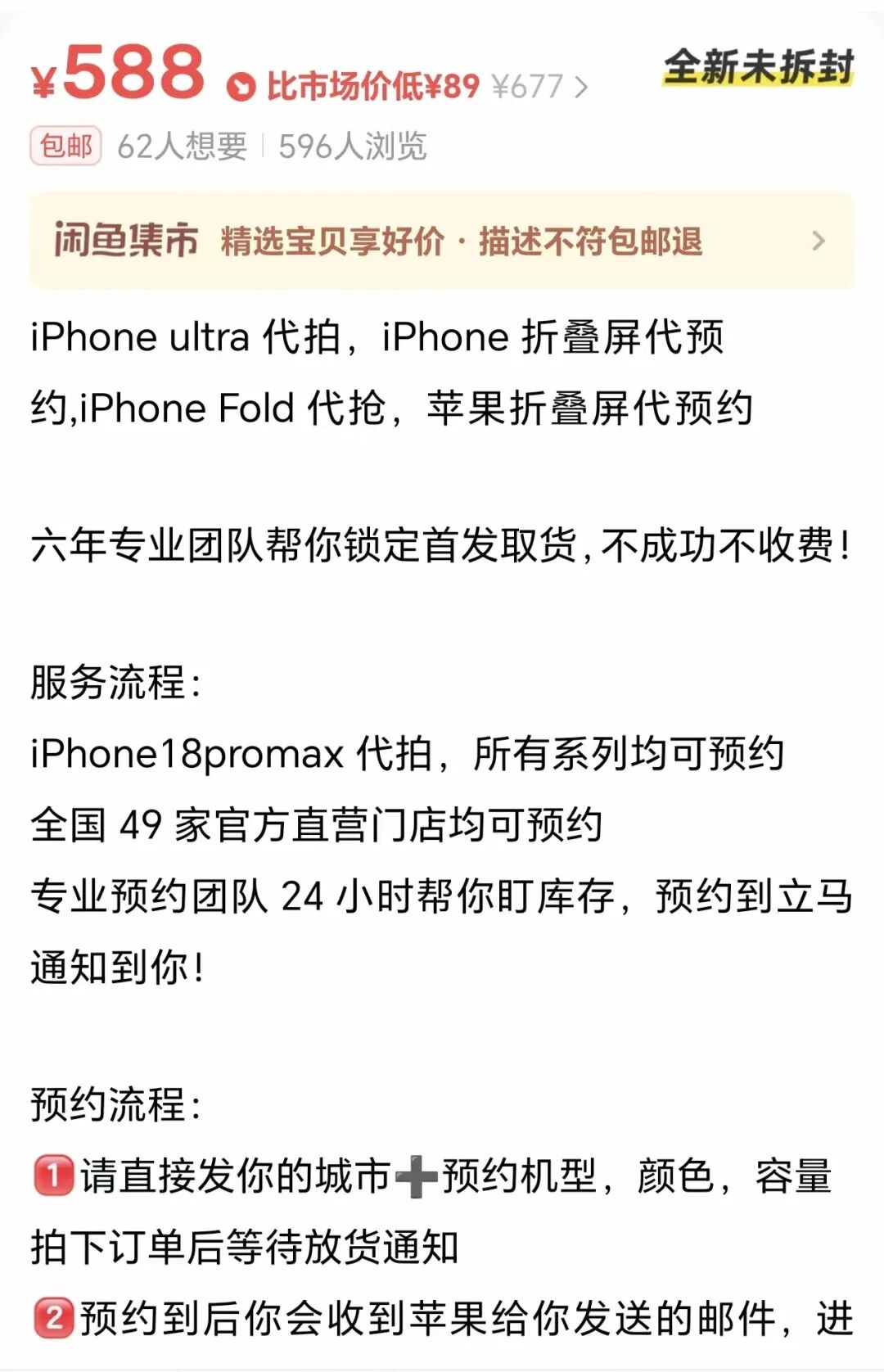
When a reporter from Jiemian News, posing as a consumer, consulted a proxy purchaser about what information was required for the service, the person replied that an ID is needed to place the order, and payment should be made via email after the reservation is confirmed. "If you are worried, just register a new ID or buy one for a few yuan." Registering a new ID requires providing a mobile phone number, the last four digits of the ID card number, payment method, and the city for device pickup, etc.

According to Beijing Daily, some proxy queuing services even require users to provide and log in to their e-commerce accounts such as Taobao and Pinduoduo to grab the products. Jiang Han, senior researcher at Pangoal Institution, stated that providing Taobao accounts and personal information means giving away real-name personal information, delivery addresses and even payment permissions, which can be easily exploited by illegal cyber groups for money laundering or fraud. Abnormally high-frequency and cross-region logins may also trigger the platform's risk control mechanism and lead to account bans. In case of disputes over funds or devices, private transactions lack platform guarantees, making consumers vulnerable to losing both money and products. People should firmly reject such high-risk operations and choose official and formal purchase channels.
This year's Apple autumn launch event will start at 1 a.m. Beijing time on September 10 at the Steve Jobs Theater, with the theme "Open a New Chapter, Shine Bright". This is also the first launch event after new CEO John Ternus took office. It is expected that the new flagship iPhone 18 Pro series will be released during the event, and the foldable iPhone Ultra will be launched for the first time.
The foldable smartphone launched by Apple this time has drawn widespread attention. Previous reports stated that Apple plans to produce 8 million to 10 million foldable iPhones within this year, and hopes to stimulate market demand with this model featuring a brand new form factor, so as to boost revenue. According to this production target, tens of thousands of foldable iPhones need to be produced every day under normal circumstances.
However, latest reports indicate that due to Apple's extremely strict quality control standards, the initial daily production volume of the first Apple foldable iPhone is only "several hundred units", while Apple and its suppliers are making every effort to ramp up production. This may further push up the price of the foldable smartphone.
The product prices of this Apple launch event have been leaked in advance. On September 7, citing foreign media reports, Huanqiu.com revealed that the backend price tags of Apple's overseas carrier Vodafone in Australia and Egypt were accidentally exposed, and the estimated regional selling prices of the iPhone 18 Pro, iPhone 18 Pro Max and the first foldable iPhone Ultra were made public.
Leaks from Australian channels show that the iPhone Ultra has three storage versions: 256GB, 512GB and 1TB, starting from 3699 Australian dollars (about 17,881 yuan). Industry insiders estimate based on this that the starting price of the US version of Ultra may be around 2000 US dollars (about 13,425 yuan). It should be noted that these prices are only reference prices pre-entered in the carrier's internal system, and do not represent the official pricing of Apple.
Since the beginning of this year, against the backdrop of memory shortage, major smartphone manufacturers including Apple, Huawei and Xiaomi have raised prices for many times. According to the latest global smartphone price trend tracker released by Counterpoint Research, since 2026, the average retail price of smartphones sold worldwide has risen by 15%, and the price of some models has nearly doubled. As the costs of memory and other components continue to rise, OEMs are constantly passing the higher costs on to consumers.
Against the general downward pressure on the smartphone market, the foldable phone segment has bucked the trend and achieved growth. According to CCTV News, data from market research institutions shows that from January to August this year, the sales volume of domestic foldable smartphones reached about 4.5 million units, among which the total sales of new-form products, including compact small foldables, large foldables and tri-fold phones, exceeded 1.35 million units, a year-on-year increase of 29%.
According to the quarterly foldable display panel shipment and technology report released by Counterpoint Research in July, the total shipment of foldable smartphone panels in 2026 is expected to reach about 27.5 million units, a year-on-year increase of about 24%; the revenue is expected to reach about 44 billion US dollars, a year-on-year increase of about 48%.
This article is from the WeChat Official Account "Jiemian News", author: Hou Ruining, published by 36Kr with authorization.