What impact will NVIDIA's acquisition of Hugging Face have on China's open-source models?
Nvidia is preparing to spend 12.9 billion US dollars to acquire a company that generated only 150 million US dollars in revenue last year.
Calculated by revenue, the acquisition multiple is roughly over 80 times.
This price is indeed extremely high, but it is actually acceptable once you understand that what Nvidia really wants to grab is the unavoidable entry point for developers — HF is the only way to go when searching for and downloading models, so it is naturally necessary for Nvidia to take such a critical hub into its own hands.
For domestic open-source models such as Qwen and DeepSeek, this hub used to be the most important post for going global. Most of the scenarios where models are discovered, tried out, and secondary developed take place here. Strictly speaking, HF has always been a US company, and the risk of export control is not something that only appears today; the real change brought by this acquisition is that the platform is now tied to the global computing power overlord, which is also the core enforcer of export control — the old risk is amplified, and a new variable of commercial bias is added: who is optimized by default, how the ranking caliber is determined, and where the one-click deployment points to, all have room for manipulation.
Then on August 14, Hugging Face itself released a report titled State of Open Models: Summer 2026. There is a section in the report with a very interesting title.
Qwen has become the community's base model.
Yes, Qwen has become the base model of this community.
What is more interesting is that Nvidia's own OpenCodeReasoning-Nemotron-7B, its model card clearly marks that it is derived from Qwen2.5-7B-Instruct, and the qwen2 tag is also hung on the page.
This makes the relationship between Nvidia and domestic enterprises represented by Alibaba quite complicated. Both sides are using the same family of open-source models, and both hope to make money from the computing power behind the models.
The difference is that Nvidia sells GPUs, while Alibaba sells cloud services.
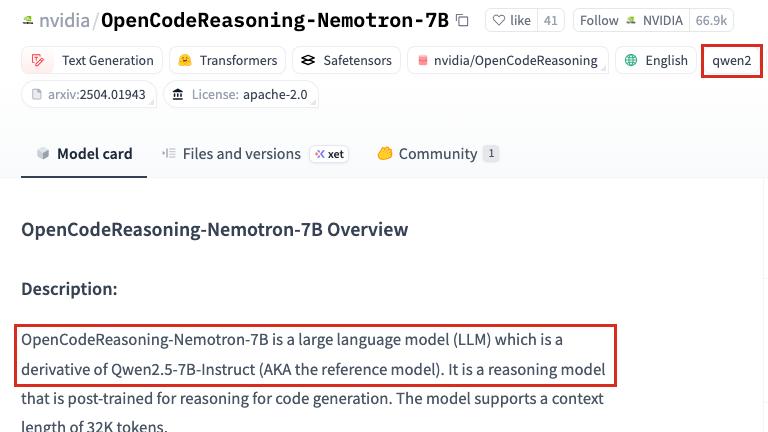
The part in the red box: Nvidia's official model card has the qwen2 tag, and the description clearly states that this is a derived model of Qwen2.5-7B-Instruct
Spending 12.9 billion on an entry point
What kind of place is Hugging Face? It is like a supermarket for AI models.
Developers usually come here first when looking for models, downloading weights, and checking deployment solutions. The platform barely makes money, and what is valuable is its position in the developer's workflow.
Nvidia does not lack growth either. In its latest quarter, its revenue reached 96.2 billion US dollars, and its data center business revenue was 89 billion US dollars, a year-on-year increase of 117%. The company even calculated its Chinese data center computing power revenue as zero in its revenue guidance, to prove that Nvidia's business can still grow rapidly even without the Chinese market.
Therefore, for Nvidia, the money spent on acquiring Hugging Face is more like buying insurance. Today, a large number of open-source models run on CUDA by default, but this sky-high bill is very envied by AMD, Google TPU, and cloud vendors' self-developed ASICs.
What Nvidia cares most about is that developers will always find CUDA the most convenient, no matter whether they change models or deployment methods.
However! Acquiring Hugging Face does not mean that you can modify the default settings of the platform at will. The value of the platform comes from its neutrality, and it supports AMD, AWS Inferentia, and Google TPU at the same time.
If Nvidia turns it into an exclusive platform for its own products, it will inevitably severely damage the asset it just bought.
Therefore, we can infer a more realistic approach: Nvidia is very likely to influence some seemingly trivial choices, such as who can get the first-day adaptation faster; which set of tools is prioritized for the recommended deployment plan; what caliber is used for the performance ranking; which cloud the one-click deployment jumps to by default, and so on.
After acquiring HF, Nvidia does not need to directly suppress competitors such as AMD on the platform, as long as its own integrated software and hardware ecosystem continues to become the option with the least resistance.
For domestic models that rely on HF to go global, this means that they are on a platform that they cannot fully control, facing a rule environment that is increasingly likely to be biased.
How influential is Qwen in this entry point
Let's look directly at the data from Hugging Face itself: there are a total of 151,448 derived models modified based on Qwen.
What does this mean? Google can only rank second, with only 82,506; the number of Qwen-derived models is about 2.6 times the sum of the Meta series, and 4.7 times if only Llama is counted.
And this number is constantly rising. In the first 7 months of 2026, Hugging Face added 180 to 210 new Qwen-derived repositories on average every day. At this rate, more than 60,000 new projects will be added in a year.
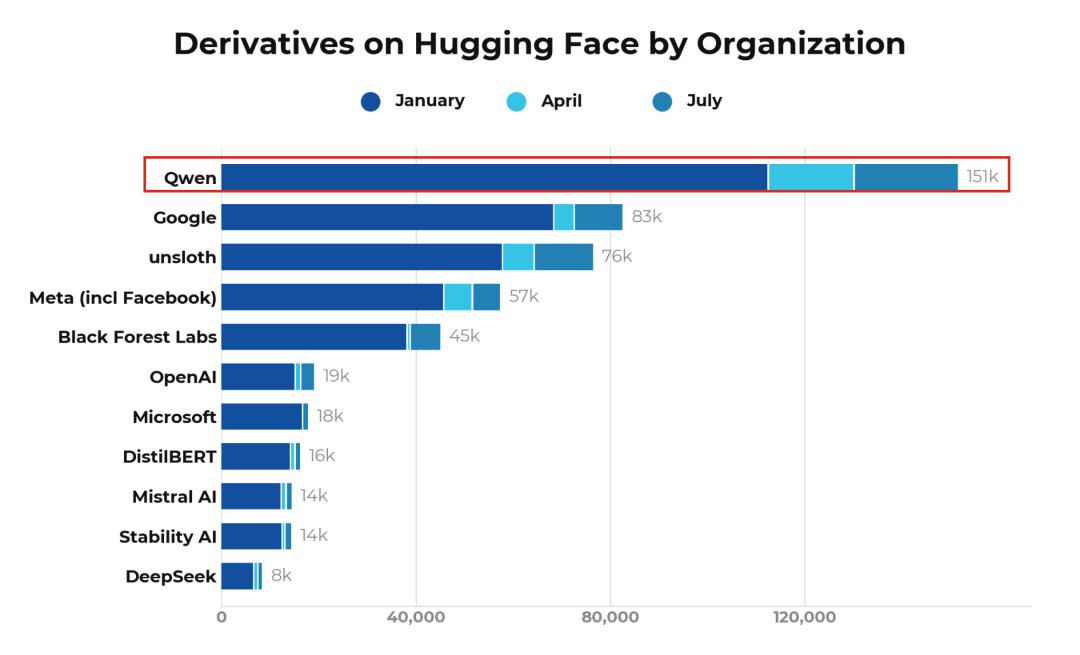
The part in the red box: There are 151k Qwen-derived models, nearly twice that of Google, the second-ranked player. Source: Hugging Face
The local operation data can better illustrate the actual usage. GGUF is a commonly used format for developers to download models to local devices for operation. Calculated by month, Qwen has 39.6 million downloads, Gemma has 20.8 million downloads, and Llama has 7.5 million downloads; Qwen is more than 5 times that of Llama.
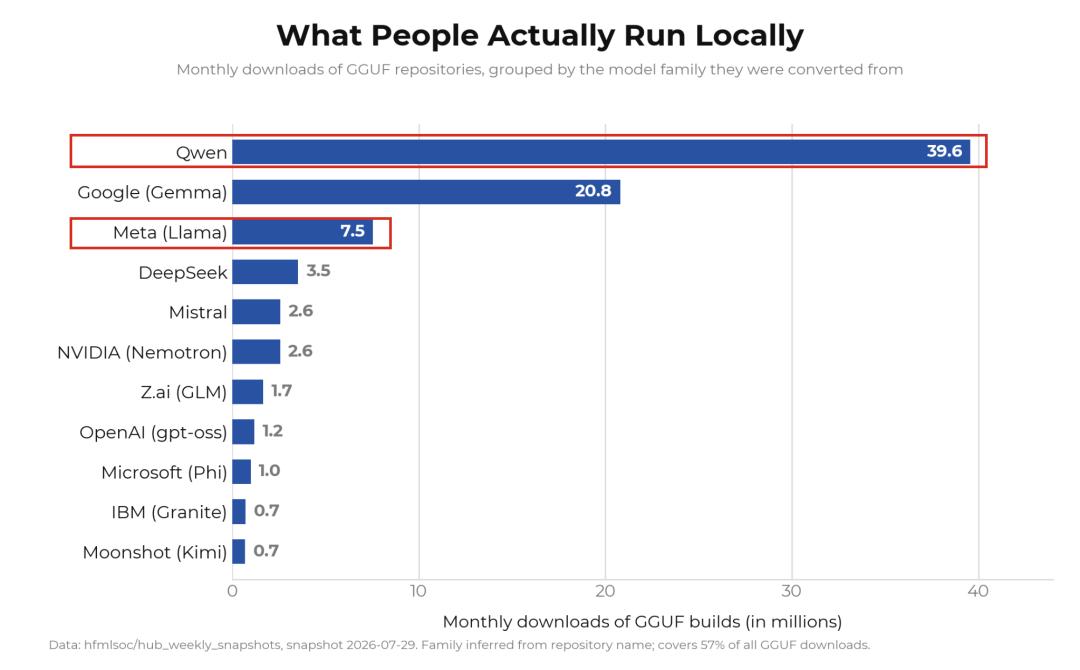
The part in the red box: For developers' local actual operation, Qwen has 39.6 million monthly usage, more than 5 times that of Llama's 7.5 million. Source: Hugging Face
Why open-source Qwen to the public
Models as popular as Qwen and DeepSeek, why do domestic enterprises open-source them?
First of all, this is an active ecological strategy, not a passive concession of benefits.
Model weights can be free, but reasoning, APIs, Agents and cloud computing power all require payment. After developers use open-source models to make products and enter the deployment stage, domestic cloud vendors will have one more chance to get orders.
Alibaba is also pushing this usage habit to downstream users. On May 26, Alibaba Cloud released the overseas version of Qwen Cloud in Singapore, and simultaneously launched the Agent product MuleRun, the programming platform Qoder, and held a hackathon for global developers. It did not build another overseas version of ModelScope to compete with Hugging Face for model hosting — because the hosting platform itself has thin profit margins. What Alibaba thinks is to bypass hosting and directly compete for the reasoning entry point.
DeepSeek also chose the parallel path of open-source weights and its own API, guiding developers to the controllable service layer.
Secondly, open-source also allows domestic manufacturers to avoid the head-on consumption war of closed-source models. OpenAI and Anthropic have already occupied brand awareness and API usage habits; it is too difficult to convince users to switch closed-source services. The threshold for open weights is much lower, developers can use it for free first, and then decide whether to stay for a long time.
Third, more than 150,000 derived models are also equivalent to a large-scale free test. Some people put Qwen into mobile phones, some use it to process medical Q&A, legal documents and minor language translation. Alibaba cannot cover all scenarios by itself, developers can do it for it, and continuously feed back problems and improvement directions.
At this point, the intention of giving away models for free is already very obvious: open-source models are an excellent magic weapon for selling computing power.
The Hugging Face report also mentioned that the two companies that released the most open-source models in 2026 are AMD and Nvidia. It is not difficult to understand why they do this, because open models optimized for their own hardware are themselves a proof of performance.
The report's judgment on commercial returns is also very straightforward: these models are not designed to collect licensing fees, and the benefits are earned from APIs, cloud services, hardware sales and platform positions. In other words, the models are responsible for attracting traffic, and the underlying infrastructure is responsible for making profits.
From this perspective, what Nvidia and domestic cloud vendors are doing is actually the same action — both are using free models to attract customers for their own computing power.
The difference is that Nvidia only has the chip layer; while domestic enterprises including Alibaba not only have models, clouds, but also their own chips.
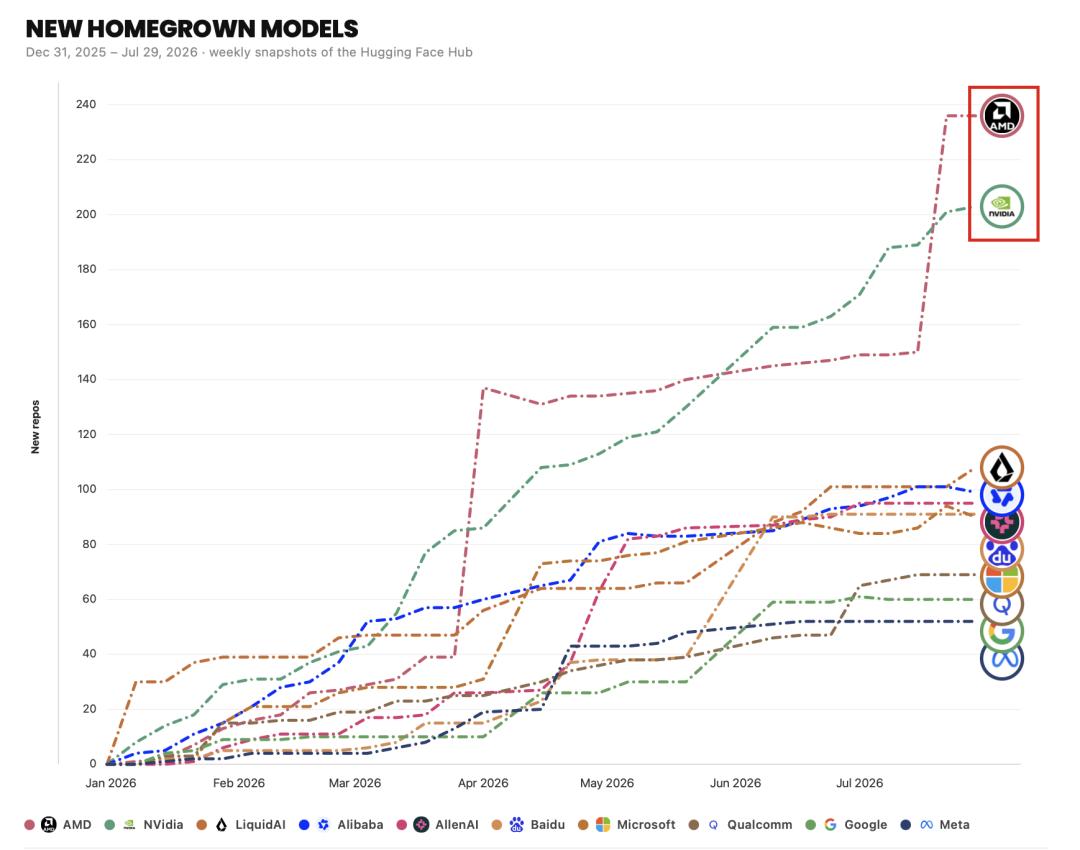
The part in the red box: The two companies that released the most new open models this year are hardware manufacturers AMD and Nvidia. Source: Hugging Face
Nvidia buys positions, Alibaba cultivates usage habits
For the same business, the two sides adopt completely different strategies.
Nvidia buys the path. Nvidia's approach is very straightforward: after acquiring Hugging Face, it has the opportunity to influence what developers see first and what is easiest to deploy. It does not have to explicitly exclude anyone, it is enough to move the default value slightly towards its own side. This is an expensive investment but brings quick results.
Alibaba cultivates habits. Qwen maintains a complete layout from small models that can run on mobile phones to flagship models. The Hugging Face report points out that developers tend to build standards around a model family, rather than picking a single flagship model each time. After getting familiar with small models, the cost of continuing to use the same family of models for large projects is lower, because the toolchains, prompts and fine-tuning scripts will all be retained.
Alibaba is also working hard to push this usage habit to downstream users. On May 26, Alibaba Cloud released the overseas version of Qwen Cloud in Singapore, and simultaneously launched the Agent product MuleRun, the programming platform Qoder, and held a hackathon for global developers.
More critically, Alibaba is stringing together "model-cloud-chip" into a complete line:
Model layer: The Qwen series is open-source, covering the full spectrum from end-side small models to flagship large models;
Cloud layer: Overseas version of Qwen Cloud, Alibaba Cloud API, MuleRun Agent, Qoder programming platform;
Chip layer: T-Head Zhenwu M890 training and inference integrated chip, Panjiu AL128 super node.
It did not build another overseas version of ModelScope to compete with Hugging Face for model hosting. The reason is very realistic: the hosting platform really does not make money. Hugging Face's annual revenue is only about 150 million US dollars, and the real large-scale revenue comes from reasoning calls and cloud resource consumption. What Alibaba thinks is to bypass hosting and directly compete for the reasoning entry point.
On May 20 this year, T-Head released Zhenwu M890. The cumulative shipment of the Zhenwu series is about 560,000 chips, covering more than 400 customers. 6 days later, the overseas version of Qwen Cloud was released. The chip and the overseas cloud entry point were unveiled in the same week, indicating that Alibaba is putting the three layers into the same business arrangement.
This part of the business has already generated revenue. The financial report on August 20 shows that Alibaba's AI Cloud and Compute Services division recorded a revenue of 48.437 billion yuan, a year-on-year increase of 45%. Among them, the revenue of AI-related products was 12.376 billion yuan, achieving double-digit year-on-year growth for the 12th consecutive quarter; the adjusted EBITA increased by 133% year-on-year.
12 consecutive quarters of triple-digit growth means a full 3 years, every quarter is at least double the same period of last year.
The dual significance of Qwen
At the moment, Nvidia is the first to get benefits.
If Nvidia buys Hugging Face for 12.9 billion US dollars, one of the most active model ecosystems on the platform is Qwen, and it does not need to pay a penny to Alibaba for this. The wider Qwen is used, the more reasoning loads it will bring; today, a considerable part of these loads still fall on CUDA and run on Nvidia GPUs.
This is a normal commercial behavior under the Apache 2.0 license. Anyone can use it for derivation and commercial use, which is the path that domestic manufacturers took the initiative to choose. Alibaba has no intention of collecting money for model licensing, what it values is the subsequent revenue — the money from cloud services, APIs, and chips.
Therefore, domestic enterprises have worked hard to open-source the models, and Nvidia may still be the first to make money from the new computing power demand.
However, the concentration of models also reduces the difficulty of challenging CUDA.
As we all know, CUDA's moat is not only GPU performance, but also the low friction brought by the entire toolchain. For example, codes, libraries, tuning experience and deployment processes are all built around CUDA, so continuing to purchase Nvidia products is usually the most convenient choice.
When popular models are very scattered, peers such as AMD want to challenge this default choice, they need to prove that tens of thousands of models can run stably, which is too costly.
If developers' workloads gradually concentrate on a few model families such as Qwen, the test paper becomes much simpler. AMD only needs to adapt these models well, and it can directly take away part of the workload that originally naturally fell on CUDA.
This is already reflected in the first-day support. When Qwen releases a new model, AMD will immediately complete the adaptation, so that developers do not need to wait for several months. From Qwen 3.5, 3.6 to 3.8, AMD has followed up for multiple consecutive generations. For developers, the choice may change from "running large models must use CUDA" to "when running Qwen, both Nvidia and AMD are available".
Alibaba is also supplementing its own chips — the scale of 560,000 chips certainly cannot compete with Nvidia. Nvidia's single-quarter data center revenue has reached 89 billion US dollars. The realistic goal of Alibaba making chips is to reduce the operating cost of Qwen on its own cloud and external procurement.
Therefore, Qwen is producing two parallel effects:
In the short term, most of the new loads it creates will still benefit Nvidia;
In the medium and long term, it also cultivates a large enough common workload for alternative solutions such as AMD and Alibaba's self-developed chips.
What Nvidia will really worry about is that Qwen continues to expand, and developers begin to not care whether the underlying layer is CUDA.
From this point of view, what the 12