Large models are getting increasingly intelligent, yet they still always fail to "remember you"? Origin Stone Technology leverages cognitive systems to build a long-term AI layer that can represent "you".
Neural Stone Technology Solves the AI Discontinuity for Knowledge Workers with Cognitive Systems
Large language models are becoming increasingly adept at answering questions, but for people who need to process complex information over a long period of time, a new contradiction is emerging: AI is getting smarter, yet it still struggles to continuously and fully understand the same individual.
A product manager may have discussed product solutions with AI dozens of times, an entrepreneur may have formed a large number of judgments over several months, and a researcher may have accumulated years of materials, notes and research contexts. However, when a new AI interaction starts, past experiences, judgments, personal relationships and unsolved problems often still need to be re-searched, re-organized and re-interpreted.
At the same time, most of today's AI understanding of humans still mainly occurs in digital interactive interfaces. AI starts working only after users input a text, upload a document or raise a question. But the real work and life experiences of a person do not only exist in the chat window.
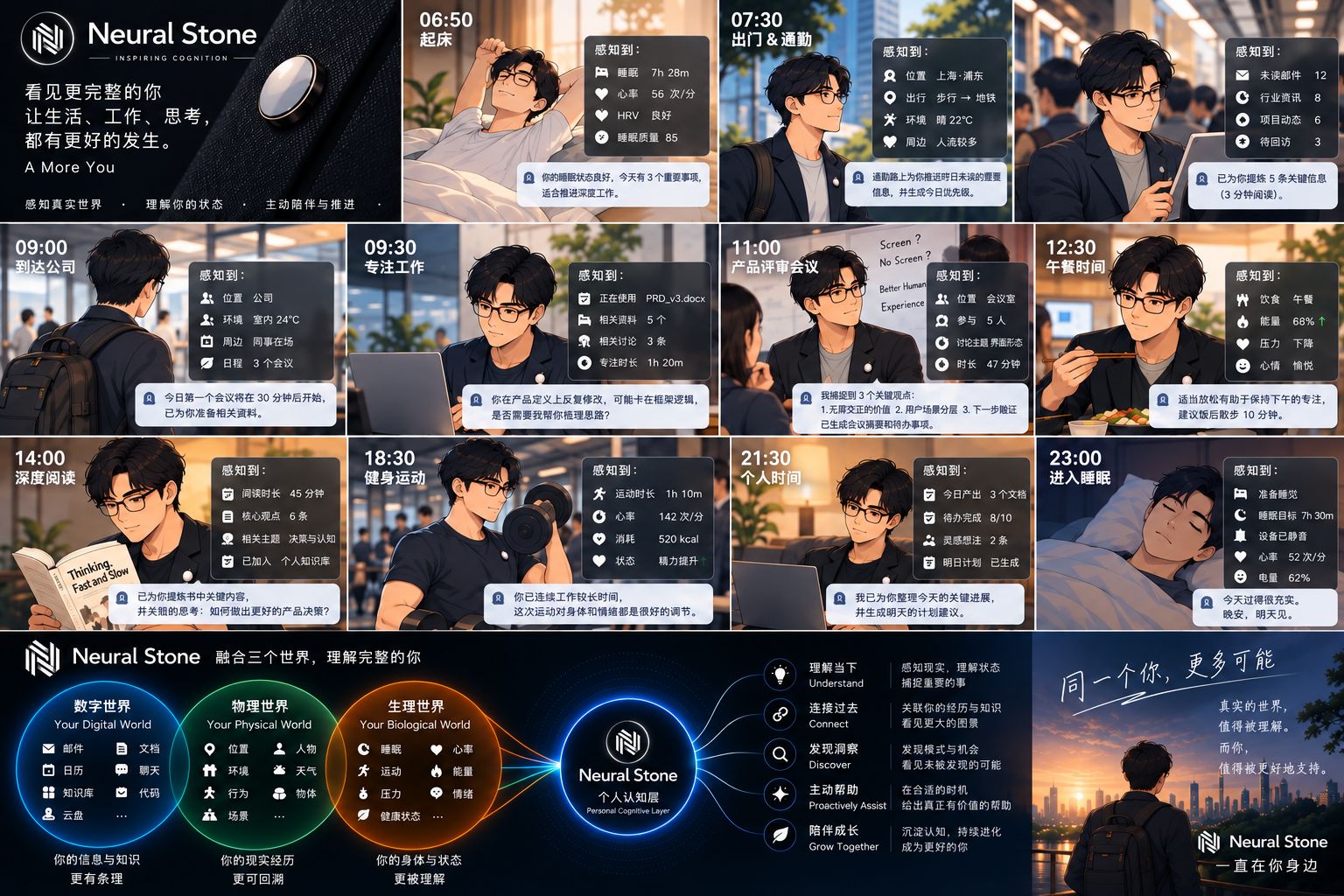
Sleep and physical state when waking up in the morning, location and environment during commuting, files and tasks being processed at work, participants and discussion content in meetings, and judgments formed around the same issue over the past weeks — all this information together constitutes a person's real context at a certain moment.
Human cognition itself has obvious resource constraints. Psychologist George Miller's research on short-term memory capacity (Miller's Law, 7±2) shows that the number of pieces of information that humans can process simultaneously is limited; Anthropologist Robin Dunbar's research on the scale of stable social relationships (Dunbar's number, 150±50) explains from the perspective of social cognition that there is also a boundary to the complex relationships that humans can maintain for a long time. Although the two studies have different research objects, they both point to a fact: human attention, memory and relationship processing capabilities are not infinite.
Herbert A. Simon, Nobel laureate in Economics and one of the early founders of artificial intelligence, put forward the theory of "bounded rationality". He believes that individuals in reality cannot obtain all information, exhaust all solutions and complete unlimited calculations. Therefore, decision-makers usually do not look for the absolute optimal solution, but look for a "satisfactory enough" solution under the conditions of limited information, time and cognitive ability.
More information does not necessarily mean that human judgment will become better. What is truly scarce is not the information itself, but the ability to continuously retain important experiences, connect relevant contexts, and re-invoke them at the right time under limited cognitive resources.
Neural Stone Technology is trying to solve this "personal context discontinuity".
The team's developed Neural Stone is positioned as a Personal Cognitive System, which attempts to establish a long-existing Personal Cognitive Layer between general intelligence and individuals: continuously perceive and understand the user's current state, connect truly relevant information from the past, discover patterns and changes across time, actively provide assistance at the right time, and precipitate newly formed important cognition back into the long-term system.
Its goal is not to let AI store all the information of a person, but to make AI gradually move from understanding "what the user told this time" to perceiving and understanding a long-term, continuous person in the real world.
Ray Dalio's latest long article "2026, Very Similar to 1929" proposes that as more and more computable mental labors are automated by AI, individuals need to further improve their ability to use AI to enhance their own cognition and adapt to the environment. Compared with predicting which specific skill will not be replaced in the future, it may be more important to continuously improve cognitive ability and use AI to amplify personal capabilities.
What AI lacks is not just memory, but a continuous "you"
Neural Stone does not first target the scenario where "large models cannot answer questions", but two discontinuities generated during the long-term collaboration between humans and AI.
The first is the temporal discontinuity.
People's ideas, materials, meetings, decisions and experiences occur at different times and are scattered in different tools. The real problem is often not that "the file cannot be found", but that the understanding formed in the past cannot re-participate in today's judgments at the right time.
The second is the real-world discontinuity.
Most AI understands users mainly through information actively provided by users. But real people live in both digital and physical environments, and have constantly changing physical states. Relying only on a single conversation is difficult to form a complete understanding of a person's current state.
Neural Stone addresses current market pain points: many real problems initially only feel "something is wrong" or "a little stuck", and have not yet formed a complete problem that can be directly raised to AI; past materials, meetings, decisions and experiences are difficult to play a role again today; although general AI has strong understanding and generation capabilities, it still lacks sufficiently continuous personal context for a person's judgment style, long-term relationships, recurring patterns, and how this person is changing.
Therefore, Neural Stone is not designed as a traditional knowledge base, nor does it plan to retrain a larger-scale foundation model.
Its current core is a unified main cognitive chain.
Users do not need to organize the problem completely first. A vague idea, a document, a natural expression, or even just "there seems to be a problem here" can be the starting point for the system to perceive and understand the user's current state. The system first judges whether the user is expressing, judging, acting or supplementing information, and then decides how to follow up.
Subsequently, the system reconnects current information with past related themes, materials, people, decisions and unresolved issues through mechanisms such as long-term cognitive assets, personal cognitive graphs, semantic recall and Cognitive Weaving.
The key here is not to "remember more".
What Neural Stone tries to solve is: what information from the past has become important again now, and why.
For example, a product manager is re-discussing a certain product decision. A traditional retrieval system can find a PRD from three weeks ago, while a personal cognitive system needs to further understand: what judgment was formed three weeks ago, what information was based on at that time, what new evidence has emerged today, and whether these changes are sufficient to modify the original judgment.
Therefore, the technical focus of the project is not to infinitely expand the memory capacity, but to make the long-term personal context truly participate in every current understanding and judgment.
On this basis, Neural Stone further attempts to move from "information recall" to "cognitive advancement": identify real stuck points, key differences and judgment criteria, help users form a clearer next step; new important themes, decisions, relationships and patterns re-enter the long-term system, and existing understanding can also be corrected with new evidence.
This forms a continuous cycle: understand the present → connect the past → advance the current situation → write back to the long-term system → participate in the future again.
This is also the main difference that Neural Stone tries to establish with traditional notes, knowledge bases and general AI. The former mainly relies on users to actively save, organize and search for information; general AI is better at answering, generating and analyzing around current tasks; what Neural Stone hopes to add is long-term personal context, so that themes, decisions, relationships and patterns can evolve over time and continuously participate in current cognition.
Integrate the digital, physical and physiological worlds to understand what really happens
Long-term memory solves the problem of "the you in the past". The problem that Neural Stone will solve in the next stage is how to perceive and understand "the you at present" more completely.
The team's ongoing long-term product framework divides a person's context into three interrelated information dimensions: the digital world, the physical world and the physiological world.
The digital world includes information and behaviors in emails, documents, calendars, chats, knowledge bases, codes, web pages and other applications; with the future integration of wearable devices and sensing capabilities, the physical world including location, people, objects, environments, behaviors and real events will be connected; by opening up data from third-party devices, physical states such as sleep, exercise and heart rate may also form part of the physiological world.
The three worlds are not three independent functional modules. They describe different sides of the same person, at the same time, in the same event.
Take a product review meeting as an example.
In the digital world, there may be the PRD being discussed, past versions, related emails and decisions formed before; the physical world includes the meeting scene, participants and events happening on site; part of the physical state may also become a signal to assist in understanding the user's current state.
What Neural Stone needs to do is not to display the three sets of data to users separately. What really needs to be answered is: What do these pieces of information mean when put together?
If the meeting is re-discussing an issue that has already been judged three weeks ago, does new discussion produce evidence sufficient to change the original conclusion? Is the view put forward by a certain participant today related to the patterns in many previous project discussions? Has a problem that has remained unresolved for several weeks reached the time when a decision really needs to be made?
This means that the basic unit that Neural Stone hopes to process in the long run will no longer only be Message, Note or Document, but gradually expand to events and contexts (Event / Episode / Experience) that a person experiences in reality.
This is where real-world perception generates real value after entering Neural Stone.
The system knowing that "the user is in the meeting room", "the heart rate has changed" or "the user is opening a certain file" does not have much value in itself. The real product capability is to convert these signals into structured Evidence, connect them with the person's long-term context, and understand why they are worth noting.
Therefore, Neural Stone's complete capability chain will also gradually expand from the current "Understand — Connect — Advance — Evolve" to: Sense → Understand → Connect → Discover → Assist → Evolve.
Real-world perception is still in the stage of research and subsequent construction. In the future, hardware may obtain real-world environment information through Audio, IMU and low-resolution semantic vision, while avoiding long-term storage of worthless raw data as much as possible, and converting important changes into Evidence to enter the same cognitive system.
What Neural Stone ultimately hopes to establish is not another independent AI hardware, but a low-friction perception entry for the real world to enter the personal cognitive system.
Neural Stone's future Web, Mobile, AI Hardware and different data sources are not several independent products, but different entrances to the same Personal Cognitive Layer.
At the same time, the team is also carrying out research and technical exploration with teams related to neuromorphic computing, taking sustainable learning, brain-like memory and long-range reasoning as key research directions.
These issues are directly related to the long-term personal cognitive system: if a system needs to continuously receive new personal experiences over a time scale of several years, how to learn continuously without repeatedly retraining the entire system; how to decide what is worth remembering for a long time, what should be gradually faded, and how old cognition can be corrected by new evidence; and how to make important events separated by a long time truly participate in today's reasoning, all are problems that long-term cognitive systems need to face.
The team positions this part of work as cutting-edge research, not a productized capability that has been completed. At this stage, the core technical main line of Neural Stone is still the capabilities of unified Cognitive Runtime, long-term personal context, Recall, Cognitive Weaving and cognitive asset write-back.
Start verification from the Web, and gradually move towards a multi-terminal personal cognitive system
Neural Stone is still in the early product stage.
The main process and cognitive advancement of the Web-side product have formed the foundation, and the capabilities related to Recall and long-term assets, Cognitive Weaving and Graph are being continuously put into production; the Mobile side is under construction, and it is planned to share the same Cognitive Runtime and long-term personal context with the Web, instead of building a simplified or independent mobile-side system.
In the next stage, the team plans to further promote active cognitive capabilities such as Observation, Pattern, Decision, Relationship and Cognitive Emergence, so that the system will gradually move from "user invokes AI" to "AI actively perceives, and the system discovers things that are truly worthy of the user's attention at the right time".
After that, Mobile, cross-device cognitive continuity, AI Hardware and Physical Context will further expand the scope of context that the personal cognitive system can understand.
In terms of target users, Neural Stone first focuses on individuals with high cognitive density.
They include knowledge workers such as product managers, engineers and researchers, as well as writers, designers and content creators, as well as high decision-density groups such as entrepreneurs and managers. The common feature of these people is not their income level, but that they have long been dealing with complex problems, have high information density, run multiple projects in parallel, and the experiences and judgments formed in the past have high value for the future.
In terms of business model, the project currently plans to take B2C personal subscription as the core, and charge according to capability levels; subsequent Professional capabilities will be oriented to professional individuals and small high-cognitive teams, providing stronger data access, professional workflow and advanced cognitive analysis; cognitive hardware is a more long-term commercialization option, mainly for core users who have formed long-term use value. In the future, Cognitive Store will be launched in due course based on the development of corresponding technologies.
In terms of the team, co-founder Du Xiaodong has a master's degree in software engineering from Beihang University and Internet entrepreneurial experience. His previous entrepreneurial project U Zhanggui has received investments from Today Capital, Peak Capital and Haier Capital; Chief Algorithm Scientist RJ-Zhu holds a doctorate from the Department of Electrical and Computer Engineering, University of California, Santa Cruz, and his research experience covers directions such as neuromorphic computing; Chief Computing Power Architect YS has educational background related to robotics from Xi'an Jiaotong University and Duke University, and has experience in large model reasoning acceleration, model quantization and end-side AI deployment.
As foundation models continue to improve their reasoning, generation and multimodal capabilities, the problem that Neural Stone Technology bets on is not how to rebuild a larger model, but: after general intelligence becomes stronger and stronger, whether there is still a need for a long-term cognitive layer that represents "this person" between humans and AI.
Foundation models solve increasingly powerful general intelligence, while what Neural Stone tries to solve is how to make these intelligences understand and serve the same person for a long time — not only understand what the user said at the moment, but also connect what he experienced in the past, what he is experiencing now, and how these experiences are changing future judgments.
Wang Yuefei, a researcher at the Institute of Automation of the Chinese Academy of Sciences, mentioned in "The Knowledge Origin of Artificial Intelligence" that IoM (Internet of Minds) will be the era that human society will definitely enter after the Internet and the Internet of Things. Its core is to connect various AI agents, digital humans and large models. In the future, humans will communicate with AI agents, large models and others through digital humans with the help of the Internet of Minds. This model is far more powerful, more efficient and has a wider range of applications than the current brain-computer interface. This is also the extension and future development of the cybernetics and cognitive science ideas that Norbert Wiener pioneered back then in the intelligent era.