For just 500 yuan, you can purchase the full exclusive rights to a person's face. With AI short dramas targeting the silver-haired demographic, has the bulk "face selling" business become a highly coveted, lucrative hot ticket?
"200 yuan per year, 500 yuan for a lifetime license..." The business revolving around the portrait rights of the elderly is quietly on the rise in the short drama industry.
Since the beginning of this year, with the continuous development of AI technology, the production mode of short dramas has ushered in reforms. In the short drama industry, producing short dramas with AI technology is no longer a novelty. An AI tool can easily generate a 100-episode short drama with each episode lasting 2 minutes, which not only boasts high production efficiency but also costs less than real-person dramas.
However, over time, audiences have found that most AI-generated actors are largely identical, with stiff expressions and stereotyped facial features becoming the main reason why AI short dramas drive viewers away.
As a result, generating AI characters with real human faces has become a new business booming in the short drama industry. Production parties do not need real people to perform on site. Instead, by obtaining portrait authorization, they embed the faces of real people into virtual characters, and then AI completes the subsequent performance and content generation. Correspondingly, a previously inconspicuous "face-buying" industrial chain is surfacing.
AgeTravel finds that a large number of AI artist recruitment notices have appeared in the short drama market this year. The price of real-person portrait authorization ranges from hundreds of yuan to thousands of yuan, and the objects of AI portrait authorization have expanded from actors and internet influencers to ordinary people, including middle-aged and elderly people with distinct age characteristics and vivid life textures...
01
Selling your face for 100 yuan,
Middle-aged and elderly people enter the AI short drama industrial chain
If it were not for AI, 62-year-old actor Lawrence Ng would hardly return to the age of 20.
Just a month ago, when attending a new drama promotion, the famous actor Lawrence Ng revealed that he had authorized his portrait from the age of 20 to the production team for the production of an AI film. According to him, the production team will use AI to restore his appearance at a young age, and he can get paid without joining the filming crew. As for whether AI will take jobs from actors, he holds a very optimistic attitude, believing that it is more like adding a new development path for actors.
Almost at the same time, 59-year-old actor Joey Wong, who has been out of the public eye for more than 20 years, also reappeared in public view in a similar way. In the AIGC advertising short film *Qian Ying* released by a brand, AI was used to restore Joey Wong's screen image from the age of 20 to 30. For Joey Wong, who has not publicly appeared in film and television works for many years, this "comeback" is surprising, and it has also sparked extensive discussions in the industry about the "face-selling" business.

In April this year, a survey by *National Business Daily* found that information related to "face-buying" for AI short dramas has appeared in actor notification groups. Some portrait authorization quotes range from 500 yuan to 2000 yuan, and many transactions adopt the one-time authorization method.
Shortly afterwards, recruitment methods that price human faces according to the grades of "A+, A-, B+, B-" began to appear in the market, and qualified people can get corresponding remuneration. Some agency companies acquire the portraits of ordinary people at a price of 500 yuan a year, while some AI short drama companies offer quotes of only 100 to 200 yuan. People willing to participate are not limited to third- and fourth-tier professional actors, but also include internet influencers, students, and middle-aged and elderly groups.
In just a few months, AI has gradually turned the "portrait authorization" that used to belong to the links of star brokerage and film production into a standardized business for ordinary people.
Data from DataEye shows that the proportion of AI comic dramas in the top 100 comic dramas has risen rapidly from about 7% in early 2025 to more than 60%; in the first quarter of 2026, more than 100,000 various types of AI dramas and comic dramas were newly launched, of which AI realistic human dramas accounted for 55%.
However, characters generated only by text prompts are prone to inconsistent facial features, expressions and makeup between different shots. To keep the same character stable in consecutive shots, a real human face is needed as reference material.
As a result, the business of face authorization is quietly emerging in the industry.
Once a face is authorized, it can be imported into the model and become a stable digital character. This character does not require the person himself to join the crew, and is not restricted by schedule, region or even physical state. For production parties, this means that the cost that originally required repeated coordination with actors is compressed into one portrait collection and authorization; for ordinary people, it means that portraits that had almost no commercial value in the past have the opportunity to directly enter the content production link for the first time.
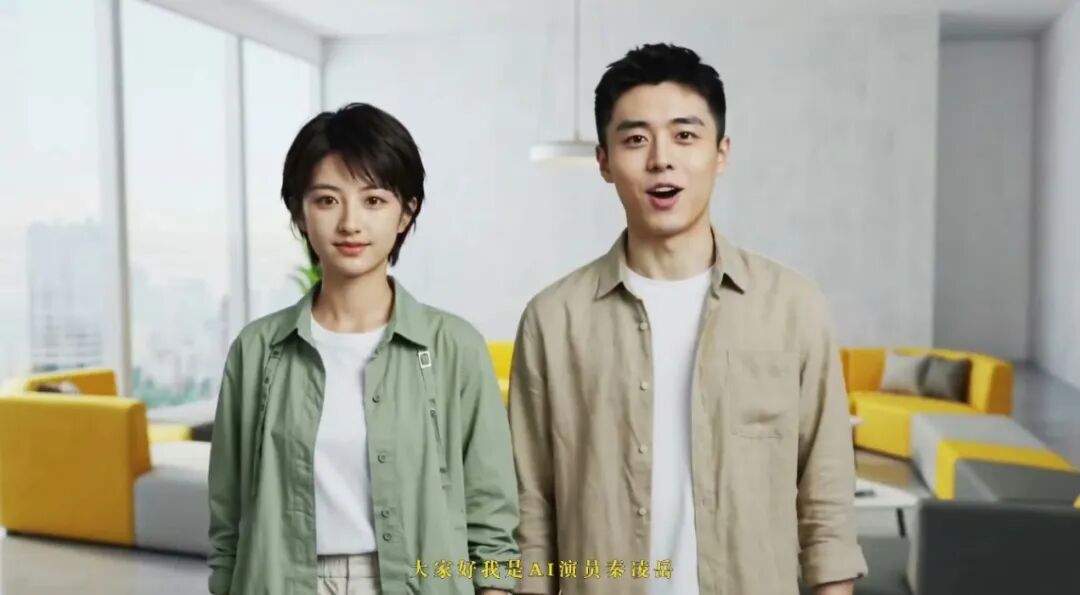
Among all groups of people's portraits, the middle-aged and elderly are the type with the largest demand and relatively low authorization cost in the short drama industry.
In the traditional film and television industry, young actors usually have higher commercial premiums, while ordinary middle-aged and elderly faces mostly take on functional roles. However, AI content production does not distribute demand completely according to the logic of traditional film and television. An AI short drama requires a large number of characters of different ages, occupations and temperaments, such as family elders like parents, grandmothers and grandfathers, elderly professional roles like bosses and doctors, and various supporting roles like neighbors and villagers...
This huge character matrix directly pushes the middle-aged and elderly groups to become highly sought-after resources in the digital transformation of the short drama industry. Between major film bases and professional brokerage companies, co-creation of digital portraits is gradually moving to the forefront.
Industry insiders revealed that some small companies, in order to acquire the right to use the images of the elderly, directly give away eggs at the gate of communities to attract people to sign and take photos, and the authorization fee is often hundreds of yuan. This kind of cooperation not only allows the silver-haired group to participate in short drama production in a brand new way, but also continuously supplies various character models for relevant companies.
02
Intermediaries collect faces in batches,
The "AI actor" business surfaces
In the industry, a standardized and platform-based path centered on portrait authorization is beginning to emerge. In April this year, iQiyi launched the film and television creation platform "Nadou Pro" and established an AI artist library, with 117 artists settled in the first batch.
However, the AI portrait authorization of stars solves the problem of how a small number of top talents continue to release their personal IP value; for the rapidly expanding AI short drama industry, the truly huge demand obviously cannot be met only by a limited number of stars.
All kinds of roles in the script require a large number of "real human faces" of different ages and appearances as materials. In this context, an intermediate business that matches supply and demand for AI portraits has surfaced.
Recruitment information such as "AI portrait authorization" and "AI actor" keeps appearing in multiple short drama actor groups and social platforms. Some people only need to provide 2 to 3 half-body photos, full-body photos and close-up facial photos, and then sign an authorization agreement to get a remuneration of about 100 yuan.
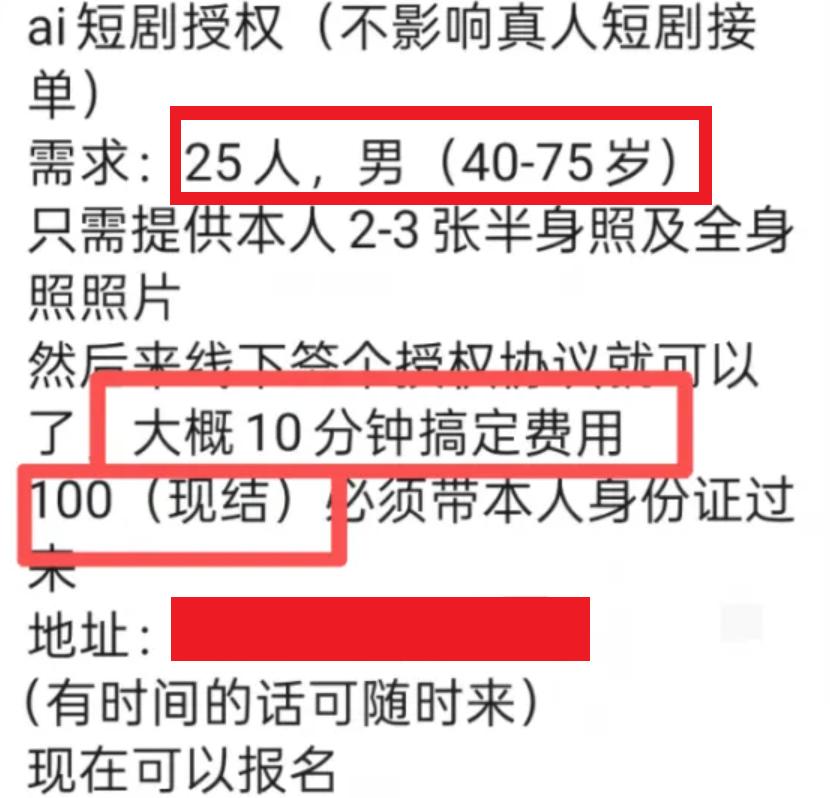
It is worth noting that a staff member of an AI short drama company clearly stated that with the increase in demand for portrait authorization, a large number of agency companies have emerged in the industry. In other words, "face-selling" is growing from scattered part-time information into an embryonic supply chain.
Its basic logic is not complicated: The agency is responsible for "collecting faces", the AI short drama company is responsible for "using faces", and pricing is carried out according to different durations, different roles and different authorization scopes.
A portrait resource intermediary once showed *National Business Daily* his "AI actor library", which includes both ordinary actors, anchors, internet influencers and ordinary people, with styles covering different types such as ancient style and modern style. More importantly, short drama production parties do not purchase one by one, but can adopt a bundled procurement method. The intermediary introduced that the mainstream package is 10,000 yuan or 20,000 yuan, and you can choose the portrait rights of up to 50 people to use in a single short drama.
In traditional short drama production, if a work needs 10 supporting roles, it means that dozens or even hundreds of people need to complete auditions, and the final 10 selected people will sign contracts, join the crew, film and coordinate. For AI short dramas, part of this work can be moved forward to portrait collection and digital modeling. For production companies, once they get enough faces with rich age layers and appearance features, they can quickly call them according to the needs of the script. For this reason, AI short drama companies do not need to build a huge actor management team by themselves, but prefer to purchase in batches from intermediaries that have ready-made resources.
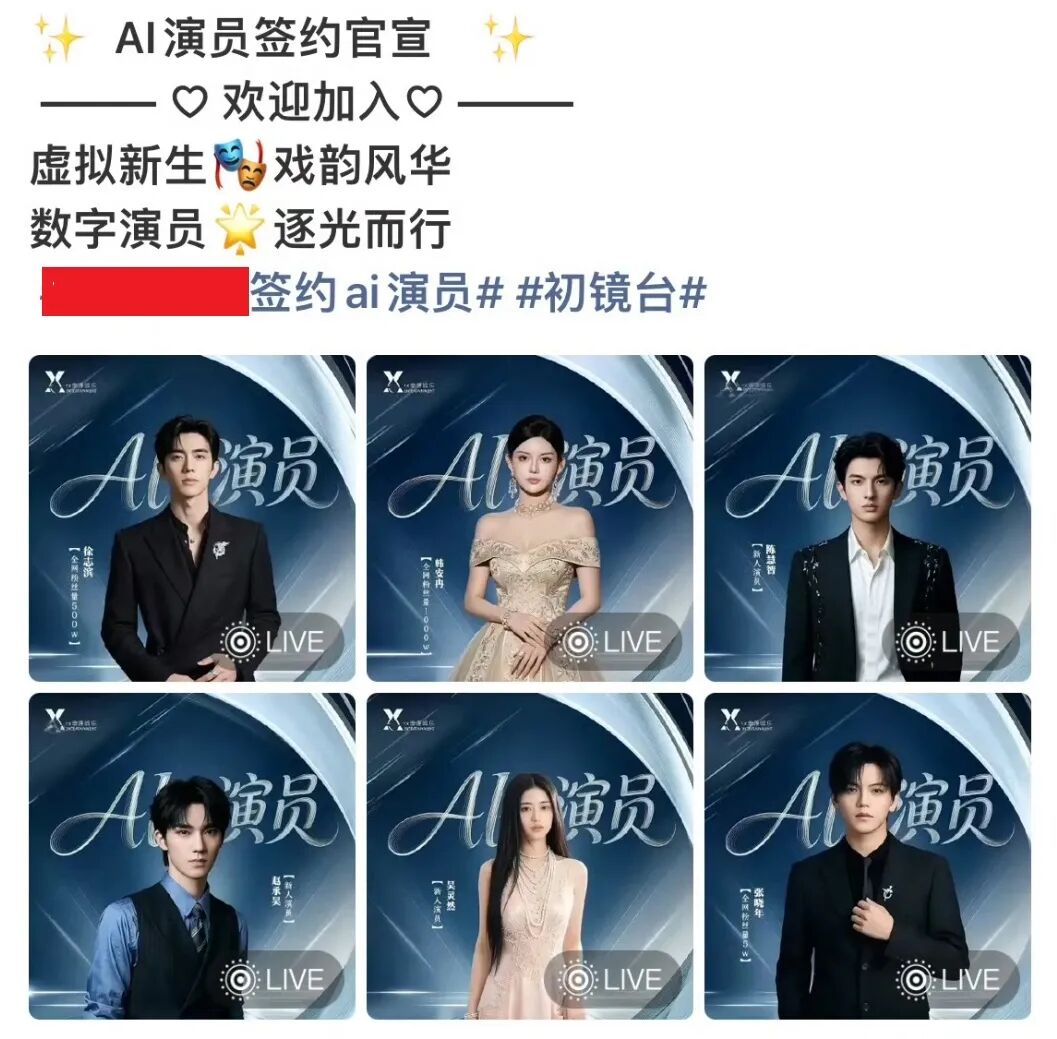
This is also why the middle-aged and elderly groups enter this industrial chain.
Public information shows that students in universities for the elderly and uncles and aunts in communities have become the main recruitment targets of some portrait agents. An intermediary even directly said that many of the ordinary people signed by his company are silver-haired people. "This group of people is generally interested in being actors, but had no access in the past. By authorizing their faces to AI short dramas, their dream of being actors has come true."
For production parties, middle-aged and elderly ordinary people have a very practical advantage: low cost, high return, and clear role demand. "Their value lies precisely in that they do not need to bear the star premium, but can cover a large number of high-frequency roles with clear age and appearance features in AI short dramas," a short drama producer revealed.
It can be seen that when production parties can obtain a portrait that meets the character setting at a cost of hundreds of yuan or even lower, and then AI completes the subsequent performance and scene generation, purchasing portraits is more flexible than temporarily finding real actors to join the crew, and it is easier to achieve mass production.
03
More than "selling faces",
AI human faces explore more silver-haired commercial scenarios
In addition to shooting short dramas, AI human faces are also entering broader content scenarios such as advertising and commercial endorsement.
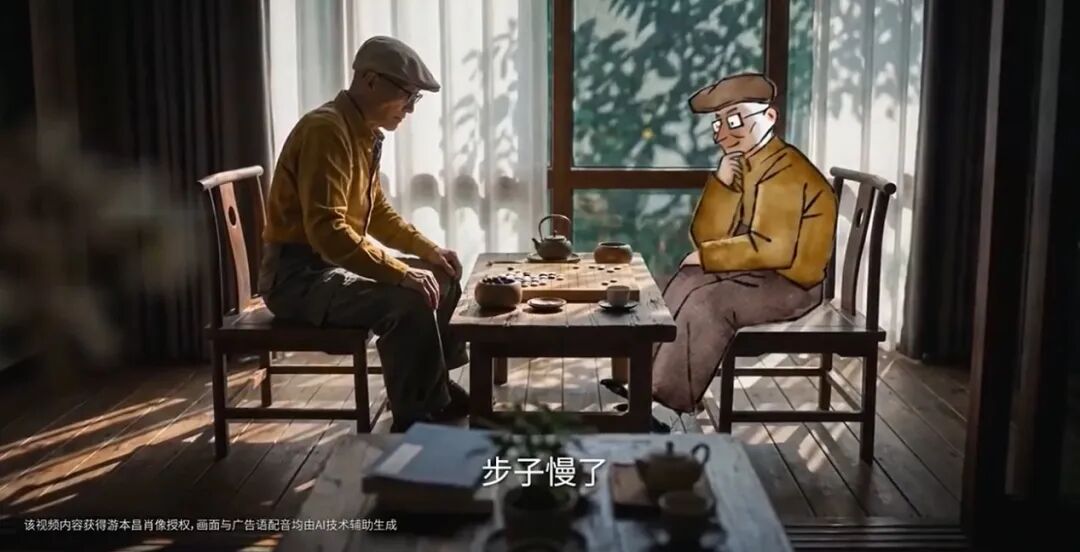
This year, the famous actor You Benchang authorized his image to AI, participated in the micro-short drama *Jigong: The Fake Dragon Subduing Arhat* in the form of a digital human, and also appeared in the elderly care product advertisement *At the age of 93, I have my first robot in my life*.
For brands, the significance of this kind of cooperation is not only to save shooting costs with AI, but also to allow an elderly image that already has public recognition to get more possibilities of being invoked beyond real-person shooting, and make target consumers trust the brand more.
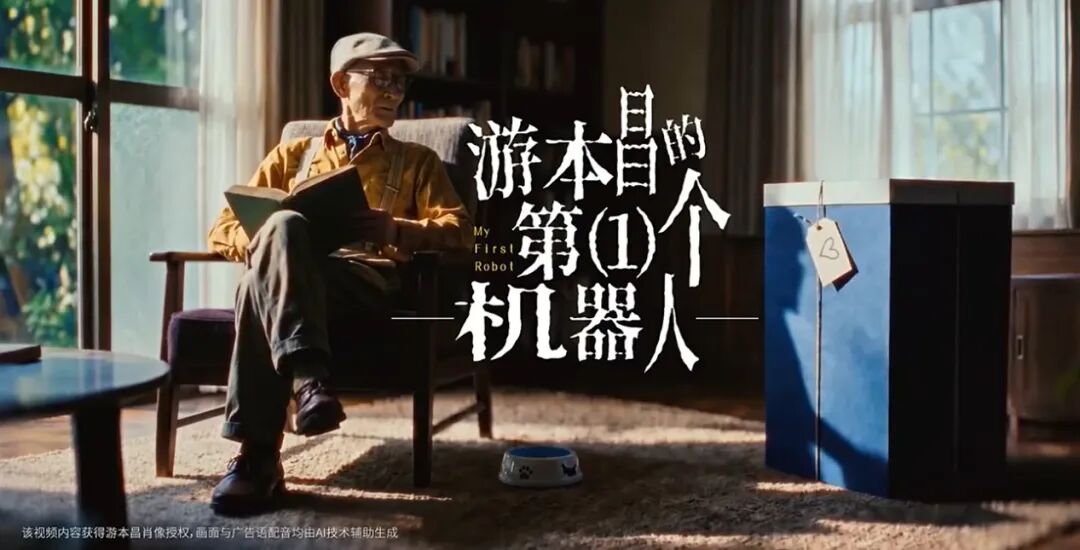
You Benchang's case provides a new content expression method. His real age of 93, the public image accumulated over decades, combined with the AI digital avatar, makes his image not only retain the identity recognition of a real elderly person, but also break through the restrictions of real-person shooting in terms of time, scene and physical state.
This is also the point worthy of the industry's attention for middle-aged and elderly AI portraits.
For the same middle-aged and elderly face, some people can only get hundreds of yuan in authorization fees, while some digital images can enter multiple scenarios such as short dramas and advertisements. The core gap is not only popularity, but also the depth of authorization, the recognizability of the portrait itself, the role or professional identity behind it, and the subsequent digital asset operation capabilities.
An elderly digital human with distinct identity and content value can further undertake functions such as brand endorsement, knowledge expression, and emotional communication.
Looking at the entire silver-haired market, the rise of the middle-aged and elderly AI portrait business is not just a new tool for the short drama industry to reduce costs and increase efficiency. In the past, whether it was long video dramas or short drama marketing, silver-haired faces often fell into two extremes: one was the stereotyped kind elderly person responsible for providing family warmth, and the other was the functional elderly role that only appeared when the plot required.
For silver-haired consumers, there is a certain distance between this kind of expression and real life. Retired old people are not just parents and grandparents, they also have their own interests, social interactions, travel, consumption choices and lifestyles.
The emergence of AI portrait technology allows more real, richer and lower-cost middle-aged and elderly faces to enter commercial content, which is also where the middle-aged and elderly AI portraits are most likely to generate commercial value in the future. For example, an age-appropriate consumer goods enterprise can create a digital character with a real elderly image, which continuously appears in product education, usage tutorials and brand content; while a health care and travel enterprise can produce content such as travel experiences and destination introductions around the digital images of real silver-haired users.
For silver-haired brands, this means that the marketing method that used to rely on one-time advertising investment may further transform into long-term content operation. A suitable middle-aged and elderly digital image can continuously undertake tasks such as product explanation, brand story, user education, and scene display.
This also provides a new imagination space for institutions that originally have a large number of middle-aged and elderly users, such as universities for the elderly, health care institutions, and silver-haired cultural tourism enterprises. In the past, what these institutions precipitated was mainly user relationships, while in the future, users with distinct personal characteristics and content capabilities can further become the providers of silver-haired digital content. Their portraits can be digitized at lower cost and enter multiple scenarios such as short dramas, advertisements, education, tourism, and age-appropriate products.
Of course, this market is still some distance from mature development. At this stage, a large number of ordinary people's portraits still remain at the one-time authorization level. In the future, the ones that can really form long-term commercial value will still mainly focus on people with popularity, professional identities or distinct personal characteristics.
Therefore, for relevant silver-haired enterprises, what is really worth planning may be to start looking for silver-haired groups