The critical inflection point has arrived, and the major provinces in central China are becoming increasingly strong and confident.
Recently, China's intelligent cutting and polishing factory with an annual production capacity of over 400,000 carats was officially put into operation in Zhengzhou.
The implementation of the project "marks that China's lab-grown diamond industry has successfully made up for the key shortcoming in the midstream cutting and polishing processing link".
Almost at the same time, the operating performance of Henan's superhard material industry in the first half of the year was released: among 7 listed superhard material companies and NEEQ-listed enterprises, 6 achieved double growth in operating revenue and net profit.
Among them, Power Diamond's revenue increased by more than 80% year-on-year, and its attributable net profit surged by 247.61%, leading the industry.
The successive good news from the investment and capital market is no coincidence.
Behind this, diamond, with its ultra-high thermal conductivity, is regarded as the "ideal material" for AI chip heat dissipation, which is expected to bring a hundred-billion-level market blue ocean.
In this new track competition, Henan, which accounts for 80% of the country's man-made diamond output, has taken the lead in completing its strategic layout.
This unprecedented opportunity is particularly critical for Zhengzhou.
Looking at the central region, compared with Wuhan's rapid breakthrough in the optoelectronic information industry and Hefei's rapid expansion in integrated circuits, new energy vehicles and other tracks, Zhengzhou is in urgent need of an irreplaceable "industrial ace" at present.
01
Dividend
"After nearly three years of painful de-capacity, the superhard material industry as a whole warmed up in the first half of 2026." This brief statement reveals the difficult transformation that Henan's superhard material industry is undergoing.
Back to the first half of last year, affected by global economic fluctuations and the structural adjustment of downstream demand, the market demand for superhard materials declined, and the net profits of many enterprises such as Power Diamond, Yellow River Cyclone, and Sifangda dropped sharply, with the gross profit margin of lab-grown diamonds plummeting.
A year later, the differentiation of the industry market has intensified, and the industry even describes the half-year performance reports of various enterprises as "a world of ice and fire". Among them, Henan's enterprises have handed in a report card of overall recovery, whose value is self-evident.
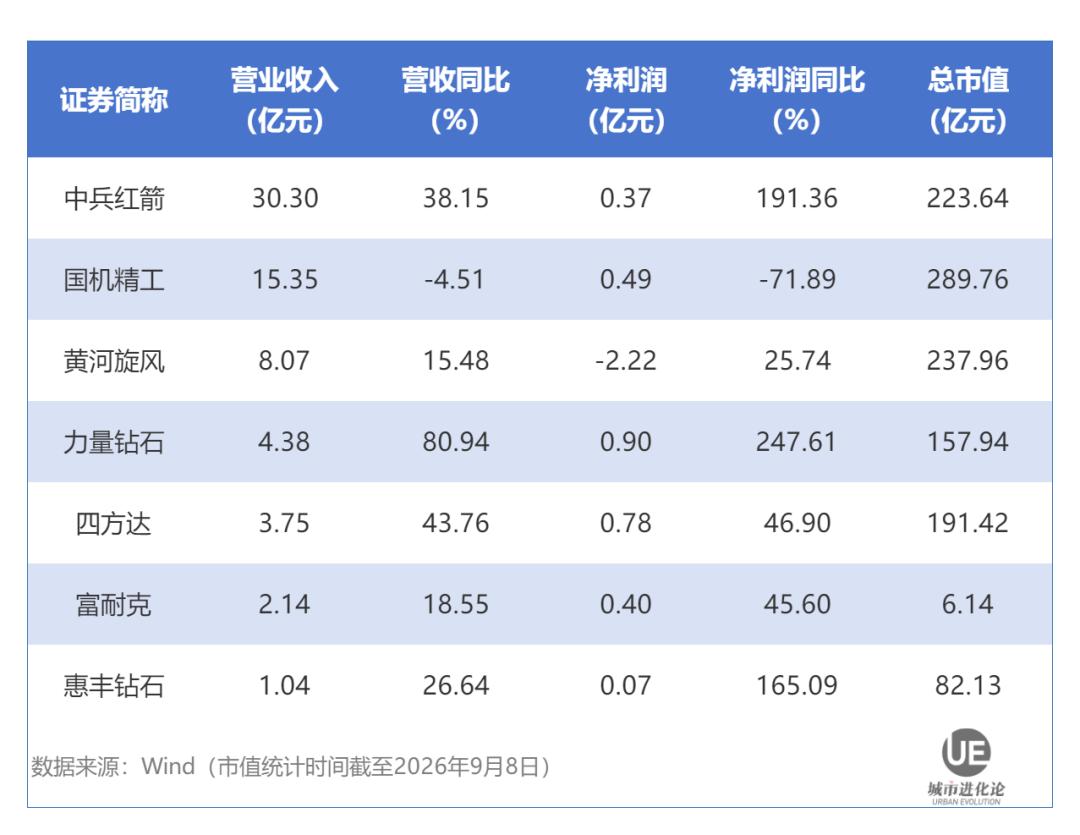
Performance of Henan's listed superhard material companies and NEEQ-listed enterprises in the first half of the year
Specifically, among the 7 Henan-based listed superhard material companies and NEEQ-listed enterprises, Power Diamond saw the most prominent performance growth in the first half of the year: the company achieved revenue of 438 million yuan, up 80.94% year-on-year, and attributable net profit of 90.0816 million yuan, up 247.61% year-on-year.
In its main revenue composition, the revenue of large-particle diamonds (lab-grown diamonds) reached 297 million yuan, up 141.93% year-on-year, accounting for as high as 67.83%.
It is worth mentioning that not long ago, this superhard material giant successfully cultivated a 247.82-carat ultra-large lab-grown single crystal, setting a new world record for the largest lab-grown diamond single crystal in the world, less than a year after it last refreshed the world record.
The second place in revenue growth goes to Sifangda, which has been deeply engaged in composite superhard materials for more than 20 years. In the first half of the year, the company's revenue was 375 million yuan, up 43.76% year-on-year, and its attributable net profit was 78.1797 million yuan, up 46.9% year-on-year.
In the same period, Norinco Red Arrow achieved revenue of 3.03 billion yuan, up 38.15% year-on-year, and its attributable net profit was 37.198 million yuan, turning losses into profits year-on-year. Its subsidiary Zhongnan Diamond ranks first in the global market share of industrial diamonds.
These Henan enterprises have achieved an upward trend amid the differentiation. What did they do right?
A key signal is that under the trend of global AI computing power explosion, these leading enterprises in the industry have almost collectively entered the diamond heat dissipation track.
As the local media put it, this round of sharp rise in stock prices is neither due to the super hardness of man-made diamonds nor the sparkle of lab-grown diamonds, but because this stone has been endowed with a new mission: chip heat dissipation.
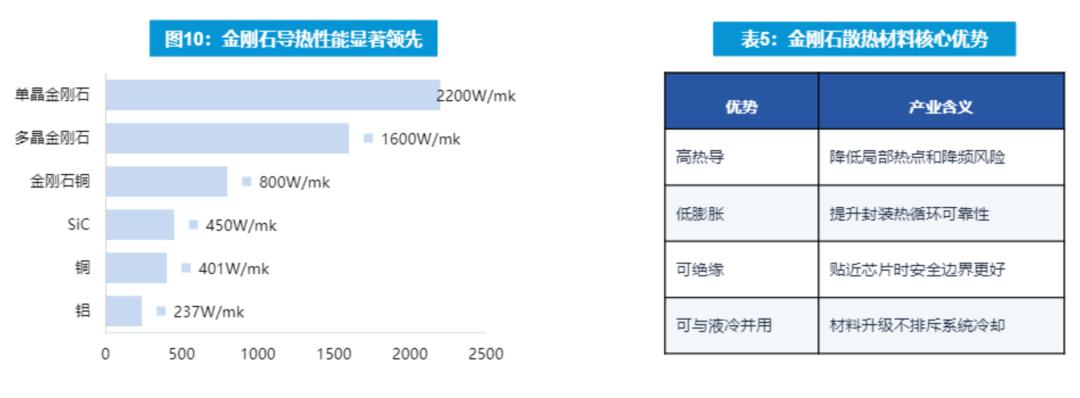
Image source: Soochow Securities Research Institute
The market has the most sensitive sense of smell.
2026 is called the "first year of industrialization" of diamond heat sinks by the industry.
According to the research report of Guotai Haitong, the global diamond heat dissipation market size is expected to rise from about 300 million yuan in 2025 to the 100-billion-yuan level by 2030.
As the world's largest production place of man-made diamonds, Henan obviously does not want to miss this wave of dividends. Before that, all leading superhard material enterprises in Henan entered the heat dissipation track to place their bets, which once aroused widespread public attention.
Some industry insiders pointed out that this is a key inflection point of the diamond industry, "marking that diamonds have been upgraded from traditional industrial materials to core strategic assets supporting future technologies such as AI and semiconductors".
At present, with the release of the latest semi-annual reports of several listed companies in Henan, the high value-added new track of diamond heat dissipation has entered the substantive harvest stage from strategic layout.
02
Foundations
"The world's superhard materials look to China, and China's superhard materials look to Henan". Henan's decades of in-depth accumulation in the field of man-made diamonds is undoubtedly the biggest confidence for local enterprises to take the lead in reaping dividends.
In 1963, China's first man-made diamond was born in Zhengzhou, breaking the foreign technology blockade; in 1965, the first six-anvil press was successfully developed, realizing the mass production of domestic diamonds; in 1966, the first cubic boron nitride was successfully developed, completing the puzzle of the two major superhard materials...
In 2024, the Zhengzhou-Nanyang-Shangqiu-Xuchang superhard material cluster and the Luoyang modern agricultural equipment cluster were selected into the national advanced manufacturing clusters at the same time, becoming the only advanced manufacturing cluster themed on superhard materials in China.
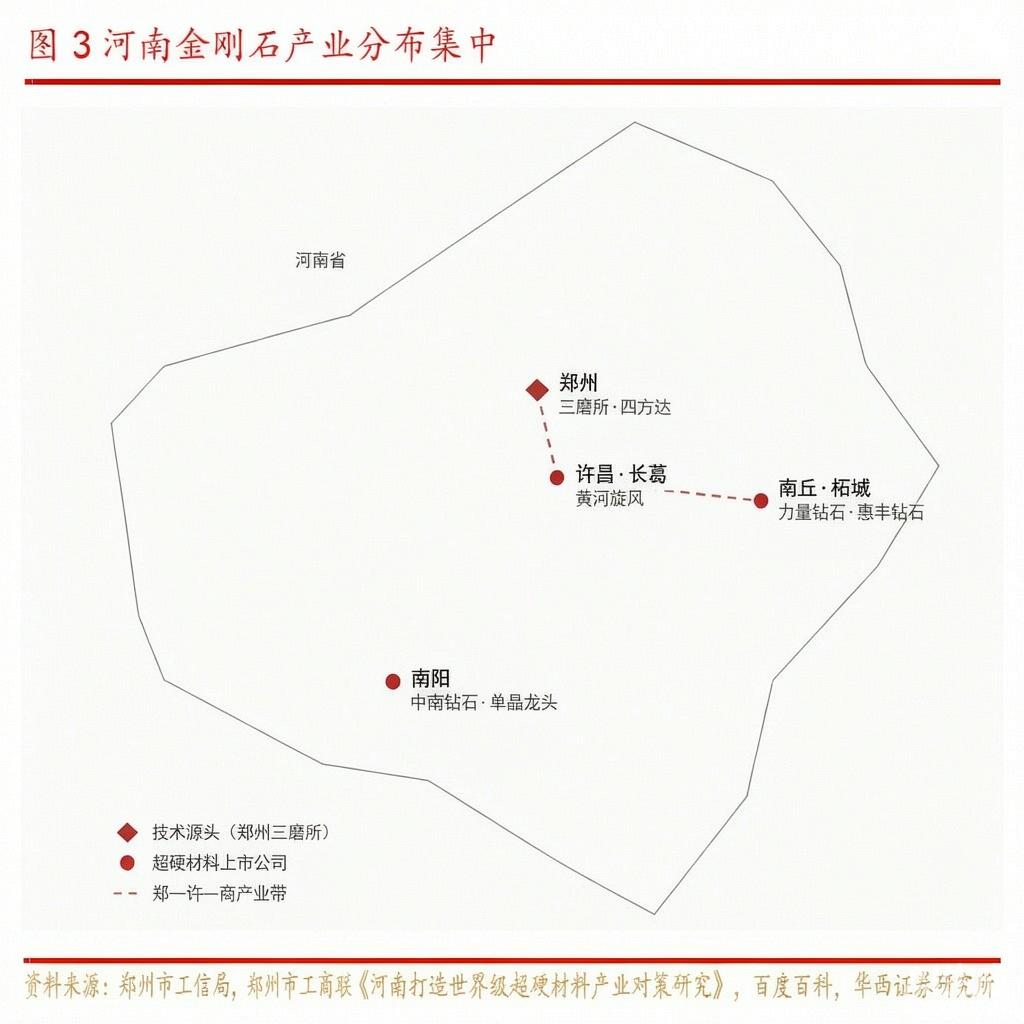
A major highlight of the Zhengzhou-Nanyang-Shangqiu-Xuchang superhard material cluster is the precipitation of decades of industrial chain collaboration: in the R&D center in Zhengzhou, as soon as the technicians design a new synthesis process, the equipment enterprises in Xuchang can come up with supporting solutions on the same day; when the micro-powder enterprises in Shangqiu need high-purity raw materials, the suppliers in Nanyang can deliver them the next day...
According to public reports, an analyst who has long focused on the global diamond industry once said frankly after many investigations: "I have traveled to all major producing areas in the world, and the industrial cluster with full-chain independent controllability from graphite powder to end products like Henan's is the only one of its kind."
Today, Henan has formed a complete industrial system covering crystal growth, equipment manufacturing, cutting and polishing processing, and trading services in this field, becoming a core agglomeration area of global superhard materials, with 361 enterprises above designated size, 6 listed companies, 6 national-level manufacturing single champion enterprises, 9 national-level specialized and sophisticated "little giant" enterprises, and 30 enterprises with annual sales revenue exceeding 100 million yuan.
Data shows that China's man-made diamond output accounts for 95% of the global total, of which Henan contributes 80% of the national total, cubic boron nitride accounts for 95% of the national total, and the annual output of industrial diamonds is about 12 billion carats, accounting for half of the global total output.
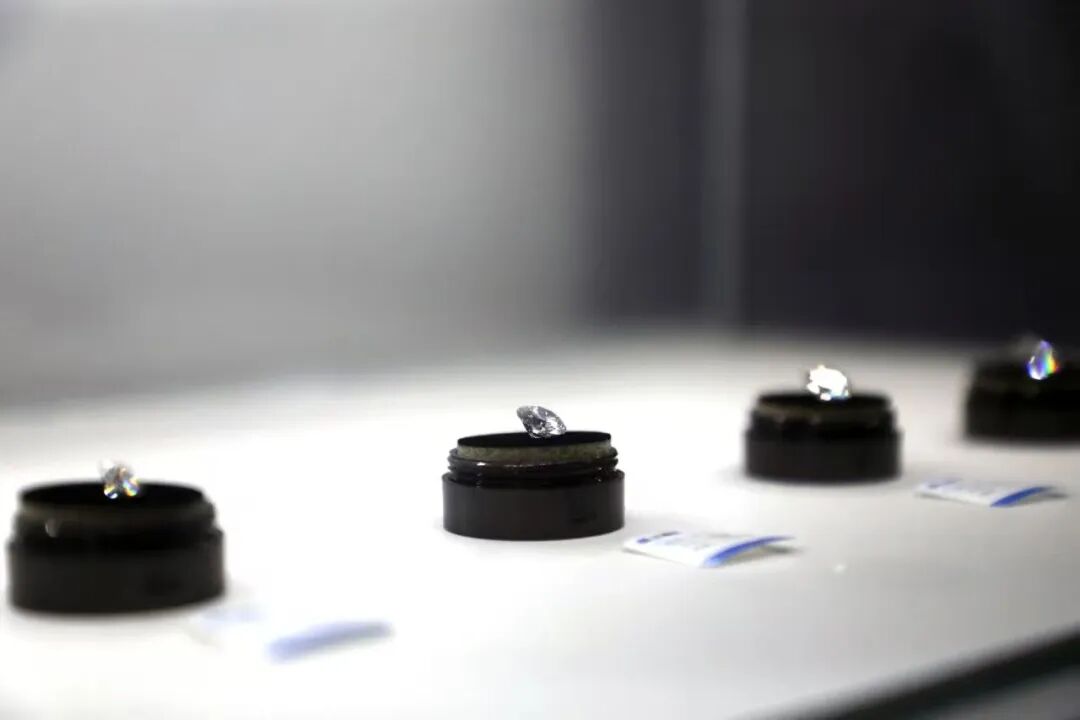
Image source: Zhengzhou Daily
However, this solid "foundation" once encountered difficulties. For a long time in the past, Henan, with the world's largest diamond production capacity, only earned meager profits in the industrial chain ——
Industrial diamonds are sold by the ton, and have long remained at the low value-added stage of industrial abrasives; lab-grown diamonds once excited the industry, but the fierce "price war" quickly turned the blue ocean into a red ocean.
A profound transformation has quietly started.
As early as 2023, Henan systematically reshaped the development system of the province's manufacturing industry, in which superhard materials were listed as the first of the 28 key industrial chains, and took the lead in launching industrial chain breakthroughs.
To this end, the local government has successively issued the "1+5" action plan for the superhard material industrial chain, established the Henan Superhard Material Association, inaugurated the Henan Superhard Material Industrial Technology Research Institute, and set up an industrial investment fund to "deeply implement the advantage reconstruction strategy".
Today, the structural optimization dividend brought by the transformation has been first reflected in the reversed performance reports of leading enterprises.
The exploration to seek a breakthrough is still ongoing.
On September 4, China's first lab-grown diamond intelligent cutting and polishing base with an annual output of 400,000 carats was launched in Zhengzhou.
Public information shows that the first phase of the project put into operation this time realizes the full-chain connection from local synthesis to local fine polishing, and then to large-scale intelligent production, effectively filling the gap in the field of midstream intelligent processing of lab-grown diamonds in China.
The realistic background is that Henan, as the "world factory" of diamonds, has always faced the shortboard of high value-added cutting and polishing processing in the global industrial chain.
Therefore, this key move will provide key technical support for Henan's superhard material industry to leap from production capacity advantage to value chain advantage.
03
Challenges
The good news from the investment and capital market is undoubtedly a signal worthy of celebration. But beyond the data, Henan still faces many challenges if it wants to gain a firm foothold in this industrial track and truly achieve a breakthrough in high value-added links.
On the one hand, institutional research reports point out that the current performance recovery of the superhard material sector is mainly driven by the price increase of industrial diamonds, rather than the expansion of heat dissipation business; the diamond heat dissipation business has not yet contributed substantial revenue.
At the same time, superhard materials and diamonds have been clearly written into the outline of the 15th Five-Year Plan, and many regions across the country are quietly accumulating strength for the diamond heat dissipation track.
For example, in March this year, Guangdong issued the "Guangdong Province Action Plan to Accelerate the Cultivation and Development of New Tracks and Lead the Construction of Modern Industrial System (2026-2035)", proposing to "carry out technical and technological breakthroughs in materials such as gallium oxide, aluminum nitride and diamond and their preparation processes".
In July this year, the "15th Five-Year Plan for the Development of Strategic Emerging Industries in Shanghai" clearly proposed to "agilely lay out future-oriented cutting-edge technologies". In the fourth-generation semiconductor direction, it clearly proposed to carry out R&D on super-wide bandgap technologies such as gallium oxide, diamond, aluminum nitride and super-narrow bandgap technologies such as antimonide, so as to accelerate the application in power, radio frequency, sensing and other scenarios.
In addition, many provinces such as Zhejiang, Hubei, and Fujian have included diamond materials in the key development directions of the 15th Five-Year Plan. With the full launch of the industrial positioning battle, Henan's first-mover advantage may be weakened at any time.
The local side has no lack of reflection on this.
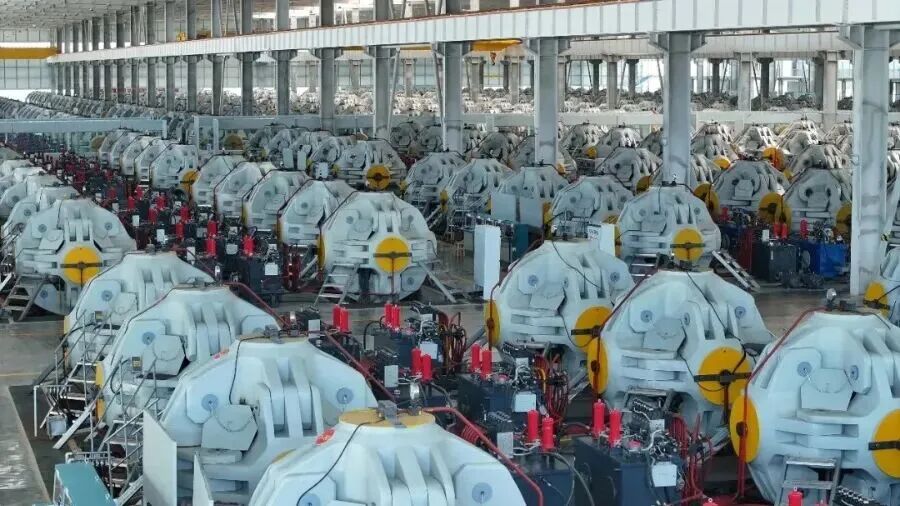
Power Diamond production workshop Image source: Henan Release
Tang Kai, Vice Dean of the School of Business of Zhengzhou University and researcher of the Digital Economy and Industrial Innovation Laboratory, previously wrote an article pointing out that the production capacity of Henan's superhard materials is not commensurate with the overall influence of the industry, presenting an "inverted triangle" pattern of "heavy upstream and hollow downstream" —— the advantages are concentrated in the upstream blank production link, and the total output value only accounts for about 40% of the national total. There are still obvious shortcomings in the higher value-added links of the industrial chain, especially facing great competitive pressure in the global value chain competition.
Another set of data shows that although diamond is regarded as a new fulcrum for the local area to connect the high-end industrial chain, and leading enterprises are also experiencing the collective transition from traditional abrasives and abrasive tools to high-end functional materials such as semiconductor heat dissipation and optical windows, the current high-end product production capacity of Henan's superhard materials is only about 10%, and there is still much room for improvement.
At present, Henan has included "promoting the superhard material cluster to move towards the global forefront" into the province's 15th Five-Year Plan outline.
However, as experts said, compared with the strategic goal of moving towards the global forefront, the existing industrial governance system of Henan's superhard material cluster still has obvious shortcomings, and it is urgent to release institutional dividends through governance transformation and enhance competitive advantages through policy innovation.
Among them, strengthening the concept of "coordinating the whole province as a single chess game" and transforming from decentralized local competition to provincial-level overall planning is particularly critical.
For example, support Zhengzhou to strengthen its functions of R&D and innovation, headquarters economy, brand operation and international trading, promote Xuchang to develop high-end equipment and precision tools, support Shangqiu to consolidate its advantages in micro-powder and superhard material products, guide Nanyang to strengthen the manufacturing capacity of raw materials such as graphite and major equipment, and promote other advantageous regions to form specialized superhard material industrial clusters around characteristic applications...
The unprecedented market dividend is accelerating to be realized, but the real test has just begun.