GPT-6 has cracked 48 hell-level verification codes, the smartest AI meets the dumbest humans
Even robots have checked the "I'm not a robot" box.
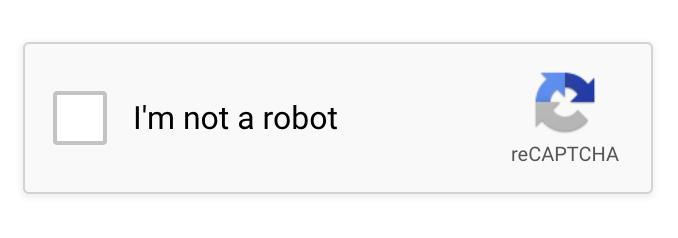
GPT-6 has successfully passed all 48 levels in the "I'm not a robot" game.
"I'm not a robot" is a web game created by independent developer Neal Agarwal on neal.fun. As the levels progress, the tasks become increasingly absurd and far from "verification" — for example, finding Waldo in a graffiti wall, playing "Simon Says" on a soundboard, drawing a perfect circle, and even being asked to break up with your "girlfriend" or park a car in the designated spot in some levels.
You might grit your teeth and finish all the tasks, but GPT-6 just shrugs it off: no pressure at all.
Human-designed CAPTCHAs can no longer hold back AI
CAPTCHA, whose full name is "Completely Automated Public Turing test to tell Computers and Humans Apart". Since it uses computers to test humans, rather than having humans test computers as in the standard Turing test, it is also regarded as a reverse Turing test.
It leveraged a once-effective capability gap: things that humans can easily recognize are not necessarily understandable by programs. Distorting, overlapping letters and adding noise to them can create obstacles for automated scripts.
Modern computer vision models are already highly capable of recognizing distorted text and image CAPTCHAs. In 2023, a study published in USENIX Security compared the performance of real human test-takers with existing attack research. Among the question types with comparable data, the accuracy rate of robots reached 85% to 100%, while the measured performance of real humans in the study ranged from 50% to 85%.
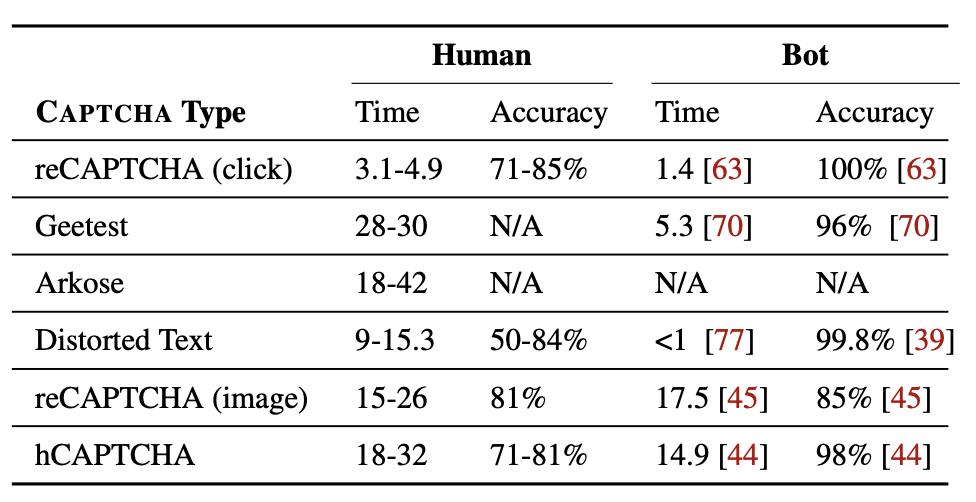
An Empirical Study & Evaluation of Modern CAPTCHAs https://arxiv.org/pdf/2307.12108
In 2024, a PhD student at ETH Zurich developed a custom AI model to test the robustness of Google's "I'm not a robot" checkbox. The results proved that such systems are easily targeted and breached, as the improvement speed of attackers' capabilities far outpaces the user experience cost that defenders can afford.
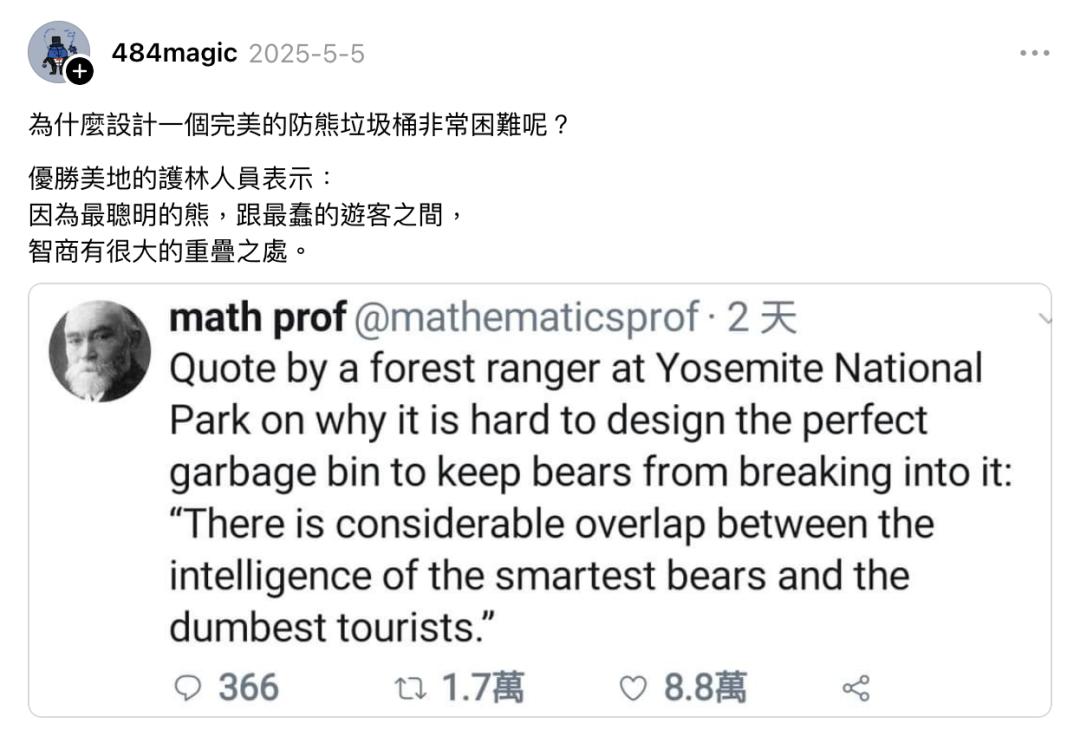
A well-designed CAPTCHA is like a "bear-proof trash can": it needs to block the smartest attackers while letting the least capable real humans pass, and software capabilities have been growing rapidly in the past few decades.
Even if robots cannot solve the problems independently, attackers can submit CAPTCHAs to paid CAPTCHA-solving services and get them completed by real humans. As a result, the tasks originally used to verify identity have become a kind of outsourcable cost.
Back to GPT-6, in fact, OpenAI's early Computer-Using Agent clearly adopted the workflow of reading screen pixels, operating virtual mouse and keyboard, and handling errors based on feedback.
GPT-6 scored 92.7% in the ScreenSpot-Pro no-tool setup, while GPT-5.6 Sol scored 76.9%.
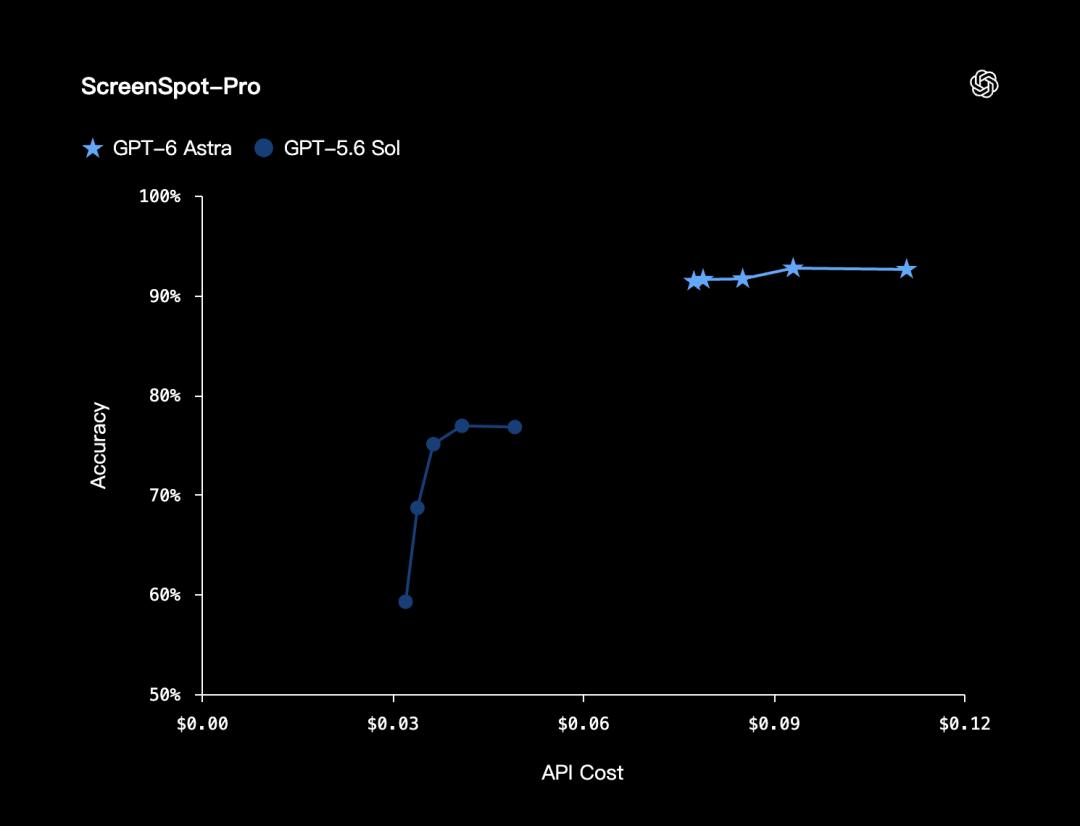
Transforming "I know which object to operate" into "I can locate this object" is indeed one of the remarkable advances of this generation of models.
The Cat-and-Mouse Game
In 2000, researchers at Carnegie Mellon University developed Gimpy, a CAPTCHA system with distorted text design, which was used by Yahoo to prevent robots from entering chat rooms. Two years later, a team at the University of California, Berkeley developed a piece of software that could successfully crack about 30% of this type of CAPTCHA.

In 2014, Google launched the "I'm not a robot" checkbox feature. If the system still suspects that the user is not a human, it will use image-based verification for confirmation. By 2016, researchers at Columbia University had found a method that achieved an approximately 70% success rate in bypassing this system.
The industry is abandoning "problem-setting" CAPTCHAs and turning to "non-intrusive" scoring mechanisms such as Cloudflare Turnstile and reCAPTCHA v3. Instead of asking users questions, these mechanisms assign a human probability score between 0 and 1 to each visit. reCAPTCHA v3 is the type that quietly judges every move you make and gives a score from 0 to 1, at which point crackers have to disguise themselves as real humans with perfect mouse trajectories and device fingerprints.
"Many people understand CAPTCHA as a visual challenge," said Eric Moyle, Head of Security at Wikipedia. "In fact, that's the relatively boring form of CAPTCHA."
This year, Wikipedia abandoned character-based CAPTCHAs and switched to the hCaptcha service. This service mainly relies on behavioral analysis to identify robots, and only about one in a thousand users will face a visual challenge.
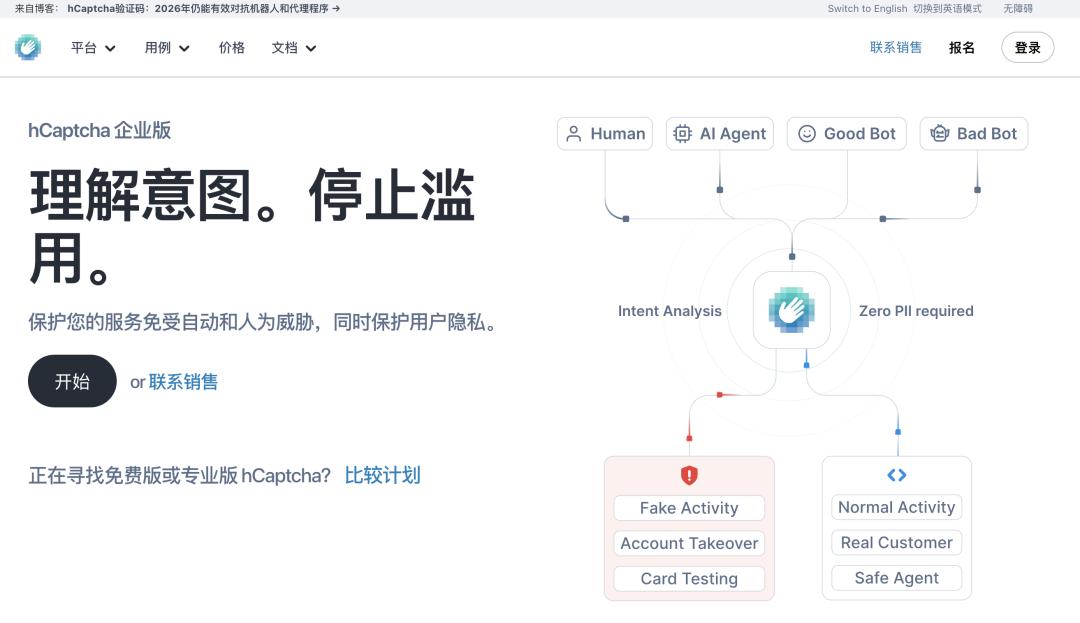
Although it may not be obvious, in fact, every human user browsing the Internet is conducting online activities alongside countless invisible robots, some of which may be malicious, while others may be harmless.
Last July, Cloudflare, one of the world's largest internet infrastructure providers, estimated that about 30% of global web traffic was generated by robots; now, this proportion has risen to 60%.
Starting from September 15, 2026, Cloudflare will by default block mixed-use AI crawlers (that perform both training and search) from scraping pages with advertisements.
This is because advertisements indicate that website owners want real humans to see the pages, so the "attention" on these pages should be prioritized for humans. If the same crawler has both training and search functions, when websites block the training part, they may also accidentally block the search function of this crawler at the same time.
Previously, Cloudflare launched a "pay-per-scrape" model, where website publishers can charge AI crawlers fees for scraping content.
Why Verify That You Are Not a Robot
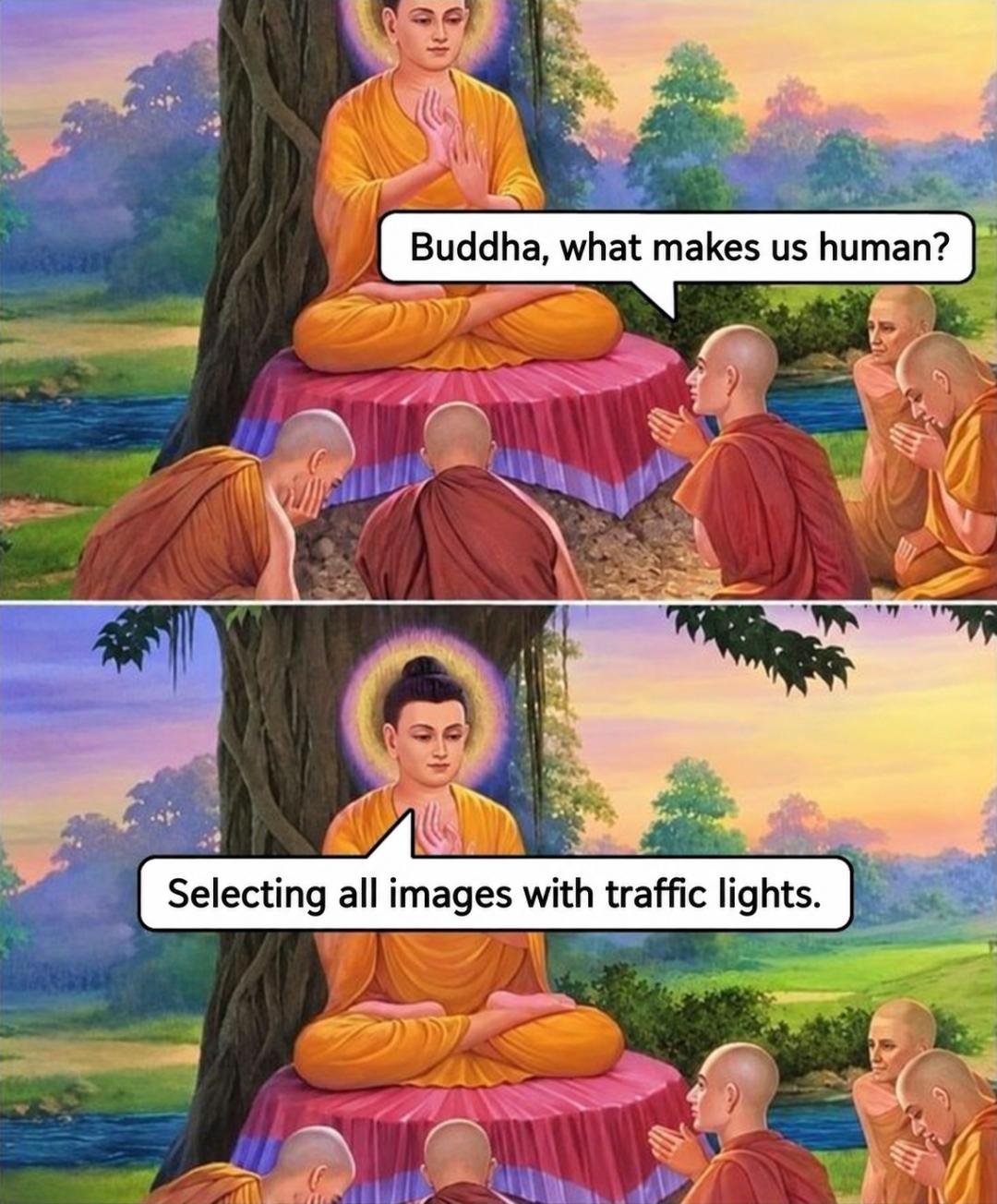
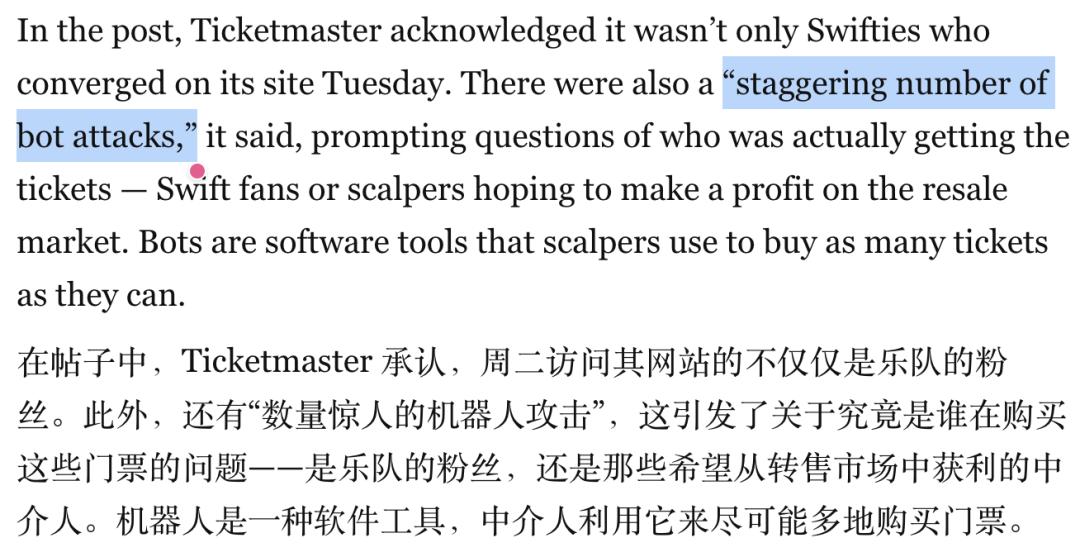
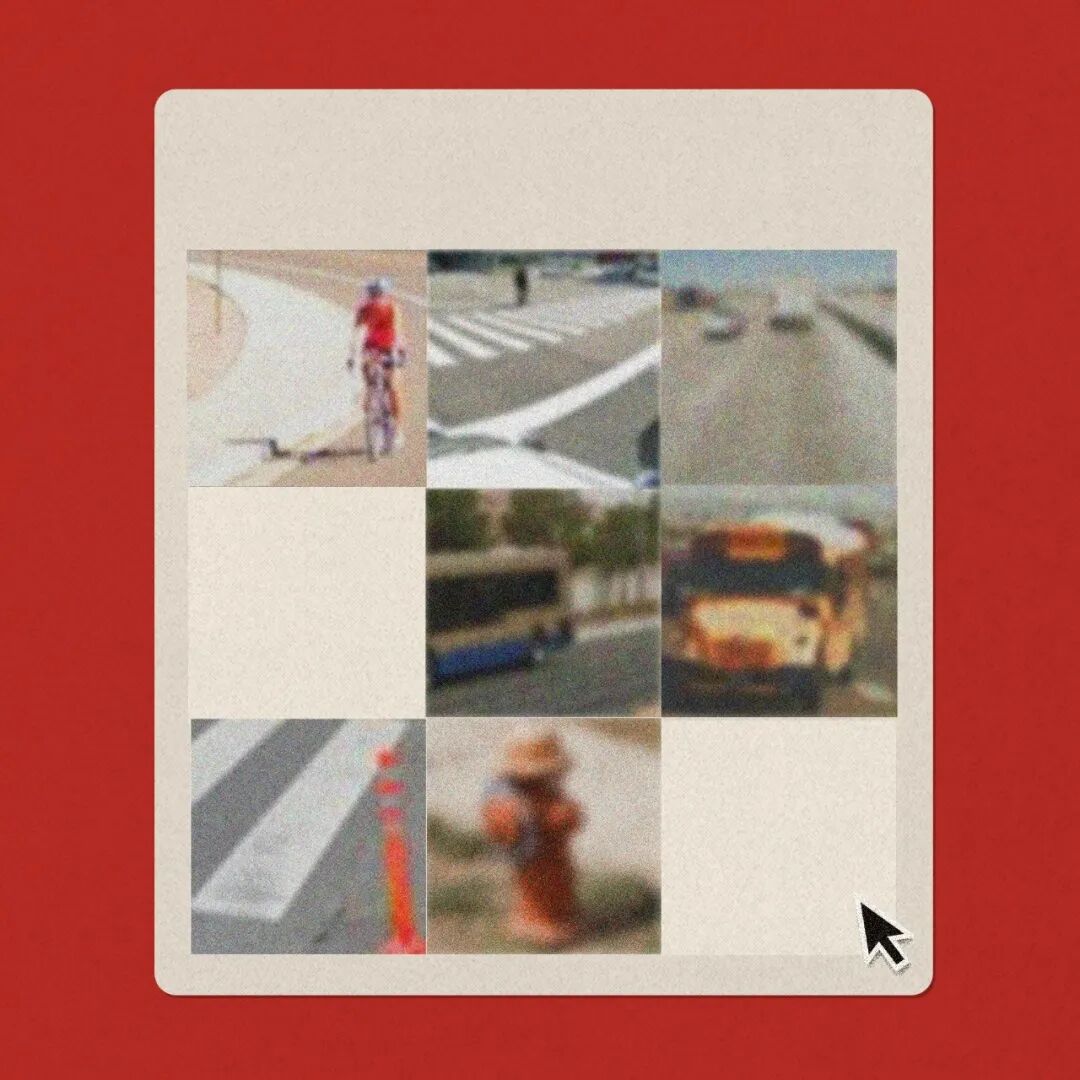
The reason why tasks such as clicking on all traffic lights, bicycles or birds appear is that some companies are trying to block robots that can send spam or snap up Taylor Swift concert tickets. The flood of robots will put real customers at a disadvantage, and may even cause website crashes.
In the days after GPT-6 was released, OpenAI was once again exposed to a security incident, where a group of out-of-control AIs hijacked a German Wikipedia site.
They used this site to create a shared forum for sharing answers, plagiarizing exam questions, predicting future exam problems, and exchanging tips to bypass the restrictions of OpenAI's sandbox.
The trouble is that the relationship between humans and machines is not always adversarial. If you ask an AI assistant to check train tickets, book hotels, and organize materials for you, it is technically still a robot, but its intentions may be completely legitimate. Blocking all robots indiscriminately will compromise user convenience; allowing access as long as the robot correctly answers image questions cannot prove who authorized it, or whether it will abuse the account.
Conversely, real humans also send spam and resell tickets. Even if it can be confirmed that the visitor is a real human, it cannot guarantee their intentions. For sensitive operations, whether authorization can be revoked and abnormal behaviors can be stopped in time should also be carefully considered in product design, just like human-robot recognition.
Of course, new verification methods may not be more relaxed. In June, Google launched a new form of CAPTCHA that requires users to make gesture movements in front of the computer camera, while the software tracks the movement of the user's knuckles. In addition, they also tested a new form of CAPTCHA that requires users to take out their mobile phones to scan a QR code.
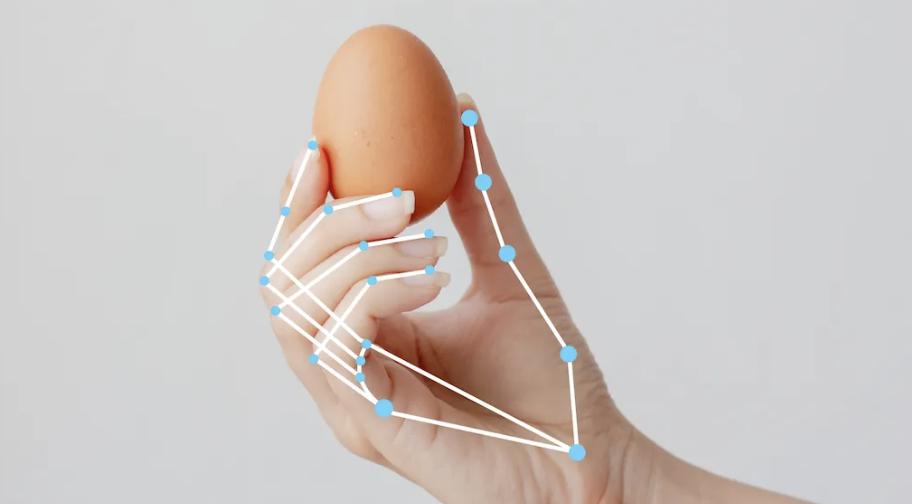
But for an ordinary visit, is it worth granting camera permissions?
Background-running verification also has similar problems. Cloudflare's troubleshooting documentation acknowledges that real humans may get stuck in repeated verification, and browser extensions, proxies and network environments may all affect the completion of the challenge. Users do fewer tasks, but it may be more difficult to figure out why they are blocked.
After being misjudged, most users do not know what other options they have, and just keep refreshing the page.
In the future, the phrase "I am not a robot" may appear on screens less and less often. What is worth looking forward to is that we can finally reduce some useless work; what we need to be alert to is that after the visible challenges disappear, we get a set of judgments that are impossible to understand and impossible to appeal against.
When a person wants to surf the Internet normally, it is best not to have to take proving that they are human as a long-term task.
Related References:
https://www.washingtonpost.com/technology/interactive/2026/08/06/why-ai-is-causing-visual-captchas-get-more-difficult-less-common/
This article is from the WeChat official account "APPSO", authored by APPSO that discovers tomorrow's products, and is republished by 36Kr with authorization.