DeepSeek has begun to pursue the ultimate "intelligence density"
DeepSeek sets a question for its new Flash model: can it replace its current Pro version?
Yesterday, the V4.1 Flash intermediate version launched its closed beta. New model architecture, native multimodality, and faster speed are all the selling points stated in the official announcement. But in the accompanying feedback questionnaire, DeepSeek directly asked users: "Do you think this model can fully replace the DeepSeek V4 Pro currently online?"
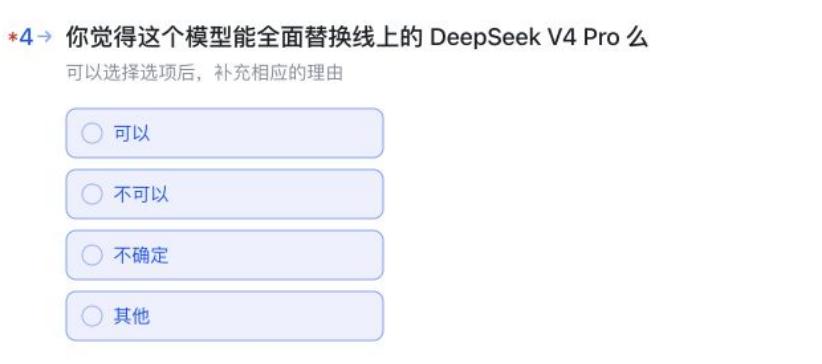
Well, it is a case of outperforming one's own product. DeepSeek is testing whether the Flash model can surpass the Pro version in performance, and whether it can be handed over to a cheaper model that is more suitable for large-scale invocation scenarios.
There has always been a tangible price gap between the Pro and Flash versions. At present, for every million output tokens during peak hours, Flash charges 9 yuan, while Pro charges 27 yuan.
But just now, DeepSeek announced on its Open Platform that it will lower the price of the Flash series starting at noon on September 10: during off-peak hours, the cache-hit input per million tokens will be reduced to 0.02 yuan, the cache-miss input will be reduced to 1 yuan, and the output will be reduced to 4 yuan; the peak-hour price will still be twice that of the off-peak price. The three price cuts are 60%, about 33%, and about 11% respectively.

The new Flash is still under testing to verify if it can take over the work of Pro, but the usage threshold of the Flash series has already been lowered first.
Developers can occasionally pay three times the unit price to get better results. But in daily usage, the necessity of Flash becomes prominent in those non-mandatory scenarios.
DeepSeek wants the new version to have the advantages of both: Flash is fast, Pro is powerful, and Flash V4.1 is both fast and powerful.
More than a year ago, the breakout of R1 made people willing to give AI more time to see what creative solutions it could come up with. Now, the question DeepSeek needs to answer is: how can the existing reasoning capabilities be utilized more frequently?
"Intelligence Density" Begins to Matter
When R1 became popular in early 2025, its appeal also came from the fact that this high-level reasoning capability finally became easily accessible. DeepSeek opened the model weights at the same time, and deployed R1 on its official website, App and API. Ordinary users can use it by turning on the "Deep Thinking" feature, and developers can also use its output to distill their own models.
High-level reasoning is no longer a capability that only a small number of laboratories can demonstrate. It has entered chat windows, and has also been integrated into the product development processes of other companies.
When DeepSeek updated R1 in May 2025, it regarded "deeper thinking" as the most important progress of the update.
In the AIME 2025 test, the old version of R1 used about 12,000 tokens per question on average, while the new version increased the number to 23,000; the accuracy rate increased from 70% to 87.5%. This update made R1 answer more accurately, and the reasoning consumption per question on average almost doubled.
This approach has its rationale. There are no ready-made answers for difficult questions, so the model needs to try different methods, check intermediate steps, and recalculate after finding errors. As long as the result is valuable, the extra waiting time is acceptable.
But in the V3.2 report released in December 2025, DeepSeek put forward another requirement for itself: to improve the "intelligence density" of the reasoning chain. The reason is also clear: to reach the output quality of models such as Gemini 3.0 Pro, it usually needs to generate a longer reasoning process.
The waiting time for output has become very important. The gap will be reflected in the generation speed, and also in the cost of each invocation.
This problem will become more prominent in the division of labor between large and small models. The early V4 model card mentions that after being given more thinking budget, Flash can obtain reasoning performance close to that of Pro, but it still lags behind in knowledge reserve and the most complex Agent workflows.
The calculation of small models is cheaper at each step, but they may need to take more steps to get the same result as large models. How much of the unit price advantage seen by developers can be retained in the end depends on how the task is completed.
Therefore, if Flash wants to replace Pro, it needs to improve both capability and efficiency at the same time. Generating lengthy reasoning faster can reduce part of the waiting time; finding effective methods earlier can even save the subsequent calculation steps. For people who use AI frequently, the latter is equally important.
The academic community has begun to include user waiting time into the optimization objectives. A study from EMNLP 2025 points out that the computationally optimal test-time scaling scheme does not necessarily bring the lowest latency; researchers need to rearrange parallel computing and speculative decoding to get better results within the limited time.
DeepSeek has also been working on improving generation speed. The team reported in the DSpark paper published in July that under the online user traffic of V4-Flash, compared with the MTP-1 baseline while maintaining the same throughput level, the single-user generation speed increased by 60% to 85%. The team addressed the verification waste in speculative decoding, allowing users to get output faster, while ensuring that the entire service can support a larger number of requests.
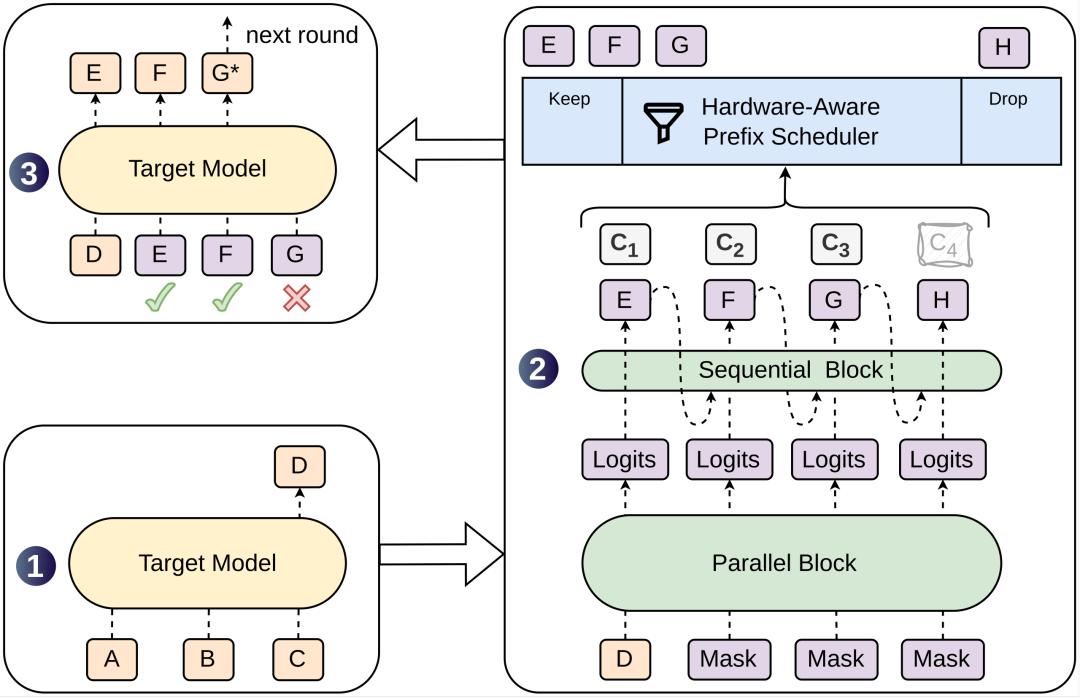
Figure 3|Official architecture diagram of DSpark: generate candidate tokens first, then filter out the low-confidence tail part, and finally verify by the target model. Source: Figure 1 of DSpark paper (July 2026, CC BY 4.0)
This is very important for DeepSeek, which provides API services. Faster request completion can only be effectively realized without seriously sacrificing the overall service capacity. Developers need shorter waiting time, and DeepSeek needs to make the same batch of computing resources serve users more efficiently.
"Whether the problem can be solved" and "whether users are willing to wait for the problem to be solved" have become two different assessment criteria.
They also correspond to two different markets. Researchers can invest a large amount of computing power for one difficult problem, while the daily-use assistant must continuously respond to new requests. After the former capability is improved, manufacturers need to turn it into the latter type of service to get the opportunity of larger-scale adoption.
The intelligence density proposed by DeepSeek in its report will eventually be tested here: can tasks that originally required expensive models and long-time calculation be gradually turned into ordinary low-cost invocations.
Agent Needs to Calculate the Cost for Completing Work
On the day of this closed beta, a LINUX DO user named "Jue Qian" happened to need to make a downtime maintenance page, so he connected the new Flash to his programming tool.
The performance of the model surprised him. It noticed a deprecated but not deleted decision record requirement in the project specification, and carefully listed the document maintenance, code submission and review arrangements. After the page was generated, he proposed that the style should not be disconnected from the original project, and the model found the existing illustrations in the repository for modification.
He was satisfied with the execution capability of the model, but thought it was expensive: completing this maintenance page cost him 15.5 yuan.
This is also the difference between Agent and ordinary chat scenarios. Users only assign one task, but the model may run many rounds in the background: first read the project specification, then check files, modify code, and continue to check after getting the results returned by the tool. Each round of invocation may generate new input and output costs. The low unit price of the model does not mean that the whole task is necessarily cheap.
To make Agent cost-effective, in addition to reducing the unit price of the model, we also need to check whether these invocations are necessary. Some steps require model judgment, while others are only to read, filter and organize materials according to the already determined rules. If the latter also needs to be handed over to the model step by step, it will increase the number of invocations and waiting time, and the intermediate results will also continuously occupy the context space.
The DeepSeek open-source Harness can participate in arranging this execution process. The official website of DeepSeek uses "Agent = Model + Harness" to explain the relationship between the two: the model is responsible for judgment, and Harness provides tools, manages sessions and operating environments, to turn the model's decisions into actual operations.
The PTC mode in it allows the model to write a piece of program at a time to connect multi-step tool operations. For example, if the model needs to find content that meets the conditions from a batch of files, it can let the program read in batches, complete the filtering, and then return the relevant results. The model does not need to re-determine the next step after reading each file, nor does it need to receive all the original content.
This can save repeated invocations and useless input in the process of completing the task. DeepSeek also listed these two types of overhead as problems to be solved in the official design record of PTC. For developers, the final thing to compare is whether the same task can be completed well, and the total bill after completion.
There is room to save the process that the model does not need to participate in repeatedly. For a batch of materials that have known processing methods, the program can execute the complete process, and the model then makes judgments only on the remaining information.
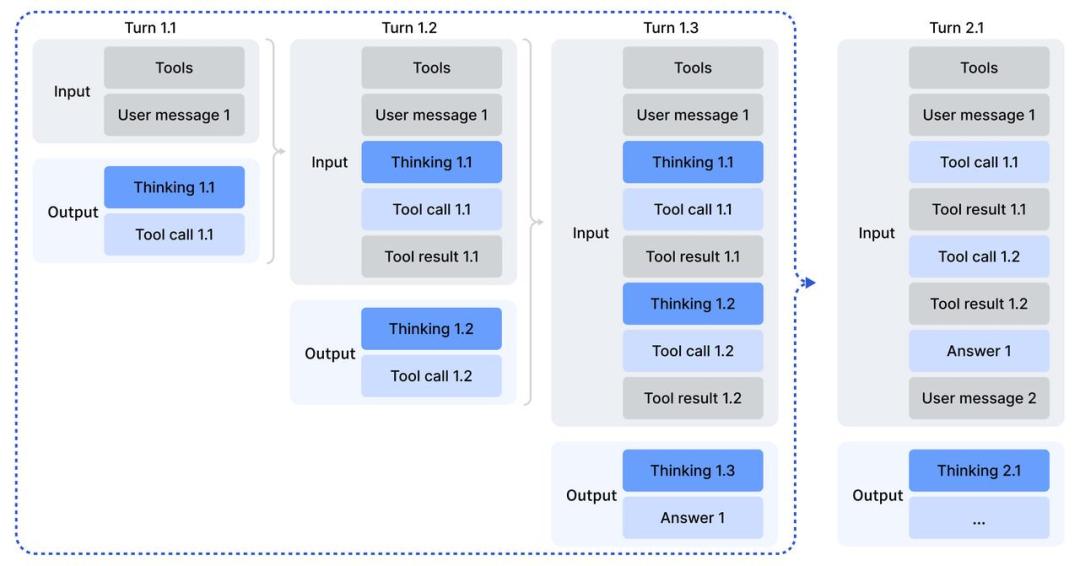
Figure 4|The reasoning retention mechanism for tool invocation of V3.2. Continuous tool interactions triggered by the same user message retain the existing reasoning; the previous reasoning is removed after a new user message arrives. Source: Figure from V3.2 technical report
DeepSeek's processing of repeated calculations can also be traced back to earlier designs. The V3.2 report once pointed out that discarding existing reasoning in continuous tool interactions will force the model to re-analyze the entire problem. Therefore, the team adjusted the context management to allow the previous reasoning to be retained in this process.
From how the model thinks to how the tool executes, efficiency loss can no longer only be found in the model parameters.
Harness also records prompts, tool invocations and results, allowing developers to review tasks and check where repeated processing and execution failures occur.
An official development record on August 10 shows that DeepSeek revised the tool and prompt configuration of the minimalist mode, making it use the persistent Bash consistent with the reinforcement learning operating environment to retain the working state of continuous operations.
These details explain why model companies also need to develop execution frameworks. After the model learns how to use tools, there must be suitable tools and environments for actual operation. DeepSeek opens up a set of clear operation methods, so application developers have a reference that can be directly adopted, checked and modified.
These improvements are gradually converging into the same goal: the server side accelerates generation, the model reduces repeated reasoning, and the execution framework reduces unnecessary invocations. In the past, users waited for the AI to think, now we also need to let the AI work continuously without amplifying the cost and waiting time.
Daily Use Models Keep Upgrading, Flagship Models Need to Solve More Difficult Problems
DeepSeek is not the only model company that rearranges high-end capabilities.
On July 24, Anthropic released Opus 5, which is positioned to provide capabilities close to its cutting-edge level at half the price of Fable 5, and set it as the default model of Claude Max.
Anthropic even directly used "cost per task" to introduce Fable. In the official CursorBench 3.2 test, Opus 5 under the maximum thinking intensity is close to the highest score of Fable 5, and the task cost is about half. Sualeh Asif, co-founder of Cursor, summarized it in the same release material as providing intelligence close to Fable at the speed and cost of Opus.
This direction is extremely similar to that of DeepSeek: Once high-end capabilities can be provided at a lower cost, the original price tiering system needs to be recalibrated.
The positioning of Fable and Astra can provide a reference for the next-generation Pro. Anthropic positions Fable in programming tasks that take several hours, span multiple applications, or even last for many days; OpenAI positions GPT-6 Astra in the most difficult end-to-end work, covering complex reasoning, programming, research and document production.
These flagship models compete for complex tasks where users are willing to allocate more time and budget. Users give the goal, and the model needs to decompose the task by itself, call tools, check the results, and continue to push forward when encountering problems. Its value needs to be proved by the work finally completed.
High-end models need to take more complete responsibilities. Users assign a task to it, expecting to get verifiable and usable results. The model needs to maintain the correct direction, use tools, and continue to push forward after failure, instead of requiring users to take over every few steps.
Looking at the future DeepSeek Pro from this perspective, a reasonable speculation is: if Flash can really take over a large number of current Pro's work, the next-generation Pro can invest more computing power in more difficult and longer tasks, striving for the product position represented by Astra and Fable. If enough time is needed for thinking, the result obtained must be excellent enough.
This also explains why native multimodality and Harness become important. A model that needs to complete work independently will sooner or later need to read charts, view pages, and judge whether the interface it generates meets the requirements. Only being able to process text and only give suggestions will limit the scope of work it can take over.
As early as when releasing the V4 preview version in April, DeepSeek clearly mentioned that it had adapted to Agent products such as Claude Code, OpenClaw, OpenCode and CodeBuddy, and the displayed achievements included generated PPT pages. The model has already been involved in code and document work in specific tools.
Now, the new Flash is updating its architecture and multimodal capabilities, and Harness is adjusting its execution mode. Putting these actions together, the efficiency improvement that DeepSeek is working on has covered the whole process from a single reasoning to a complete task.
For DeepSeek, improving efficiency has two kinds of returns. Reducing the calculation required to complete tasks can lower the cost; completing more effective reasoning within the same waiting time can create the possibility of solving more difficult problems. The latter allows "Deep Thinking" to continue to advance, and the former determines how many people's daily life these progress can enter.
V4.1 Flash is still an intermediate version at present. The full replacement of Pro, the shortening of the reasoning chain and the positioning of the next-generation Pro all need to be verified by subsequent results. The DSpark speedup mentioned in this article belongs to the test of the previous V4 service, and cannot be directly counted as the achievement of this update.
However, the question to be answered in the next round of competition has changed. Flash needs to make more of this kind of work cost-effective. Pro needs to find more work that is worth waiting for.
This article is from the WeChat official account "Xiang Xian Zhi"