A top-tier smart glasses brand has secured nearly RMB 1 billion in Series C financing and officially initiated its IPO preparation process | HardKr Exclusive
Author | Huang Nan
Editor | Yuan Silai
Hard Krypton learned that INMO Technology, a global smart glasses brand, has recently completed its Series C3 financing round, led by Sichuan Revitalization Science and Technology Innovation Fund, with follow-on investments from Jing'an Capital, Shibei Hi-Tech, Guangzhou Industrial Investment, Sichuan Pilot Test Platform, Meishan Pilot Test Platform and Dongpo State-owned Investment. Following the completion of Series C1 and C2 financing rounds earlier this year, the total amount of the company's Series C financing has reached nearly RMB 1 billion.
The funds from this round will be mainly used for the R&D and implementation of the new generation of spatial intelligent hardware product lines, as well as the continuous iterative upgrading of the INMO AIOS system, to strengthen the construction of underlying core capabilities of hardware and software. Meanwhile, the company will increase brand building and omni-channel layout, improve commercialization capabilities, promote product breakthroughs to wider user groups and accelerate business growth.
At present, INMO Technology has officially launched the preparation for listing, and its revenue growth rate has remained above 200% for consecutive years in recent years.
Smart glasses are being pushed to the most prominent position in the consumer electronics sector. IDC data shows that the global shipment of AI smart glasses in 2025 increased by more than 200% year-on-year; the growth rate in the Chinese market is even more significant. Statistics from RUNTO show that the omni-channel sales volume of domestic smart glasses in the first half of 2026 has reached 909,000 units, a year-on-year increase of 85.5%, with corresponding sales revenue of RMB 1.88 billion, a year-on-year increase of 98.7%.
The market size is expanding rapidly, but benchmark products that can truly capture the minds of mass users have not yet emerged. In the past few years, the mainstream product form in the industry has always stayed at the initial stage of "enabling glasses to display", generally adopting the combination of Birdbath solution and external computing unit, which essentially realizes the "display" function on glasses, while the "computing power" still relies on external devices.
Yang Longsheng, Founder and CEO of INMO Technology, pointed out that "Display itself does not constitute independent terminal value. What users really need is not a screen worn on the face, but an intelligent agent that can operate independently without a mobile phone. The market demand is experiencing a key transition from 'mobile phone accessories' to 'independent terminals'."
Behind this judgment is the tangible change in product structure. In the first quarter of 2026, the sales proportion of AI smart glasses with displays has risen to 60%; the sales ratio of all-in-one AR glasses to split products has rapidly changed from 9:91 in the first quarter of 2025 to 47:53 in the second quarter of 2026. It can be seen that users' acceptance of "independent terminals" is in a rapid growth trend.
In Yang Longsheng's view, to judge whether smart glasses can become the "next-generation terminal", three questions must be answered: Can it run independently without a mobile phone? Can it provide value that mobile phones cannot offer? Can it achieve imperceptible wearing experience in daily use?
All the answers point to the same direction: integration.
Founded at the end of 2020, INMO Technology is one of the earliest domestic brands to enter the consumer-grade smart glasses track. From the very beginning, the team has firmly adhered to the lightweight integrated technical route, integrating optical display, local computing, and AI perception computing power into the glasses body, so as to get rid of the dependence on external devices such as mobile phones and external hosts.
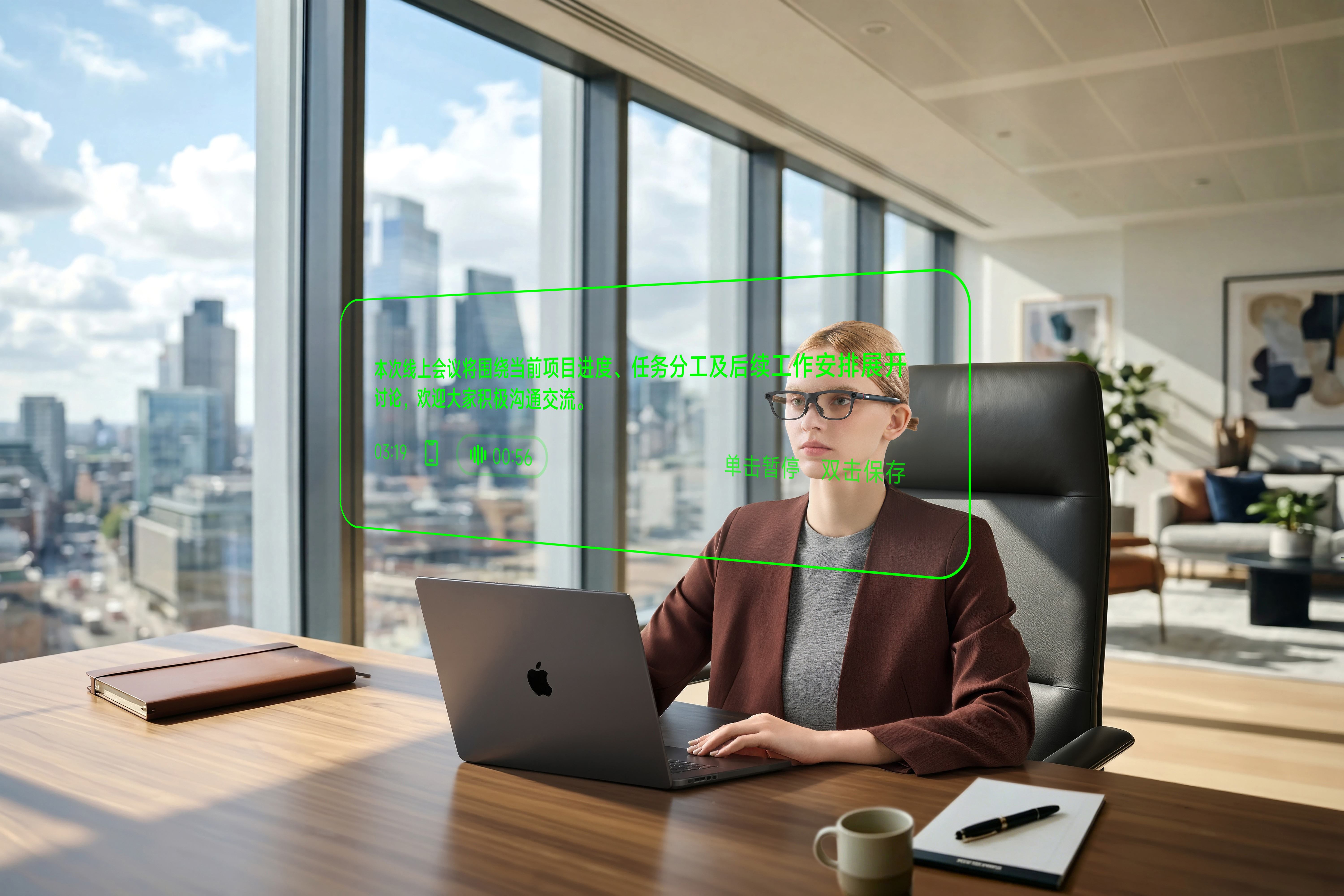
INMO smart glasses applied in office scenarios (Source: Enterprise)
The cost of integration is that the difficulty of hardware development rises exponentially.
The physical space of glasses is extremely limited: batteries, chips, antennas and speakers need to be placed in the temples, display and optical modules need to be superimposed on the lenses, and the total weight of the device must be controlled within the range of ordinary sunglasses, avoiding top-heavy feeling, pressure on the bridge of the nose and clamping on the temples. This means that optics, computing power, power consumption, heat dissipation, weight and wearing comfort must be optimized simultaneously in a space of only a few millimeters.
As early as 2021, INMO took the lead in launching full-color waveguide smart glasses, pushing waveguide technology to the consumer market. The AIR3 released in 2024, jointly with Sony, made the global debut of the 0.44-inch Micro-OLED screen, achieving a resolution of 1920×1080, with brightness three times that of the previous generation.
At the same time, the GO series released in 2023 focuses on AI capabilities, which has been verified by the market in business scenarios such as translation and teleprompter, and once occupied 80% of the translation glasses market share.
If hardware integration is the first moat of INMO, the INMO AIOS operating system that has been polished and iterated synchronously with multiple generations of hardware is a deeper competitive barrier for the enterprise. This system was initially developed along with INMO's first-generation AIR products, and has continuously added Agent and multi-modal perception capabilities on the basis of spatial interaction, gradually evolving into a complete AI-native spatial operating system.
"Our judgment is very simple: glasses are not mobile phones worn on the face, and the operating system has completely different things to manage. Mobile OS manages applications, windows and touch operations; glasses OS needs to manage space, context, intention and attention — where you are, what you are looking at, what you are doing, and whether you should be disturbed at the moment." Yang Longsheng said.
The technical architecture of INMO's self-developed INMO AIOS includes three key layers. First, the full-stack self-developed spatial layer has been mass-produced and implemented. Monocular VIO, 6DoF spatial positioning, spatial anchor, virtual-real fusion rendering and gesture interaction all run under the power consumption and weight constraints of glasses-level devices. Therefore, INMO's idea is end-cloud integration: the end side only performs positioning and rendering that require ultra-low latency, and large-scene reconstruction is handed over to the cloud, using algorithms and cloud computing power to achieve lightweight of the glasses end, instead of stuffing more chips into the temples.
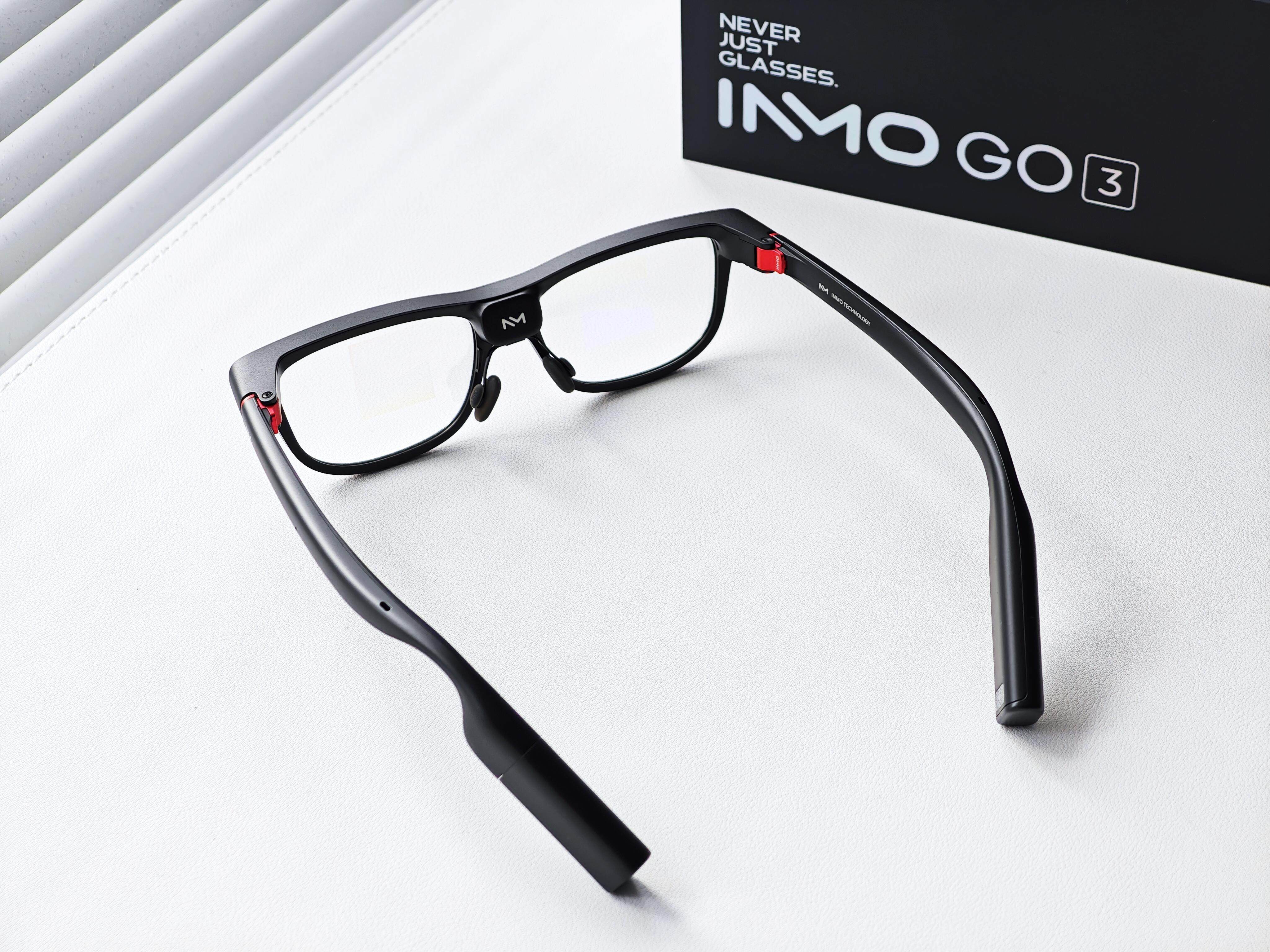
Lightweight design (Source: Enterprise)
The second layer is AI-native. INMO does not develop the underlying large model base, and supports flexible switching of bases from multiple manufacturers. At the same time, it focuses on upper-layer capabilities close to the human eye, including multi-modal context understanding, Agent task orchestration and tool invocation. This year, the GO series released by the enterprise is positioned as Agent physical hardware. When the user sends a voice command to the glasses, the cloud Agent can complete a whole set of work such as booking air tickets, checking emails, and writing meeting minutes.
The third layer is a unified underlying system covering all product lines. The AIR series carries full-stack spatial computing capabilities, and the GO series focuses on voice interaction and Agent capabilities. Different product lines share the same technical base, and then perform capability stratification according to product positioning, so as to ensure that every R&D investment can be reused on multiple product lines. This architecture enables INMO to maximize the efficiency of technical investment while maintaining product differentiation.
"Since the beginning of this year, the whole industry is piling up parameters, but the computing power and power consumption of glasses are only a fraction of that of mobile phones. What will finally widen the gap is not the parameters, but how the system schedules this limited computing power to make space and AI run smoothly." Yang Longsheng told Hard Krypton, which is the fundamental logic for INMO to heavily invest in self-developed spatial AIOS.
At the user level, INMO Technology is accelerating the transformation from "technology-driven" to "dual-driven by technology + user groups". The launch of the X series is the implementation of this logic. It no longer adopts the strategy of "one pair of glasses for all users", but makes differentiated product definitions around different segmented needs such as fashion, sports and family.
Among them, INMO has reached a strategic cooperation with WHL to launch the INMO x Magic AI series, which was designed by Wang Jiaer and worn by him for a long time. The first batch of pre-sales reached 50,000 units, and it made its exclusive debut in North America in July. This is the first time that INMO has broken through the tech enthusiast circle and truly reached the mass consumer market. INMO has also launched co-branded camera glasses for female users, focusing on appearance design and daily recording needs, covering a wider range of groups such as new white-collar workers and refined mothers.
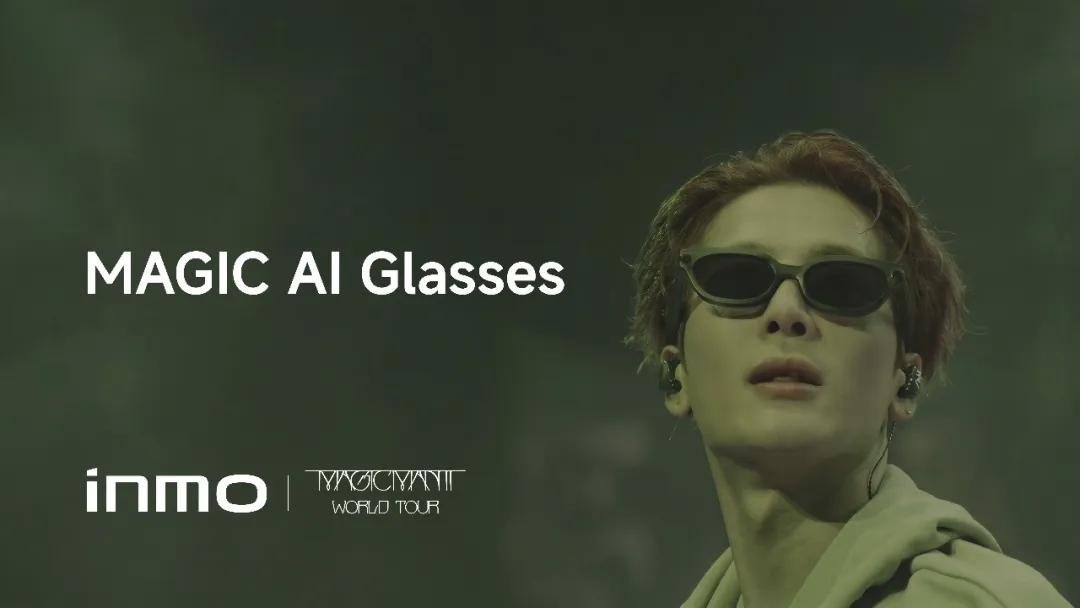
Magic AI Glasses jointly launched by INMO and WHL (Source: Enterprise)
Through this strategy of clearly defining users and usage scenarios first, and then deriving the hardware form and interaction mode, smart glasses are truly transformed from "geek toys" to "mass daily consumer goods". It is no longer a tech product only tried by a few early adopters, but an intelligent terminal that ordinary people are willing to wear daily and can really use.
The core value of smart glasses does not lie in replicating the display capabilities of mobile phones, but in taking "independent terminals" as the anchor point to reconstruct the scenarios and modes of human-computer interaction. With integration, lightweight and AI-native as the core goals, around users' daily life scenarios, spatial computing and AI capabilities are embedded into glasses, which is a natural high-frequency wearable device, to achieve true independent intelligence.
This is also the underlying logic migration of terminal competition in the AI era. When large models gradually eliminate the functional boundaries between applications, the competitive barriers no longer stay at the algorithm parameters, but migrate to two ends: one end is the independence of hardware form, and the other end is the depth of scenario embedding and the native capabilities of AI.
INMO breaks the category limitation of "mobile phone accessories" with integrated waveguide technology, and builds an independent terminal ecosystem combined with self-developed AIOS, trying to realize the path upgrade from "feature phone-style glasses" to "next-generation spatial computing terminal".
The following is an excerpt from the interview between Hard Krypton and Yang Longsheng, Founder of INMO (slightly edited):
Hard Krypton: Compared with the Birdbath and external solutions that can achieve faster short-term volume growth, INMO has long adhered to the all-in-one waveguide route. From the perspective of competitive situation, how do you view the respective positions of different technical routes in the future market pattern?
Yang Longsheng: Birdbath and external solutions can indeed ship products faster in the short term, but they have a fundamental problem: they are essentially a "mobile phone accessory" business. From the first day of its establishment, INMO has adhered to the all-in-one route, because we define that what we want to make is the "next-generation terminal".
If smart glasses really want to replace mobile phones, they must eventually be independent terminals, not accessories attached to mobile phones. With the continuous evolution of the industry in recent years, this judgment has been continuously verified.
All-in-one smart glasses have several values that compromise solutions cannot provide. The first is the initiative of AI. If AI really wants to understand you, it needs to constantly see what you see and hear what you hear — it has to be "present". However, once the split-type glasses leave the mobile phone, the connection is broken, and AI becomes a tool that users need to actively wake up, rather than a partner that is always online. Only AI that is not tied to other devices can have the opportunity to truly release its potential.
The second is the completeness of spatial computing. The biggest difference between glasses and mobile phones is that it can allow digital content and the real world to coexist in the same space, realizing virtual-real symbiosis. However, any wired design will essentially limit the freedom of movement, and free movement is exactly the premise of spatial computing experience. If users want to wear it outdoors, for sports, and in any scene, it must be wireless, lightweight and integrated.
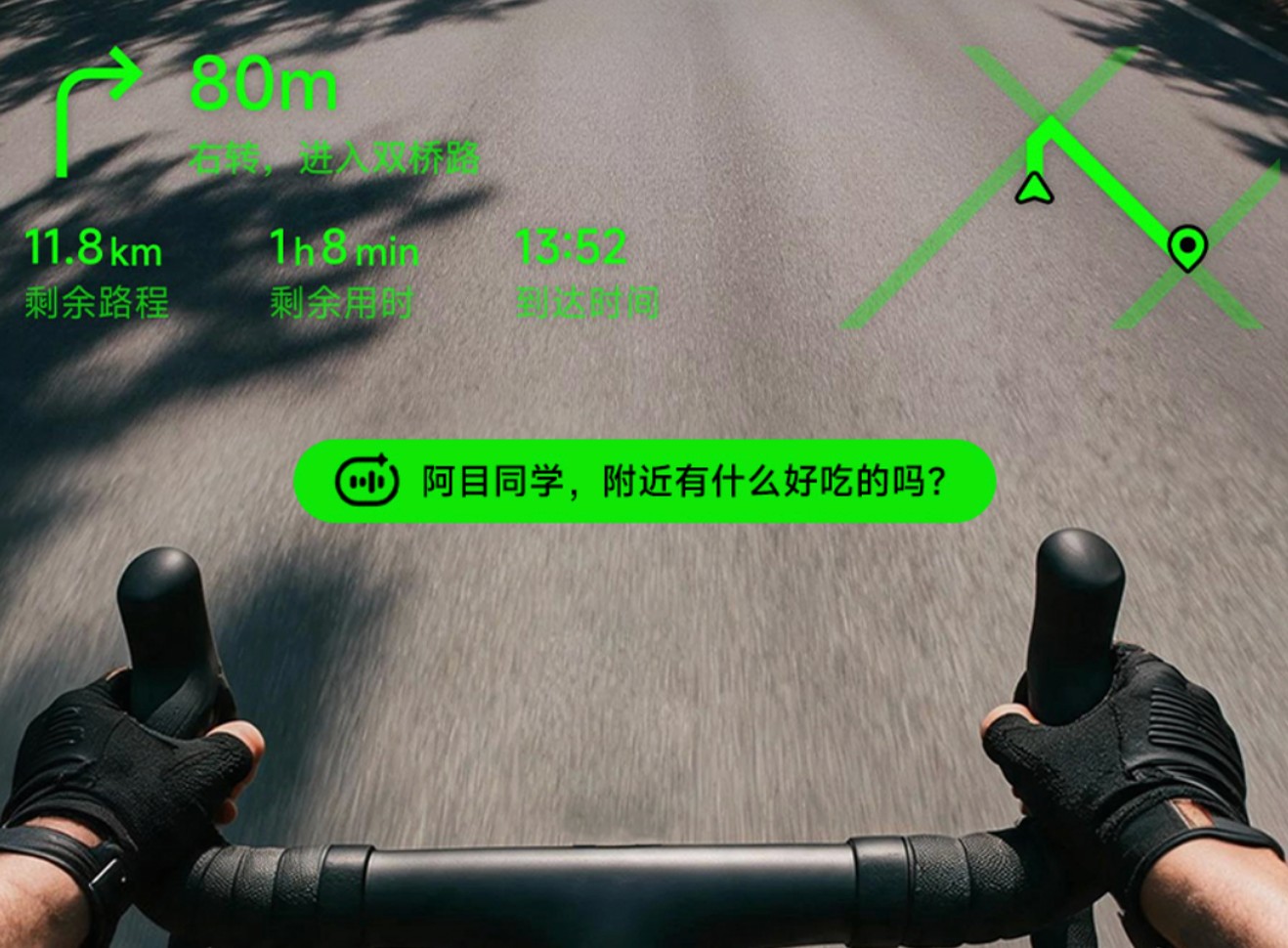
INMO smart glasses applied in outdoor scenarios (Source: Enterprise)
The third is the ability of continuous learning and evolution. Wearable devices that users carry with them can continuously collect environmental data, allowing AI to continuously learn and adapt to user habits.
Therefore, although the all-in-one route does require a longer R&D cycle and higher cost, we believe that it is the only answer that can enable smart glasses to cross the "geek toy" stage and truly enter the daily life of the public. We chose this path not because we want to do more difficult things, but because we believe it is the only correct path.
Hard Krypton: Translation business is a scenario with high barriers and strong rigid demand, which is the main track that INMO focuses on. In contrast, consumer-grade general scenarios generally have pain points that users find products look good but not practical, and are low-frequency and non-essential. How to balance between these two markets with different logics? How to reflect the differentiation at the scenario level?
Yang Longsheng: INMO has been working on solving the pain point of "looking good but not practical".
From creating new categories to focusing on translation scenarios to complete rigid demand verification, and then to AI smart glasses, we have done several practical things in product definition. The translation and teleprompter functions are industry firsts, and the swappable battery solution that allows users to replace the battery in five seconds completely solves the battery life anxiety. The front-back balanced integrated design makes the total weight of the device about 50 grams, with the thinnest part of the temple being 8mm, so it will not press the bridge of the nose when worn. At the same time, we have built 21 sets of industry lexicons, pushing intelligent translation into the super-professional era. In other words, we have made smart glasses from "usable" to "decent and natural".
Regarding homogeneous involution, we believe that what the mass market lacks is not products, but brands with innovative capabilities. What INMO has been doing is to define categories, not to follow others.
Specifically at the scenario level, our way of achieving differentiation is to first find specific segmented scenarios and user groups, and then define products accordingly. This includes the sports series, which meets the navigation and call needs during outdoor sports; the family series relies on the basic skills of making glasses such as lightweight and wearing comfort; the camera series cooperates with celebrity brands to bring smart glasses into the fashion consumption circle. Each product is made for people in specific scenarios, not made first and then find out who to sell to.
Hard Krypton: How to build the ecological barriers of products?
Yang Longsheng: At the ecological level, we do not plan to replicate the app store model of mobile phones. We start from three dimensions: first, build a developer platform, provide visual orchestration tools and SDK, so that developers can complete application development and deploy it to glasses devices in a few days, realizing one-time development and multi-terminal adaptive operation; second, create differentiated content, focusing on scenarios that interact with the physical world such as mobile business, navigation and travel, and offline games; third, promote ecological co-construction, and cooperate with partners such as Ant Group, Tencent and Zhipu AI to open up the world coordinate system, and jointly build the real world model, which is also the future base of spatial AI intelligence.
We believe that the real barrier of software ecology is not the number