V4.1 Flash closed beta test, Liang Wenfeng is back to being the "Saint Liang"
Without any prior notice, the intermediate version of DeepSeek V4.1 Flash, deepseek-v4.1-flash-expires-on-0910, has started its internal beta test.
DeepSeek officially stated that, "DeepSeek V4.1 Flash adopts a new model architecture, features native multimodal support, stronger capabilities, faster speed, and lower cost."
There is no technical report or performance parameter sheet, but the information released by the official is already quite shocking.
V4.1 Flash is DeepSeek's first native multimodal model. Although V4 Flash Vision-Exp also supports multimodality, it belongs to the "plug-in" type, which connects a visual encoder and an Aligner externally on the basis of the V4 Flash 0731 pure text base model.
V4.1 Flash comes with integrated text and image input and output right out of the factory.
Moreover, only 40 days have passed since the official release of V4 to V4.1, and it has adopted a new architecture that can reduce costs while improving performance... Shouldn't this be called V5 Flash instead?
After tests by many technical bloggers in the community, even though this model is only an intermediate version of V4.1 Flash, not the official release, its performance is quite stunning.
01
What makes DeepSeek V4.1 Flash so exceptional?
Around the time the recruitment notice was released, the intermediate test version codenamed DeepSeek-v4.1-flash-expires-on-0910 inside DeepSeek suddenly launched its test, with the testing period closing on September 10.
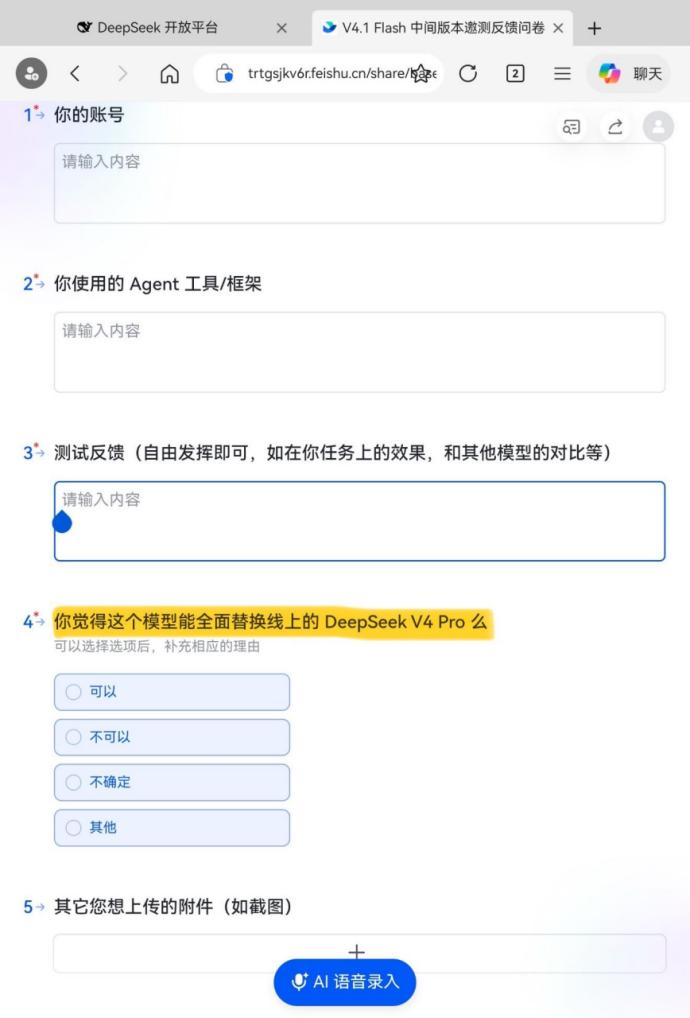
DeepSeek did not release a technical report for this model, but in the "V4.1 Flash Intermediate Version Invited Test Feedback Questionnaire" initiated by the official, there is a very interesting question.
The question is "Do you think this model can fully replace the DeepSeek V4 Pro online?" The options are "Yes", "No", "Uncertain", and "Other".
To figure out whether it can replace V4 Pro, we first need to see what it is really capable of.
After testing, we found that the speed of V4.1 Flash is incredibly fast.
In the past, when we talked to large language models, no matter how fast the response was, the thinking indicator on the interface would usually flicker for one or two seconds. But on V4.1 Flash, a developer typed "Hello" tentatively, the model only took 0.3 seconds to think, the generation rate instantly soared to 159.3 tokens per second, and the end-to-end time of the whole round of conversation was only 0.8 seconds.
In another real test screenshot of heavy long-text inference, the model's generation speed even reached 420 tokens per second directly, with an end-to-end throughput of 409.5 tokens/second.
In the teasing of industry insiders, "This throughput directly turns other companies' so-called Highspeed mode into our own daily baseline."
But this is far more than just "fast" — it is both fast and accurate.

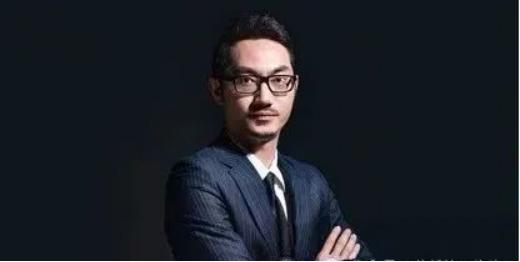
Blogger Xiang Yangqiao Mu sent a photo of a man in a suit to DeepSeek V4.1 Flash, and the model replied that he was wearing a striped suit.
At first he thought it was a hallucination just like what happened on V4 Flash Vision-Exp, but when he opened the full image and looked carefully, the person in the picture was indeed wearing a striped suit.
Many senior technical bloggers who got early access to the test conducted end-to-end comparative evaluations between V4.1 Flash and the previous V4 Flash Vision-Exp for the same tasks.
The results show that in the 49k ultra-long context retrieval scenario, the new model's processing speed is 5.2 times faster; in SVG code generation, it is 6.0 times faster; in solving the classic Manacher palindrome algorithm problem, it is 4.6 times faster; in large-scale SQL query generation and optimization, it is 5.0 times faster; in the highly difficult asyncio asynchronous architecture refactoring task, its processing speed still reaches 3.9 times that of the previous generation.
Therefore, the official statement that V4.1 Flash adopts a new architecture and natively supports multimodality is completely true.
That's not all. While achieving a surge in performance, its calling price is the same as that of V4 Flash.
There are many memes about Liang Wenfeng in the community. When DeepSeek delivers good performance at low prices, people respectfully call him "Saint Liang" or "Ancestor Liang", but when the price rises, they call him "Liangzi" or "Little Liang". With the release of V4.1 Flash, Liang Wenfeng has once again become "Saint Liang".
02
The Little Whale's Coming-of-Age Ceremony
The day before the release of V4.1 Flash, DeepSeek suddenly announced a large-scale recruitment of 150 positions, which are clearly targeted at senior engineers with 2 to 10 years of working experience, while also taking into account fresh graduates and emerging talents.
This recruitment focuses on two directions. The first is server-side development engineer, covering large model research platforms, Agent framework components, R&D efficiency infrastructure, DeepSeek API, online services and data engineering; the second is Agent elastic computing R&D engineer, including platform development and maintenance, underlying optimization and technical breakthroughs.
As the head of DeepSeek Harness, Cui Tianyi posted on social platforms that this expansion of recruitment is by no means to add headcount for routine business, but because "the surge in volume has triggered an exponential explosion in complexity".
Cui Tianyi wrote: "In the computer field, when the volume of anything increases, there will be a huge increase in complexity. The volume of data, the number of machines/containers, the number of training tasks, the number of evaluation tasks, the number of Agent environments, the number of users, the number of requests, and so on, are all increasing sharply. This creates growing complexity that makes the previous backend systems gradually unable to fully meet the demand of future volumes, so we need to recruit a large number of people to upgrade, maintain and rewrite various backend systems."
In the past public perception, DeepSeek was a "special forces unit" composed of dozens of talented algorithm scientists, who relied on extreme code obsession and workshop-style innovative inspiration to achieve impressive results that caught Silicon Valley's attention. However, from the first round of financing to the intensive moves today, DeepSeek has evolved into an enterprise with a scale of hundreds of employees.
Before getting the first round of financing, DeepSeek's servers often crashed under the impact of massive traffic. After the financing was in place, the server-side was expanded, and no long-time crash has occurred since then.
But this only solves the superficial web page and API problems. What DeepSeek is facing today is far more than server pressure.
From the perspective of technological evolution, large language models are undergoing a profound qualitative change from "static pre-training" to "dynamic environment interaction".
In the past, when training a language model, the engineering task was relatively simple: engineers put the massive cleaned static text from the Internet into the hard disk, and let the graphics card process the data.
In the current era of reinforcement learning and Agents, in order for the model to learn to solve real-world tasks, it must interact with thousands of dynamic "sandboxes" in real time at the millisecond level.
For example, to teach a model to play chess, in the past, we showed it millions of fixed chess game records, but now we let the model play against itself on hundreds of thousands of dynamic chessboards at the same time.
The startup, state recovery, network isolation, and result capture of each sandbox environment must all be completed at the millisecond level.
The original workshop-style system of DeepSeek was fine for its own testing, but it cannot withstand this level of industrial dynamic load.
With the throughput and inference speed of the V4.1 Flash level, it requires extremely strong scheduling capabilities to meet the needs of these developers.
For example, which requests should be placed on the same GPU for batch processing? How to interleave long and short requests so that they do not drag each other down? Where to allocate resources at the second level when the traffic suddenly triples? How to automatically scale down to save money when the traffic drops at 3 a.m.?
As a laboratory, DeepSeek did not need to care about these problems, but now Liang Wenfeng runs an enterprise, and these engineering problems have become the key instead.
Similarly, the new architecture means that DeepSeek may need to modify the inference framework by itself, write CUDA operators by itself, and complete model compression and quantization by itself, which is still an extremely time-consuming and laborious engineering problem.
The stronger the Agent capability of V4.1, the more sandbox environments it requires, and the more complex the elastic computing scheduling becomes; the more mature the multimodal understanding of V4.1, the greater the pressure on the data pipeline and storage system.
This is exactly where the role of these 150 engineers lies.
Although the number of 150 people is only the quarterly quota of a department in an ordinary large tech company, for DeepSeek, this is already a major move that doubles its headcount.
DeepSeek has completed the process from 0 to 1. Now the problem Liang Wenfeng faces is how to go from 1 to 100, so DeepSeek uses 150 headcounts as the answer, and V4.1 Flash becomes DeepSeek's coming-of-age ceremony.
Geniuses eventually grow up, and large language models cannot only stay in papers and benchmark competitions. The real-world business and engineering framework is the pillar for this company to survive for a long time and win the next round of competition.
This article is from the WeChat Official Account "Letter AI", author: Miao Zheng, editor: Wang Jing, published with authorization from 36Kr.