A cup of coffee, the new foothold of AI + embodied intelligence
On August 16, a crowd of people queued up at the entrance of a newly opened coffee shop in Beijing Galaxy SOHO.
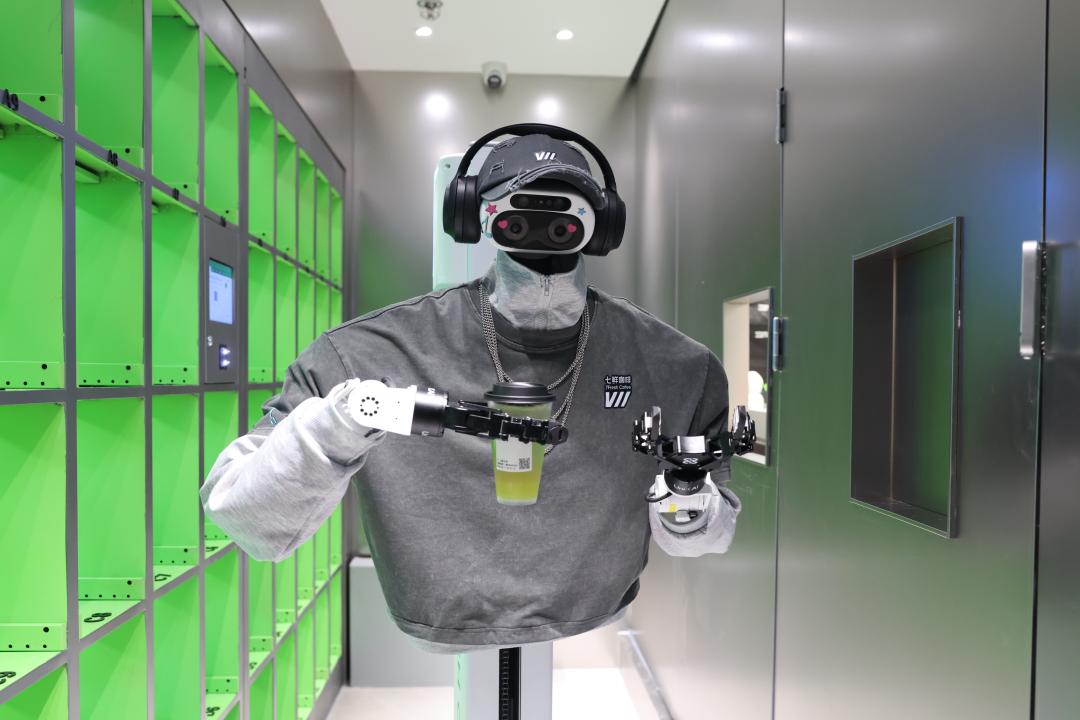
There is no bar counter inside the store, and no baristas are visible. After a drink is fully prepared, an embodied robot grabs it and delivers it to the pickup locker. After receiving their drinks, people hold their smartphones through the glass to record the robot at work.
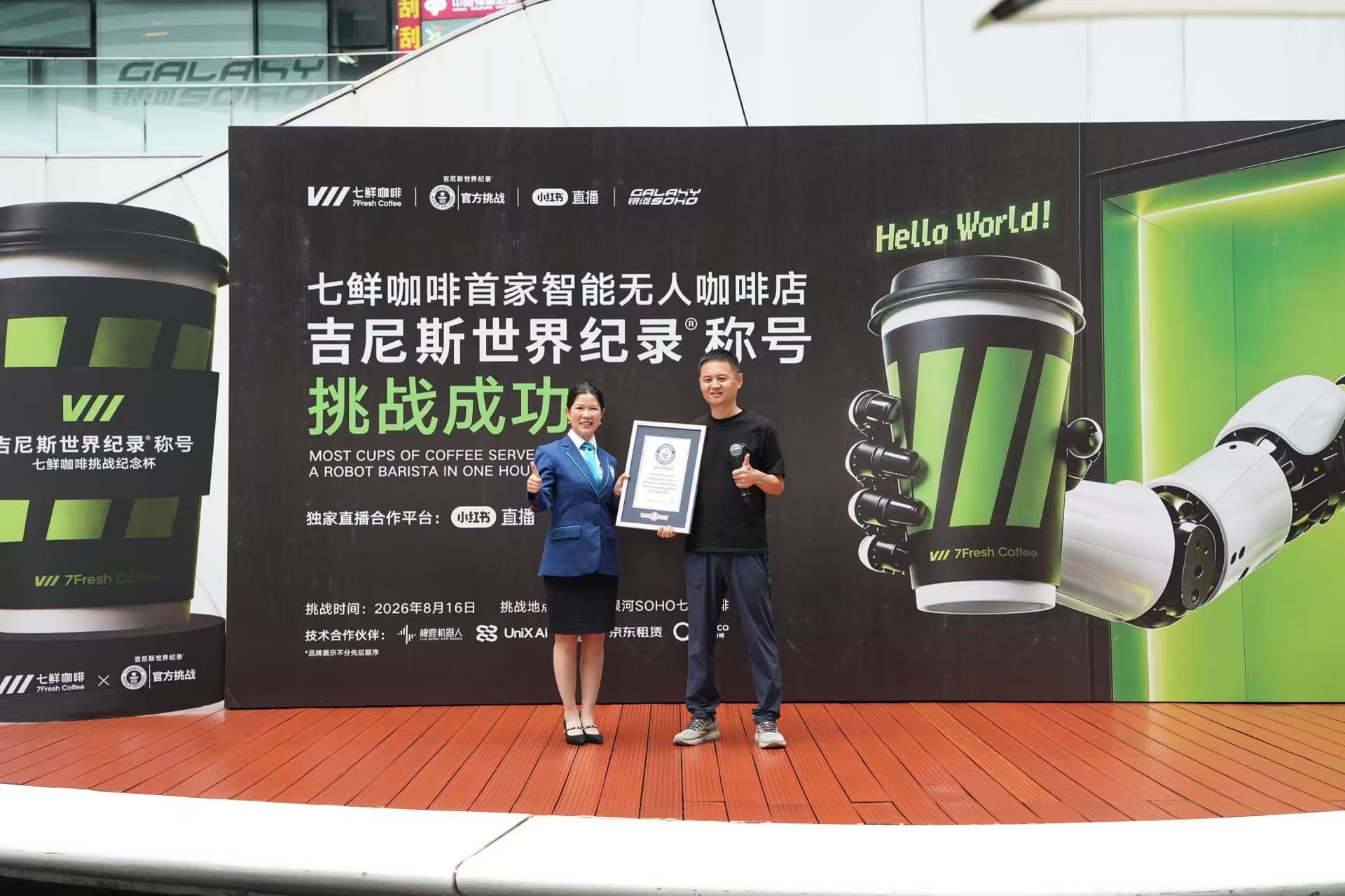
This store is called 7Fresh Coffee, which operates 24 hours a day. On its opening day, it completed the supply of 202 cups of coffee within one hour, successfully challenging the Guinness World Record for "the most cups of coffee served by a robotic coffee shop within one hour".
Soon, the attention spread from Beijing to overseas. Media outlets including CBS in the US and 7NEWS in Australia reported on this unmanned store, with roughly similar focuses: a drink can be prepared within 30 seconds, 24-hour operation, and how the robot delivers coffee to consumers. The embodied robot is only the most visible part of this store.
What truly supports the operation of the store is a complete system covering AI demand insight, product R&D, digital formula, automated production, embodied delivery, and consumer feedback. The reason why 7Fresh Coffee has quickly drawn attention at home and abroad is precisely that AI and embodied intelligence are implemented in real catering scenarios and tested through a complete commercial chain.
A cup of coffee has thus become a small enough and complete AI sample in the physical world.
The System Behind a Cup of Coffee
The store operation of 7Fresh Coffee is jointly supported by AI, intelligent automated production and embodied intelligence.
Before a drink enters the production process, market hotspots, user reviews and consumption trends have been analyzed by AI, helping the team judge which products and flavors are favored by users and worth developing. R&D personnel and the supply chain then complete the raw material preparation, formula design and offline debugging, converting these judgments into digital formulas that the equipment can execute to start stable production.
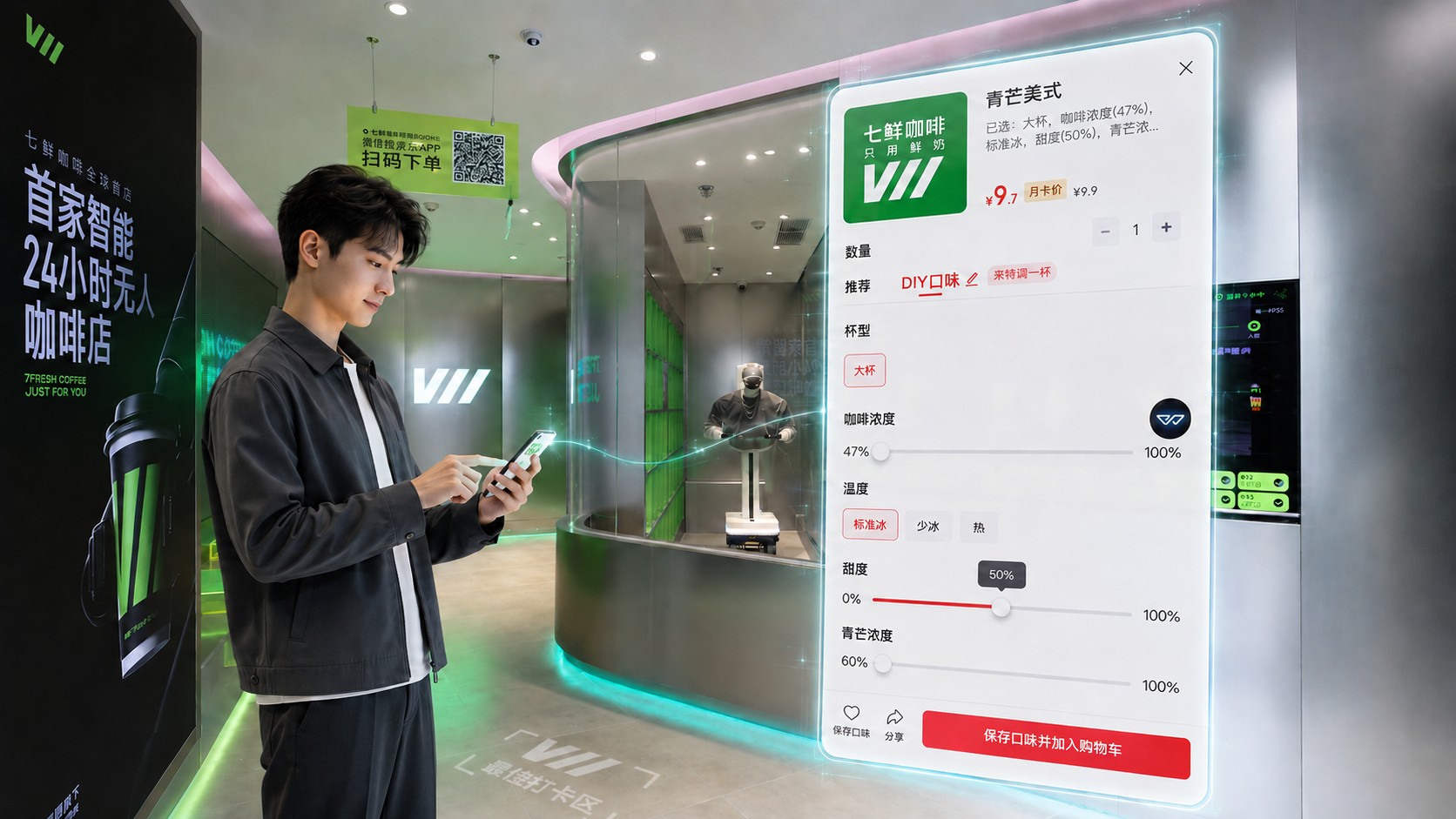
For a specific order, after the user selects the drink on the JD App or the 7Fresh Coffee mini-program, the system completes cup placing and ice adding according to the cup size, temperature preference and ice amount, injects coffee liquid, fresh milk, fruit juice and other ingredients in accordance with the formula, and then sequentially completes cup labeling, lid placing, lid pressing and weighing quality inspection. The qualified finished product that passes the inspection is grabbed by the embodied robot and placed in the designated compartment of the self-pickup locker.
According to the data provided by 7Fresh Coffee, the average production time of a single cup of drink is within 30 seconds, and the entire production line can produce 7 to 8 cups at most at the same time.
Speed determines the maximum production capacity of coffee and tea stores.
Taking coffee as an example, its consumption is concentrated in several periods such as morning peak, noon peak and afternoon tea time. The carrying capacity at peak time directly determines the queuing time, and also determines whether users are willing to continue waiting. For manual stores, there are usually only two ways to cope with peak hours: adding more staff or adding more equipment, and both have upper limits.
"Reducing the time for a single cup to 30 seconds is the margin reserved by the automated production line for peak hours," the technical director of 7Fresh Coffee told 36Kr. The store's production capacity can also adjust the number of equipment according to demand to adapt to the production needs of different periods.
Such a speed leaves very little room for the equipment, so there are naturally no shortage of difficulties.
Take fresh milk as an example. 7Fresh Coffee only uses high-quality fresh milk. Fresh milk has strict storage conditions, and the storage temperature needs to be maintained at 0-5℃; for the quality requirements of finished drinks, the fresh milk needs to be heated to about 60℃.
This means that the equipment needs to complete the whole process from heating to serving within about 30 seconds, without damaging the ingredients and taste. The subtle balance between meeting the temperature standard and ensuring good taste is a specific problem that the R&D team needs to handle.
According to the technical director, at present, 7Fresh Coffee can achieve nearly 100% digital standard production of drinks, with the ratio error controlled at 1%-3%. The difference within this range will hardly affect the taste experience of consumers.
After the error is narrowed, an old problem in the catering industry has been alleviated. It is very common that the same brand and the same drink taste different in two different stores. The traditional model basically relies on repeated calibration through staff training and process supervision. The digital formula fixes the ratio and process into repeatable parameters, which lays a foundation for maintaining the same taste across different stores. More importantly, no matter in peak or off-peak hours, the quality of a single cup will not change with the number of orders.
Of course, the digital formula does not mean that everything is done after inputting the numbers into the machine. There are many details in the ratio that need to be handled. The viscosity, dosage, particle size and temperature of raw materials will all affect the final result.
Apart from production, there is the on-site delivery of embodied robots.
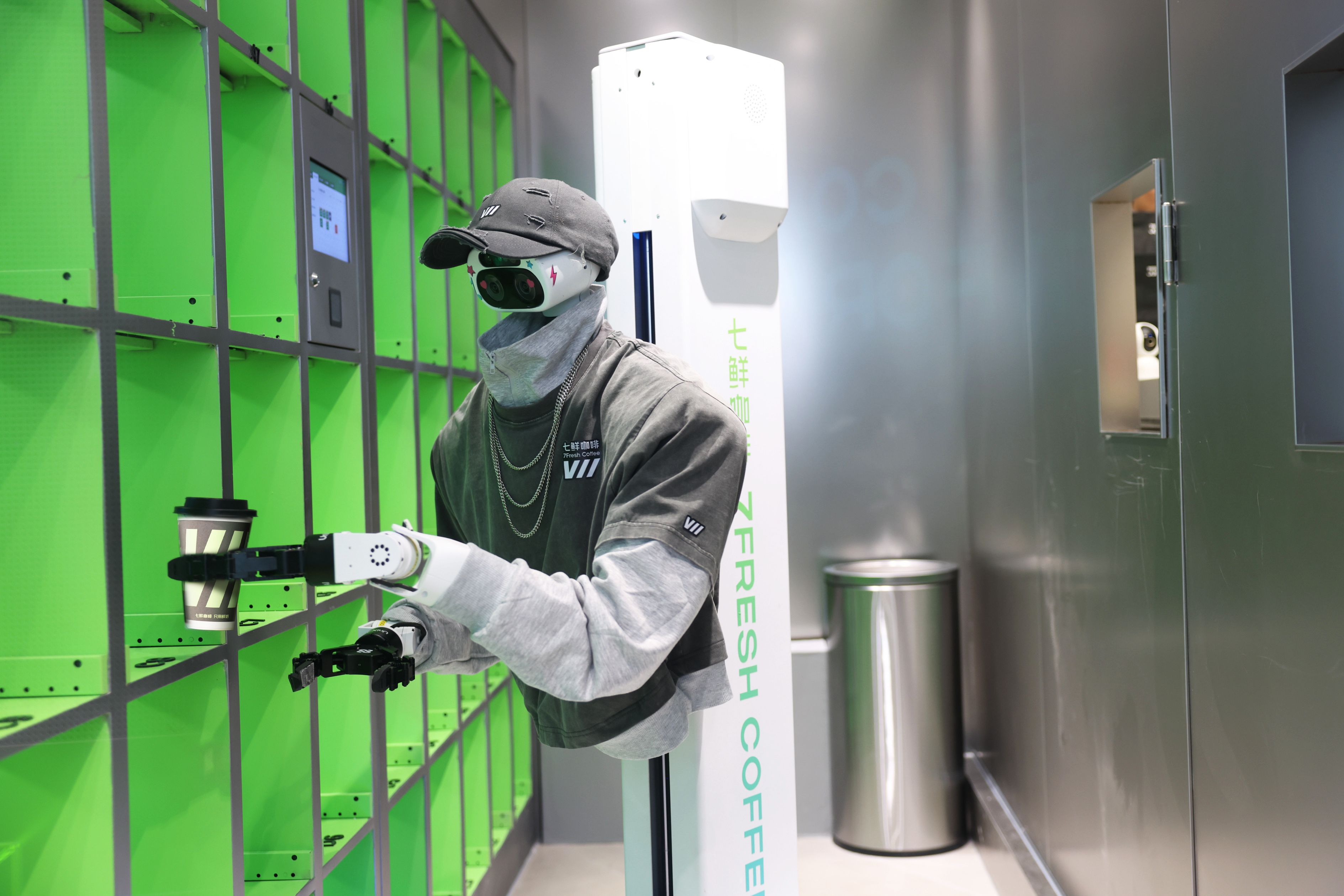
In the real store scenario, there are far more variables than in the laboratory site. The robot needs to judge the state of the cup, grab it stably, and then find the right position to place it accurately. The outer wall of the cold drink cup will have condensed water and become slippery; the occupancy status of nearly 100 compartments in the pickup lockers changes every minute, and some orders contain more than one cup.
In a real commercial environment, embodied intelligence can "try again", but every attempt has a cost. Grabbing the wrong position will lead to wrong orders, spilling the drink will cause loss, and system shutdown means the store stops operating. To solve this problem, 7Fresh Coffee's solution is to make the system identify and handle anomalies on its own as much as possible, and manual intervention is only required in extreme cases. In the production process, weighing quality inspection is also arranged, and unqualified drinks will be automatically remade.
These automatic error correction functions also form part of the stable operation of the system.
Judging from the results, this store of 7Fresh Coffee has withstood the test. The result of 202 cups per hour is actually a public inspection of the overall scheduling capability of the system, and it also presents an intuitive result of the collaboration between AI and embodied intelligence in real catering scenarios.
We have seen too many seemingly excellent DEMO products on exhibition stands and in venues, which are enough to prove whether "AI + embodied robot" is technically feasible. But a store that opens for business every day needs to answer the question of "whether it can operate sustainably all the time", and finally form sustainable operating efficiency.
This point demonstrated by 7Fresh Coffee may be more valuable for the whole industry.
The AI Closed Loop of a Cup of Coffee
The implementation of AI in 7Fresh Coffee is not limited to the store site.
"At 7Fresh Coffee, AI + embodied intelligence forms a complete chain," the business director of 7Fresh Coffee told 36Kr. According to his disclosure, the overall business flow of 7Fresh Coffee is: after AI identifies market opportunities, users will form their own exclusive formulas with the assistance of AI, and then the store completes accurate production and service delivery. If users give feedback, the feedback will be re-injected into the judgment technology of the AI R&D system.
Along this chain, AI participates in the very early stage of drink R&D.
After the whole network hotspots, user reviews and consumption trends are imported into the system, AI will help the team judge which flavors are worth developing, and undertake part of the information sorting and direction judgment work in the early stage of drink product managers.
Take the recently popular "small butter" latte in the industry as an example. The name itself is a flavor concept, and most of the ingredients in the formula have nothing to do with real butter. It is necessary to further break down what consumers really like: is it the velvety, smooth taste, or the flavor close to butter and popcorn. The same popular keyword corresponds to different demands behind it, and AI needs to distinguish these preferences from real reviews first.
Then it is the turn of human work. The supply chain finds raw materials, R&D personnel communicate with suppliers for customization and formula adjustment, and then carry out offline debugging and on-machine testing. AI shortens the distance from massive information to product direction, and the final taste is actually produced and tasted through the automated production line.
However, a standard formula after tasting tests may not satisfy everyone.
The team once carried out an internal test for this purpose. They took an existing drink, adjusted the flavor intensity, sweet-sour balance and caffeine concentration, made more than ten versions for the team to taste, and the distribution of preferences was more scattered than expected: the strong taste that some people like in the same drink is exactly the part that others find too sweet and greasy.
The internal judgment of 7Fresh Coffee is that taste preferences vary from person to person, but consumers have lacked outlets to express their preferences for a long time, and cannot find more suitable choices.
In recent years, chain drink stores have maintained standardization by relying on fixed SKUs and limited options. The combination of AI and embodied capabilities brings new possibilities for 7Fresh Coffee on the basis of standardization. It is understood that it opens parameters such as sugar content, coffee liquid concentration and fruit juice concentration to consumers, supporting 1%-100% adjustment.
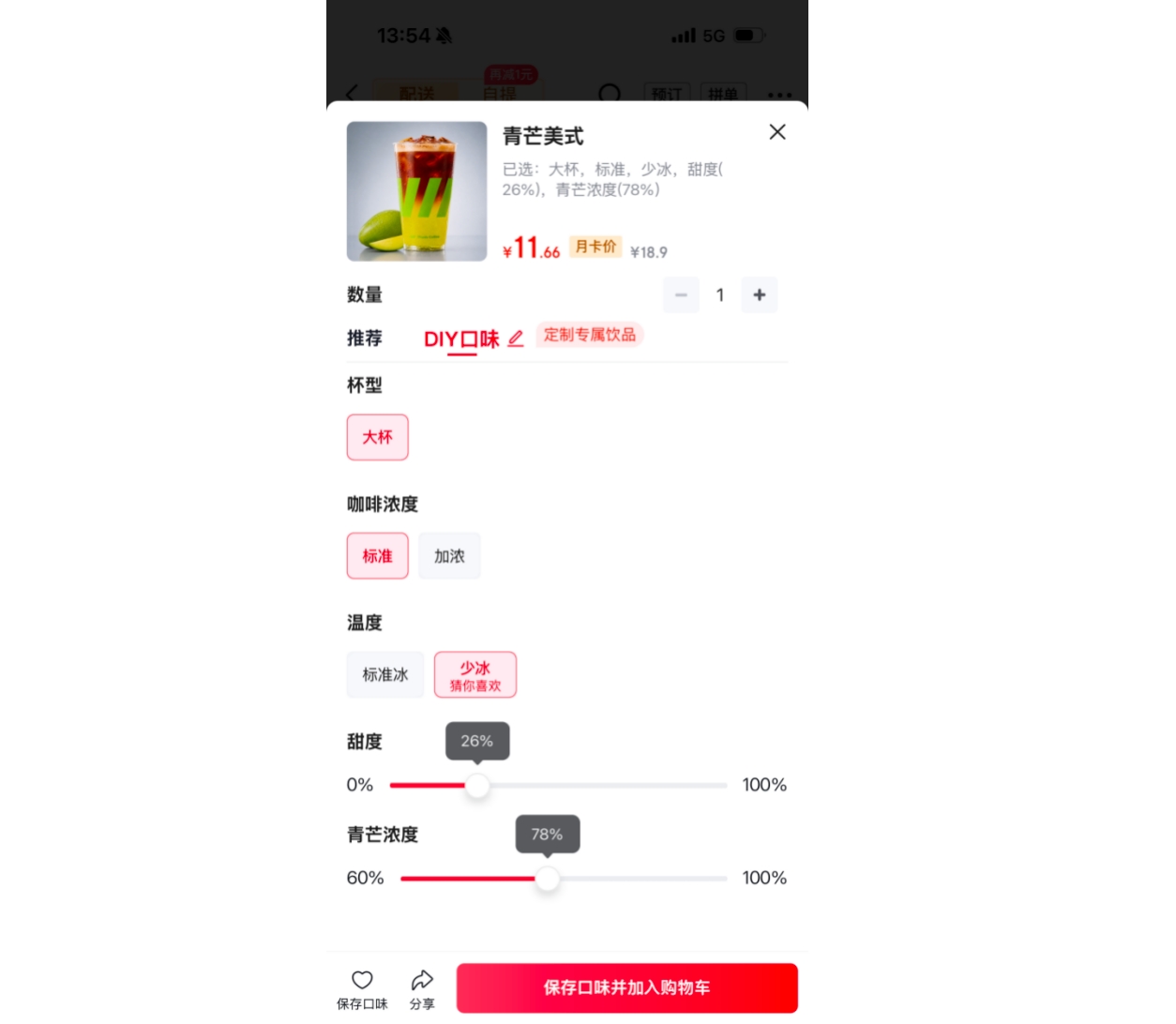
It is not easy to operate. This means that every cup of drink may be an independent formula. The combination of multiple parameters can form tens of thousands of formulas. The difference between formulas is so subtle that people cannot remember it, nor can they execute it stably.
But it is logical for machines to handle this.
After finishing DIY, consumers can also name their own drinks and generate custom cards.
This experience is still being iterated continuously. The business director of 7Fresh Coffee admitted that how to let users find the taste that suits them within one or two choices is the problem to be solved next. Opening parameters is the first step, and reducing consumers' exploration also requires design at the product and interaction levels.
After the drink is sold, the chain will continue. The user's selection, storage and repurchase, as well as the sales volume and user reviews after new products are launched, will be re-injected into the R&D system. 7Fresh Coffee always maintains a continuously updated drink library, and AI assists in judging which products need adjustment and what is worth developing next.
After the Galaxy SOHO store opened, there was such a product adjustment. The team found that there were training institutions and schools around, with a large number of child customers, so combined with these scenario information, market trends and AI analysis, they developed lactic acid bacteria drinks. According to the director, the product performed well in sales after launch.
The links of store identifying demands, AI forming definitions, R&D implementation, online sales and new data backflow have been connected. Following this idea, stores in different locations may eventually develop different product structures.
The real 24-hour operation has also opened up a broader demand scenario. On the premise that the site conditions allow, the automated store can extend the service time to the full, and the marginal cost of adding new time periods is very low, so there is no need to require every hour to bring high sales. For ordinary stores, adding business hours usually requires considering shift arrangement and corresponding investment.
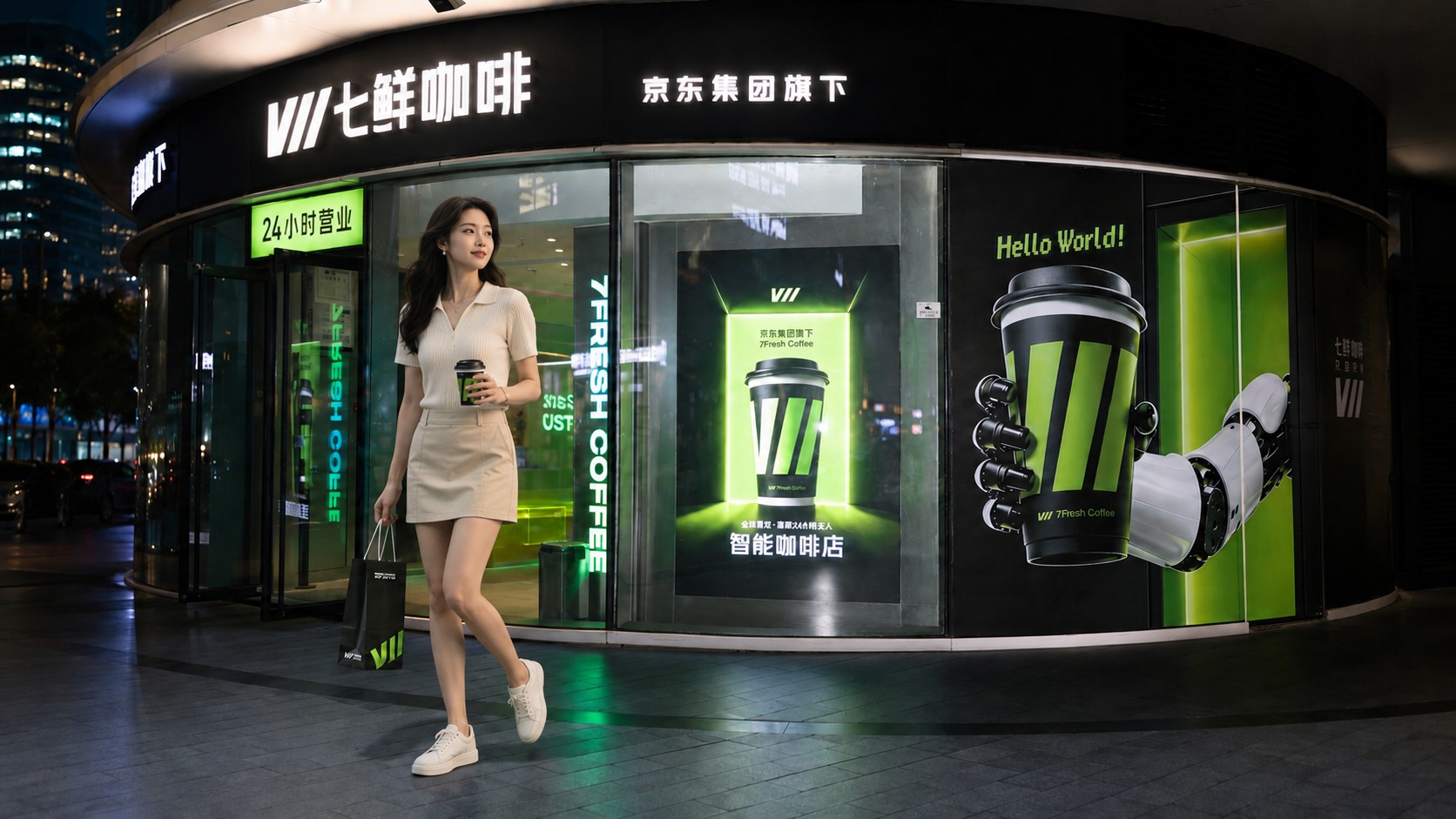
This makes up for the vacancy of business hours of traditional coffee shops. The demand for a freshly made drink at night and in the early morning can also be met. The products include coffee, tea drinks, sparkling water and lactic acid bacteria drinks, and the store can serve different groups of people for a longer period of time.
For the R&D team, all-day operation also means that they can more clearly observe what drinks people choose at different times. Consumption data will continue to affect product selection and formula design, and continuous tasks and environmental changes on site also provide continuous testing opportunities for technology iteration.
These are exactly the innovations that make 7Fresh Coffee widely concerned. AI + embodied intelligence is no longer limited to the laboratory, but has really begun to enter daily consumption, forming a store model that can actually operate, and gradually verifying the feasibility of AI in commercial scenarios. The data generated in these real scenarios is precisely a more powerful fuel for training AI based on the real physical world, allowing AI to combine with business models and be truly applied to industries.
JD is Building More Such Physical Worlds
The physical world does not accept drafts. Whether physical AI can be successfully implemented really depends on who has the scenarios and data that allow AI to "actually work". The full operation of real scenarios is a watershed for AI to enter the physical world.
From this perspective, 7Fresh Coffee has initially completed the full closed loop of AI and embodied intelligence in the catering consumption end. One end is the real supply chain of coffee beans, fresh milk and other raw materials, and the other end directly faces consumers. From AI making judgments, to machine execution, to real feedback driving adjustment.
A cup of coffee has gone through the whole process of this cycle.
That's why in the words of the business director of 7Fresh Coffee, this is a "real, closed-loop and complex commercial scenario". When 7Fresh Coffee is placed in JD's overall AI layout, its significance is more like a pilot, a specific attempt to enter the catering scenario.
It is necessary to distinguish that having physical world scenarios and enabling AI to form a closed loop in the physical world are two different stages.
Take the delivery of embodied robots in 7Fresh Coffee as an example again. If the coffee is spilled, it needs to be remade; if the compartment is placed incorrectly, it will affect the pickup; the state of hot cups and cold cups is different, and the weight of drinks varies... These in the laboratory stage may only be a successful grab and placement at a fixed position and path, but in the real consumption scenario, every time you pick up a cup of coffee, the state of the object you face may be different. The path that has not been verified by the demands of real scenarios is not enough to cope with these changes in daily operation.