The world's first AI-native smart residence: What does a home that evolves into an intelligent living entity look like?
AI Knocks on the Door of Homes: The Era of Redefining Residential Spaces Has Arrived
As devices in a home become increasingly intelligent, people are acting more and more like system administrators.
Sometimes, when you get home and want to sit quietly on the sofa for a while, you still have to pick up your phone first to configure all the devices in the house one by one.
Lights, air conditioners, fresh air systems and curtains all have their own independent control logic. The more devices there are and the richer their functions are, the higher the coordination cost in the home space will be. Many so-called "smart homes" still require people to decide when to turn devices on and off, and complete control across different operation entrances.
The industry once used the concept of "scenarios" to alleviate this problem. Pre-combining a set of fixed actions for scenarios like returning home, leaving home, and watching movies does reduce part of the operations. But life never follows several preset modes.
Large language models have brought new changes. The interaction between people and devices has become more natural, users no longer need to memorize so many instructions, and devices can be called more flexibly. However, large language models cannot automatically turn a room full of devices into a real home. Devices, data and control capabilities are still scattered in different systems. AI can understand a single sentence, but it may not understand what is happening in the whole space at the moment.
As AI begins to enter the physical world, residences have also become a key part that determines whether AI capabilities can be effectively implemented. For AI to understand and manage a home, the space itself needs to support unified perception, calculation and invocation. The long-existing fragmentation of smart homes is no longer just an operational inconvenience, it has begun to limit what AI can do in family scenarios.
On September 7, at the autumn technology launch event held in the H3 Design High Ground Pavilion of Modern Shanghai Design Week, Habitat presented its solution: a new underlying architecture for residences, the AI-native smart home underlying architecture "Gaia", as well as the supporting software hub, hardware base, environmental system and design tools.
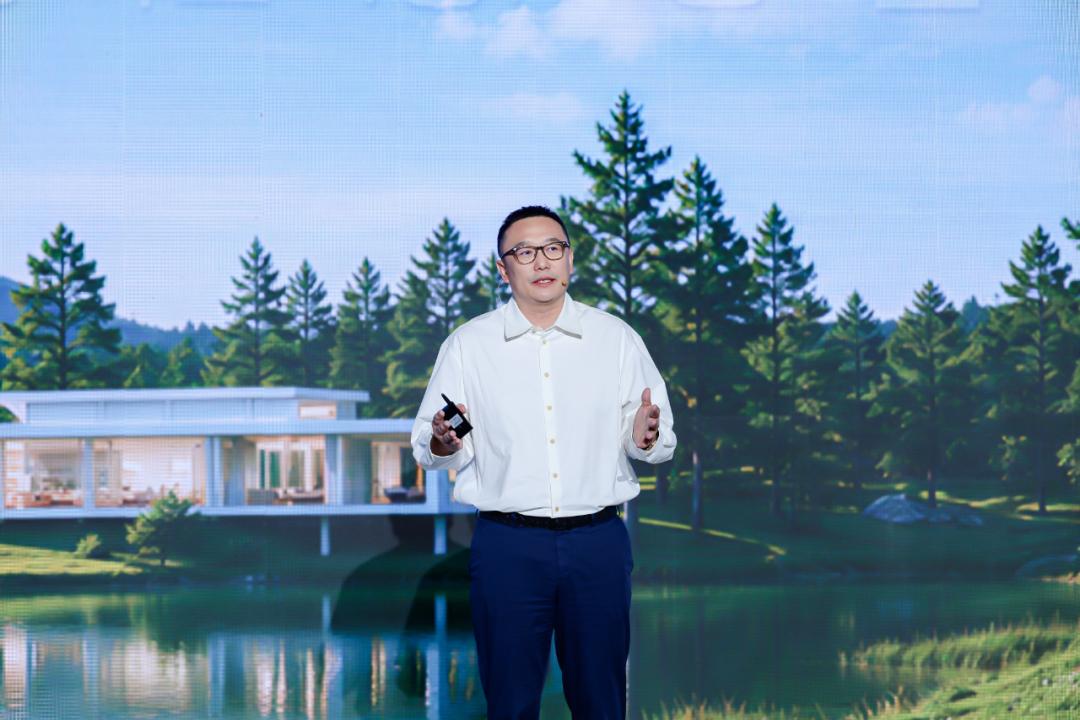
Shen Yanan, founder of Habitat, unveils the Gaia architecture
Shen Yanan, founder of Habitat, divides the evolution of smart residences into four levels from L1 to L4.
L1 solves the problem of productization of residences: it reconstructs the decoration mode of decentralized procurement and combined delivery in the past into a complete product integrating software and hardware. The previous generation of Habitat products completed this step, and connected home intelligent agents on this basis.
At the L2 stage, the design starting point of residences has been further changed. AI is no longer an additional capability, but has been embedded into the underlying design of residences. R&D personnel need to first figure out how to make a home more comfortable, healthier and more energy-saving, and then reorganize perception, computing power, communication, control, energy and devices accordingly.
This also forms the more essential difference between the AI-native smart residence released this time and traditional smart homes: accessing large language models has become increasingly easy, and the real difficulty is to reorganize the entire residence around AI.
From this moment on, what Habitat is trying to change is no longer how intelligent a single device is, but whether the residence itself can become a unified and operating intelligent system.
The Basic Unit of Intelligence Shifts from Individual Devices to the Entire Home
After the basic unit of intelligence shifts from individual devices to the entire home, the core problem also changes: what capabilities should a home that truly operates as a whole have?
Habitat named the underlying architecture of its AI-native smart residence "Gaia". The name comes from the Gaia hypothesis proposed by James Lovelock: the Earth is not composed of isolated parts, but a whole that can continuously adjust and maintain dynamic balance.
Habitat borrows this metaphor. In the Gaia architecture, switches, lights, air systems, energy, sensors and intelligent agents are integrated into the same space system, performing functions equivalent to different "organs" to collaboratively complete perception, decision-making and execution.
Such a home needs to answer three core questions: can it actively respond to the environmental changes in front of it? Can it continue to upgrade after people live in it for five or ten years? When its capabilities become more and more complex, can users worry less instead?
Habitat summarizes them respectively as: self-adaptation, evolvability, and imperceptibility.
When guests come to the house and everyone sits around to eat hot pot, the environment in the room will change. Steam rises from the pot, and the temperature, particulate matter and carbon dioxide concentration change accordingly. For people who are eating and chatting, these parameters are usually not noticed until someone feels hot or stuffy.
In traditional residences, someone usually has to pause what they are doing to adjust the air conditioner and turn on the fresh air system at this time. It is not difficult to figure out what each device can do, the difficulty lies in who will organize all these devices to work collaboratively.
The AI Ultra-constant Climate System released by Habitat this time is designed to take over this coordination work. It continuously perceives the state of the space, combines the position, activities of people and environmental changes, and links the fresh air, exhaust air and temperature control systems together. Constant temperature, constant humidity, constant oxygen, constant cleanliness and constant quietness are the five dimensions that this system focuses on. In the scenario of having a meal, it can make the environment keep up with people's activities, and minimize the interruption of the conversation at the dining table.
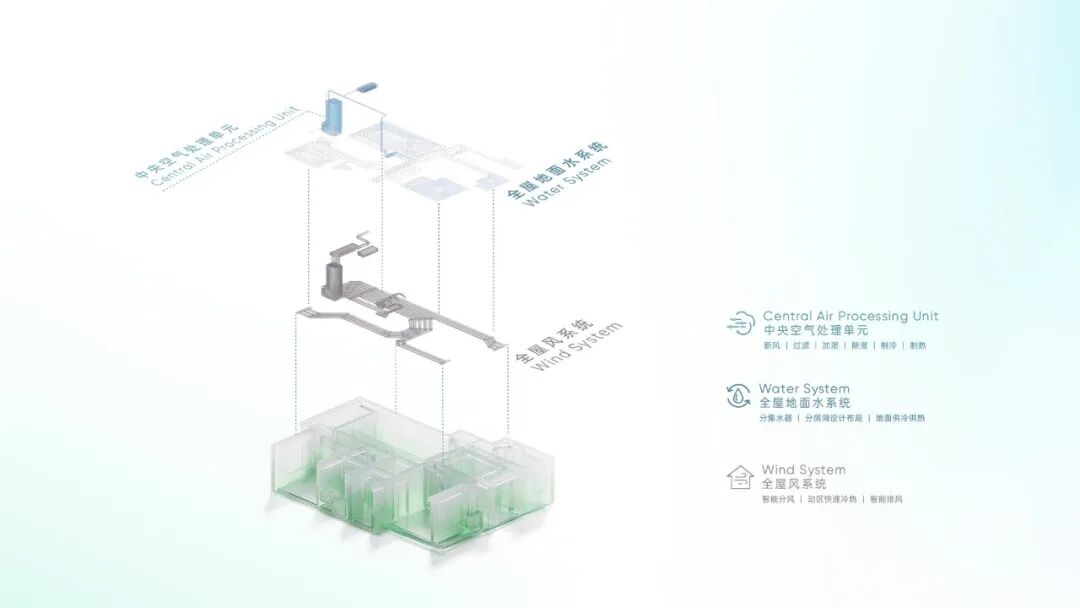
Structure diagram of the AI Ultra-constant Climate System
After the dinner, the family members go to rest one after another, the environmental management does not end. The system will continue to adjust its operation strategy to find a balance between comfort and energy consumption. And when people leave home, the adjustment process still runs in the background.
Shen Yanan calls this continuous experience of following people's environmental needs a "comfort bubble". The self-adaptation of AI-native residences lies in making the home keep up with these daily changes: complex parameters and adjustment processes are hidden in the background, and what users feel is only more stable air quality, more suitable temperature and humidity, and a quieter environment.
A meal tests whether the residence can respond to immediate changes, and when we extend the time to the fifth or tenth year after moving in, the test becomes different. New family members may join, the purpose of the room may change, and the devices on the market have been updated for several generations. People's needs are always changing, but the house often stays at the state when the decoration is completed.
The life cycle of a residence lasts for decades, but the panels, circuits and devices are basically fixed when the decoration is completed. The Gaia architecture tries to leave room for the house to continue growing: the home computing hub is responsible for local computing, storage and system operation, and the space controller integrates multiple power supply methods and communication protocols into a unified architecture. Panels can be redefined, devices can be continuously expanded, and the fixed binding between software and hardware is gradually broken. When adding new sensors, environmental equipment or embodied intelligent products in the future, there is an opportunity to continue using this base without retransforming the entire residence.
This base also undertakes more daily work. After the power consumption data of key devices is collected uniformly, "Xiao Qi" can generate energy consumption analysis to further optimize the energy use of the whole house. After the house is delivered, its functions can still be continuously expanded. The "evolvability" mentioned by Habitat answers that when life changes in a few years, this home can still keep up with the changes.
However, the more things a home can do, it does not mean that the people living in it need to know more professional knowledge. The person sitting on the sofa may just say casually: "It feels a bit stuffy."
HClaw home intelligent agent "Xiao Qi" will understand your needs. It acts as the spatial decision-making hub, combining sound source positioning, human body sensing, voiceprint recognition and spatial state to judge who is speaking and where the person is, and then adjust the corresponding devices. The same sentence "The room is a bit dark" can also trigger the adjustment of lights and curtains.
What users express is their feelings, and the residence is responsible for converting these feelings into specific actions. The former "system administrator" who used to switch back and forth between different operation entrances finally gets the chance to put their attention back to life itself.
This "imperceptibility" also extends to the surrounding space. Habitat integrates the space control terminal with the wall design to reduce the number of complex panels; the air and water systems are hidden in the ground and space structure as much as possible; environmental equipment is combined with storage systems. The sense of presence of machines is gradually weakened, and the intelligence of the residence continues to perceive, adjust and evolve in these invisible places.
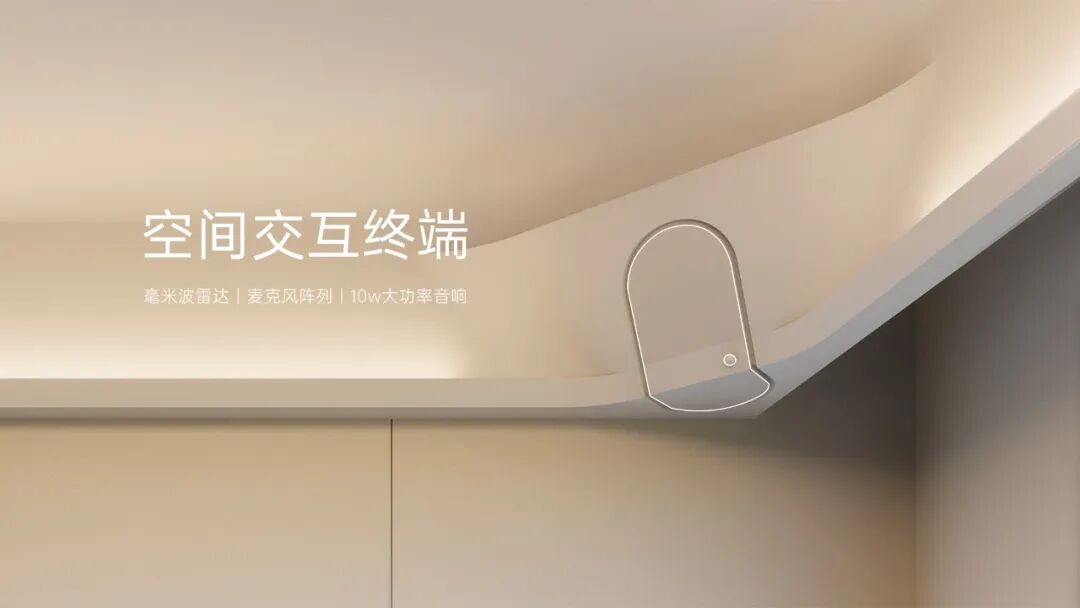
Space interactive terminal sensor integrated with the ceiling structure
From Design to Delivery, AI Begins to Rewrite the Way Homes Are Built
After the underlying architecture of the residence is redefined, another more practical problem arises: can such a residence still be designed and delivered in the traditional way?
The large home furnishing industry has long been highly dependent on personal experience. To complete a residence from demand to implementation, multiple links including design, product, supply chain and construction need to coordinate repeatedly between house type, function, aesthetics, materials, cost and on-site conditions. The more links there are, the easier information will be lost; the more complex the demand is, the stronger the dependence on personal experience will be.
Compared with the consumer electronics and automotive industries that have formed a mature industrial system, the supply side of the residential industry still relies heavily on manual experience. AI needs to enter the design, data and delivery processes to promote the change of the production method of "building homes".
This is also the real difficulty in the productization of residences: product definitions can be unified, but if design, product configuration and construction still operate independently, the complexity will be amplified as the scale expands.
Habitat hopes to use AI to further transform this whole process. ANDI released this time is an end-to-end AI interactive residential design Agent. It is built on Habitat's existing house type, product and delivery data, and tries to integrate the previously scattered house type understanding, space design, effect presentation, product configuration and delivery information into the same data system.
After the user imports the house type, ANDI can identify the original structure and generate a floor plan, then adjust the room function, space layout and product selection according to natural language instructions, and generate a browsable VR real scene at the same time, so that users can see their future home at the design stage.
More important changes take place after the renderings are completed. ANDI will synchronously generate a full information model covering the relationship between space, products and materials, and generate the corresponding product configuration list. The design data can therefore continue to flow into the supply chain and delivery links, without the need for repeated disassembly, translation and re-entry between different teams.
The unified data base reduces repeated sorting and information loss between teams, and allows designers to spend more time on links that require professional judgment. According to Habitat's vision, the design response speed can be shortened from the day level to the minute level, and the dependence on the experience of individual designers will also be reduced; after it is open to consumers in the future, users can even directly participate in the design and adjustment of their own home space.
When demands, design schemes, product configuration and delivery data are truly connected, residential design has begun to transform from a one-time professional service to an iterable production process that can be directly connected to delivery.
A necessary step for the productization of residences is to gradually convert the judgments and processes that used to rely on personal experience into capabilities that the system can identify, calculate and execute.
Technology Steps Backstage, Life Returns to the Center
Ultimately, AI-native residences should not be a technology exhibition hall.
No matter how complex the underlying architecture is, what users really feel is still whether the air is fresh, whether the light is comfortable, whether the temperature is appropriate, and whether the night is quiet. Only when technology is transformed into these daily experiences can it truly integrate into people's lives.
At the press conference, the immersive aesthetic space "Ease House" designed by Chi Wing Lo gave a more intuitive answer. The space takes spring, summer, autumn and winter as the clue, and integrates woodwork, air, light and water into the same experience. A large number of technical capabilities released by Habitat this time are hidden in it, and rarely appear in the form of devices that occupy people's sight - because people's feelings are the center of this space.
This is also consistent with the logic presented by the entire press conference: The more complex the system is, the less things users need to understand.
Just as "Xiao Qi" can handle more complex intentions, users only need to express their feelings; the space controller manages more device relationships, and the switches on the wall can be simpler; the AI Ultra-constant system continuously perceives and judges in the background, what users finally feel is only more comfortable temperature and humidity and a quieter night.
But for residences, what is really important is not just being more comfortable at a certain moment.
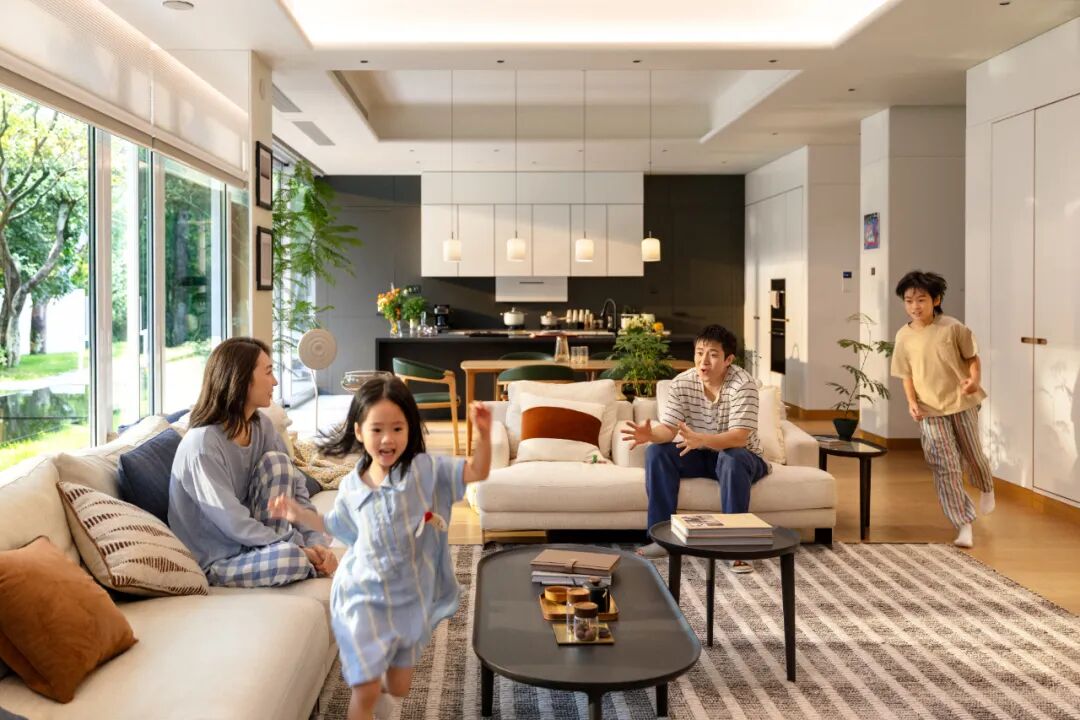
A house often accompanies a family for ten years or even longer. In the past, the spatial relationship, devices and control methods were basically fixed when the decoration was completed, but people's needs are always changing. Family members will increase, life rhythm will change, and new devices and new demands will continue to emerge.
AI-native residences try to endow homes with the ability to change: continuous perception, continuous learning, continuous upgrading, and adjust together with the family. This exactly echoes the meaning behind the name "Gaia": The reason why a system can maintain balance for a long time is the continuous feedback and adjustment.
The home in the future may be like this: intelligence does not need to be seen, nor does it need to be operated repeatedly. It leaves perception, judgment and adjustment in the background, and reserves comfort, freedom and ease for life.