Graduates with a bachelor's degree in AI earn 7,000 yuan per month, while salaries for materials and mechanical majors have increased by 25%: Has the notorious "pit major" title changed hands?
Got admitted to AI major with high exam scores, but end up earning less than materials or mechanics graduates?

Text | Liu Ziyan
Editor | Liu Sijie, Zhang Wei
Designer | Qu Mei
Cover Source | AI-generated
In recent days, hundreds of thousands of freshmen are stepping into classrooms of artificial intelligence major one after another.
During the college entrance examination season two months ago, artificial intelligence became one of the undisputed most popular majors. In the job market, stories of large tech companies scrambling for AI talents emerge in an endless stream. Along with the AI boom, the admission cutoff scores for artificial intelligence majors have also kept rising steadily.
But after entering the classroom, they will soon find that there is no direct equivalent relationship between an artificial intelligence major and a high-paying position in the AI industry. Search for "artificial intelligence major" on social media, and there are no small number of dissuasion posts calling it a new "pitfall major". Undergraduate graduates of artificial intelligence have not ushered in the "high salary right after graduation" they imagined.
Why can't the artificial intelligence major that students get admitted to with high scores bring the expected high salary?

Who has taken the high-paying dividend of AI?
In media reports, "interns earning more than 1000 yuan per day" seems to have become the norm in the new round of AI talent scramble.
In March this year, Tencent Qingyun Program launched its full-year intern recruitment, clearly stating that "there is no upper limit on compensation". A month later, Moonshot AI announced the launch of the "Crossing Plan" for top Kimi talents, planning to grant company stock options to interns who have not yet graduated. According to LatePost, the annual salary of ByteDance's Top Seed campus recruits was about 1.5 million yuan in 2024, rose to 3 million to 5 million yuan in 2025, and some core positions in 2026 can offer up to 6 million yuan or even higher.
Behind the high salary is the extreme demand for talents in the current AI industry. The 2025 Annual Talent Supply and Demand Trend Report released by Liepin states that the talent gap in the AI field has reached 5 million. The recruitment scale of large companies is also expanding simultaneously: for Alibaba's 2027 cohort of fresh graduates, AI-related positions account for 80% of all openings; for Baidu's 2027 summer intern recruitment, more than 90% of positions are related to AI.
But these figures actually correspond to a very small group of very specific candidates: those with top lab backgrounds, competition experience, or master's and doctoral degrees. Liepin data shows that among AI technical positions in 2025, as high as 46.98% of positions clearly require a master's or doctoral degree. Taking the five types of AI positions with the largest demand as examples, algorithm engineers and deep learning engineers have the highest proportion of requirements for master's and doctoral degrees, reaching 50.85% and 49.45% respectively; image algorithm and machine learning positions have a requirement rate of about 40%; only machine vision positions are relatively lenient, with a rate of 23.39%. That means nearly half of the core technical positions in the AI industry are not friendly to undergraduate students.
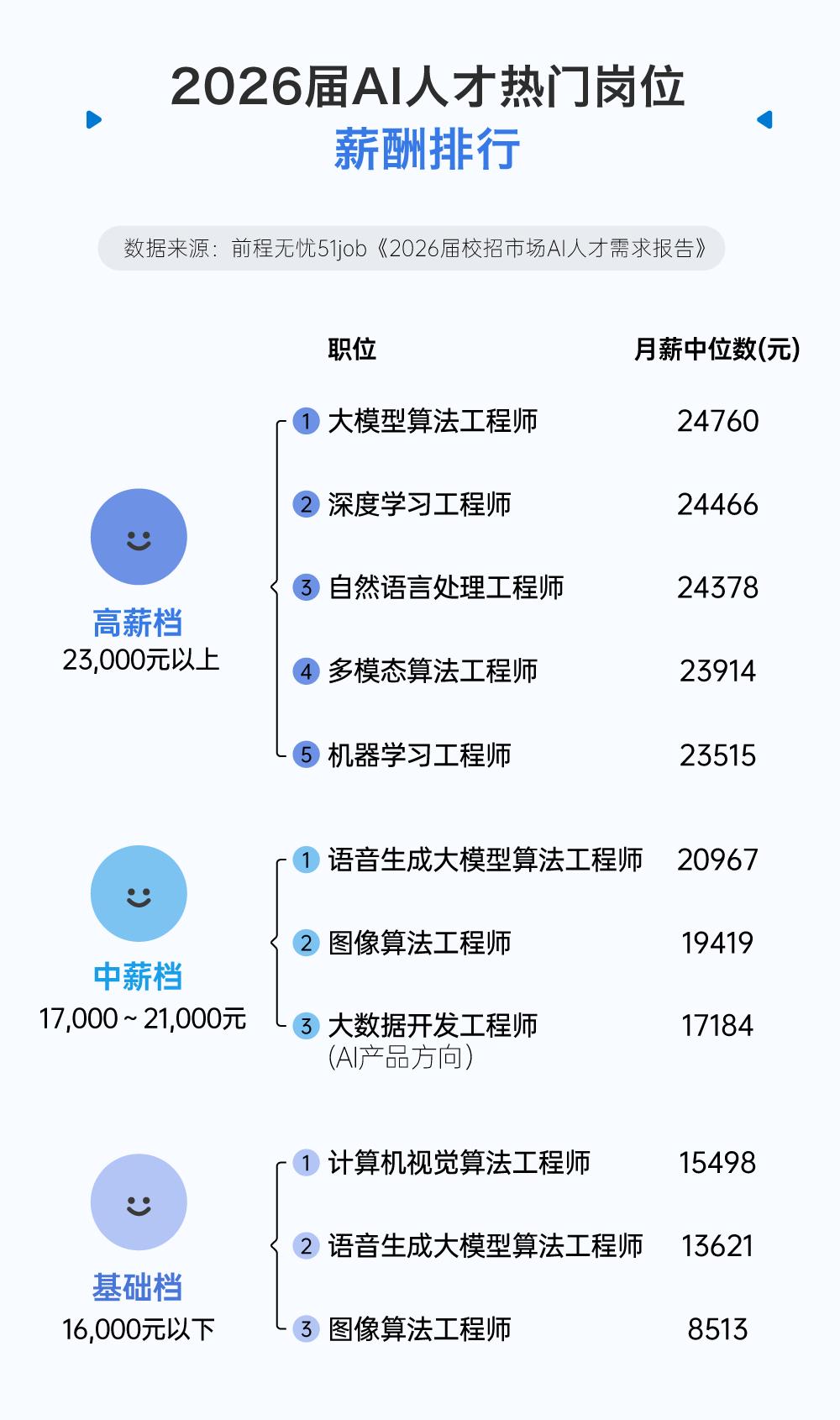
This academic threshold directly divides the income curve of AI practitioners. 51job data shows that the median monthly salary of core technical positions such as large model algorithm engineers and deep learning engineers is close to 25,000 yuan, while that of support positions such as AI data trainers is only about 8,500 yuan, with the former being nearly three times the latter.
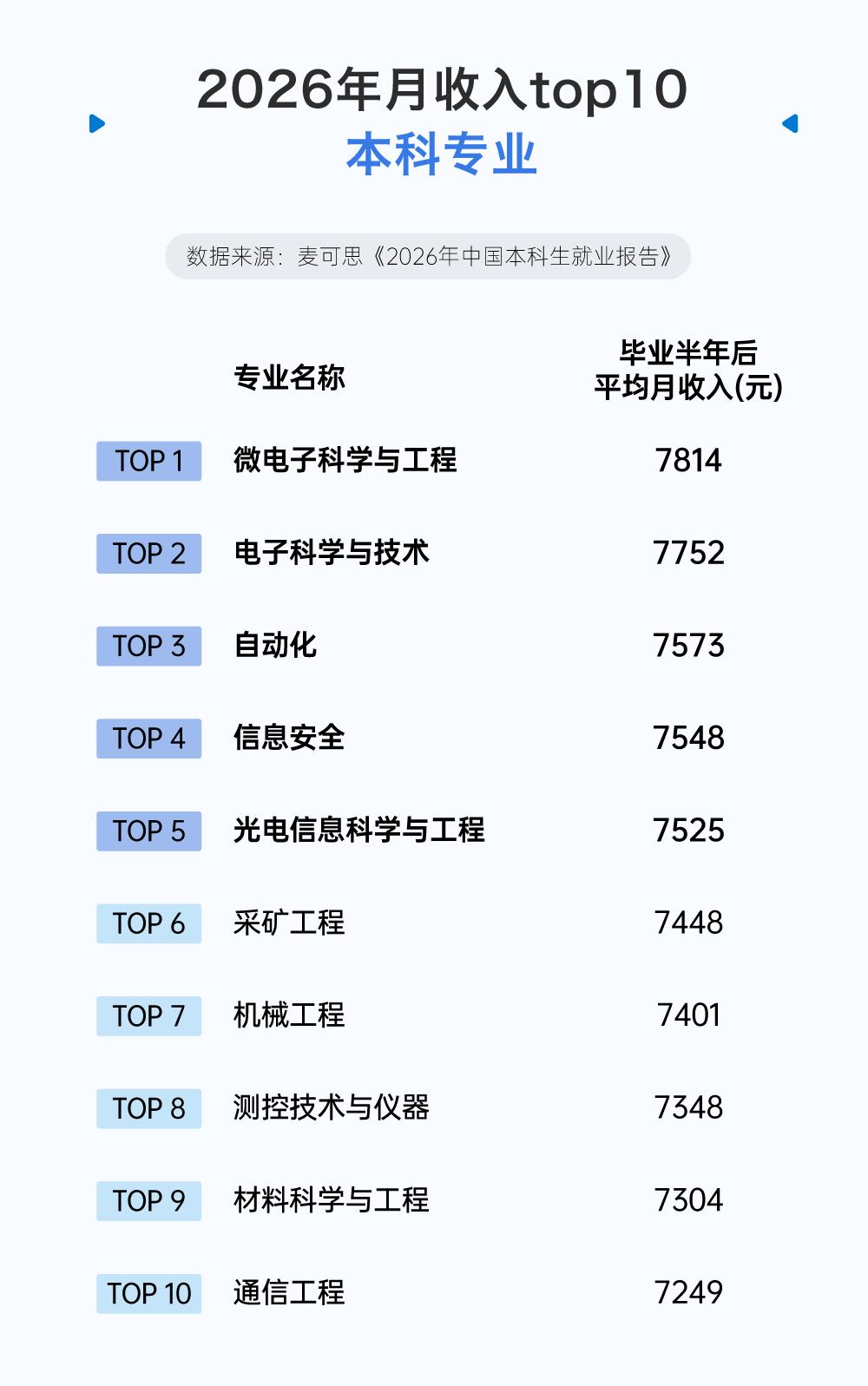
Data from MyCOS Institute directly answers the question of "how much do AI undergraduates actually earn": the monthly income of 2025 cohort artificial intelligence undergraduate graduates is 7,084 yuan, which is almost the average level of engineering majors. In the 2026 list of top 10 undergraduate majors by monthly income, electronic information-related majors almost occupy half of the list, but artificial intelligence major is nowhere to be found.
MyCOS data also shows that only 56% of AI major graduates work in positions related to their major, and nearly 30% of them turn to unrelated jobs because they cannot find matching positions.
The dividend that artificial intelligence undergraduates failed to seize was instead taken by undergraduate graduates of majors once regarded as "pitfall majors" such as materials science and engineering and mechanical engineering.
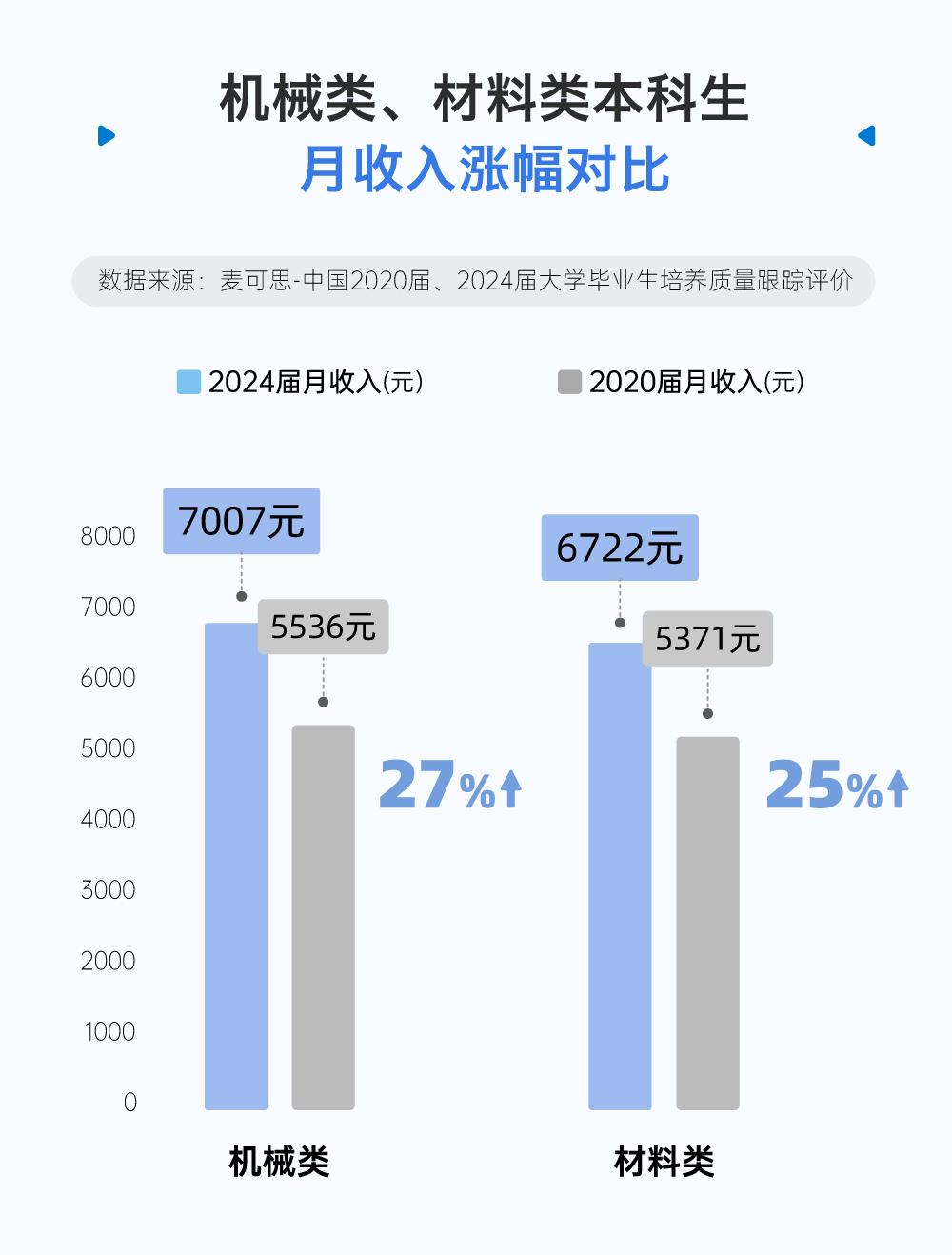
MyCOS research data shows that over the past five years, the salary growth rate of undergraduate graduates in mechanical and materials majors has exceeded 25%, which is more than twice the average growth rate of all undergraduates nationwide in the same period.
The reason is not complicated. The artificial intelligence undergraduate major was not approved for establishment until 2018, and most universities began to recruit students after 2019. The first batch of fully trained graduates did not step out of the campus until 2023, and most of them are not yet capable of becoming the main force of the current AI industry.
In contrast, graduates of materials and mechanical majors seem to be closer to the industry. As chips, new energy and high-end manufacturing become the new industrial priorities, there are more and more job demands behind silicon wafers, batteries and robots.
On September 1, CXMT launched its 2027 global campus recruitment, opening more than 180 positions, clearly targeting majors such as microelectronics, integrated circuits and electronic engineering, covering circuit design, R&D technology and mass production technology. These positions are not directly involved in the production of large models, but they are pushing the models to run faster and further behind the scenes.
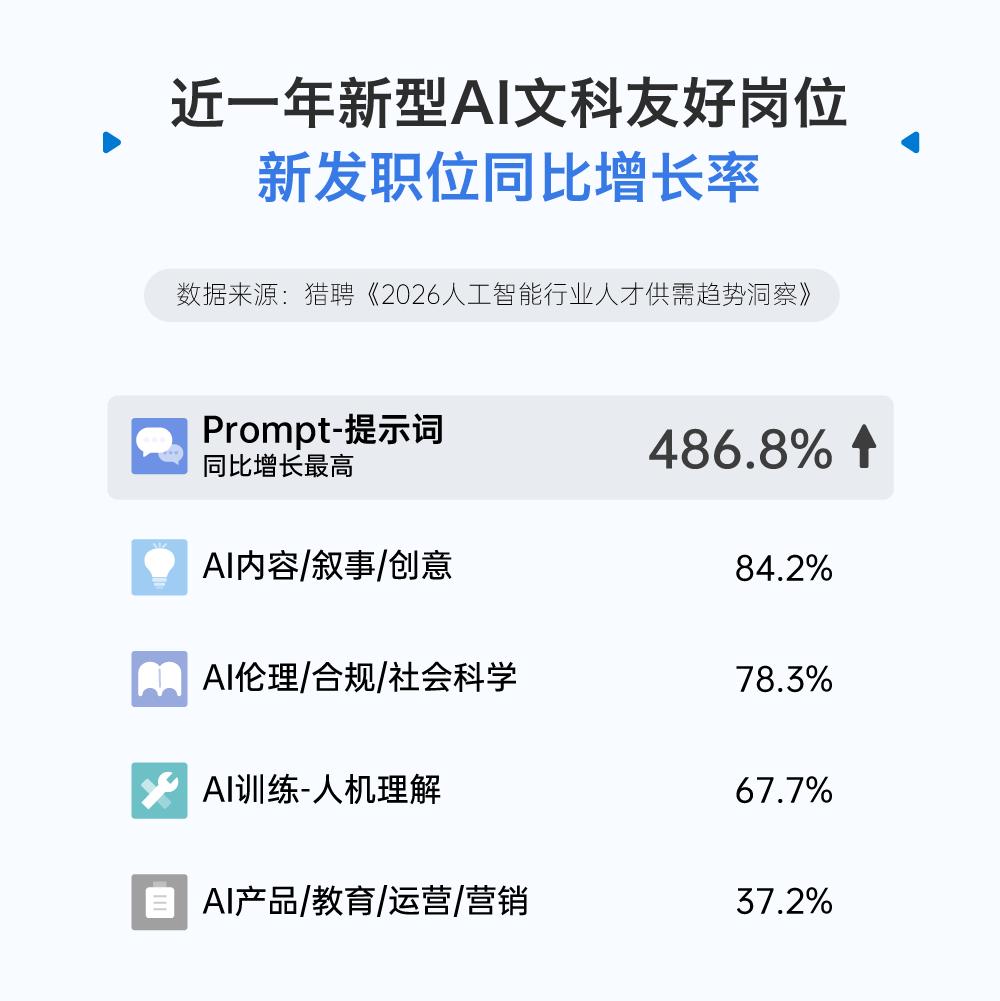
The AI boom has not only created new career paths for traditional engineering majors, but also allowed liberal arts students to get a share of the benefits. Liepin data shows that from March 2025 to February 2026, the number of new positions related to Prompt increased by 486.84% year-on-year, AI content, narrative and creative positions increased by 84.21%, AI ethics, compliance and social science positions increased by 78.26%, and AI training and human-computer understanding positions increased by 67.70%. However, most of these positions are at the bottom of the AI industry chain.

What are the examinees betting on?
The employment side presents a not-so-easy situation: there are dividends in the AI industry, but the dividends are concentrated in a small number of high-threshold positions. However, on the side of college application, the popularity of artificial intelligence major has not decreased because of this.
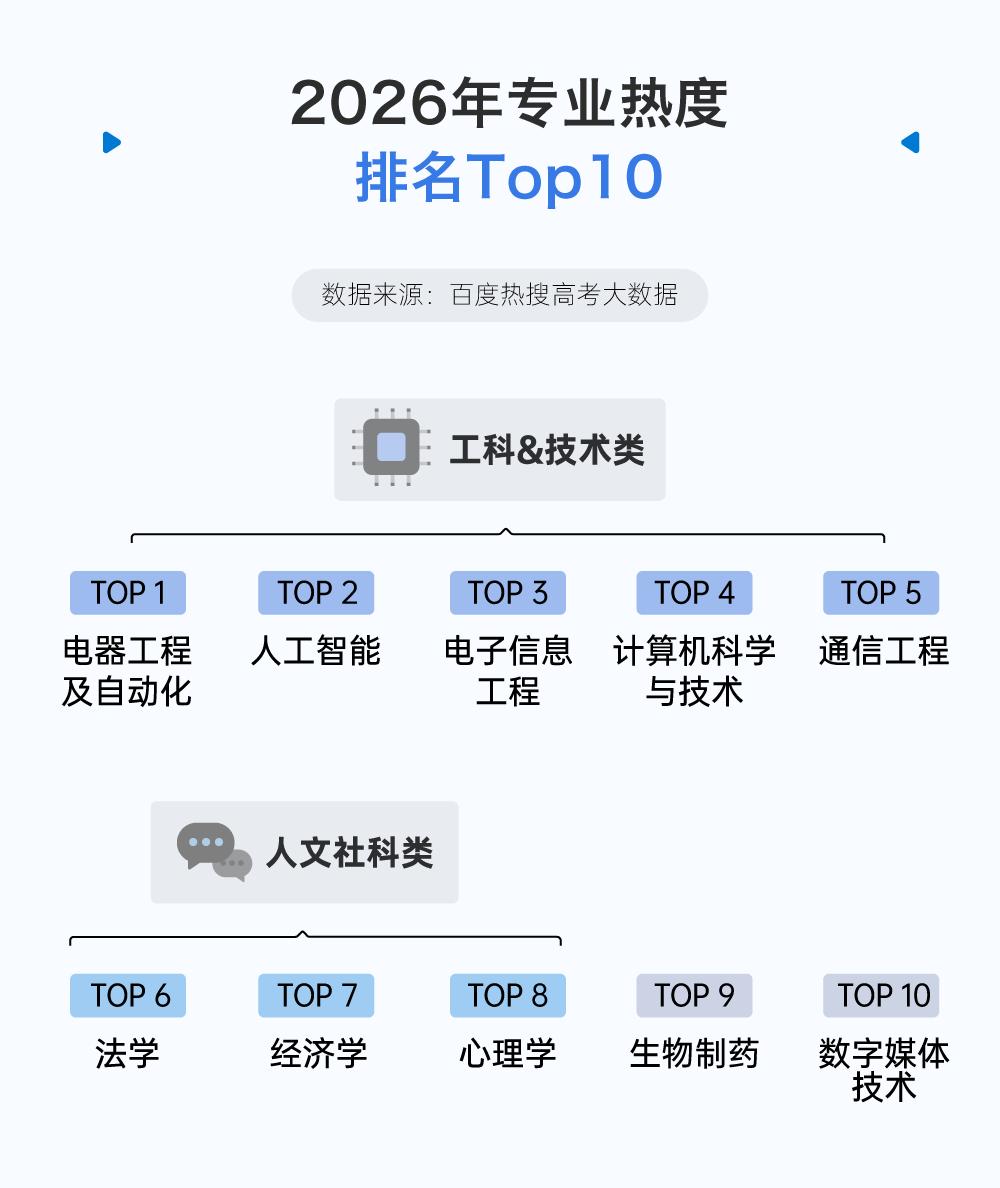
Data from Baidu Hot Search Gaokao Big Data Platform on June 30 shows that the top 10 most popular majors this year are: electrical engineering and its automation, artificial intelligence, electronic information engineering, computer science and technology, communication engineering, law, economics, psychology, biopharmaceuticals, and digital media technology. The top five on the list are all engineering majors, and majors such as law and economics have also received a lot of attention.
Artificial intelligence ranks second on the list, with undiminished popularity. The admission scores of top universities are still soaring: taking Zhejiang, a major education province, as an example, with the number of enrolled students unchanged, Xi'an Jiaotong University raised its cutoff score by 4 points, with the admission rank moving up 454 places; Beijing University of Posts and Telecommunications raised its cutoff score by 6 points, with the admission rank moving up 1114 places.
The same trend appears in many top domestic universities. The popularity is not limited to top universities: the admission ranks of artificial intelligence majors in local universities such as Wenzhou University and Zhejiang Shuren University have also increased significantly.
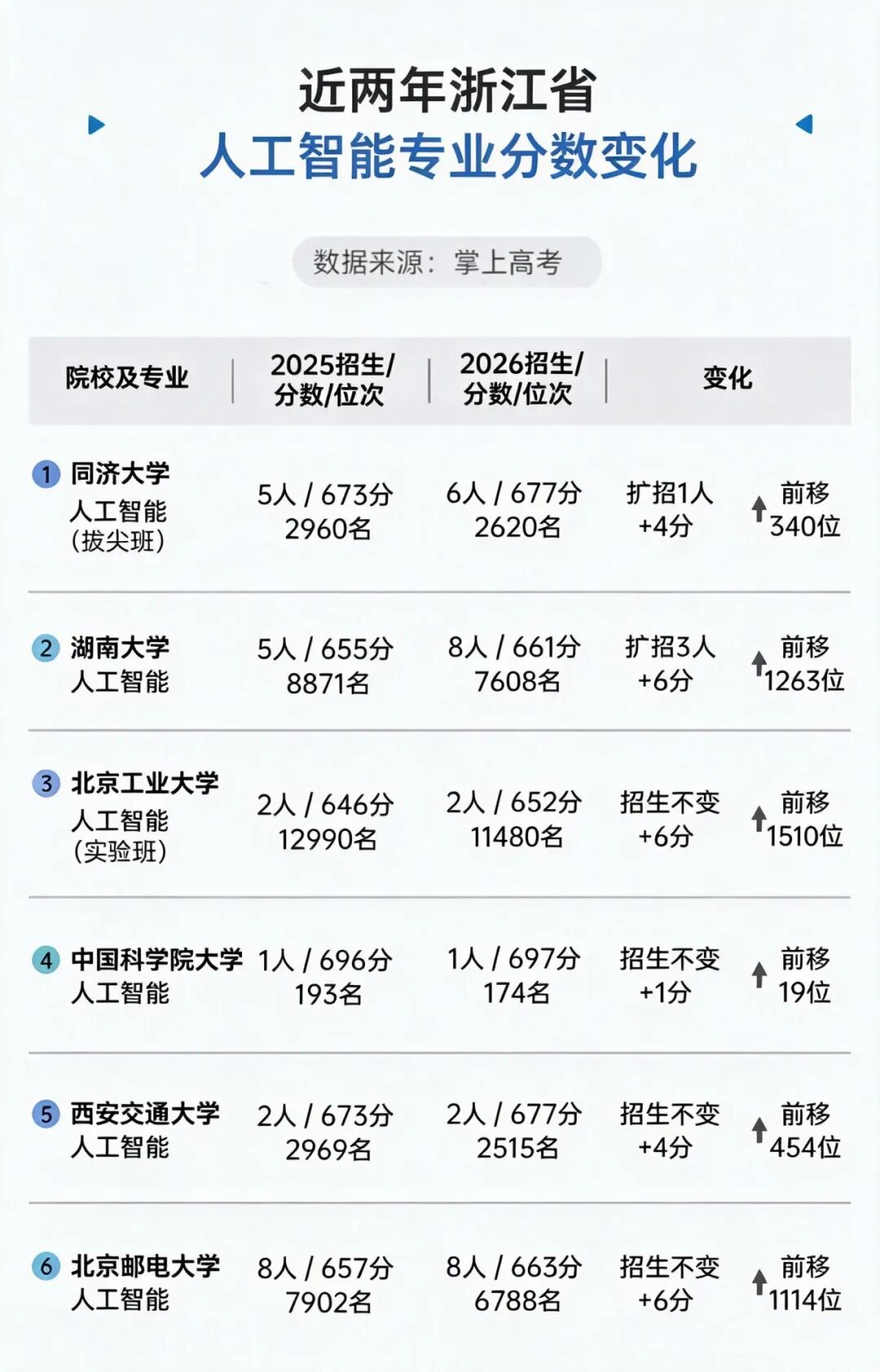
This shows that even if the imagination of "high salary right after AI major graduation" is being corrected by reality, examinees and parents are still willing to put artificial intelligence at the top of their college application lists.
According to Alibaba Qwen data, as of July 8, more than 40 million users have consulted Qwen about college application, among which "what emerging majors are rising" and "what jobs are promising in the next 5 years" are the most concentrated questions. College application is ostensibly about choosing universities and majors, but behind it is a calculation of input and output related to employment prospects. In the past few years, computer science, finance, civil engineering and medicine have all been included in such calculations, and in the AI era, artificial intelligence has become the new answer.
Examinees' bet on AI does not mean chasing all AI directions indiscriminately.
According to iiMedia Research data, among AI-related majors, application development is the most favored direction for examinees, followed by data science. Only about 30% of examinees favor the algorithm direction, and the proportion for cybersecurity is even lower.
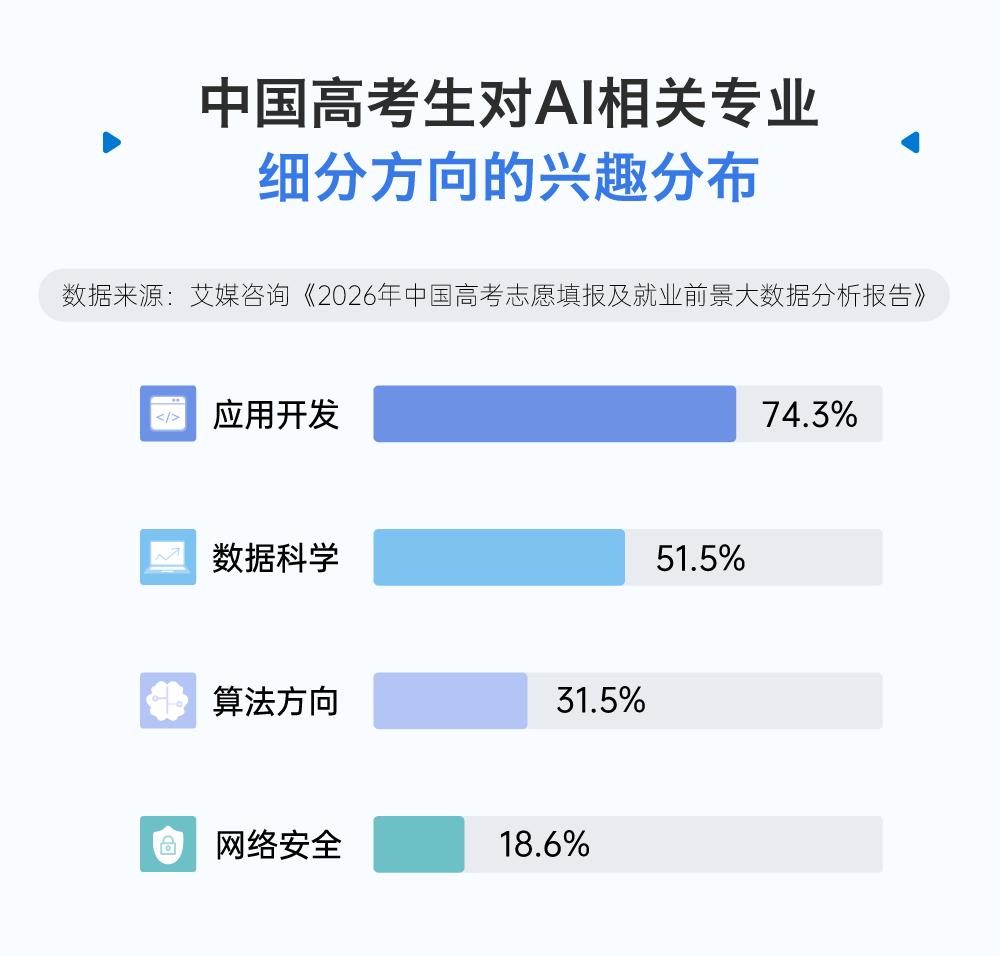
Such a choice is closely related to the current situation of employment stratification. Algorithm and deep learning positions prefer master's and doctoral graduates, while application development positions have wide demand and relatively friendly entry thresholds. For most undergraduates, becoming a large model scientist is not the most realistic path. Applying AI capabilities to products, businesses and industry scenarios is a more realistic employment path.

The artificial intelligence major is still immature, how do universities respond?
One important reason why artificial intelligence undergraduate majors have not caught the dividends of the AI wave is that it is too young. And universities are trying to narrow this gap through curriculum reform.