The city specifically designated in the state plan that is approaching the trillion-yuan GDP mark has started to make up for its industrial shortcomings.
On September 7, the official website of Xiamen Municipal Government released the notice on printing and distributing the *Special Plan for the Development of Strategic Emerging Industries during the 15th Five-Year Plan Period of Xiamen*. According to the development objectives of the plan, Xiamen will focus on the transformation and upgrading of urban development, target the key development directions of industries, consolidate key supports, strengthen the core driving force of scientific and technological innovation, expand and develop strategic emerging industries such as new energy, new materials, biomedicine, cultural tourism and creativity, and make forward-looking arrangements for future industries including artificial intelligence, hydrogen energy, biomanufacturing, deep sea and aerospace development, future networks and quantum technology, brain-computer interface, so as to fully enhance the core competitiveness of industries.
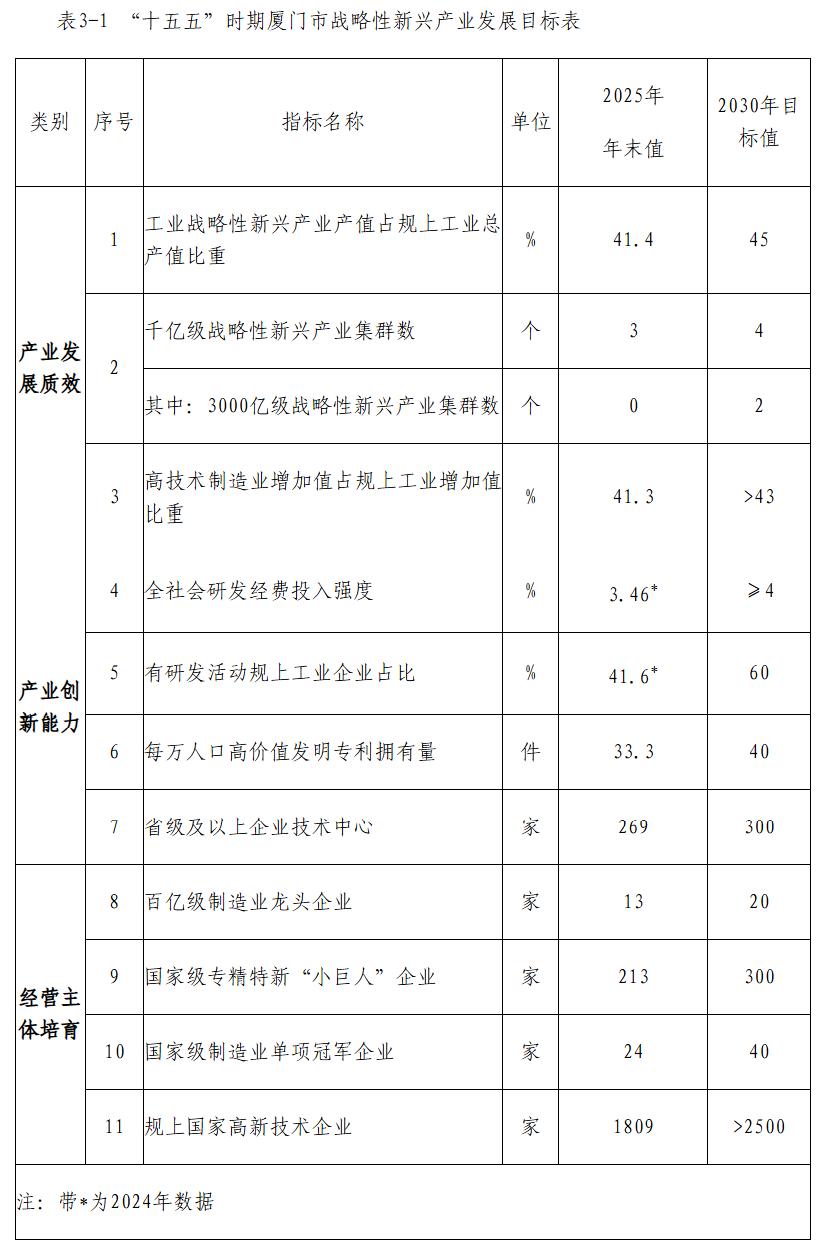
The goal is that by 2030, the development level of the city's strategic emerging industries will be comprehensively improved, the output value of industrial strategic emerging industries will account for 45% of the total output value of industries above designated size, 4 strategic emerging industry clusters with an output value of 100 billion yuan will be cultivated, breakthroughs will be made in key core technologies and cutting-edge leading technologies of industries, the number of high-quality enterprises will increase significantly, and the openness, inclusiveness, innovation and synergy of the industrial ecology will be significantly enhanced.
Among the five separately planned cities, Xiamen is currently the only one whose GDP has not exceeded one trillion yuan. In 2025, Xiamen's GDP reached 898.037 billion yuan, and the growth rate of 5.7% is not low among similar cities, but the total gap is still obvious. The small industrial volume and relatively single industrial structure are considered as one of the prominent shortcomings of Xiamen's economic development.
This is related to Xiamen's "innate conditions" to a certain extent. As one of the cities with the most tense land resources in China, Xiamen has a land area of only 1,699 square kilometers. Some experts have analyzed that in Xiamen, the scarcity of land factors and the soaring land prices have led to rising costs of land use and labor for enterprises, and the profit margin of traditional manufacturing industries has been continuously squeezed.
The outline of Xiamen's 15th Five-Year Plan also frankly states that compared with advanced cities at home and abroad, Xiamen still has shortcomings such as the industrial structure of "strong trade but weak industry", insufficient basic support for advanced manufacturing industries, weak overall strength of scientific and technological innovation, limited land and space resources, unbalanced and uncoordinated development, and there is still much room for improvement in the city's comprehensive strength.
Shenzhen is a worthy example for reference. Under the same situation of limited land resources (land area of 1997.47 square kilometers), Shenzhen promoted industrial upgrading through "replacing the old with the new", transferred out traditional manufacturing industries, and developed high-end manufacturing industries. Data shows that the total output value of industries above designated size in Shenzhen reached the level of 5 trillion yuan in 2024, making it the first city with an industrial output value of 5 trillion yuan in China.
The special plan for the development of strategic emerging industries during Xiamen's 15th Five-Year Plan period issued this time, on the one hand, stabilizes the basic market — the four strategic emerging industries of new energy, new materials, biomedicine, cultural tourism and creativity are pushed to the key development positions. On the other hand, it bets on the future — six directions including artificial intelligence, hydrogen energy, biomanufacturing, deep sea and aerospace development, future networks and quantum technology, and brain-computer interface are included in the forward-looking layout.
Taking the new energy industry as an example, the output value of Xiamen's new energy industry exceeded 100 billion yuan for the first time in 2025. For the next five years, Xiamen will adopt the model of "leading enterprises driving + diversified layout" to promote the R&D and application of key materials, chips and precision components, accelerate the implementation of achievements such as new batteries and various energy storage technologies, fully build an innovative city for the new energy industry, strive to make the industrial scale exceed 300 billion yuan by 2030, and cultivate one leading manufacturing enterprise with an output value of 100 billion yuan and another with an output value of 50 billion yuan.
At present, CALB, a leading power battery enterprise, is building a power lithium battery production base with a total capacity of 70GWh in Xiamen, and Xiamen has become an important strategic node in its national layout. At the same time, Hithium Energy Storage, the local leading enterprise in the energy storage chain, has also delivered a satisfactory report card — in 2025, the shipments of global energy storage batteries and large-scale energy storage batteries both ranked second in the world.
It is worth mentioning that Xiamen has previously customized new-type industrial land for future industries in terms of land policies, taking the stock industrial land as a pilot first, exploring new-type industrial land that integrates new industrial functions such as R&D, design, pilot test, pollution-free production and related supporting service activities, to meet the demand for composite development space for the rapid development of industrial enterprises such as future industries driven by scientific and technological innovation.
This article is from the WeChat Official Account "City Evolution Theory", written by Yang Huan, and published by 36Kr with authorization.