When robots start "going to work": Embodied Intelligence is crossing the value watershed
Over the past few years, embodied intelligence has continuously refreshed people's imagination of robots. Running, jumping, somersaulting, grasping, folding clothes, sorting shelves... Robots are becoming increasingly flexible, and technologies including large models, world models, dexterous hands, and edge-side chips are also iterating rapidly.
But by 2026, people rarely ask "what else can robots do" anymore, replaced by a more practical question: When can they actually start working?
This is probably the most critical transition for embodied intelligence to move from a technological boom to the industrial era.
On one hand, continuous breakthroughs have been made in robot motion capability, brain-cerebellum coordination and high-degree-of-freedom dexterous operation; on the other hand, the real product-market fit is still being explored. Fields such as logistics, warehousing, and supermarkets have shown the dawn of implementation, while industrial applications are still restricted by practical conditions including efficiency, safety, fault tolerance, cost and maintenance.
Technology has advanced fast enough, and the next question to answer is where the value lies?
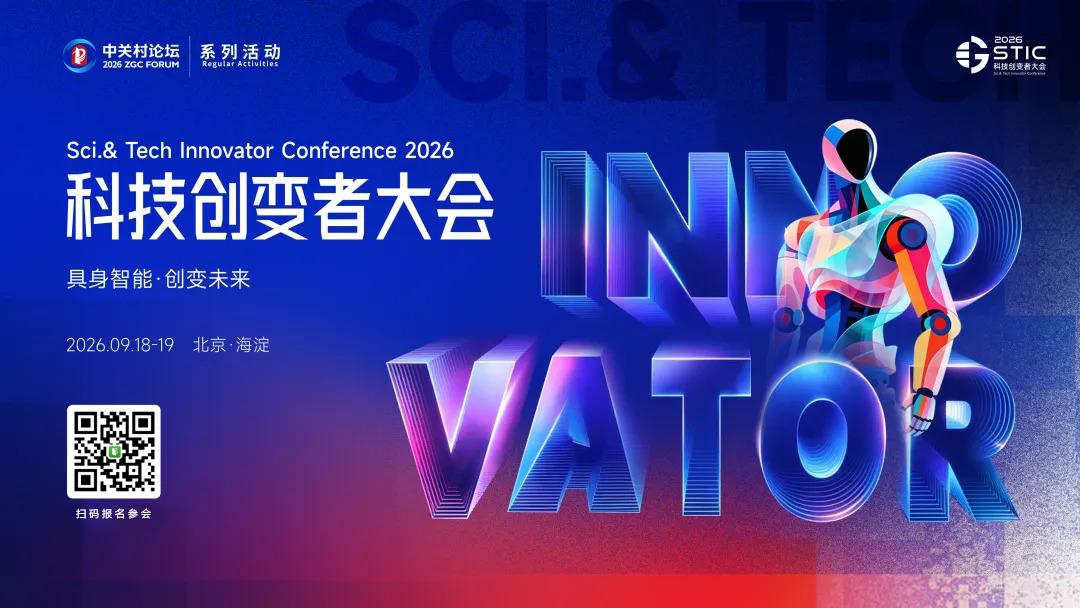
This is also one of the core issues that the 2026 Zhongguancun Forum Series Events - Tech Innovators Conference aims to discuss.
This year's main forum will focus on smart logistics, industrial manufacturing, commercial and household applications. These directions point to the same industrialization path: how embodied intelligence can gradually expand from relatively well-defined tasks with clear boundaries to more complex and open real-world scenarios.
The answer may first come from a process of "intelligent boundary definition".
Embodied intelligence does not need to solve a completely open world from day one. On the contrary, a more practical path is to first define the boundaries of landing applications: what tasks the robot faces, what kind of ontology, models and data it requires, what the fault tolerance rate is, how to maintain it, and whether it can finally create real value for customers.
The first to enter the large-scale phase is most likely relatively structured businesses such as logistics and warehousing. The reasons are not complicated. These fields have a large number of high-frequency, repetitive, and clearly defined processes: handling, picking, restocking, inventory checking, and distribution. The environment is relatively structured, the task boundaries are clear, and the commercial value is the easiest to calculate. Robots do not need to have near-human general intelligence from the very beginning. As long as they can stably complete one of the tasks thousands or tens of thousands of times, a commercial closed loop can be formed. Judging from the trend of industrial evolution, applications in the logistics sector are expected to take the lead in entering the large-scale verification phase.
The first embodied intelligence product to achieve a proven commercial closed loop may not be the smartest robot, but the one that first secures a stable job.
Greater industrial value lies in the industrial world.
Industrial loading and unloading, flexible handling, inspection and maintenance, welding and polishing, and precision assembly may all become important breakthrough points in the next stage. However, the real opportunity for embodied intelligence is not to simply replace the already highly automated production lines. From industrial practice, what is really worth paying attention to is the "automation gaps" in the industrial system: tasks with small batches, multiple varieties and constantly changing production rhythms; stations that are not worth designing expensive special rigid tooling for; links that still require manual connection between machines. These areas that are difficult for traditional automation to cover may instead become the earliest places where embodied intelligence creates value.
After entering the industrial site, the standards faced by robots will be completely different. Completing a task once in the laboratory is far from enough. It also needs to meet the requirements of yield rate, safety regulations, equipment compatibility and maintenance cost. It must not only be able to perform the task, but also do it stably and continuously, without disrupting the existing production process.
Moving further out, commercial and household scenarios represent a more open world.
Tasks such as commercial cleaning, supermarket retail, and distribution still have a certain degree of standardization, but they already require robots to cope with flowing people, changing items and more complex spatial environments. Therefore, semi-structured scenarios such as commercial services may become an important transition for robots to move from industrial environments to more open environments.
Household scenarios are at the far end of this path. The elderly, children, pets, furniture, and sundries may change every day, which puts far higher requirements on the robot's perception, reasoning, long-term sequential planning, fine operation and safety than factories.
Therefore, the large-scale entry of physical AI into households in the true sense still requires a long period of technological iteration and cost reduction.
However, embodied intelligence does not need to leap to full autonomy in one step. Tasks with clearer boundaries such as cleaning, handling, and nursing assistance can be implemented first, and autonomous operation, remote control and manual fallback can coexist for a long time. As long as robots can take over the most repetitive, most dangerous or hardest-to-recruit positions, they will already generate value.
This also reveals a possible path for the industrialization of embodied intelligence:
Instead of developing an all-powerful robot first and then looking for its use cases, we should conquer one application after another, generalize one skill after another, and finally move from countless partial intelligences to more general physical intelligence.
As robots truly enter production sites, the evaluation criteria of the industry are also changing.
In the past, people discussed degrees of freedom, motion speed, model parameters and training data. Next, customers will be more concerned about: can it work stably and continuously? Can it adapt to a certain degree of changes? Can it not disrupt the existing production process? Can it achieve safe fallback when problems occur? Is the maintenance cost controllable?
In the final analysis, they are two most simple questions: Can it reduce costs for customers? Can it improve efficiency for the industry?
This means that embodied intelligence is undergoing a standard update: shifting from "showing off technology" to "being able to do practical work", and from "having high parameters" to "being usable by customers".
It is at such a node that the 2026 Tech Innovators Conference gains more practical significance.
The moment when technology truly changes the world never happens when the demo is first unveiled.
It happens one day when it starts to be used by real people, needed by real industries, and becomes an indispensable part of a new production method. When robots start to "go to work", a tech transformation belonging to the real world has truly begun.
This is also what the 2026 Zhongguancun Forum Series Events - Tech Innovators Conference hopes to discover and present: the people who are turning the future into reality right now.

