Just now, Cambricon has secured the top seat in PyTorch, sitting at the same top-tier table as NVIDIA.
Just now, Cambricon officially became the highest-level Platinum Member of the PyTorch Foundation!
A Chinese AI chip company has secured a seat on the PyTorch Foundation Governing Board.
In the room that sets the direction for the global AI development framework, an additional seat now belongs to a Chinese enterprise.
And this seat is occupied by a Chinese chip manufacturer.
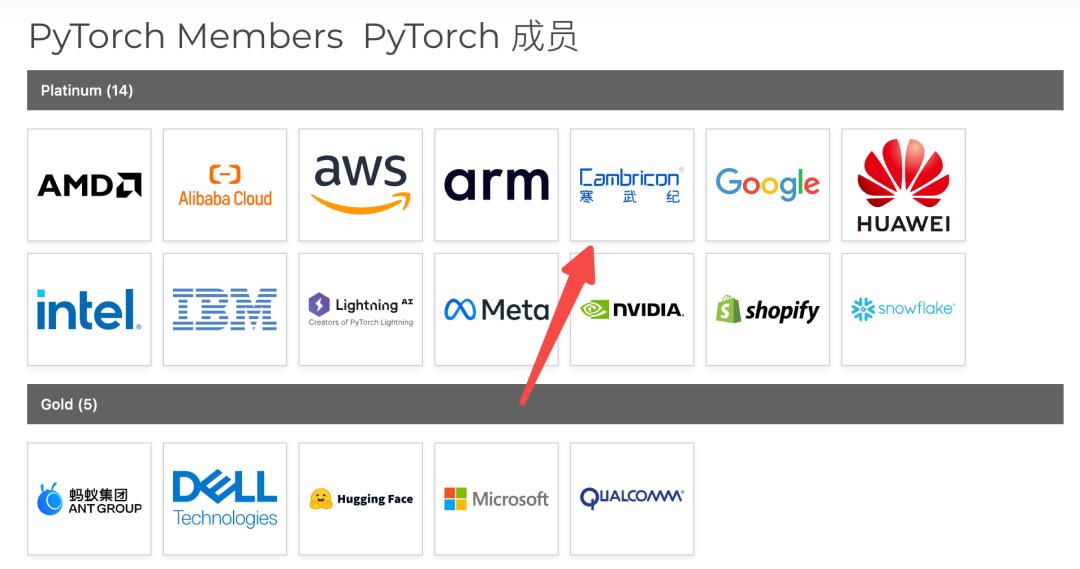
Back in May this year, Alibaba Cloud just became a Platinum Member of the PyTorch Foundation. This time, it's Cambricon.
Against the backdrop of a highly concentrated global AI chip landscape, a Chinese chip company has entered the decision-making layer of the world's most important open-source AI community.
This event is well worth paying close attention to.
What Does the Title "Platinum" Mean
Many people are familiar with PyTorch, but may not know much about the PyTorch Foundation.
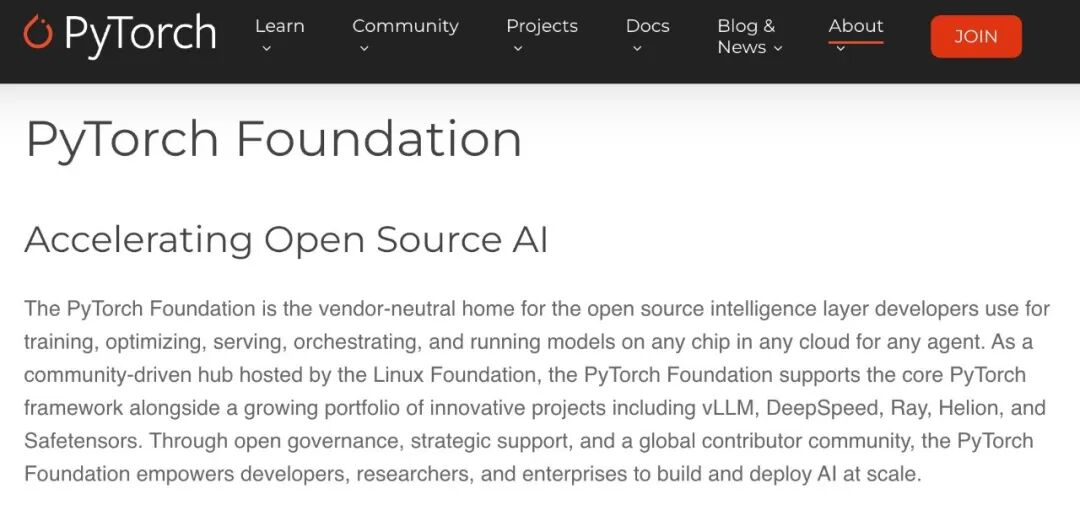
The PyTorch Foundation is a community-driven open-source AI organization under the Linux Foundation, which governs a portfolio of projects including PyTorch, vLLM, DeepSpeed, and Ray.
GPT, DeepSeek, Qwen, GLM have different names, but if you look down to the underlying layer, many of them are built on the same set of infrastructure: development is inseparable from PyTorch, while deployment is increasingly running on inference engines like vLLM.
As of 2026, the PyTorch community has gathered 12,000 contributors from more than 2,000 institutions. This set of tools is not the product of a single company, but the foundation of the entire AI industry.
The Governing Board of the PyTorch Foundation is the group that draws the blueprint for this foundation.
Members of the Governing Board do not discuss abstract technical visions. They decide who PyTorch will prioritize supporting next, how to abstract device interfaces, which capabilities will be merged into the main branch, and which will be left for manufacturers to solve on their own.
When the foundation was established in 2022, the founding members of the Governing Board were all global giants: Meta, AMD, AWS, Google Cloud, Microsoft, NVIDIA.
The Platinum seat that Cambricon has obtained now is at the highest level of the same tier.
Whoever sits on the Governing Board is answering a very specific question for global developers: When you switch to a different chip, do you need to rewrite all your code?
Chinese AI chips have been asked this question for many years. But for a very long time in the past, we were not among the people who could answer this question.
For Many Years, Chinese AI Chips Have Been Stuck in the Downstream Position
Frankly speaking, the role of Chinese AI chips in the global open-source ecosystem has long been an "adapter".
What does "adapter" mean? Others finish developing the framework, and we do compatibility work, supplement operators, and optimize performance, trying our best to make the old code written by developers run on our own chips.
This work is tiring, tedious, and unnoticeable. Every time the framework side releases a version upgrade, the downstream has to follow up with a round of adaptation; every time our own hardware is updated to a new generation, the software stack has to go through another round of adjustment. After all the hard work, the feedback we get is usually just two words —
It works.
It works, but not well. It can run, but with great difficulty.
This is the common impression of domestic AI chips in the minds of developers in the past.
Moreover, no matter how well you do the work, you are only constructing on the blueprint drawn by others. How the framework is designed, how the interfaces are defined, who to prioritize supporting next — none of these are under your control.
Cambricon has chosen a different path.
It adheres to a principle called Upstream First. In plain terms: All modifications are submitted back to the public main branch of PyTorch first, instead of being kept privately in your own private branch.
This path is much slower.
Submitting code to the main branch of the community means going through community review, being pointed out flaws, making compromises with the demands of many different hardware vendors, and it is very common for a single patch to take several months to get merged.
In contrast, developing a private branch on your own is far more convenient — you can use the modified code immediately. But the cost is that every time the upstream PyTorch is updated, you have to rework your own private code, and you will always lag half a step behind.
Cambricon chose the tougher path.
In recent years, the code submitted by Cambricon has covered 7 main modules of PyTorch: torch compiler (torch.compile), Eager mode operators, device runtime, distributed computing, automatic mixed precision, Dataloader, and Profiler performance analyzer.
Simply put, these modules cover how the model is compiled, how data is fed in, how mixed precision saves video memory, how multiple cards communicate with each other, and how to troubleshoot performance bottlenecks.
It is not "compatibility", but "co-construction". The difference is that the former is patching on other people's code, while the latter is participating in writing the code itself.
At the same time, Cambricon is also making synchronous progress on the vLLM track.
It has maintained close cooperation with the vLLM community, and realized Day 0 adaptation for mainstream open-source large models including DeepSeek-V4 and GLM-5 — the models can run on Cambricon's chips on the very day they are released.
For teams that are rushing to release their products, the three-month difference in adaptation speed is often the lifeline that determines whether a product can seize the market window.
The Two People Joining the Governing Board Are Both Code Developers
Generally speaking, when a company joins a foundation, it sends business representatives or senior executives. But Cambricon's arrangement this time is different.
Wang Jin, Senior Director of AI Framework at Cambricon, represents Cambricon to join the PyTorch Foundation Governing Board. His team focuses on software support for efficient inference and large-scale model training, covering business scenarios such as large language models, search advertising and recommendation, and reinforcement learning, with customers from the internet and financial industries.
Zhu Jing, the core maintainer of PyTorch at Cambricon, has entered the Technical Advisory Council of the foundation. His work is closer to front-line developers — he builds the Torch-MLU extension around PyTorch's PrivateUse1 backend integration mechanism, to bring users a native PyTorch development experience on Cambricon products.
With two seats, one in the decision-making layer and one in the technical layer: what Cambricon wants is not just "being supported by PyTorch", but to participate in deciding how PyTorch supports all users.
Migration Cost Is the Real Threshold for Hardware
Elton Gong, Vice President of Software Engineering at Cambricon, said: "A unified framework interface means lower migration cost for developers, as well as more consistent tools and development experience. For PyTorch, a more general device abstraction means fewer downstream branches, and more sustainable maintenance."
He added that the company's goal is not only to make Cambricon products support PyTorch, but also to promote PyTorch to better support multi-device backends through continuous co-construction of the main branch, so that "PyTorch can provide out-of-the-box native development experience on a wider range of hardware platforms".
This calculation is the core of hardware competition.
When developers switch hardware, their biggest worry is that they need to rewrite the code, re-learn the toolchain, and re-adjust the performance. Just thinking about it is a headache, which results in that no one wants to switch, no one dares to switch.
Therefore, the essence of Cambricon submitting code to the PyTorch main branch is to help unify this layer, so that switching hardware is just like switching a device, not switching a programming language.
The statement of Mark Collier, Executive Director of the PyTorch Foundation, also confirms this point: "Any AI accelerator that wants to achieve large-scale application and success must run through the full lifecycle of AI development — from building and optimizing models with PyTorch, to efficient deployment and service with vLLM."
He mentioned that Cambricon has continuously contributed to the upstream community and promoted the application of vLLM on Cambricon hardware, and welcomed it to join the foundation.
From "We Also Support"
To "We Are Part of It"
Cambricon joining the PyTorch Foundation is not a simple change of membership status.
It is a landmark node for Cambricon to evolve from a "domestic AI chip manufacturer" to a "participant in the global mainstream AI software ecosystem".
Cambricon was founded in 2016, and has been developing chips for 10 years. Over the past decade, its products have been widely commercialized in scenarios including intelligent dialogue, agent AI, search advertising and recommendation, and audio and video generation.
The construction of the software ecosystem — the Upstream First principle, contributions to 7 main modules, Day 0 adaptation, and two members joining the Governing Board and the Technical Advisory Council, all these accumulations together have earned Cambricon an admission ticket: not to adapt to the rules set by others, but to participate in making the rules.
Cambricon's key priorities in the future will be optimization of compilation infrastructure, improvement of CI/CD capabilities, and cross-device support for PyTorch domain-specific libraries.
Looking at the bigger picture: the value of Chinese AI chips to the global open-source community is changing from "we also support PyTorch" to "we are part of PyTorch's multi-device capabilities".
Chinese AI chip enterprises have already taken a seat at the table.
Reference: https://mp.weixin.qq.com/s/ktALePb6BEXfvmsDgZCn9w
This article is from the WeChat official account "AI Era", author: ASI Revelation, editor: Solomon, published with authorization from 36Kr.