What an incredible stroke of good luck! The top-ranked city in the private economy sector has moved up the rankings by seizing an unexpected opportunity that others missed.
01
The top city for private economy is about to overtake Xi'an
Luck matters more than effort, and Quanzhou is undoubtedly a lucky city.
First, let's explain why Quanzhou is recognized as the top city for private economy.
Both Shenzhen and Quanzhou can be called the top city for private economy, the only difference lies in statistical calibers.
Shenzhen is the city with the largest scale of private economy nationwide, while Quanzhou is the city with the highest proportion of private economy in its total economic output.
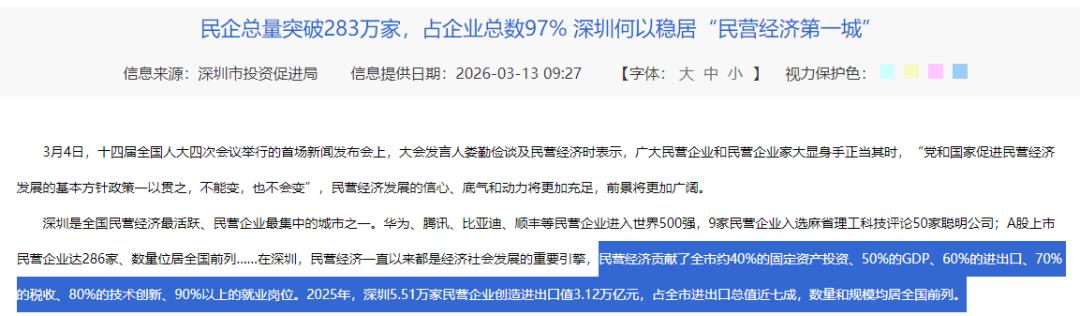
Shenzhen's official disclosure in 2026:
The private economy in Shenzhen contributes about 40% of the city's total fixed asset investment, 50% of GDP, 60% of import and export volume, 70% of tax revenue, 80% of technological innovation achievements, and over 90% of jobs. In 2025, 55,100 private enterprises in Shenzhen generated 3.12 trillion yuan in import and export value, accounting for nearly 70% of the city's total import and export volume, with both quantity and scale ranking among the top in the country.
Source: Official website of Shenzhen Municipal Government
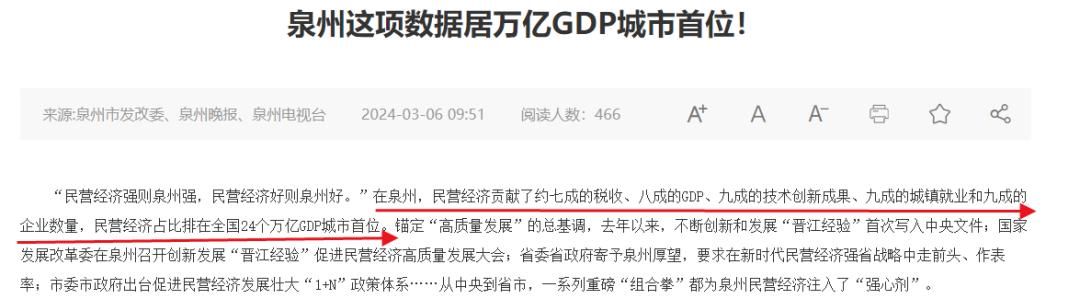
As for Quanzhou, the proportion of private economy in Quanzhou's GDP is as high as 83%, and Quanzhou's official disclosure in 2024:
The private economy in Quanzhou contributes about 70% of tax revenue, 80% of GDP, 90% of technological innovation achievements, 90% of urban employment and 90% of the total number of enterprises, and the proportion of private economy ranks first among all trillion-yuan GDP cities across the country.
Source: Official website of Quanzhou Municipal Government
Back to the topic, why is Quanzhou said to be lucky?
Because in the past few years, Quanzhou did not grow particularly fast, but the slower growth of other cities allowed Quanzhou to reap the benefits and move up in the national GDP ranking.
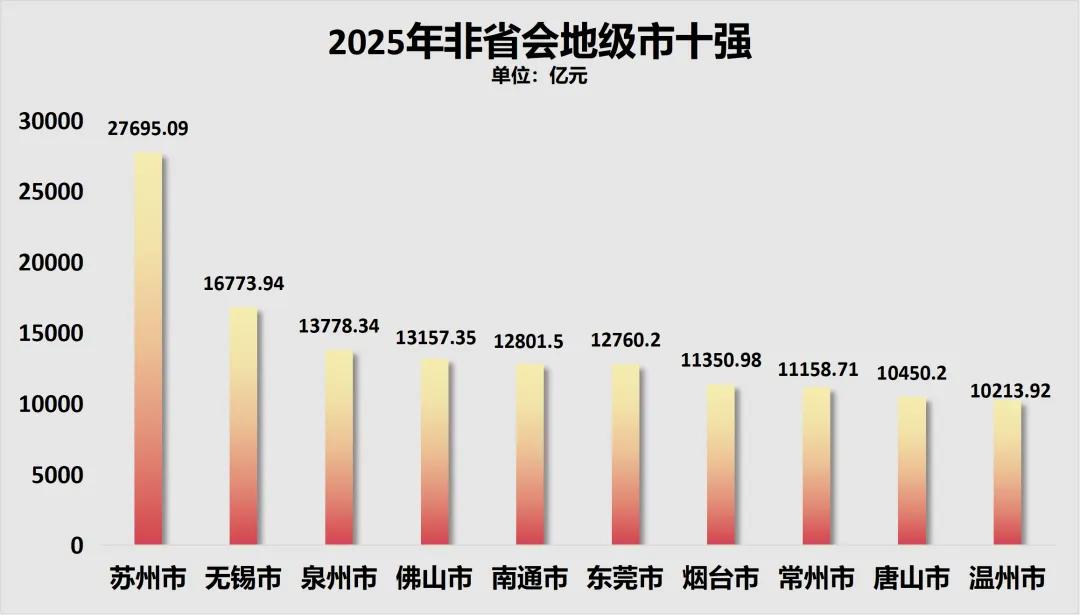
Due to the continuous slowdown and even negative GDP growth of Foshan in the past two years, Quanzhou successfully overtook Foshan in 2025, ranking 21st nationwide in GDP, and jumped to the 3rd place among the top 10 non-provincial capital prefecture-level cities, second only to Suzhou and Wuxi.
Graphic by: City Finance; Data source: Municipal Bureau of Statistics of each city
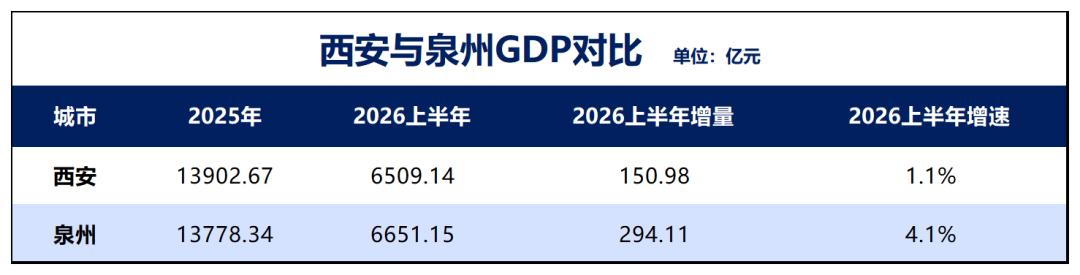
Most importantly, the development speed of Xi'an has also slowed down, and Quanzhou will most likely overtake Xi'an by the end of this year, moving up one more place in the national ranking.
At the end of 2025, the GDP gap between Quanzhou and Xi'an was only 12.433 billion yuan. In the first half of this year, the GDP increment of Quanzhou has exceeded that of Xi'an by 14.313 billion yuan, which has covered the gap of last year.
If no unexpected situation occurs, it is almost a foregone conclusion that Quanzhou will overtake Xi'an by the end of this year.
Graphic by: City Finance; Data source: Municipal Bureau of Statistics of each city
02
The slowdown of Foshan and Xi'an is the core reason
The fact that Quanzhou overtook Foshan and is about to overtake Xi'an is not because Quanzhou grows exceptionally fast, but because both Foshan and Xi'an have slowed down significantly.
Let's look at the statistics.
Quanzhou's GDP growth rate last year was 5.3%, 0.3 percentage points higher than the national average. Although its growth rate is higher than the overall national level, it is not outstanding among all trillion-yuan GDP cities.
Among trillion-yuan cities, Tangshan registered a 6.2% growth rate last year, Hefei, Wenzhou and Yantai all recorded a 6.1% growth rate, Chengdu grew by 5.8%, Dalian grew by 5.7%, Wuhan grew by 5.6%, and there are 15 out of the total 29 trillion-yuan cities whose growth rates are higher than that of Quanzhou.
In the first half of this year, Quanzhou's growth rate was only 4.1%, 0.6 percentage points lower than the national average.
In comparison, Foshan and Xi'an are growing much slower.
Foshan has been in a downturn since 2023, with negative GDP growth in the first quarter of 2024, negative annual GDP growth in 2025, a real growth rate of -2.4% in the first quarter of 2026, and a growth rate of only 0.2% in the first half of 2026.
Most critically, Foshan's GDP scale in the first half of this year is still declining, down by 4.501 billion yuan compared with the same period of last year.
As for Xi'an, its slowdown started back in 2024.
Xi'an's GDP growth rate in 2024 was 4.6%, 0.4 percentage points lower than the national average. This growth rate ranked the 4th last among 27 trillion-yuan GDP cities, only better than Foshan, Guangzhou and Nanjing.
In 2025, its growth rate was 4.7%, still 0.3 percentage points lower than the national average, ranking the 5th last among all trillion-yuan cities.
In the first quarter of this year, its growth rate dropped directly to 1.1%, 3.9 percentage points lower than the national average of 5%, ranking the 2nd last among 29 trillion-yuan cities, only higher than Foshan which recorded negative growth. It ranks the last among 27 provincial capital and capital cities.
The growth rate in the first half of the year was still only 1.1%.
On the surface, Foshan's slowdown is caused by the collective decline of industry, investment and export, but the root cause is that its industries were tightly bound to the real estate sector in the past, and now it is too difficult to reverse the situation after the real estate sector entered the adjustment cycle.
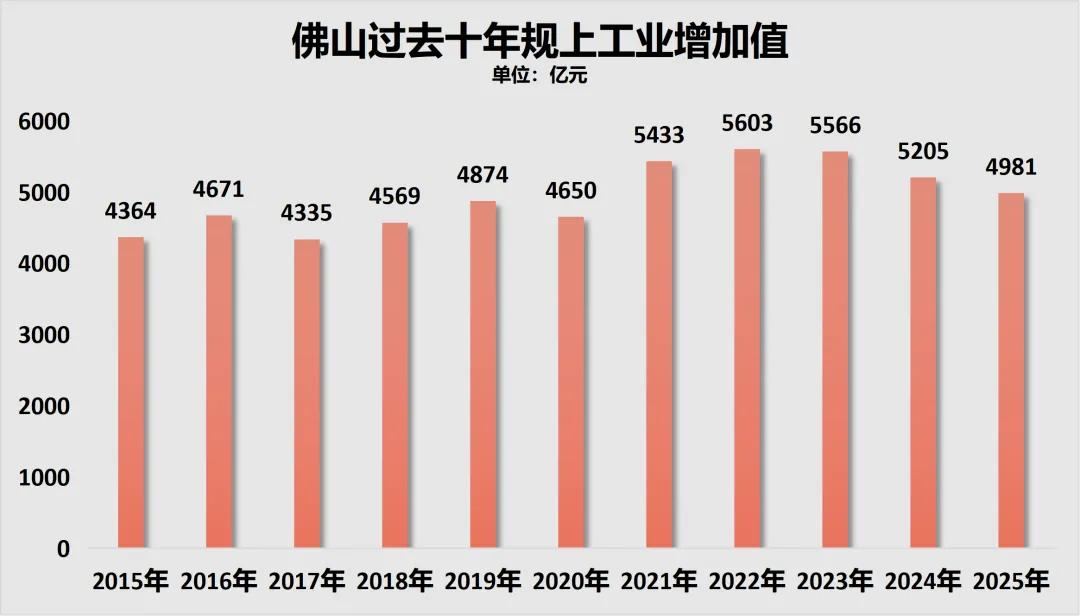
Graphic by: City Finance; Data source: Foshan Municipal Bureau of Statistics
How tightly are Foshan's industries bound to the real estate sector? This can be clearly seen from two sets of data:
First, according to data disclosed by Foshan Municipal Bureau of Industry and Information Technology, 7 major real estate-related industries including ceramics, aluminum profiles, metal products, home appliances, plastic products and furniture account for nearly 60% of Foshan's total manufacturing output.
Second, in 2024, Foshan's total export volume exceeded 380 billion yuan, among which the export of pan-home products including home appliances, furniture, lighting, building materials, ceramics and textiles was nearly 200 billion yuan, accounting for more than 50% of the total export.
On the surface, the slowdown of Xi'an's growth is caused by the sluggish consumption and investment, but the essence lies in its weak industrial strength.
In the first half of this year, Xi'an's exports surged sharply with a growth rate as high as 96.2%, ranking the first among the top 20 foreign trade cities in China.
However, as an inland city, Xi'an's total foreign trade volume is relatively low, and its contribution to the economy is limited. Therefore, even with such a high export growth rate, it still cannot drive GDP growth effectively.
At the same time, there are two more critical factors:
First, both consumption and investment are in negative growth.
In the first half of the year, the total retail sales of consumer goods in Xi'an reached 278.188 billion yuan, down 3.6% year on year. The fixed asset investment (excluding rural households) decreased by 29.9% year on year, among which industrial investment, real estate development investment and private investment decreased by 32.1%, 25.0% and 19.1% respectively, and infrastructure investment decreased by 30.8%.
With two of the three economic driving forces losing steam, it is natural that Xi'an's growth slows down.
Second, all three pillar industries are declining.
According to the disclosure of Xi'an Municipal Bureau of Statistics, in the first half of the year, the added value of industries above designated size in the city decreased by 0.9% year on year, and the decline narrowed by 3.8 percentage points compared with the first quarter. Among key industries, the added value of the automobile manufacturing industry above designated size decreased by 6.3%, the manufacturing of electrical machinery and equipment increased by 6.6%, and the manufacturing of computers, communications and other electronic equipment increased by 0.8%.
These three sectors are exactly the three major pillars of Xi'an's economy.
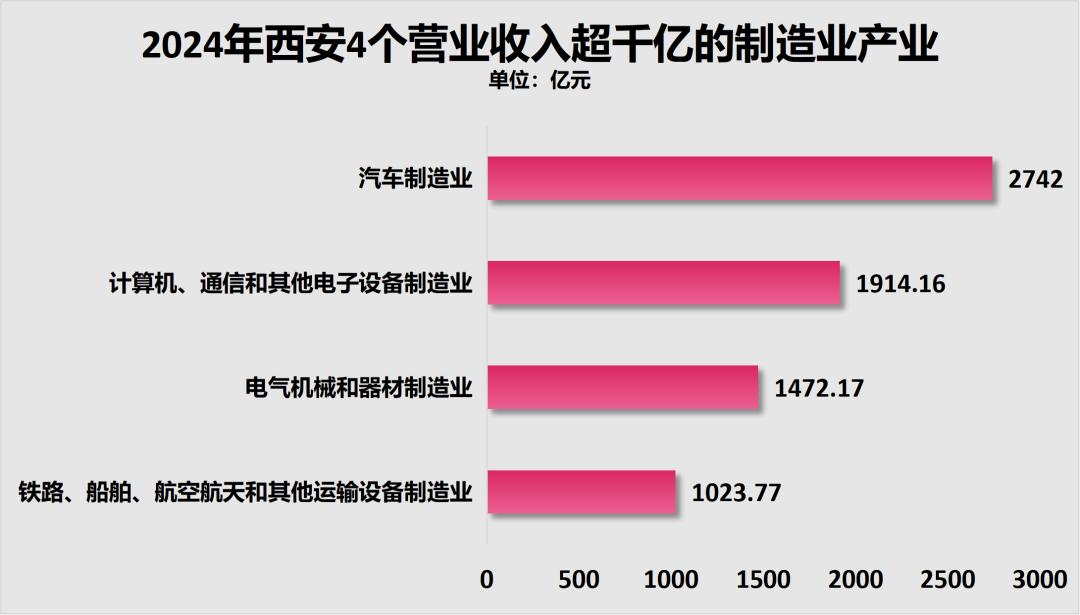
Graphic by: City Finance; Data source: Xi'an Municipal Bureau of Statistics
The essence of Xi'an's slowdown is that although the city is a renowned hub of science and education, a large number of scientific research institutes are isolated from each other and fail to effectively empower the city's industrial development.
The operating revenue of industries above designated size in Xi'an in 2025 was 1.012278 trillion yuan, a figure that ranks outside the top 20 among all cities in China.
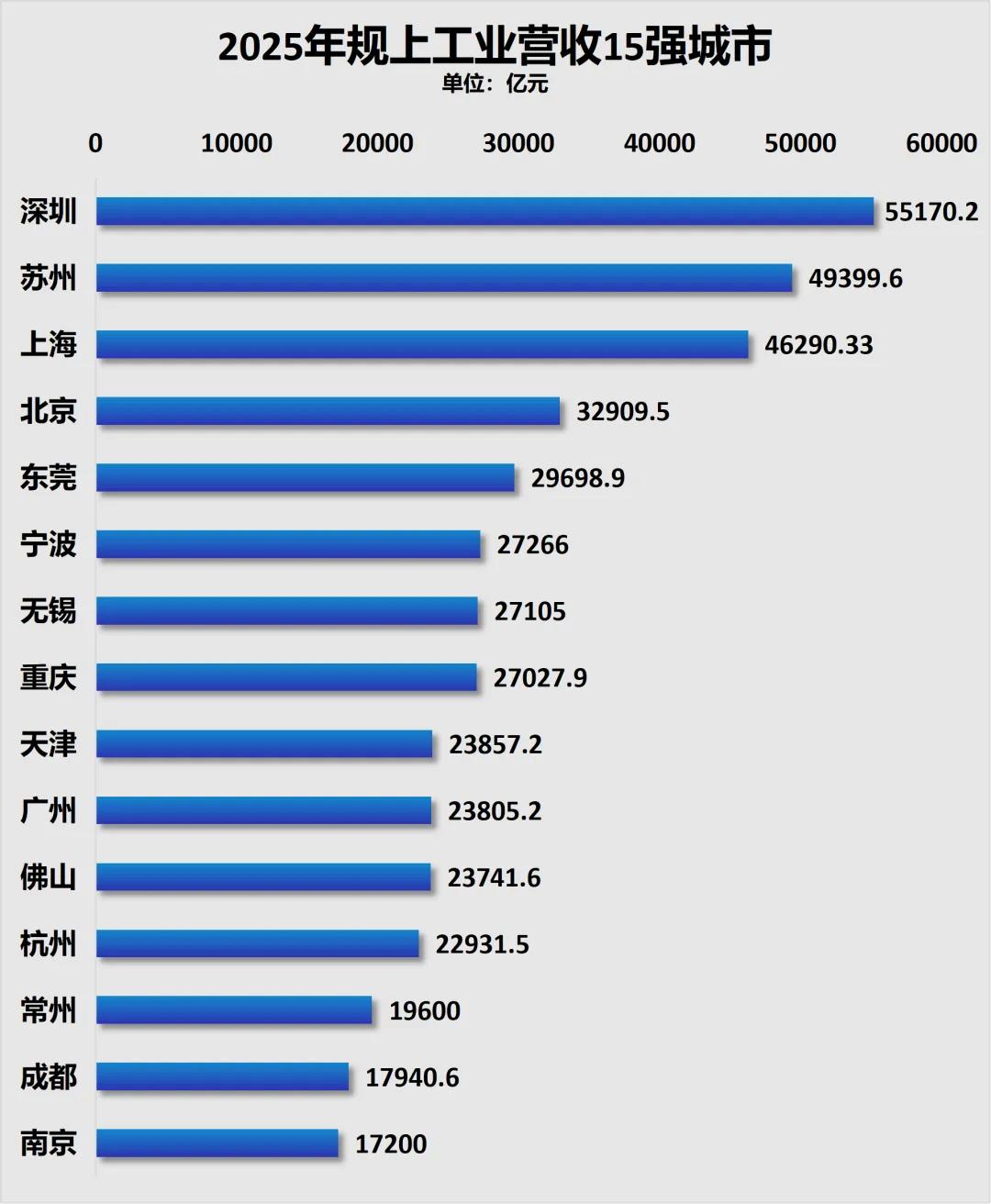
Graphic by: City Finance; Data source: Municipal Bureau of Statistics of each city
An insufficiently strong industrial foundation means limited economic risk resistance capacity.
When fluctuations occur in a small number of pillar industries such as automobile and electronics, the whole economy will be dragged down rapidly. This also explains why Xi'an's nearly doubled export volume in the first half of the year still cannot support its GDP growth.
03
Quanzhou also has its own problems to tackle
Overtaking Foshan and the upcoming overtake of Xi'an are purely opportunistic gains.
What Quanzhou needs to deal with right now is actually its own development challenges.
On the one hand, its GDP growth rate has also slowed down.
In the first half of this year, Quanzhou's growth rate was 4.1%, 0.6 percentage points lower than the national average. Among 29 trillion-yuan cities, it ranks the 4th last, only higher than Foshan, Xi'an and Changsha.
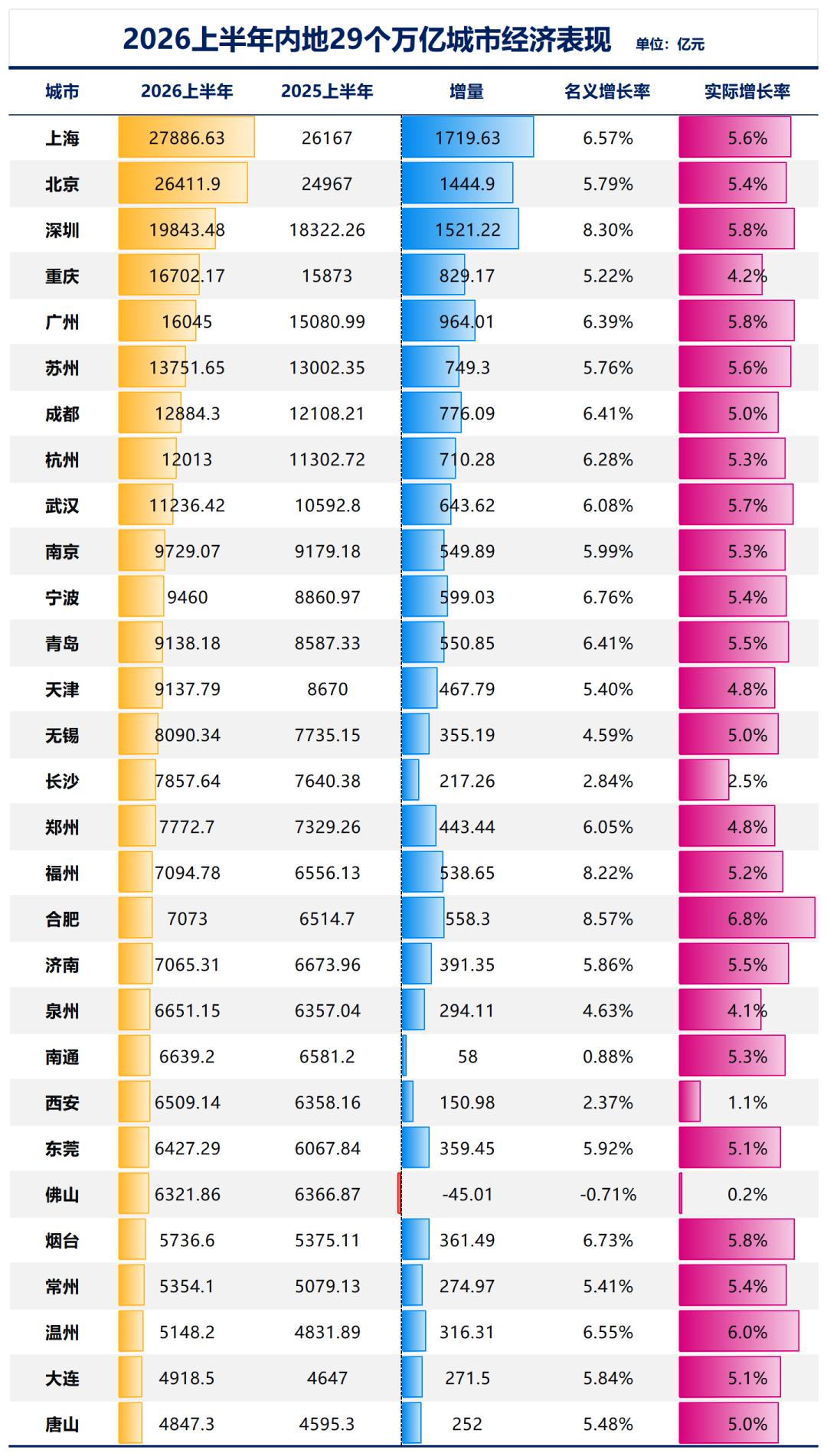
Graphic by: City Finance; Data source: Municipal Bureau of Statistics of each city
On the other hand, Quanzhou's permanent resident population recorded negative growth for the first time.
The permanent resident population of Quanzhou stood at 8.9 million in 2025, down by 14,000 compared with last year, marking its first ever population decline.
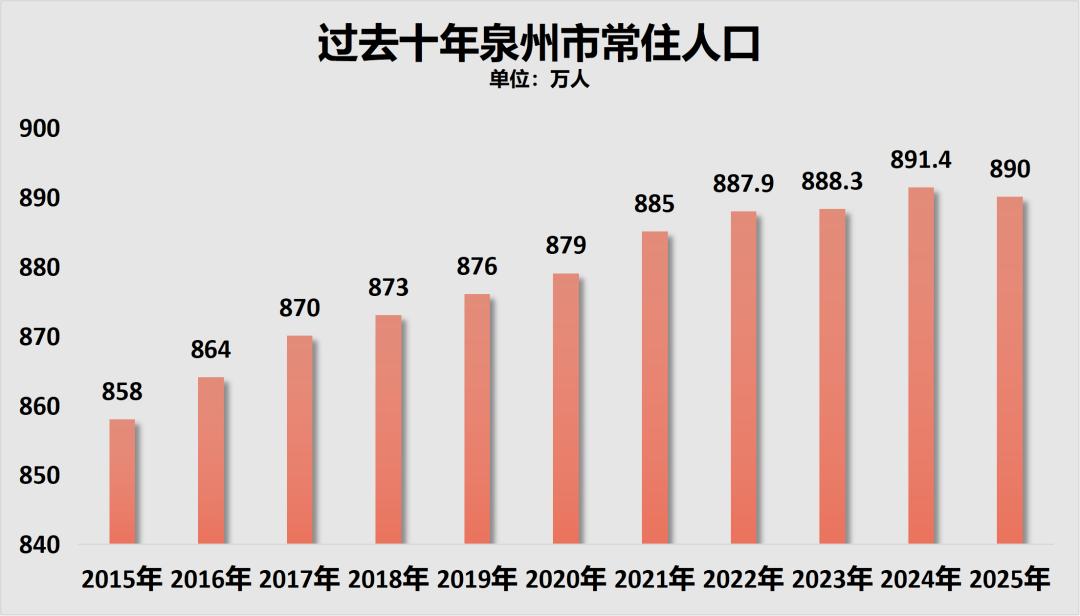
Graphic by: City Finance; Data source: Quanzhou Municipal Bureau of Statistics
The decline of Quanzhou's permanent resident population is directly related to the general national population trend, but it also has its own internal factors:
Although its industrial strength is strong, the technological content of its industries is relatively low.
The same is true for Foshan.
This is also the core reason for Quanzhou's economic slowdown, a point I emphasized back in 2023 when Quanzhou's GDP decreased by 1.8%.
Although Quanzhou has a strong