Only 45 Cybercabs have just been put into operation, while WeRide and Pony.ai, which operate a fleet of thousands of vehicles, are still calculating their losses.
Last week, 45 Cybercab units appeared in the autonomous vehicle registration records of Texas. On September 3, Tesla launched commercial services in Austin with a small number of vehicles, allowing users to hail rides via the Robotaxi app. The dedicated vehicle model without steering wheels and pedals has finally moved from product launch events to operational roads.
The actual scale of this launch is rather small. The fleets of leading Chinese Robotaxi companies have long reached the thousand-vehicle milestone: by the end of June this year, Pony.ai's Robotaxi fleet reached 1975 units; one month later, WeRide's global Robotaxi fleet exceeded 1800 units; Apollo Go covers 28 cities, with a total accumulated autonomous driving mileage of over 350 million kilometers.
With the growing number of vehicles, losses have not disappeared accordingly.
In the second quarter of this year, Pony.ai recorded an operating loss of 446 million yuan, while WeRide posted a loss of 401 million yuan for the same period. Both companies are already able to collect ride fares and achieve per-vehicle operational profitability in individual cities, but the entire companies still need continuous investment in R&D, expansion and new market exploration.
The first problem Robotaxi solved was to get the vehicles manufactured. The current issues are: how many orders a single vehicle can receive per day, whether a city can cover ground support and insurance costs, and how the ride fares should be distributed among technology companies, mobility platforms and fleets.
Lower vehicle cost, tighter cash flow
The most noticeable change over the past two years has come from the manufacturing side.
The material cost of the autonomous driving kit for Pony.ai's 7th-generation model has dropped by 70% compared with the previous generation, among which the cost of the autonomous driving computing unit decreased by 80%, and that of LiDAR dropped by 68%. The total vehicle cost of Apollo Go's 6th-generation model RT6 has been reduced to 204,600 yuan. In the past, a Robotaxi often cost over a million yuan, but today its price is close to that of a mid-to-high-end new energy vehicle.
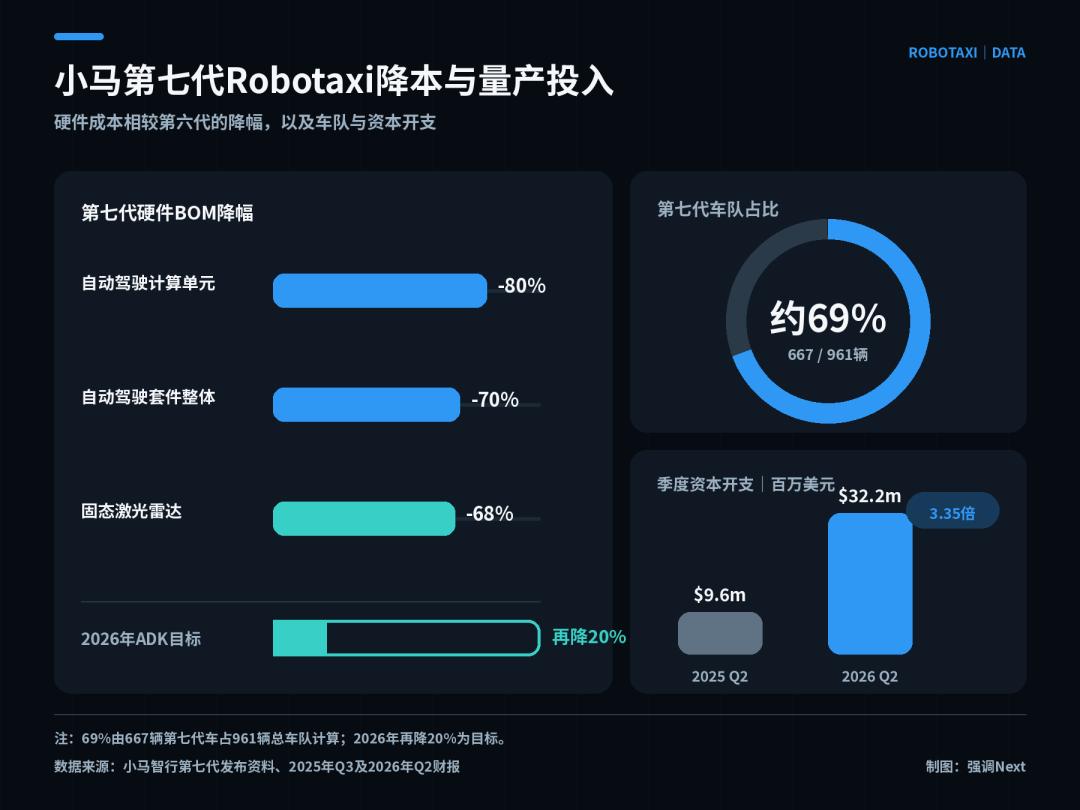
Cost reduction opens up space for fleet expansion, and also directs more cash to vehicles, servers and operation facilities.
Pony.ai's capital expenditure in the second quarter reached 218 million yuan, 3.4 times that of the same period last year, mainly invested in the 7th-generation fleet, data centers and servers. The company plans to expand its Robotaxi fleet to more than 3500 units by the end of the year, which means at least 1500 more units will be added in the second half of the year.
Lower vehicle costs have not made autonomous driving companies much leaner quickly. Pony.ai's R&D expenses in this quarter hit 382 million yuan, which is 8.9 times the company's total gross profit. WeRide's R&D expenses reached 434 million yuan, about 5 times its gross profit. The gross profit generated from operations of the two companies is far from enough to support their technology investment for the time being.
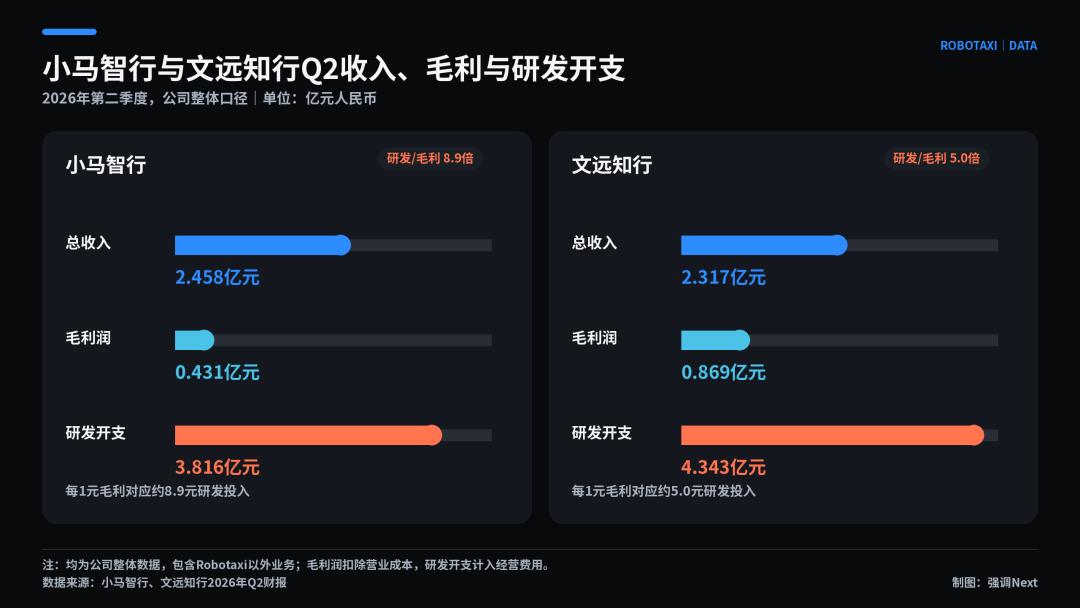
Revenue also needs to be analyzed separately.
Pony.ai's Robotaxi service revenue in the second quarter reached 81.9 million yuan, up 691.2% year on year, of which passenger fare revenue increased by 849.3%. The base of this growth rate was only about 10 million yuan. In the same period, the company also recorded 114 million yuan in product revenue, mainly from the delivery of Robotaxi vehicles under the joint deployment model.
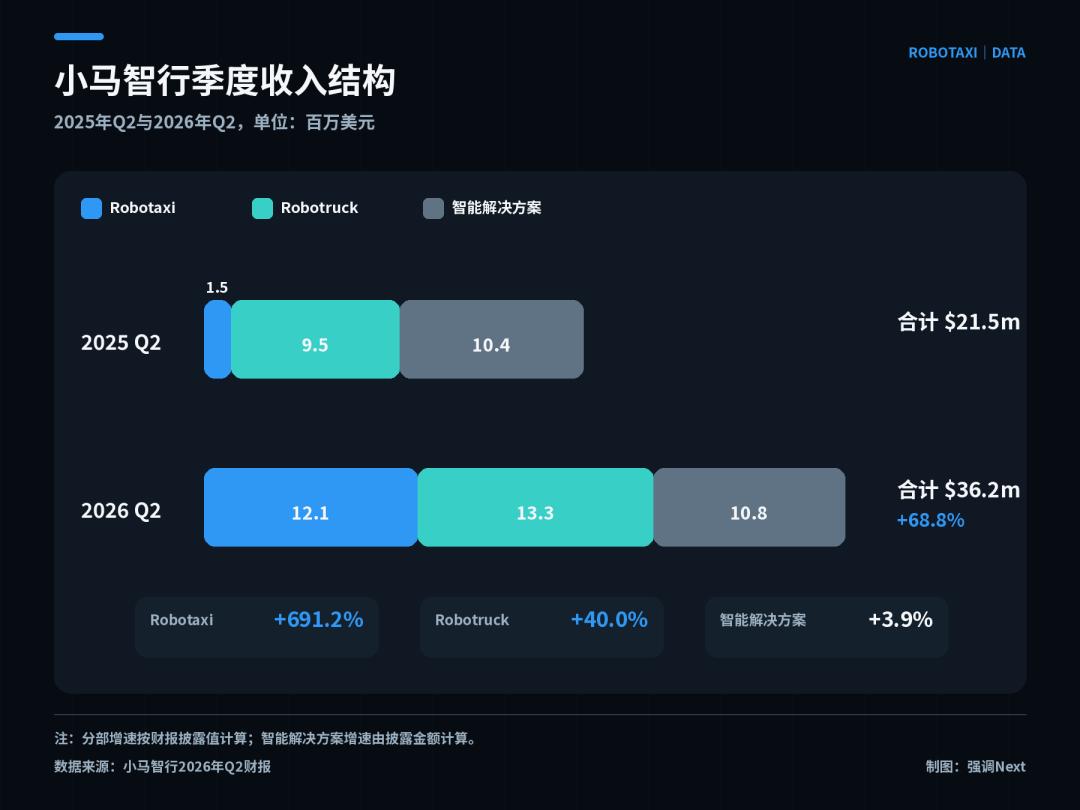
WeRide's revenue in the second quarter was 232 million yuan, up 82.2% year on year, and its gross profit margin rose from 28.1% to 37.5%. This gross profit margin seems to be double Pony.ai's 17.5%, but there are different revenue structures behind it. WeRide explicitly stated that the improvement of gross profit margin mainly came from the higher-margin L2++/L3 business and overseas L4 business. The company's revenue also includes businesses such as Robobus and AI infrastructure.
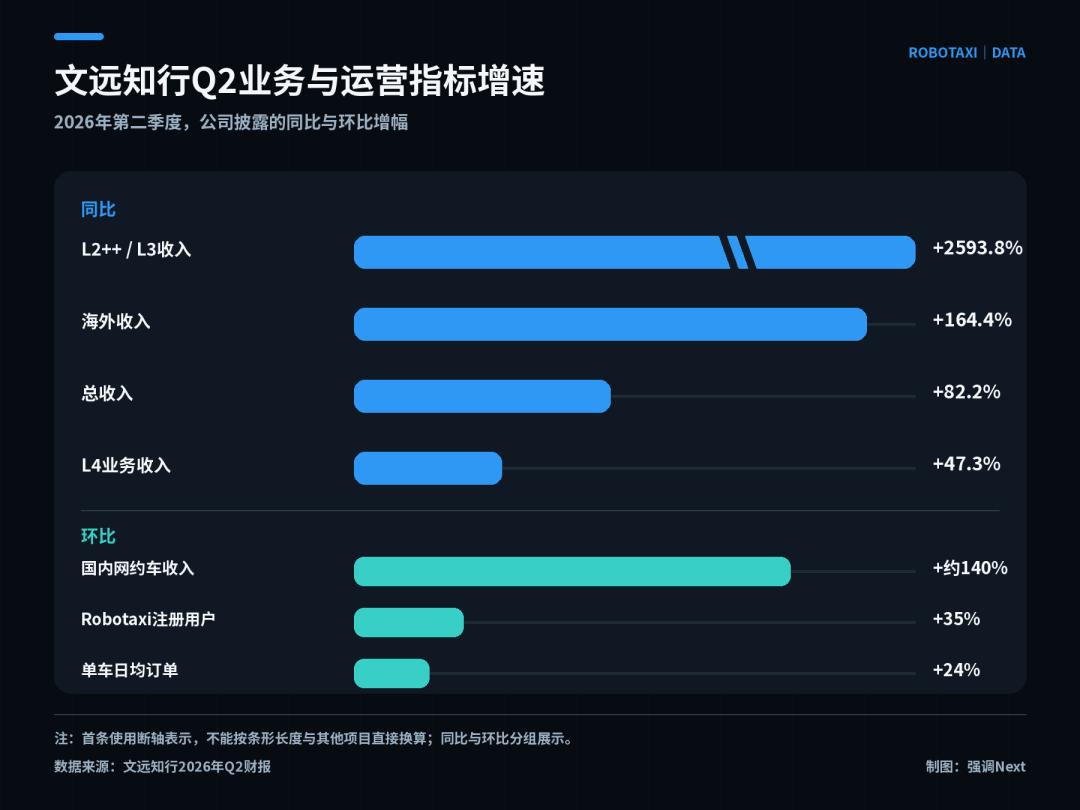
Passenger fares verify whether self-operated Robotaxi can cover costs, while vehicle delivery and technical services verify whether the supplier model is viable. Both can bring revenue, but their profit structures are completely different.
23 orders, the threshold that blocks per-vehicle break-even
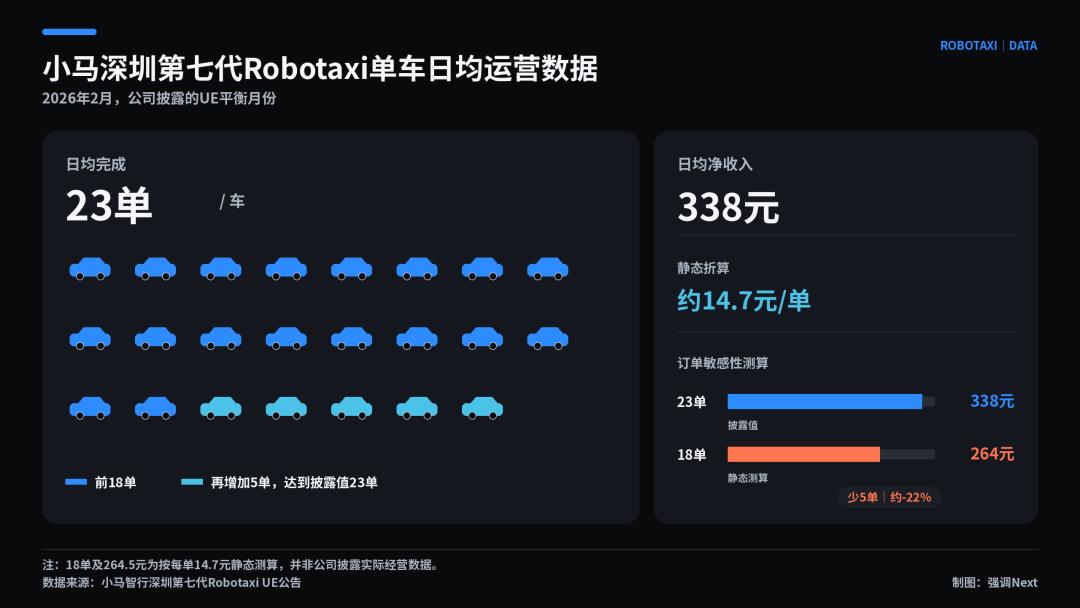
In February this year, Pony.ai's 7th-generation Robotaxi achieved per-vehicle economic balance in Shenzhen: the average daily net income per vehicle in that month was 338 yuan, with an average of 23 orders per day. The calculation scope covers depreciation of vehicles and autonomous driving kits, charging, maintenance, remote assistance, insurance, ground support, parking and network facilities.
After the vehicle cost drops to more than 200,000 yuan, order density begins to significantly affect the per-vehicle economy.
Based on the static calculation of the above data, the net income per order is about 14.7 yuan (estimated). If 5 fewer orders are completed per day, the revenue will decrease by about 73 yuan, accounting for more than 20% of the average daily net income. Compared with continuing to cut tens of thousands of yuan from hardware, reducing empty driving, extending operation hours and increasing peak-hour utilization have become more direct operational variables.
WeRide's domestic Robotaxi recorded an average of more than 21 orders per vehicle per day in the second quarter, up 24% month on month, with a peak of 28 orders. Its domestic online ride-hailing revenue increased by about 140% month on month. The data disclosed by both companies point to more than 20 orders per day, which also shows that leading fleets have shifted their operational focus to per-vehicle utilization.
This is also why the expansion of service coverage in urban areas of Guangzhou and Shenzhen is more important than winning a new pilot city.
Pony.ai's service in Guangzhou covers more than 7 million people, and it has accessed key hubs such as Bao'an Airport in Shenzhen. WeRide's service area in Guangzhou has expanded three times compared with the end of 2025, and has switched to all-day operation. Roads in airports, ports and central urban areas are more complex, with more continuous orders and higher unit customer value than peripheral test zones.
However, there are still two layers of accounts between per-vehicle profitability and overall company profitability.
The first layer is that per-vehicle revenue covers vehicle depreciation and daily operation costs. The second layer is that the revenue of one city covers stations, ground support, rescue, safety management and local teams. Finally, all cities jointly bear R&D and new market development costs.
What Pony.ai achieved in Shenzhen is the first layer of profitability. Financial report data shows that Pony.ai still recorded a loss of 446 million yuan in the second quarter. WeRide's order volume and gross profit margin are both improving, but it still posted a loss of 401 million yuan in this quarter.
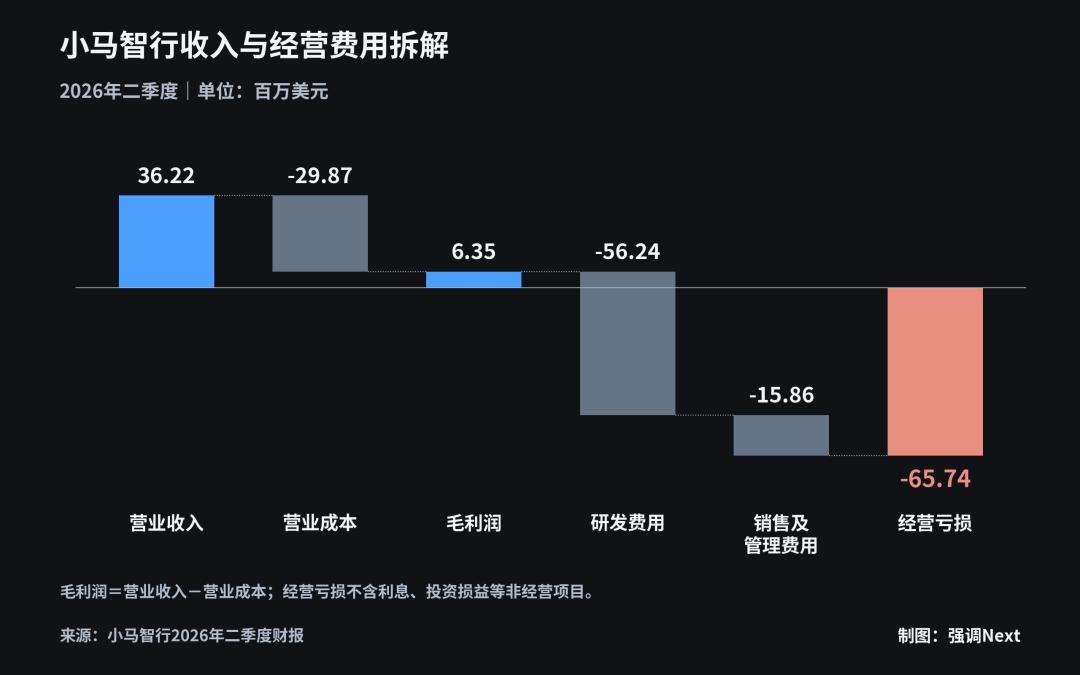
A fleet of a thousand vehicles solves the scale problem, but it is still far from forming a complete profit statement.
Asset-light model, the autonomous driving company becomes lighter
Expanding the fleet with its own funds will soon hit the boundary of the balance sheet. Pony.ai and WeRide choose to hand over part of the vehicle capital, order entry and daily operation to partners.
In August, Pony.ai expanded its cooperation with Uber, planning to deploy more than 2000 Robotaxi units in five European cities. In this cooperation, Pony.ai provides L4 autonomous driving systems, passenger experience and operation support, while Uber provides customer acquisition, order placement, payment and customer service. Vehicle capital, ownership and daily operation are undertaken by different partners according to the market. In Zagreb, the local company Verne acts as both the fleet owner and the operator.
WeRide is also copying this model. As of August 12, its autonomous driving business has entered 13 countries and more than 60 cities, with about 400 Robotaxi units in the Middle East. In the second quarter, the company's overall overseas revenue increased by 164.4% year on year, faster than the total revenue growth rate. However, WeRide has not separately disclosed its overseas Robotaxi revenue, so it is impossible to judge how much this business contributes to gross profit for the time being.
But the asset-light model does not eliminate the costs of vehicles, insurance, maintenance and ground support, it only moves these costs to the balance sheet of partners. Autonomous driving companies save the cost of purchasing vehicles, at the cost of also distributing revenue with platforms and fleets.
Responsibility cannot be completely transferred away either. New regulations that came into effect in Shenzhen in July stipulate that if highly and fully autonomous vehicles violate traffic rules or cause liable accidents when the system is activated, the vehicle owner and manager shall handle or compensate for the losses first. If the damage is caused by vehicle defects, they can recover compensation from the manufacturer and seller afterwards. Overseas projects need to re-divide responsibilities in accordance with local regulations and cooperation contracts.
The routes of several Chinese companies are not simply divided into self-operated and asset-light factions.
Apollo Go retains a large number of fleets and self-owned entrances in China, and also accesses Uber, Lyft and local public transport operators overseas. Pony.ai and WeRide operate paid autonomous vehicles in China, and rely more on platforms and local fleets when going global. Didi has announced plans to launch a pilot in the United Arab Emirates, and CaoCao Mobility is also advancing projects in the Middle East and Europe with local partners.
The same company will also switch its strategies according to different cities. When there are licenses, fleets and operation and maintenance foundations in the domestic market, enterprises tend to retain more operation links; when entering overseas markets, customer acquisition, vehicle capital and daily operation are more handed over to local partners.
Fleets can be replicated, but pricing power is hard to replicate
At the current stage, Cybercab adopts a more vertical model. Vehicles, autonomous driving systems and order entrances are all controlled by Tesla. Theoretically, it can retain more revenue links, but it also needs to bear the costs of vehicle investment, depreciation, operation and maintenance, and compliance on its own. On the same day when the commercial deployment was launched on September 3, NHTSA began to review the safety standard certification process and technical basis of Cybercab.
The advantage of Chinese companies is more like a set of quickly exportable autonomous transportation capacity. The new energy vehicle supply chain reduces vehicle costs, and autonomous driving companies then enter new cities with the help of Uber and local fleets, saving the time of acquiring customers from scratch and building their own operation networks. This route enables faster expansion, but also makes it easier for competitors to compare service prices.
Uber has already cooperated with multiple autonomous driving companies at the same time. After the platform controls users, payment and order dispatching, it can select suppliers according to urban regulations, vehicle costs and service capabilities. The more autonomous driving solutions there are, the greater the choice the platform has. Therefore, even if Pony.ai, WeRide and their peers own a large number of overseas vehicles, they may still lose real pricing power.
45 Cybercab units are not enough to prove that Tesla's vertical model is viable, and the thousand-vehicle scale has not allowed Pony.ai and WeRide to get rid of overall company losses. The global Robotaxi industry is still groping for its direction in a chaotic state.
Over the past decade, autonomous driving companies have raised financing relying on technical indicators and test mileage. The next question is whether the "thousand-vehicle fleet" is an asset, or a more expensive test. It depends on how much control over orders, pricing and operational revenue autonomous driving companies can finally retain when they expand their business with the help of platforms and fleets.
Note: The data in this article comes from public reports and financial report information, and does not constitute investment advice.
This article is from the WeChat official account "Emphasis Next" (ID: leo89203898), author: Yixiu, editor: Xiaobai, 36Kr publishes this article with authorization.