Dialogue with Lu Zongqing, founder of BeingBeyond, a portfolio company of Xinglian
In June 2025, Lu Zongqing put forward a judgment at the Zhiyuan Conference: Human video is the only scalable data path for embodied intelligence.
At that time, the industry's attention was focused on robot bodies, scenario construction, and data flywheels, and few model companies set their sights on first-person human videos. Lu Zongqing was different. He not only put forward this judgment, but also accumulated data in this direction, and has now accumulated more than 500,000 hours of data.
Lu Zongqing is a tenured associate professor at the School of Computer Science of Peking University, has long served as the Senior Area Chair of ICML, NeurIPS, and ICLR, and is also the earliest systematic promoter of the latent space route in China.
In 2025, he founded BeingBeyond, taking a completely different technical path from the mainstream video generation route — Latent World-Action Model: instead of generating frames, it directly jointly predicts what the robot will do next and how the world will respond in the embedding space.
The training cost of this route is about 1% of that of the video generation route, and the inference speed is sufficient to support real-time control, but it has a disadvantage — no frames, which makes it hard to demonstrate. In the current era of hot embodied intelligence financing and fierce demo competitions, this is a choice that requires concentration to stick to.
However, Lu Zongqing himself does not regard this as a definite bet.
He said a sentence in the interview that was unexpected: The deterministic technology of embodied foundation models has not yet emerged, and even the world model may not be that technology.
His logic is that GPT can be scaled up because Transformer and Next Token Prediction first appeared, forming a deterministic paradigm, so scaling up data makes sense. Embodied intelligence has not reached that stage yet, "We don't even know what the deterministic technology is now."
This is not false modesty, but a clear judgment.
On July 28, 2026, BeingBeyond officially released Being-H0.8 — the world's first implicit tactile world-action model. Being-H0.8 introduces the tactile modality into large-scale model pre-training for the first time, and unifies vision, tactile sense, actions and future state changes into the same latent space. This enables robots not only to understand "what they see, what they do, and what they touch", but also to further understand "how the world has changed as a result", thus forming a more complete cognition and prediction capability for physical interaction processes.
We had a conversation with Lu Zongqing around the selection of technical routes, the real value of data, how the industry division of labor is formed, and how far the general embodied foundation model is from realization. The following is the edited content without changing the original meaning:
01
From Peking University to Entrepreneurship:
Theoretical achievements will not turn into products on their own
▎ You are a professor at Peking University, have been engaged in academic research for many years, and then started an embodied intelligence business. This year we have seen many university teachers start their own businesses, including Li Yiming, Zhao Hao and you. It feels that there are an unusually large number of people from the academic circle coming out to start businesses this year. How did you make this decision back then?
Lu Zongqing: It was not a sudden change. I was already researching directions related to embodied intelligence, but at a certain node, I felt that this matter could not only stay at the stage of publishing papers. Academic research can verify whether a direction is feasible, but after you make the judgment, the theoretical achievements on paper will not turn into products on their own.
This is especially true for embodied intelligence. It requires real robots for verification, operation in real scenarios, and repeated failures and adjustments in the real physical world, which cannot be done in universities. Starting a business is a way to land research results, not a career switch.
▎ We observed that some of the scholars who started businesses this year obviously have a sense of urgency that "it will be too late if we don't raise funds now", especially those with autonomous driving backgrounds, who are extremely sensitive to the industrial rhythm. Do you have this kind of anxiety?
Lu Zongqing: Everyone has different goals. For us, our goal is to build models, and build up the foundation model for embodied intelligence. The resources in universities are difficult to meet this requirement, no matter in terms of computing power, personnel or industrial ecology, these resources are very hard to obtain in the university environment. I chose to start a business because I want to make this thing a reality, not because I am afraid that it will be too late.
Of course, most of the current domestic capital market is relatively short-term oriented. Look at those Club Deal financings, the first few rounds are basically not open to the public, top institutions pass the investment around, driving the valuation up to 500 million dollars, and then the next investors take over. I don't think they really believe in embodied intelligence or general world models. We are screening investors, hoping to find like-minded institutions that are truly long-term oriented.
▎ You mentioned "screening investors", which sounds a bit luxurious. Now every company is trying their best to raise money, but you are picking investors?
Lu Zongqing: If what you are doing takes three to five years to deliver real results, the capital you get must match this cycle. Short-term hot money coming in will distort your technical decision-making instead.
02
Latent Space vs Pixel:
A race with a 100-fold cost gap
▎ Recently we visited many embodied intelligence companies and found an interesting phenomenon — everyone says they are working on "world models", but their routes are very different. Can you help us clarify this concept first?
Lu Zongqing: (Laughs) The world model is originally a concept that has not converged, and it is a vague term when discussed out of context.
The world model is not a single model, and it will eventually land in a specific field. In the language field, the language model is the world model, which has been academically proven — there is a paper from MIT that won the best paper award at ICLR 2024. The 3D generation work done by Li Feifei's team is also a world model in that scenario. Video generation models also claim to be world models. There is no model that can output text, generate 3D space, generate video, and control robots at the same time now.
For embodied intelligence, we need to control input and output actions, so the embodied foundation model is the world model in the embodied field. What we are doing falls into this category.
▎ In the field of embodied intelligence, there are still huge divergences in routes. Li Feifei has her own classification, and NVIDIA's Cosmos is another set of frameworks. How do you understand the division of technical routes within the embodied intelligence sector?
Lu Zongqing: Divided from the perspective of backbone, there are roughly two categories. One is based on the video generation model, which conducts post-training on the original capabilities, and outputs actions while generating videos; the other does not generate frames, and directly predicts the subsequent states and actions in the embedding space.
Li Feifei's classification is different, she divides it more from the perspective of use — the rendering class that generates 3D space, the interaction class that does simulation, and another class that focuses on robot control, which is the direction of NVIDIA's Cosmos Policy.
Different people have different classification methods, but for us, we care more about what backbone to choose, because it determines the training cost, deployment speed, and ultimately whether the model can run on real robots.
▎ The demos of the video generation route are indeed more shocking and easier to tell stories, but even the strong team behind Alibaba Wan has spread the news of disbandment. Is this a very difficult road?
Lu Zongqing: The video generation route has two problems.
First, the training cost is extremely high. To predict every pixel, the pre-training of a large video generation model may require tens of thousands of GPUs and several months, with the overall cost reaching hundreds of millions of yuan. The Alibaba Wan team encountered problems, the model stopped at version 2.2, and they could not continue to support it.
Second, it cannot run on real robots. Robots need real-time decision-making, and the inference speed must be extremely fast. You have to judge the flight trajectory of a ball and output the grasping action in real time, before the frame is generated, the best timing has already passed.
Our route (latent space) has two quantifiable advantages.
The first is training cost. Assuming the same amount of data and number of parameters, only in terms of computing power, the cost of latent space prediction is about 1% of that of the pixel space generation model, a gap of two orders of magnitude.
The second is that it is easier to learn physical laws. When the supervision signal is defined at the pixel level, the model will be forced to predict frames; in the embedding space, you don't even know what that space is, but you have the opportunity to learn more essential physical and causal relationships.
▎ But the latent space has no frames, which makes it hard to demonstrate. In the current era of hot financing and fierce Demo competitions, aren't you suffering a big loss?
Lu Zongqing: Demonstration and landing are two different things. A robot that cannot catch a ball is useless no matter how beautiful the frames are. It is true that the latent space is not easy to demonstrate, there are no frames to show to others, and we accept this reality.
But on the other hand, being close to the industry and having clear goals are what investors value more. A clear goal means you know what problem you are solving, instead of using beautiful videos to cover up the model's incompetence in physical interaction.
▎ How much of those dazzling operation videos in the current industry do you think are "exam-oriented performances"?
Lu Zongqing: What you see may be the best one out of thousands of attempts. This is not a secret.
03
We started working on data two years earlier than everyone else
▎ Speaking of data, there is a very popular view in the industry now: the one who accumulates more data will have the advantage. We recently interviewed many companies and found that everyone is building their own data collection centers and setting up collection pipelines. How did you judge the value of human first-person video back then?
Lu Zongqing: I put forward this judgment in November 2023. (Deep Intelligence was registered in May 2025, it is a company widely reported in China for doing human first-person data, and my judgment was nearly two years earlier than theirs.)
The logic is actually not complicated. The data collected by robot bodies naturally has two problems: the total volume cannot go up, and the diversity is not enough. How many scenarios can you set up in a data collection site? The same is true for Simulation, you have to let engineers build the environments one by one, and the diversity is extremely poor. To train a general foundation model, the most important data attribute is diversity. At that time, we looked at the three options: simulator data, real robot data, and human video. Only the first-person videos of humans completing various tasks in daily life meet all three requirements at the same time: high diversity, large data volume, and easy to scale up. There are only a few types of data available, there is no other choice.
▎ How much data have you accumulated now? We previously saw that it was 200,000 hours.
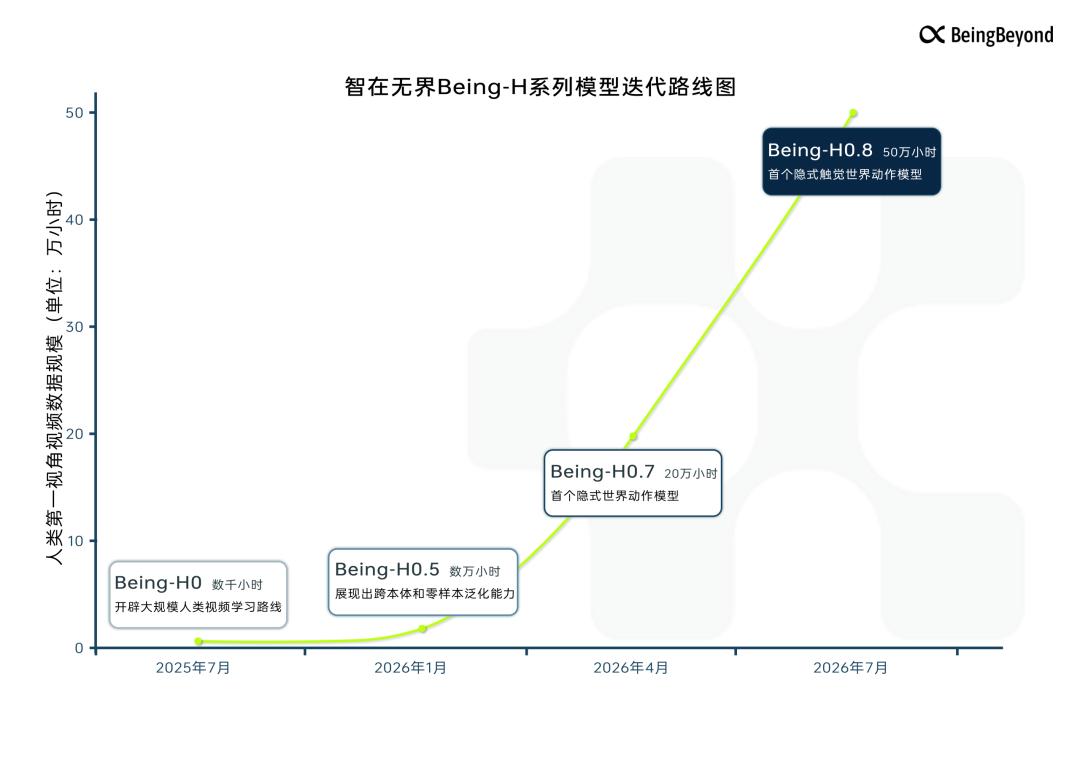
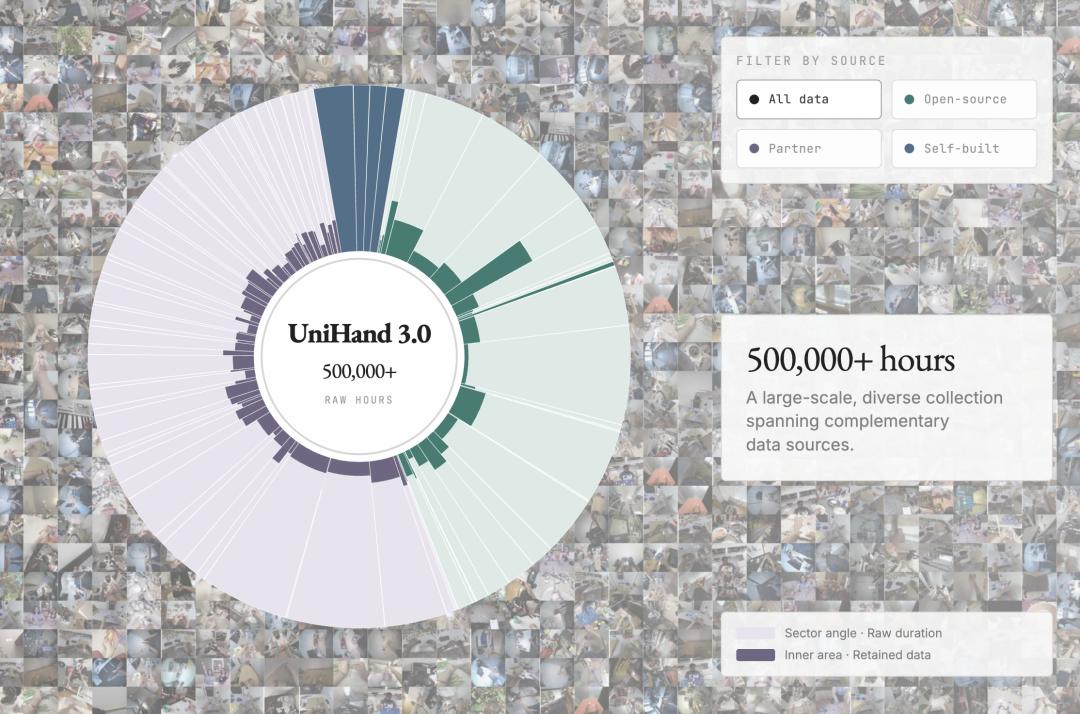
Lu Zongqing: (BeingBeyond released the latest Being-H0.8 on July 28) It has now exceeded 500,000 hours. This is not just stacking duration, every hour of data is screened according to diversity and quality standards. Repeated data is meaningless to us. Few companies in the market have existing data stock of 1 million hours, some people say they have 10 million hours, that is their target, not their current stock.
▎ Many robot body companies talk about the "data flywheel", which first deploys devices to users' homes, collects data while using, and uses mass production to drive data accumulation. For example, let users wear collection devices to do housework. Do you think this is reliable?
Lu Zongqing: The biggest advantage of this matter belongs to platform companies, not startups.
If a startup does this, it will overfit its own robot body, the data is only coupled to its own configuration, how much data can it accumulate? It is impossible to scale up in a short period of time. The data we want to see is sufficiently general and diverse, not only targeted at a specific configuration. Doing this whole thing from start to finish is not the work a startup should take on.
▎ So you think the so-called "data flywheel" is a false proposition for most startups?
Lu Zongqing: Yes, for companies that want to take the general foundation model route. If you just want to overfit several scenarios and sell robot bodies, that's no problem. But if you want to move towards AGI, relying only on the closed-loop data from your own robots, the ceiling is visible.
▎ What is the gap between your 500,000 hours of data and the data collected by others in their own data collection sites?
Lu Zongqing: To train a general foundation model, the model needs to see all kinds of scenarios, operate all kinds of objects, and complete all kinds of tasks. How many scenarios can you set up by building a data collection site?
To build up these 500,000 hours of data, you need a powerful data infrastructure — annotation, filtering, data alignment, evaluation, data management, all of these take time to build, and have high thresholds and barriers. Moreover, the outside world may not perceive it, which is also one of the most important factors that allow our model to iterate rapidly — from 0.5, 0.7 to the current 0.8. BeingBeyond has completed the full-stack infrastructure construction covering data pipeline, model pre-training, post-training, evaluation and edge-side deployment. This system can promote the continuous precipitation of large-scale data, the continuous evolution of model capabilities, and enable robots to continuously move towards the open, complex real physical world.
04
"We still don't know what the deterministic technology is"
▎ We observed that many companies first collect real robot data, do SFT, quickly make a model that can be used in one scenario, and then sell it to robot body companies. Some very large companies are also doing this. What do you think of this route?
Lu Zongqing: The ceiling is too low. Everyone's ability in post-training is roughly the same. There is no obvious gap in single-scenario performance between a company with a valuation of 20 billion yuan and a startup. The real gap lies in the pre-trained model. A good pre-trained model can reduce the downstream real robot data requirement by an order of magnitude, can quickly adapt to different scenarios, and can move towards the ultimate goal. Being-H0.5 can adapt to bipedal humanoid robots, dual-arm robots, robotic arms, grippers, and dexterous hands. After fine-tuning with data collected on one configuration, robots with completely different configurations can also perform similar actions. This is the value of the pre-trained model, which cannot be achieved by post