DeepSeek has expanded its recruitment by 150 people at one go, with zero AI research positions.
DeepSeek is on a hiring spree, adding 150 new roles at one go!
Wait a minute, their total headcount is only 300 to 500, so this must mean they are gearing up for a major move.
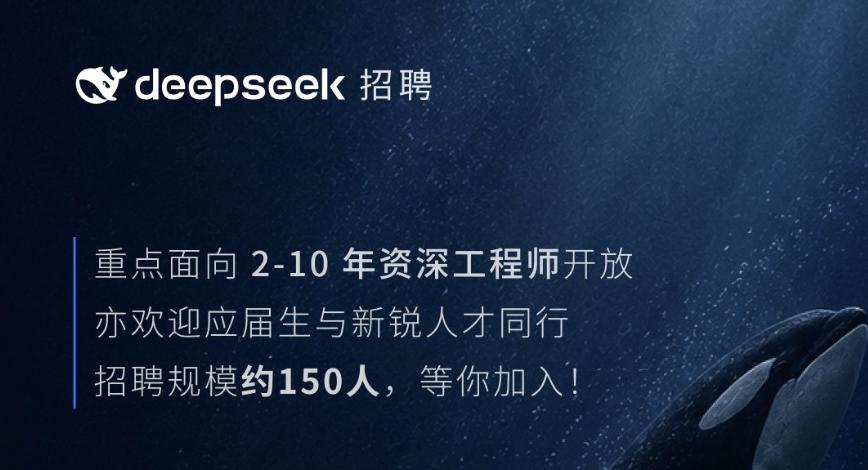
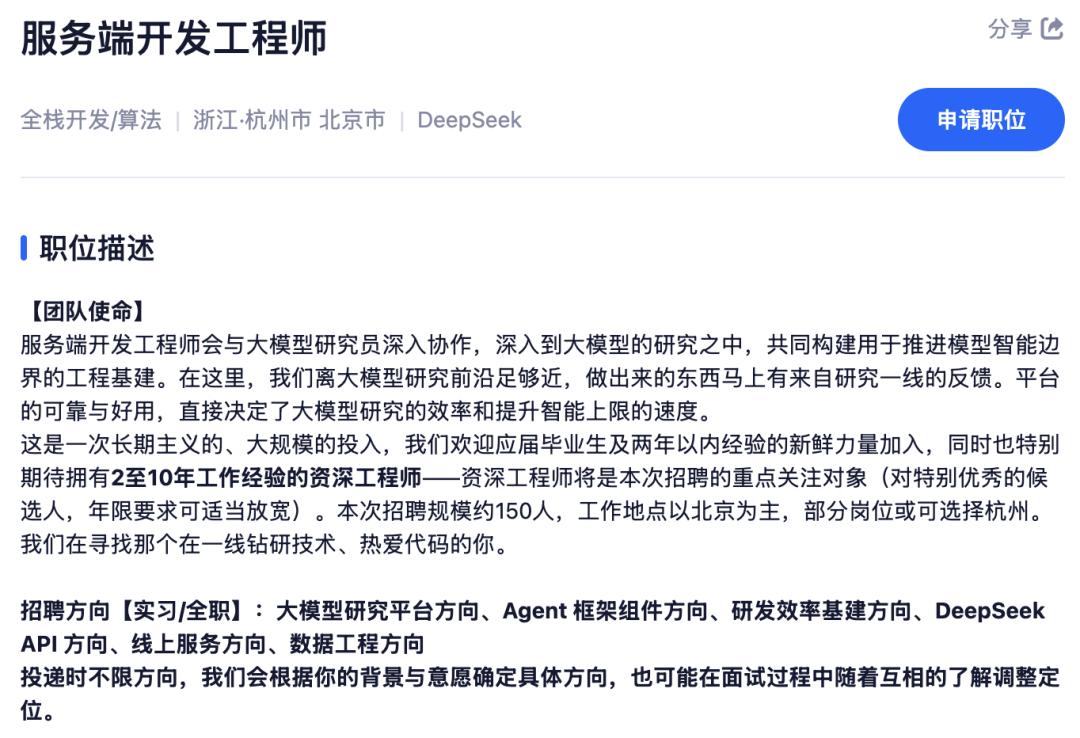
What's more, all these 150 headcounts are not for AI research positions, they are fully allocated to two roles: Backend Development Engineer, Agent Elastic Computing R&D Engineer, primarily targeting senior backend developers with 2 to 10 years of work experience.
CUI Tianyi, the person in charge, explained that as the team scales up, complexity arises, and the resulting complexity in turn requires further expansion of the scale.

Is this... the Scaling Law applied to team headcount?
DeepSeek's Elastic Computing Moves from Academic Papers to Large-Scale Engineering Implementation
The Agent Elastic Computing R&D Engineer role is further divided into two tracks: platform development and underlying system.
This platform refers to DSec (DeepSeek Elastic Compute), a custom-built elastic computing platform specifically for Agents, which was first publicly disclosed in the recently released DeepSeek-V4 technical report.
According to the description in the paper, DSec consists of three Rust components: the API gateway Apiserver, the Edge agent deployed on each host machine, and the cluster monitor Watcher. The three components are interconnected via a self-developed RPC protocol, and run on top of DeepSeek's self-developed 3FS distributed file system.
The recruitment notice has revealed the next-step plan for engineering expansion.
To improve reliability and efficiency, DSec needs to modify the entire system stack: from the operating system to virtual machines, to all levels of network and storage, all the way up to application layer scheduling and control plane services.
Most of the tasks in this project have never been attempted by predecessors, so there are no ready-made solutions to copy.
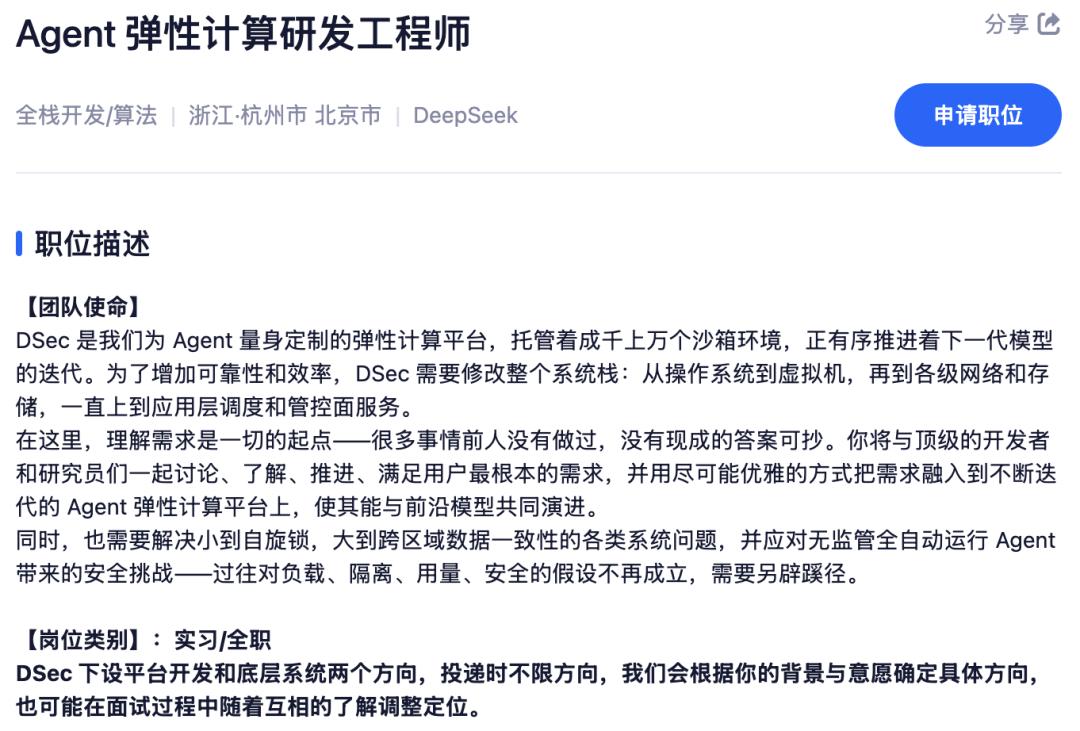
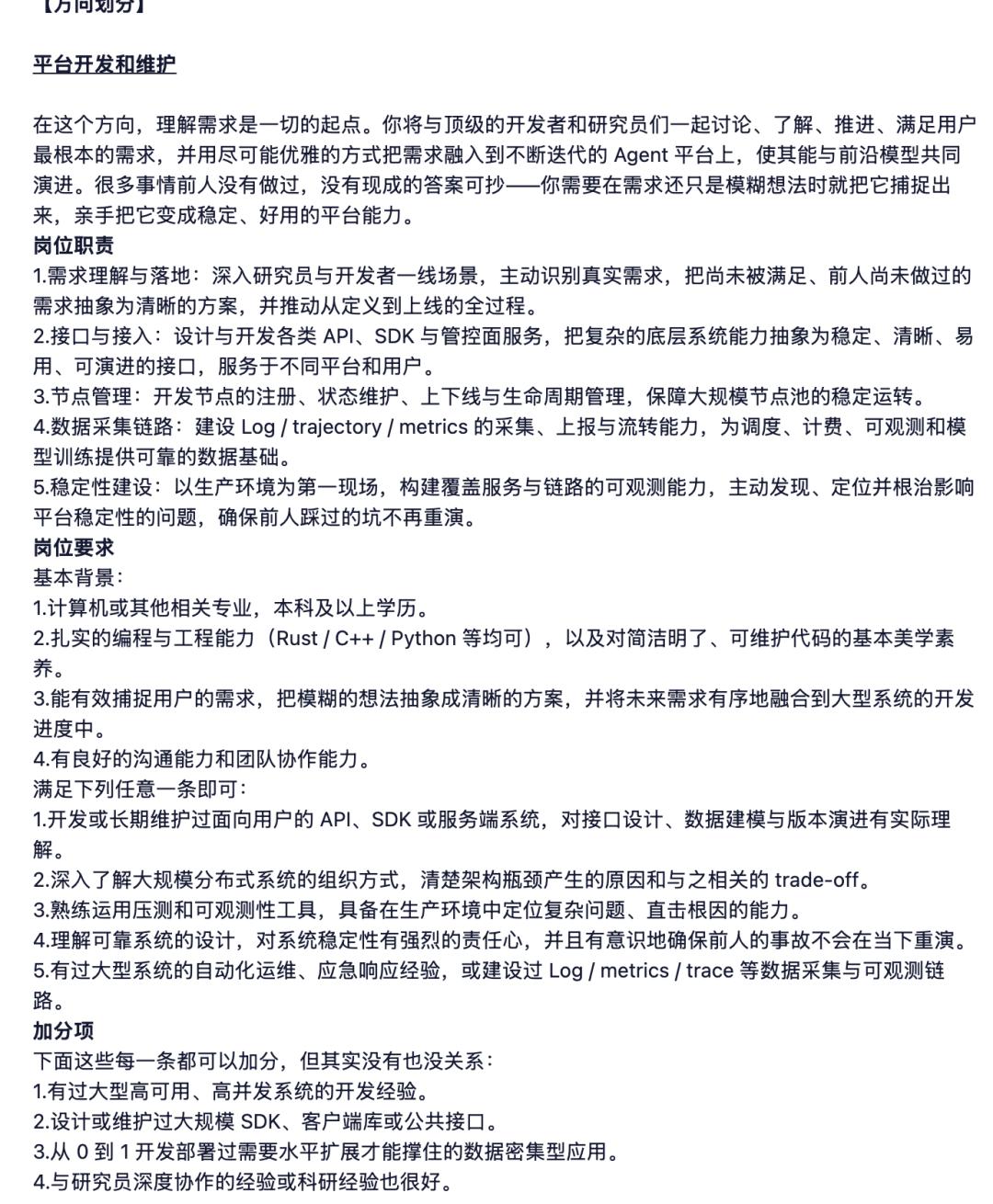
The platform development and maintenance track is somewhat a combination of product and development responsibilities. You need to participate in requirement understanding, and also be responsible for system design, development and maintenance by yourself.
The underlying optimization and hardcore technical tackling track is more technically demanding. It will be a big plus if you can push the performance of "certain operating system components to SOTA level, or even directly to the hardware limit".
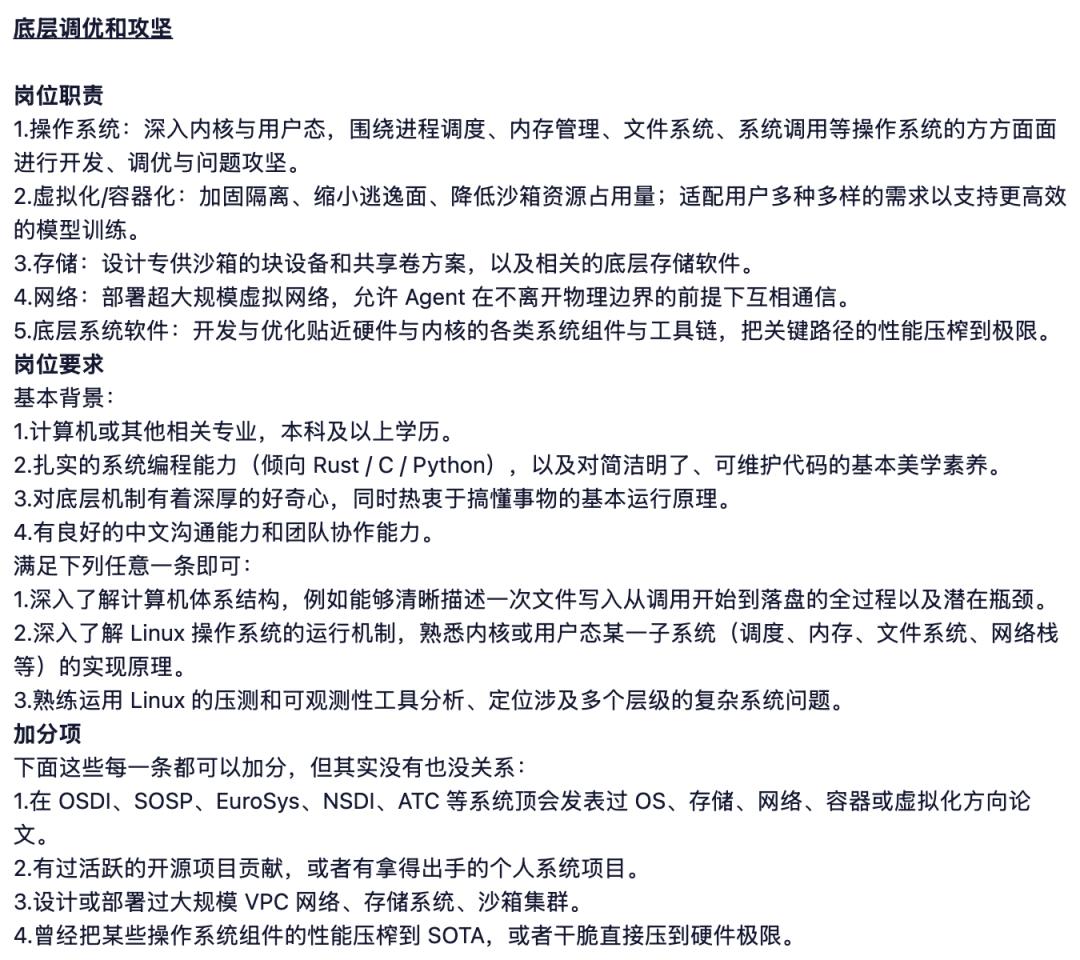
The last sentence "Your work directly determines the diversity and efficiency of Agent model training" is no empty talk.
Because DeepSeek will keep pushing to SOTA level and then open source the achievements, the impact will not be limited to DeepSeek's future Agent infrastructure, but will spread across the entire industry.

Agent Runs Through the Entire R&D Link
For the Backend Development Engineer role, six tracks cover the full pipeline from model research to user-facing services:
Large Model Research Platform Track, Agent Framework Component Track, R&D Efficiency Infrastructure Track, DeepSeek API Track, Online Service Track, Data Engineering Track.
DeepSeek describes the mission of this team as: staying close enough to the cutting edge of large model research, so that the outputs you build can get immediate feedback from frontline researchers. The reliability and usability of the platform directly determine the efficiency of large model research and the speed of lifting the upper limit of intelligence.
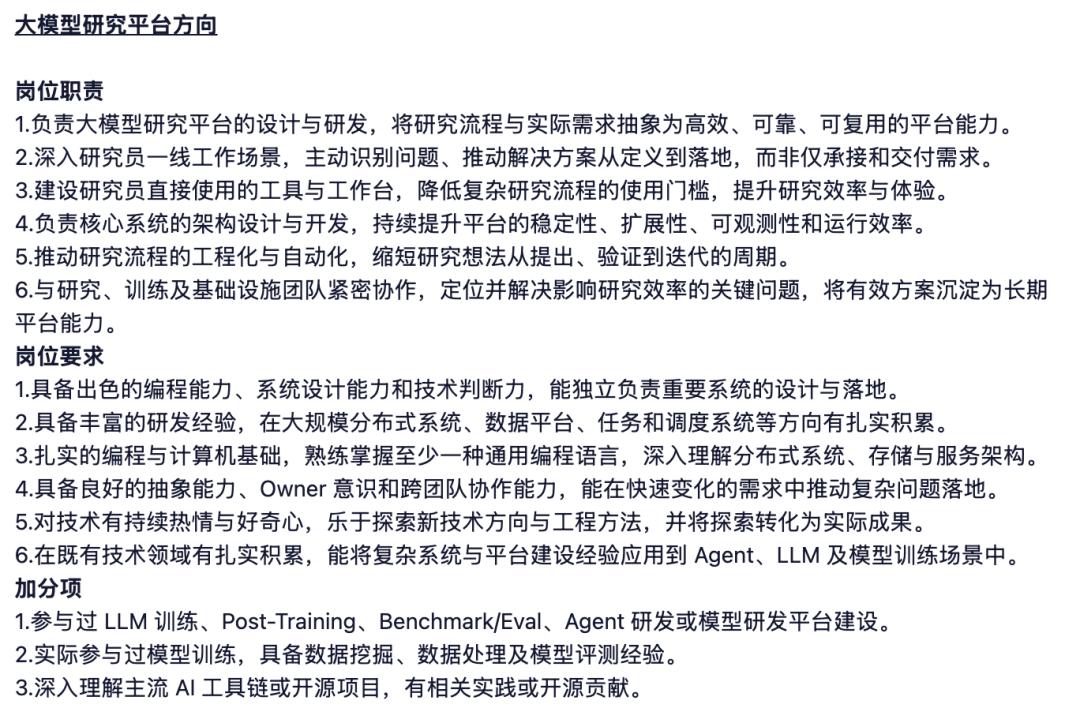
The core task of the Large Model Research Platform Track is to abstract the research workflow into platform capabilities. You need to "deeply immerse yourself in the frontline work scenarios of researchers", actively identify problems instead of passively receiving requirements. The ultimate goal is to "shorten the cycle from research idea proposal, verification to iteration".
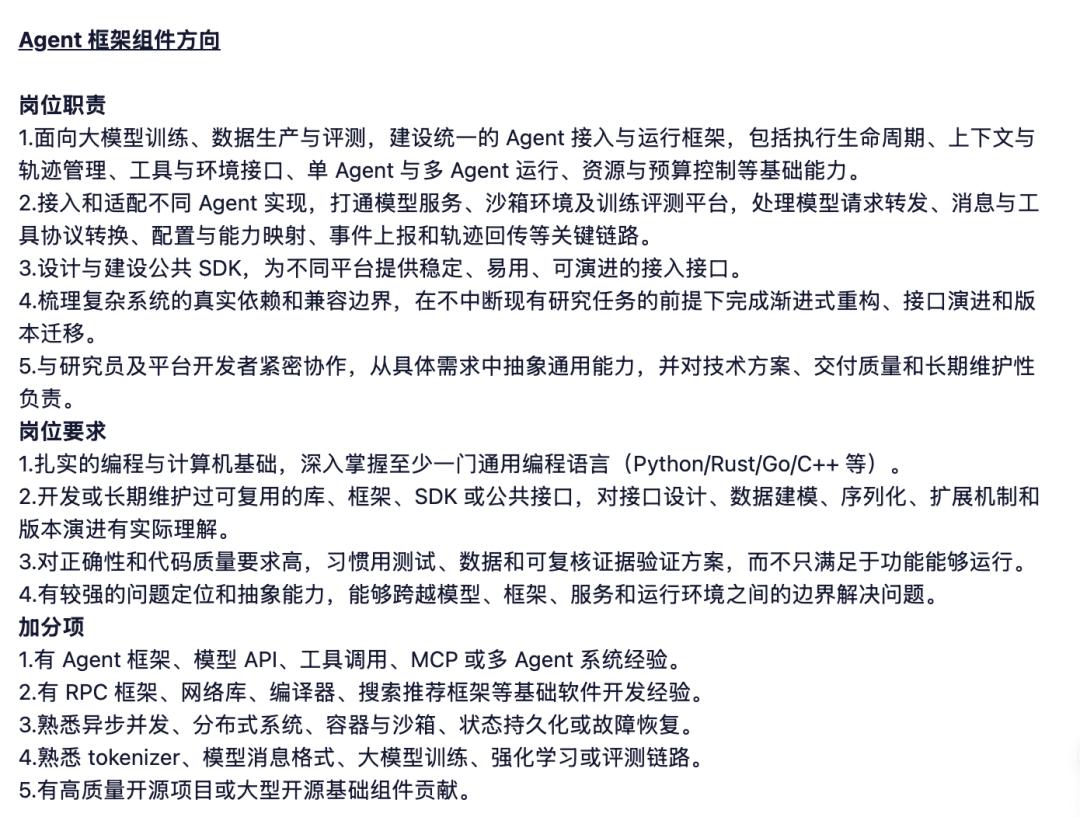
The Agent Framework Component Track is responsible for building a unified Agent access and operation framework.
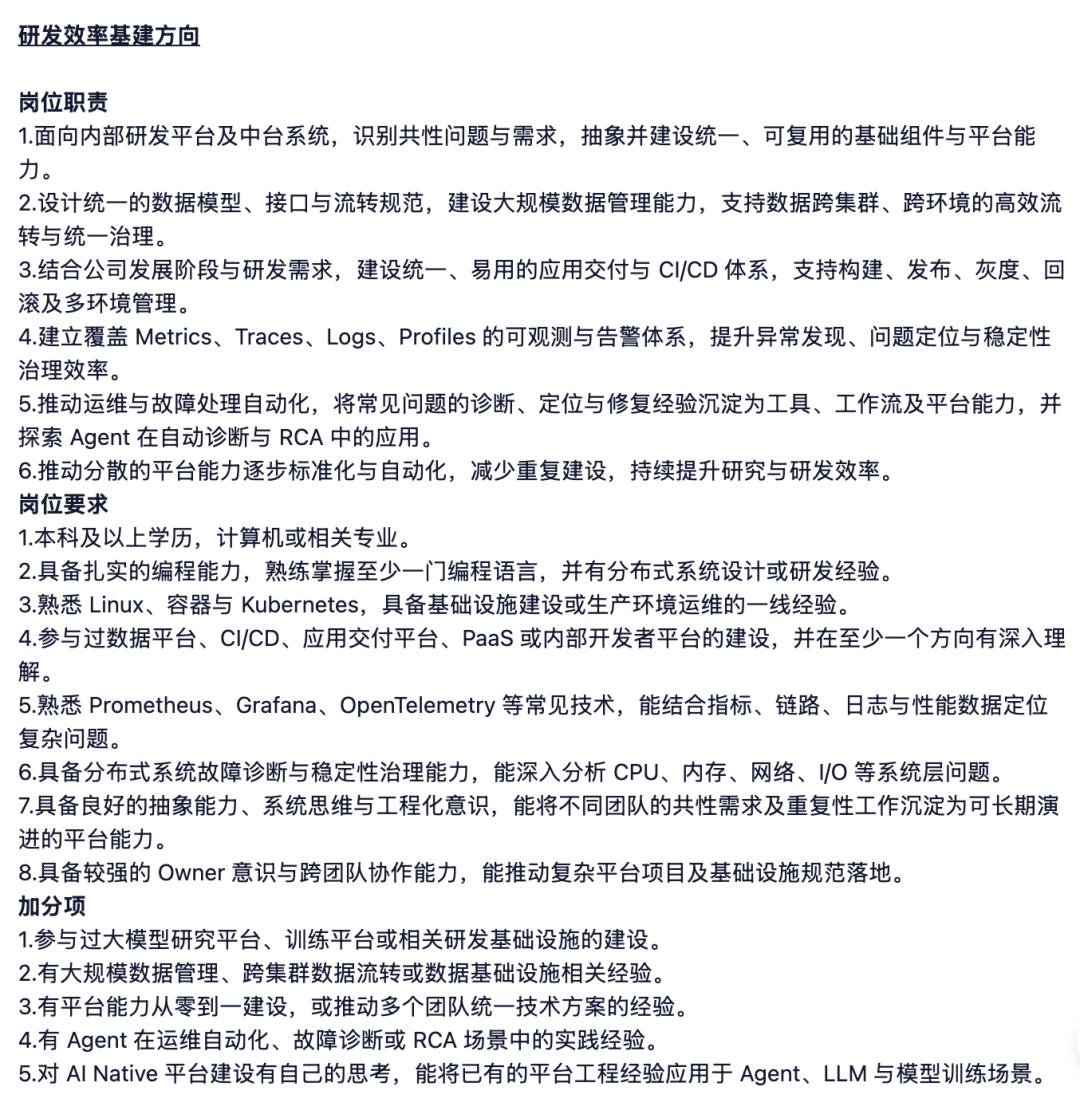
The responsibilities of the R&D Efficiency Infrastructure Track cover the unified CI/CD system, observability and alerting system, cross-cluster transfer and governance of large-scale data, operation and maintenance automation, etc., and it explicitly puts forward the requirement to "explore the application of Agents in automatic diagnosis and RCA".
The two tracks targeting external users directly serve DeepSeek's product offerings.
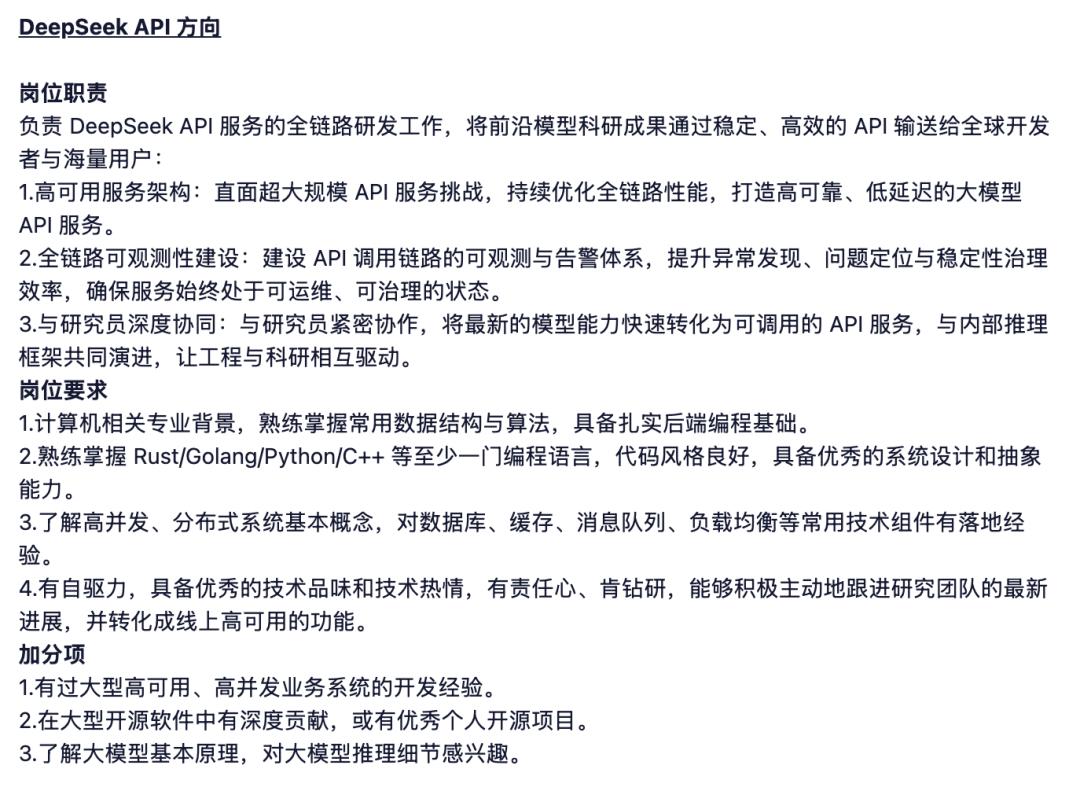
The DeepSeek API Track needs to cope with "the challenges of ultra-large-scale API services", deliver the scientific research achievements of cutting-edge models to global developers and massive users through stable and efficient APIs, and evolve together with the internal inference framework.
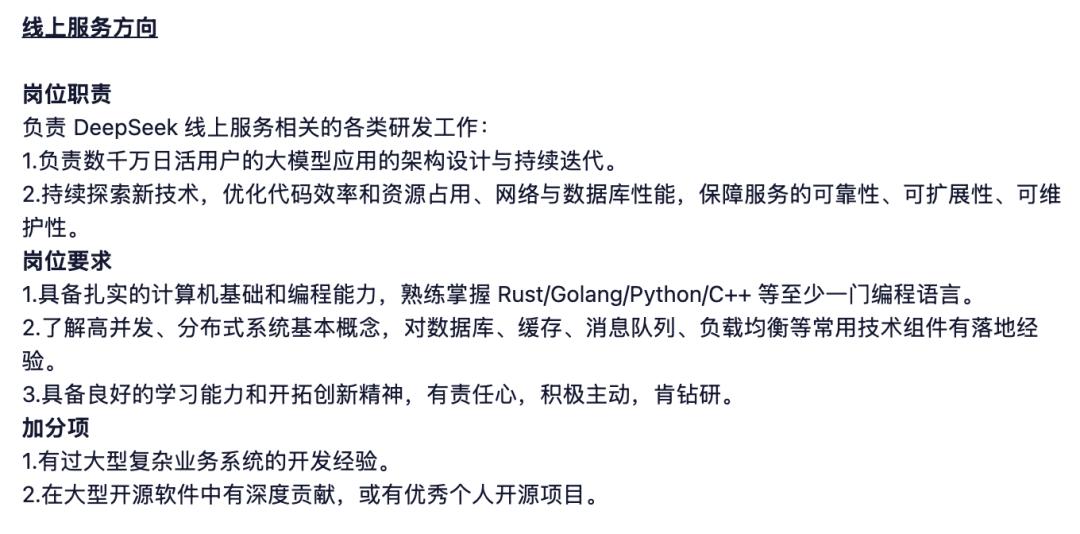
The Online Service Track is responsible for the architecture design and continuous iteration of large model applications that support a scale of "tens of millions of daily active users".
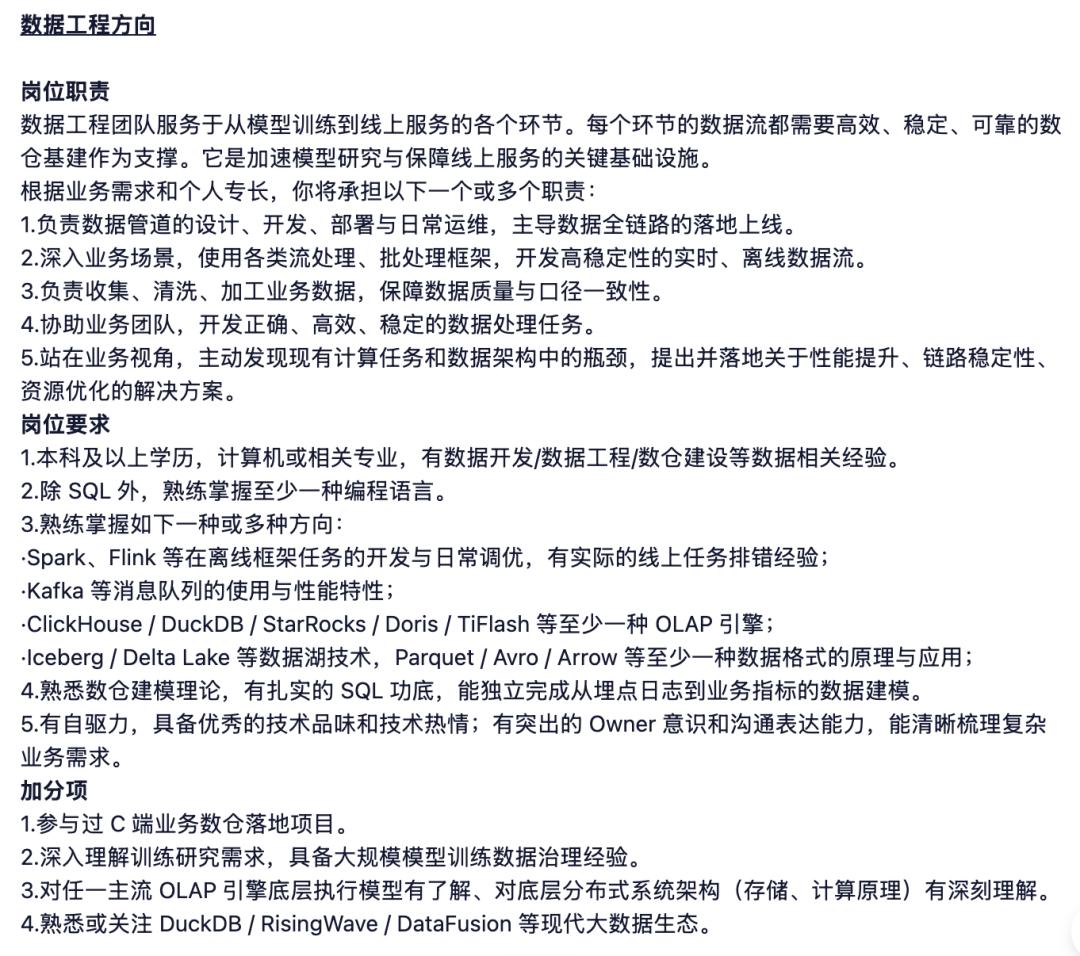
Finally, the Data Engineering Track serves all links from model training to online services. Its technology stack covers Spark, Flink, Kafka, ClickHouse, Iceberg, etc. Candidates are required to be able to independently complete full-link data modeling from tracking logs to business metrics.
If you look at the responsibilities of these tracks as a whole, they form a complete pipeline: the model executes tasks in the sandbox environment, the platform records the operation process and results to generate training and evaluation data, and the data is then used to improve the model.
What Kind of Talents is DeepSeek Looking For?
All research-related positions emphasize the same point: Engineers need to "deeply immerse themselves in the frontline work scenarios of researchers", actively identify problems and drive the whole process of solution from definition to implementation, rather than only receiving and delivering requirements.
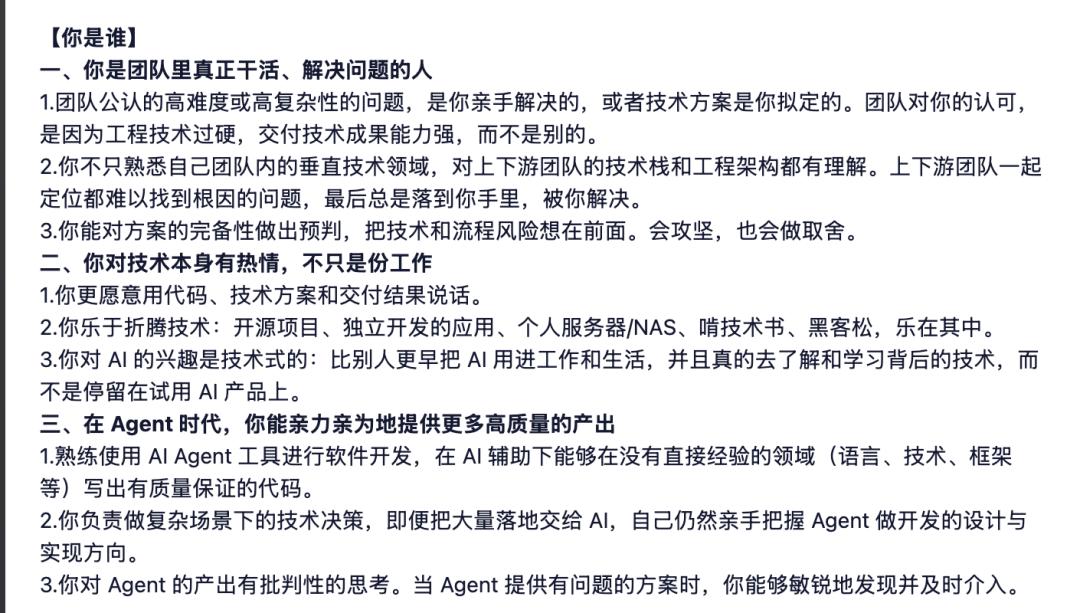
The recruitment notice uses a whole paragraph to describe the ideal candidate: DeepSeek expects the recruited engineers to already be deeply using Agents for development in their daily work.
One of the requirements is "proficient in using AI Agent tools for software development, and capable of writing high-quality code in fields where you have no direct prior experience with the assistance of AI".
It also requires that "when the Agent provides a flawed solution, you can spot the problem keenly and step in in time".
In this Agent era, the importance of experience in using specific programming languages and tools, or even having developed certain types of projects, is declining.
The R&D paradigm is shifting from "I know how to do it" to "I know what questions to ask, where things might go wrong, and how to prove that the solution is correct".
Reference Links:
[1]https://x.com/tianyi/status/2096975270578139273?s=20
[2]https://app.mokahr.com/social-recruitment/
This article is from the WeChat official account "QbitAI", written by Meng Chen, and authorized for release by 36Kr.