A major industrial province in Northeast China has finally ushered in its long-awaited cross-provincial "main artery".
On September 4, the Daan thermal power peak shaving project of the Northeast Songliao Clean Energy Base Power Transmission to North China Project ("Jilin Power Delivered to Beijing"), a key national project under the 14th Five-Year Power Plan, was officially launched in Daan, Baicheng, Jilin Province.
This means that the long-planned new energy outbound transmission corridor in Jilin is being gradually opened up.
Starting from Baicheng, Jilin, the "Jilin Power Delivered to Beijing" project runs through 6 provinces, autonomous regions and municipalities directly under the central government, and ends at Tongzhou, Beijing, with a total length of 1000 kilometers. The project covers five core sectors: thermal power, wind power, photovoltaic, power grid and energy storage, and is expected to be fully completed and put into operation in 2029.
Behind this, a realistic background has to be mentioned. The Baicheng and Songyuan areas in western Jilin are rich in wind and solar resources, and are the core area of the Songliao Clean Energy Base, one of the nine national clean energy bases. However, for a long time, the poor power outbound transmission channels and limited local consumption capacity have become the main bottlenecks restricting the development of local clean energy.
As the first UHV transmission corridor in Jilin, the "Jilin Power Delivered to Beijing" project is therefore highly anticipated.
Jilin's goals go far beyond that. According to the outline of Jilin's 15th Five-Year Plan, five major projects will be implemented with focus: green transformation and upgrading of power sources, cultivation of "green hydrogen +" industry, construction of UHV outbound transmission corridors, improvement of energy storage, and acceleration of green energy park construction, so as to build an important national green energy industry base.
In the past few years, the transformation of Jilin's traditional industries has been relatively slow, with insufficient growth momentum, and it is urgent to find new support. In this context, green energy is regarded as the "largest growth pole" and has become an important breakthrough to reshape the industrial structure.
01
No Shortage of "Wind and Solar Resources"
Northeast China was not only prosperous in history, but also has never been short of "wind and solar resources".
In particular, the Baicheng and Songyuan areas in western Jilin are located in the southwest airflow channel between the Greater Khingan Range and the Changbai Mountains, with an annual average wind speed of 6 to 7 meters per second, and the annual utilization hours of wind turbines exceed 3000 hours. The mountainous areas in the east and the central plains are also areas rich in photovoltaic resources, with an annual average sunshine duration of 2000 to 3000 hours.
With such endowments, Jilin has put forward the ambition of building an "Onshore Three Gorges of Wind and Solar Power".
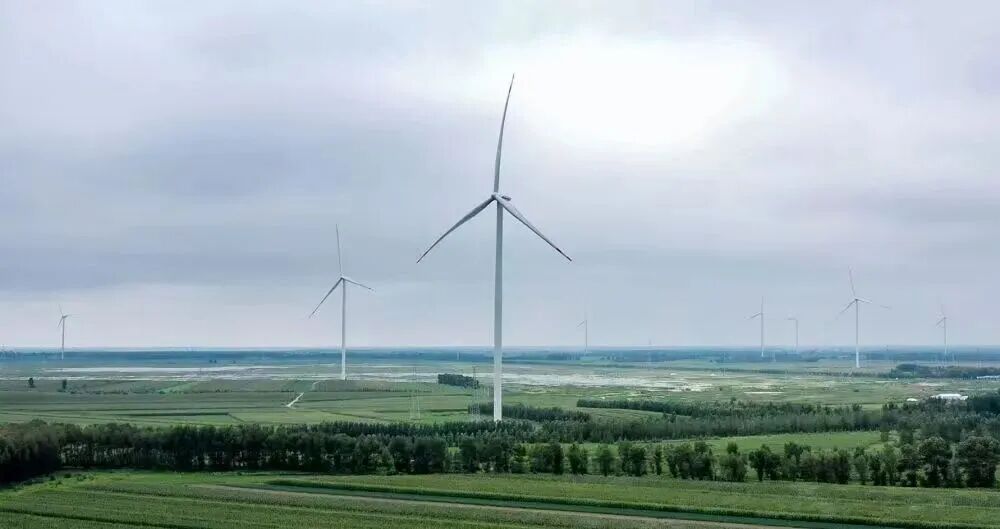
Image source: Xinhua News Agency
In October 2021, Jilin launched the "Onshore Three Gorges of Wind and Solar Power" project, which mainly covers 11 counties in 3 cities including Baicheng, Songyuan and Siping. The goal is to achieve 30 million kilowatts of new energy installed capacity and 80 billion kWh of annual power generation by 2025 — the installed capacity has exceeded that of the Three Gorges Hydropower Station.
At present, the installed capacity target has been achieved, but the annual power generation is lower than expected.
By the end of 2025, the installed capacity of new energy and renewable energy in Jilin reached 33.8967 million kilowatts, accounting for 65.82% of the total installed capacity, and the power generation reached 58.061 billion kWh, accounting for 50.19% of the total power generation.
From a national perspective, Jilin's advantages in wind and solar resources are far from being brought into play.
Data from the National Bureau of Statistics shows that in the first 7 months of this year, the cumulative power generation of Inner Mongolia, Guangdong, Jiangsu, Xinjiang, Shandong, Zhejiang, Sichuan, Yunnan, Shanxi and Hebei all exceeded 240 billion kWh, ranking top 10 in China. Jilin's power generation was 62.04 billion kWh, ranking the 7th from the bottom in China, only higher than that of Chongqing, Shanghai, Tianjin, Hainan, Beijing and Tibet, with an unremarkable performance.
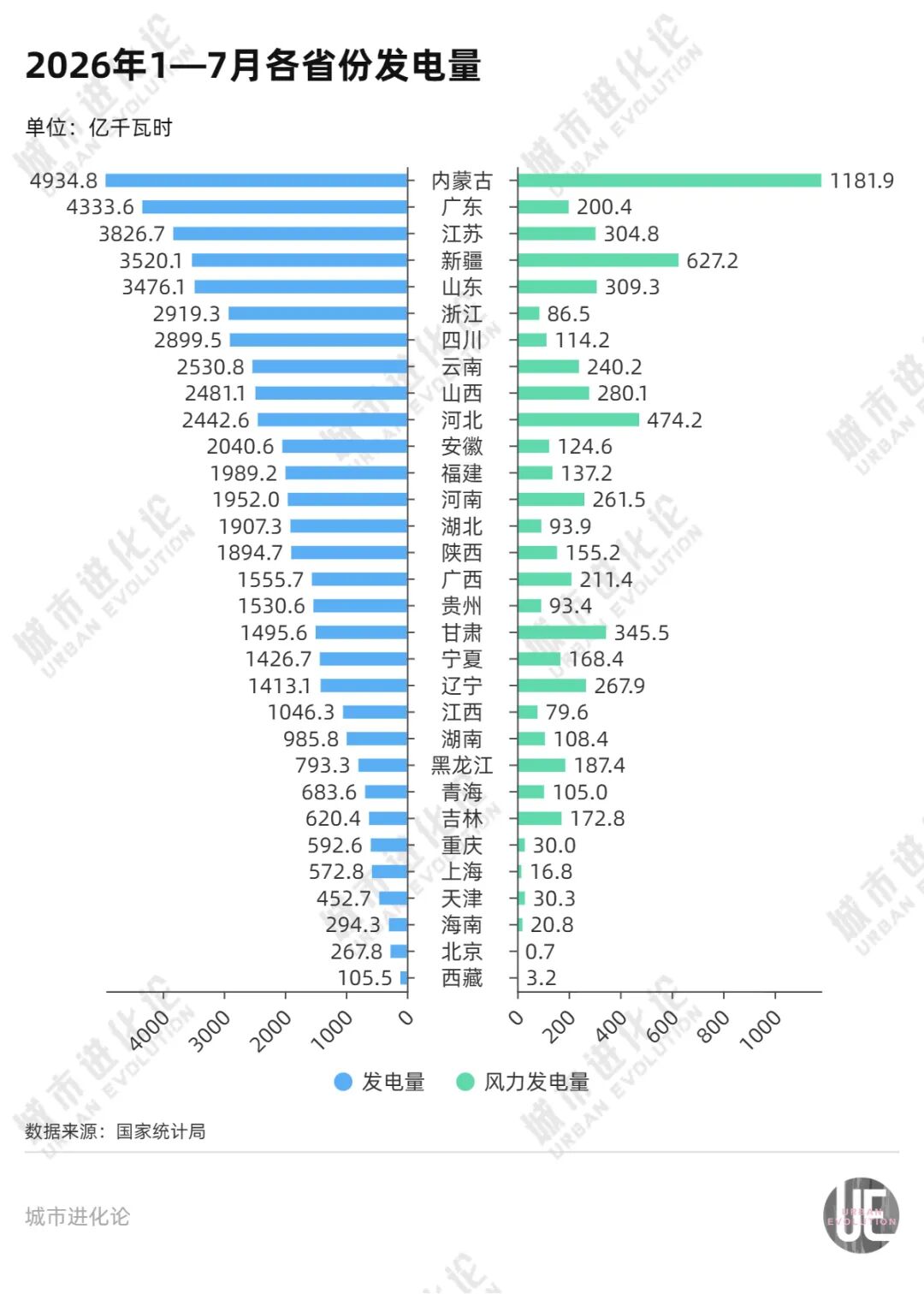
Further looking at the internal structure, in the same period, wind power generation in Jilin accounted for 27.9% of the province's total power generation, the highest proportion in China; but the absolute volume was only 17.28 billion kWh, ranking only 14th in the country.
This precisely points out the core of the problem — it is not that Jilin cannot generate power, but that the generated power lacks sufficient capacity for local consumption and outbound transmission.
Jilin has long faced pressure on power consumption. In February 2017, provinces (regions) including eastern Inner Mongolia, western Inner Mongolia, Heilongjiang, Jilin, Ningxia, Gansu and Xinjiang (including the Corps) were designated by the National Energy Administration as "red warning zones for wind power development and construction", requiring that no new wind power projects be approved and constructed in red warning zones, and effective measures should be taken to solve the problem of abandoned wind power.
It was not until 2019 that Jilin lifted the red warning and restarted wind power development. However, the consumption pressure of new energy power has not been completely eliminated.
The "2024 National Renewable Energy Power Development Monitoring and Evaluation Results" released by the National Energy Administration last October showed that the wind power utilization rates of Tibet, Hebei, Qinghai, Xinjiang, Jilin and western Inner Mongolia were relatively low, which were 83%, 92.6%, 92.8%, 93.4%, 93.6% and 93.7% respectively.
It can be seen that grid connection and consumption capacity have become the key prerequisite for determining whether Jilin's new energy power generation can continue to grow rapidly.
02
Onshore "Three Gorges"
"Jilin Power Delivered to Beijing" is exactly an important move of Jilin.
According to the plan, after being completed and put into operation in 2029, the "Jilin Power Delivered to Beijing" project will transmit 26.4 billion kWh of clean green power to North China every year, helping Beijing's total green power supply to rise to 68 billion kWh, 15 percentage points higher than the current level. Every year, it can reduce the consumption of standard coal by more than 8 million tons and cut carbon dioxide emissions by over 20 million tons.
This transmission volume is equivalent to a quarter of Jilin's total power generation (110 billion kWh) in 2025. More importantly, the clean energy advantages of Northeast China are directly connected with the market demand of Beijing-Tianjin-Hebei, the "tight hoop" of consumption rate is expected to be loosened, and more wind and solar resources will be converted into green power.
Entering the 15th Five-Year Plan period, Jilin has proposed that the average annual new installed capacity of wind and solar power will be about 10 million kilowatts in the next five years, and the total installed capacity of wind and solar power in the province will reach 70 million kilowatts by 2030.
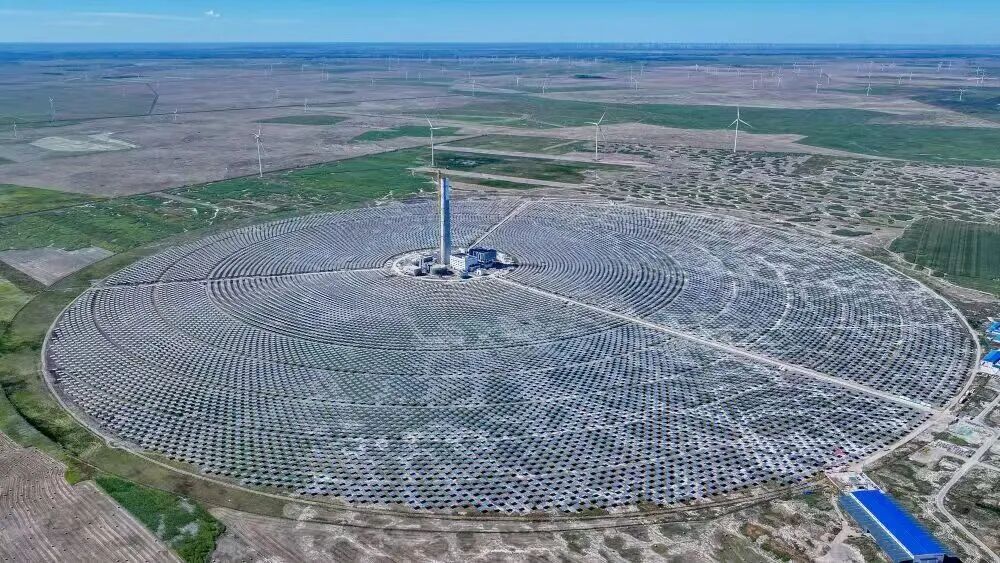
Image source: Xinhua News Agency
Western Jilin (Baicheng, Songyuan, Shuangliao of Siping) as the core area of the "Onshore Three Gorges of Wind and Solar Power": by the end of the 15th Five-Year Plan, the total installed capacity of new energy in the western base will reach 60 million kilowatts, of which the installed capacity of wind power is ≥45 million kilowatts, and that of photovoltaic is 15 million kilowatts.
According to the deployment, the western base will build three major consumption systems: three ten-million-kilowatt-level consumption paths including cross-provincial outbound transmission to Beijing-Tianjin-Hebei, direct industrial power supply within the province, and local conversion of wind and solar power to hydrogen, to completely solve the problem of abandoned wind power.
Behind this, what Jilin wants to do is not just to sell green power to Beijing-Tianjin-Hebei, but to truly convert "green power +" into industrial advantages.
Not long ago, the Ministry of Industry and Information Technology, the Ministry of Finance, and the National Development and Reform Commission jointly approved the Northeast China (including eastern Inner Mongolia) - Yangtze River Delta comprehensive hydrogen application pilot urban agglomeration. Four cities in Jilin including Changchun, Siping, Songyuan and Baicheng are included in the core sector of the pilot, making Jilin the province with the largest number of projects and the highest weight in the pilot urban agglomeration.
The Department of Industry and Information Technology of Jilin Province stated that after years of layout, the production capacity of green hydrogen, green ammonia and green methanol in Jilin Province ranks among the top in China, a number of benchmark projects have been launched one after another, and the whole chain of green hydrogen production from green power, hydrogen chemical industry and equipment R&D has basically taken shape. The successful selection of the four cities as the core sector of the pilot urban agglomeration is a major strategic opportunity for Jilin's revitalization and development.
It is worth mentioning that Changchun, Siping, Songyuan and Baicheng are all important new energy cities in Jilin, and are also the vanguards of green hydrogen production from green power.
As the first ten-million-kilowatt-level new energy power generation city in Northeast China, Baicheng is a prominent example of seizing the opportunity of "green power + green hydrogen + green ammonia + green methanol". According to the plan, by 2030, the production capacity of green hydrogen produced from new energy in Baicheng will reach 300,000 tons per year, and the production capacity of green synthetic ammonia, green methanol and green aviation fuel will exceed 2 million tons.
For Jilin, "Jilin Power Delivered to Beijing" is not just about transmitting power, and the "Onshore Three Gorges of Wind and Solar Power" is not just about generating power. Expanding the new energy base and radiating industrial momentum outward through the "green power +" model is the true essence of this energy transformation.
03
Can Jilin Achieve a Turnaround?
From a broader perspective, in the first half of this year, the GDP of Liaoning, Heilongjiang and Jilin was 1,622.72 billion yuan, 738.99 billion yuan and 697.882 billion yuan respectively, with a year-on-year growth of 2.5%, 3.5% and 2.4% respectively. The growth rate of the three provinces is far lower than the national average growth rate (4.7%). Jilin is not only at the bottom of the national ranking, but also ranks last in Northeast China.
This is largely due to the slowdown of the industrial engine. In the first half of the year, the growth rate of the added value of industries above designated size in Jilin was -1.2%, turning from positive to negative. Among them, the added value of the automobile manufacturing industry fell by 21.0%, showing a obvious downward trend.
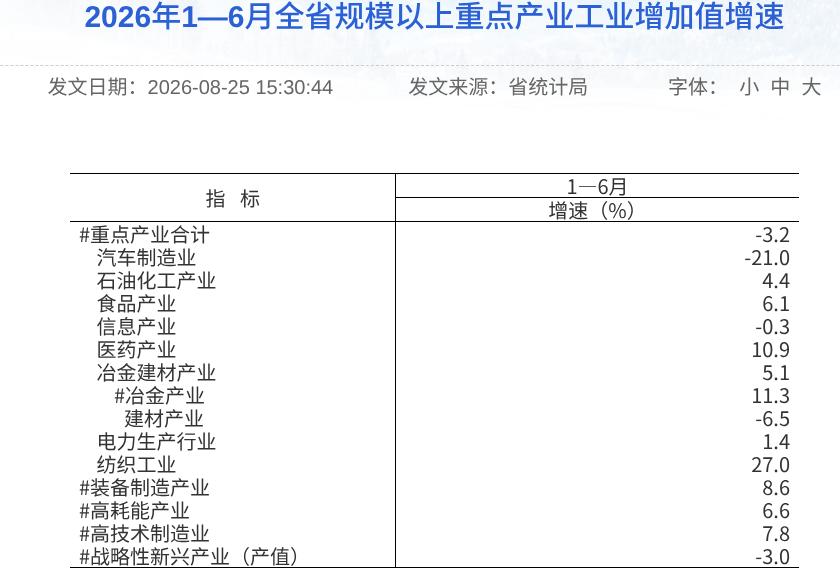
Image source: Jilin Provincial Bureau of Statistics
As the birthplace of China's automobile industry, the added value of Jilin's automobile industry once accounted for more than 1/4 of the province's total industrial added value, and its profit even accounted for more than half of the province's total industrial profit. It is an undisputed pillar industry, but now this pillar is "loosened" due to transformation. A straightforward example is that Jilin was excluded from the top 10 provinces in national automobile output for the first time in 2025, falling to the 13th place. The province's total automobile output was 1.4613 million vehicles that year, of which 183,600 were new energy vehicles, accounting for only 12.6%.
The "giant" is turning around, but it is not easy.
For many years in the past, Jilin was one of the most industrialized provinces in China, and industries such as automobile and petrochemical are well-known ace industries. However, in recent years, Jilin has been somewhat trapped in the "past", with heavy traditional industries and emerging industries yet to form effective support. Green energy is regarded as the "key" to break the deadlock —
Not long ago, the main leading officials of the Jilin Provincial Government presided over a special meeting on the construction of the hydrogen energy pilot urban agglomeration, emphasizing that we must adhere to taking green energy as the largest growth pole for Jilin's revitalization and development and an important breakthrough for future industries, amplify comparative advantages, make full use of policies, formulate practical measures, and quickly launch projects, continuously foster and expand the hydrogen-based green energy industry ecosystem, build the largest national green liquid fuel supply base, and promote the transformation of resource advantages into development advantages.
This requires not only guiding the clustered development of the green energy industry, but also promoting the accelerated implementation of scenarios such as hydrogen energy transportation, methanol vehicles, hydrogen energy peak shaving power stations, green hydrogen heating, and solid-state "storage, transportation and refueling" facilities.
In terms of the scale of the hydrogen energy industry, Jilin does not have a leading advantage. The output value of the hydrogen energy industry in 2025 was 10 billion yuan, which is expected to reach 30 billion yuan by 2030, not at the same level as Shandong, Guangdong, Inner Mongolia and other regions.
However, Jilin's intention is not to simply compete in output value scale, but to activate the root system of traditional industries through the ecological interface of "hydrogen energy +". This is not to build an industrial chain out of thin air, but to be based on Jilin's own industrial foundation — the complete industrial system of automobiles, rail transit, chemical industry and other sectors.
Leading enterprises such as FAW have long laid out hydrogen fuel vehicles, enterprises such as CRRC Changchun Railway Vehicles are paving the way for the implementation of hydrogen energy rail transit, and the huge chemical system has natural demand and digestion capacity for hydrogen-based raw materials. Seemingly independent industrial nodes are intertwined into a "hydrogen energy +" ecological network.
This is the key for Jilin to reshape its advantages. However, the hydrogen energy industry is still immature at present, and whether it can take the lead in realizing "multi-field, commercial, large-scale and demonstrative application" is the key competition point for Jilin.
This article is from the WeChat Official Account "City Evolution", author: DAN Zhongkui, authorized for release by 36Kr.