AI Cloud + Kunlunxin, is Baidu worthy of a revaluation?
After so many years and so many times, few people would take the claim of Baidu's revaluation seriously. Of course, it is impossible to achieve revaluation by relying on the traditional Internet or autonomous driving.
When we talk about Baidu again, we need to break down the "old" business — treat traditional advertising as a business that is only responsible for cash flow and has zero valuation. Under this basic premise, we rethink the value of Baidu as an AI infrastructure stock in the AI era.
For "AI infrastructure" Baidu, in the view of Dolphin Equity Research, there are two core assets:
1) AI cloud services: Bare Metal as a Service AI cloud services; and MaaS (Model as a Service) services dominated by API distribution;
2) Kunlunxin: Chip design services that sell chips and rack solutions centered on computing power ASIC.
This time, we single out Baidu alone, the key is to measure whether these two asset layouts are really valuable. Let's talk about them one by one:
I. AI Cloud Services: Starting from the 3-year Payback Model of Major Cloud Vendors
In this Q2 earnings report, North American CSP vendors Amazon and Chinese CSP vendors Alibaba and Baidu all made a quantitative description of a 3-year payback period for their AI investment returns for the first time, to ease the capital's concerns about their short-term high Capex.
There is an implicit assumption here that the gross profit margin per unit of Token will remain at least relatively stable. At present, the software iteration of the model (FlashAttention, speculative decoding, MoE, prefix caching, etc.) has improved the effective utilization of chips and released more computing power throughput.
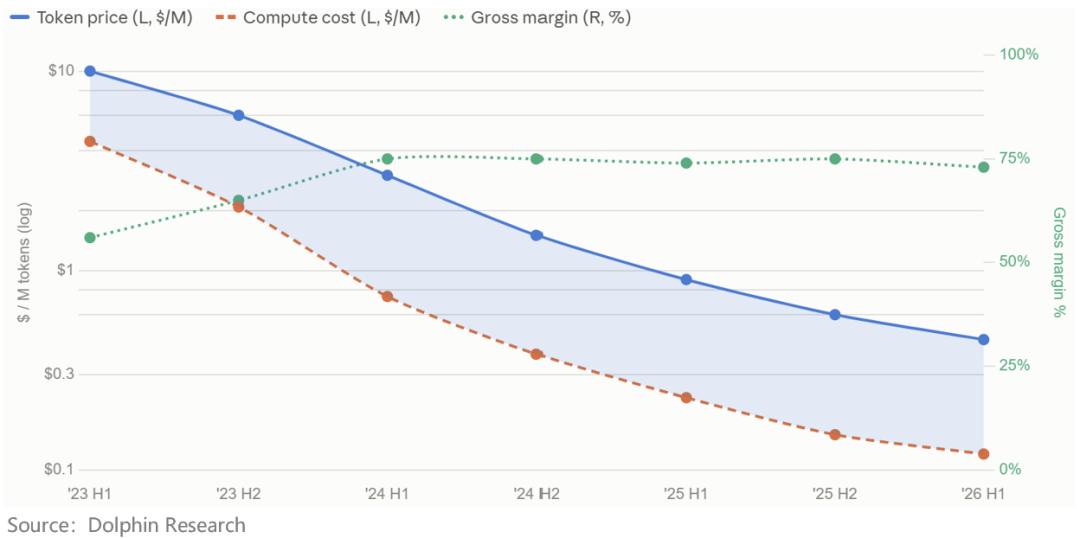
This makes that although the charging price per unit of Token is plummeting, the cost per unit of Token is also decreasing. In particular, the cost per unit of Token of old chips (meaning that the price increase per chip is limited) is likely to decrease faster than the charging side of Token. From the perspective of the economic model, this is helpful for the stability of Token gross profit margin and even short-term improvement.
But the problem lies in sustainability, which is still uncertain. On the one hand, there is a ceiling for the effective utilization of hardware computing power, and more complex software adaptation work is required to stimulate it. On the other hand, open-source models and price wars will compress the revenue side of per unit Token faster.
As shown in the figure below, taking the H100 cloud leasing business as an example, the leasing price dropped by 78% in three years, and the throughput of a single chip increased by 8 times, resulting in a 97% drop in the cost per unit of Token. However, after the gross profit margin per unit of Token rose to about 75% in mid-2024, it no longer improved. In the first half of this year, with the further drop in the end-user price of large models and the bottleneck of the effective utilization of old chip computing power, the gross profit margin per token even showed a faint sign of weakening.
Computing power cost is still a threshold that hinders the further penetration of AI. At present, it is relatively common to extend the service life. Jensen Huang also personally certified that A100 can continue to be used until 2029, extending its lifespan to 10 years.
But the above figure also proves that extending the service life of old chips is only a stopgap measure. The old H100 can no longer continuously stabilize the unit economic model in the price war. It is not easy to promise that A100 can really adapt to large models for 10 years. Industrial resources should still be tilted to the supply bottleneck on the hardware side.
1. The difference in payback between Chinese and American CSPs leaves room for domestic chips
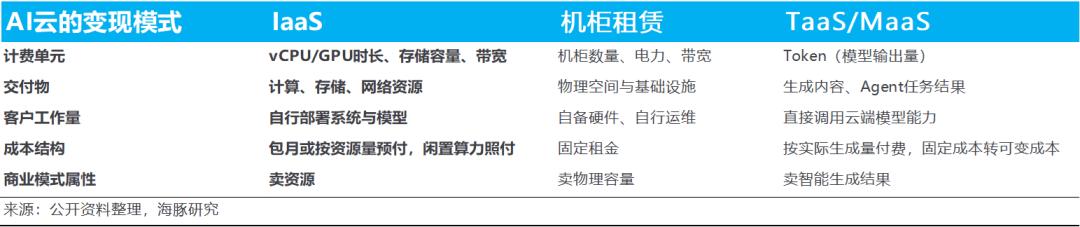
This round of CSP vendors has five main monetization models for AI business, and most of the current growth and positive ROIC are concentrated in the first two (IaaS and MaaS):

Recently, institutions made a rough calculation of the profit model of CSP. To sum up: The current computing power price and cost can meet the 3-year payback plan. The overall profit margin in North America is higher than that in China; among different segmented businesses, MaaS has a higher profit margin. The main reason is that the R&D cost of 1P large models is not fully included in the MaaS business. The external distribution of 3P large models is actually a monetization of channel distribution based on traffic, and the revenue is recognized as net commission (net revenue), which naturally pushes up the profit margin.
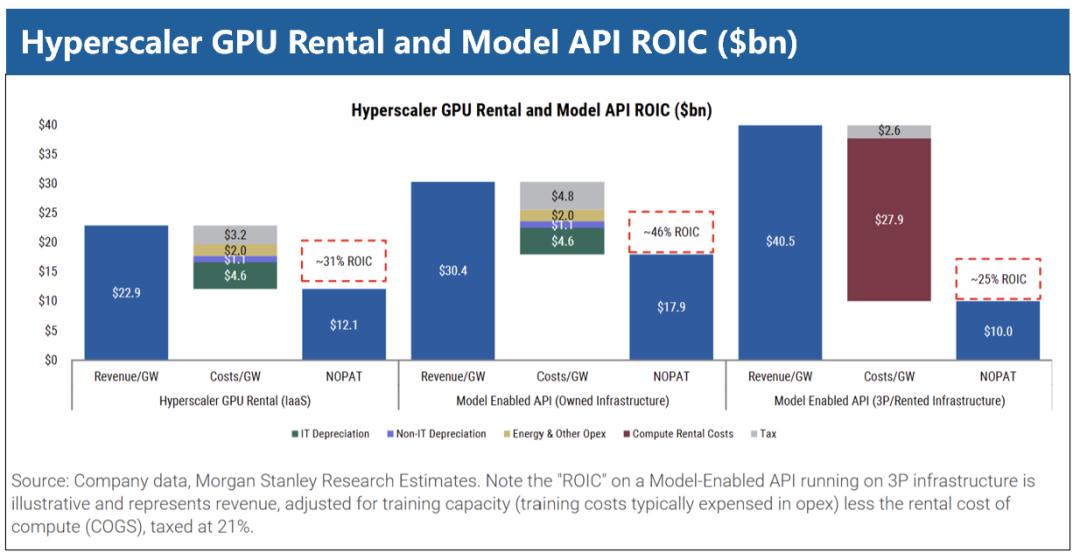
The specific rough valuation is as follows:
(1) The IaaS business of North American CSPs is mainly based on self-built data centers, and the overall ROIC can reach 30% (taking GB300 computing power as an example, the rental income is $23 billion/year, corresponding to the upfront investment Capex of $39 billion/year), the cash payback period calculated by operating cash flow OCF is 2.2 years.
(2) The MaaS business of North American CSPs provides multiple large model APIs (including 1P and 3P), and the underlying computing power is divided into two sources: computing power from self-built data centers and computing power leased from third-party platforms.
Without counting the training cost of 1P large models, the marginal operating profit margin can reach 75% (self-built computing power) and 30% (leased computing power) respectively. The former has an ROIC of 46% and the payback period is even less than 2 years; the latter does not involve upfront investment.
However, the above does not consider the profit sharing of 3P model manufacturers in the industrial chain. In particular, North American CSPs naturally do not have bargaining advantages when facing the two leading model manufacturers Anthropic and OpenAI.
For example, Amazon's Bedrock can be said to be a large model distribution platform. However, due to the weak capability of Amazon's self-developed model Nova, Bedrock mainly sells large models of nearly 20 AI Labs around the world, including China.
AWS revenue growth continued to accelerate in Q2, mainly benefiting from the popularity of Anthropic (according to institutional research, the largest proportion of Anthropic's revenue in CSP comes from Bedrock, and the revenue from Bedrock channels accounts for half of Anthropic's total revenue).
In terms of financial caliber, Bedrock recognizes net revenue, Anthropic recognizes gross revenue. The sharing method between the two is that Anthropic removes the inference cost from the gross revenue, and 50% of the rest is distributed to Bedrock as channel fee. This part is a pure increment of profit for Bedrock. Therefore, compared with the IaaS business, Bedrock naturally has a higher profit margin level.
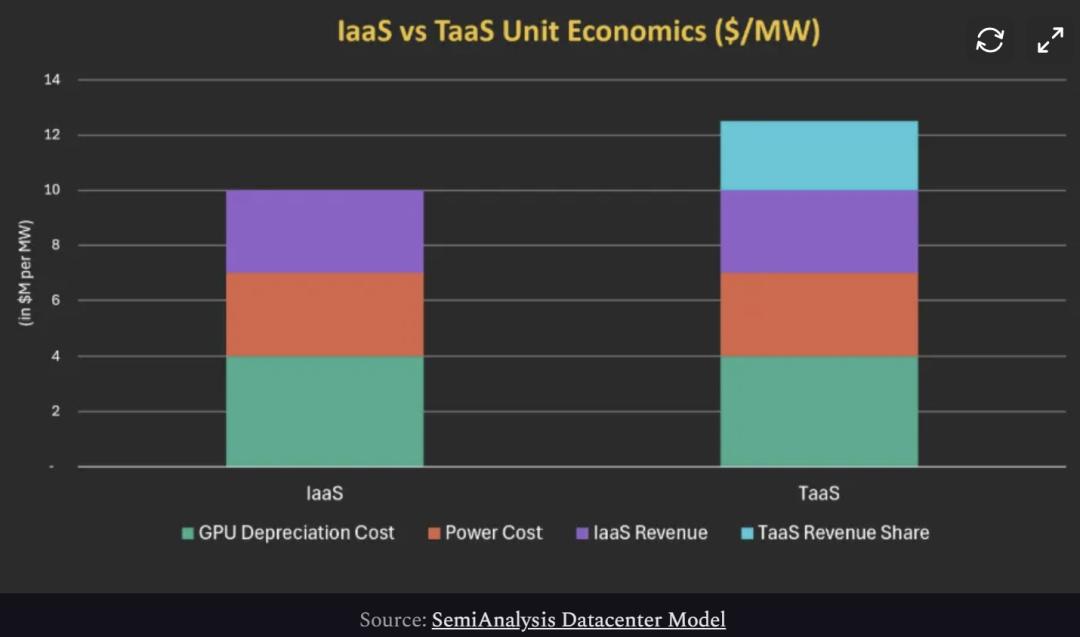
(3) For the corresponding Chinese CSPs, the unit computing power cost advantage only exists in low and mid-range server chips, as well as operation and maintenance costs and bundled software.
Due to regulatory influences, the market prices of mid-to-high-end GPUs above H200 have fluctuated sharply. Chinese CSPs often need to pay a multiple premium to complete the procurement, but the external leasing price of computing power cannot get a simultaneous premium. Even considering the purchasing power of customers, the price is discounted relative to North American CSPs, so the overall gross profit margin is lower.
Although the operation and maintenance costs in North America are high (electricity, data center cabinet space, network, manpower, etc.), due to lower operating profits and higher GPU procurement costs, the ROIC of the IaaS business of the two sides eventually differs by double.
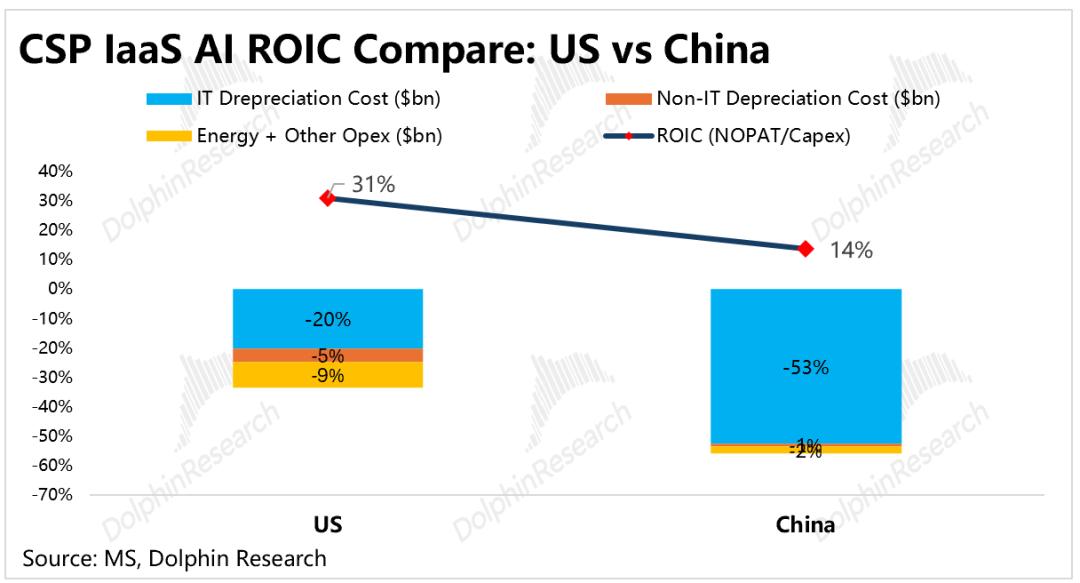
On Alibaba's conference call, the management stated that Morgan Stanley's estimate overall underestimated the actual ROIC, implying that ROIC reached more than 20%.
Dolphin Equity Research believes that the deviation here mainly comes from the cost recognition of computing power chips. For the sake of simplifying the calculation, Morgan Stanley assumed that all computing power is GB300. But in fact, most CSP vendors in North America and China currently adopt hybrid solutions, and the pursuit of single-chip performance in inference scenarios is not so high, including many A100, H100 series or domestic chips.
Non-high-end GPUs do not have a 3-4x procurement premium for Chinese CSPs, so the actual procurement cost and gross profit margin after depreciation deduction will be higher than Morgan Stanley's estimated value.
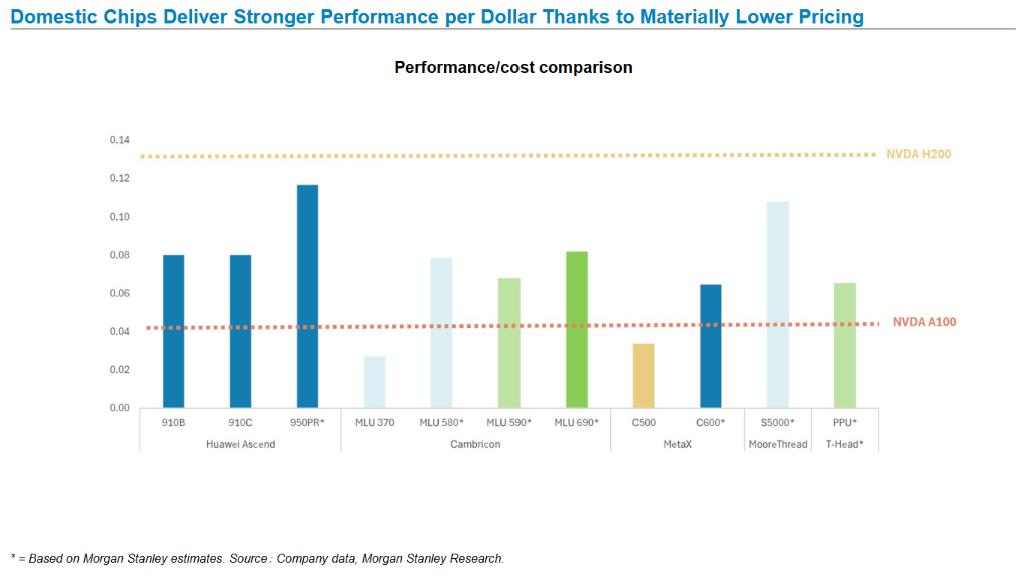
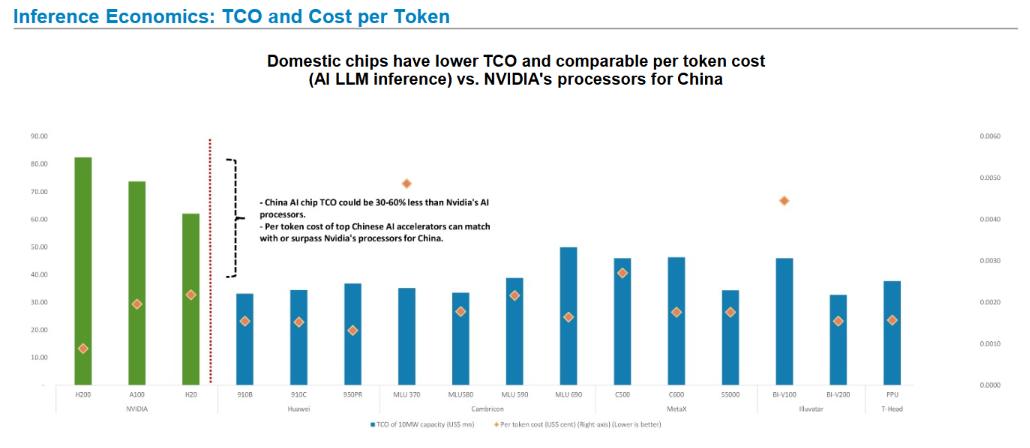
With the performance improvement of Chinese domestic chips (including the increase of single-chip computing power and large-scale networking to make up for the short board of single-core computing power), and the total cost (to achieve the same computing power, more domestic chips are needed, which will bring additional power consumption, cabinet occupation cost and supporting server head, routing, switches, etc.) can also have advantages, combined with the compliance risk of foreign chip procurement, Chinese CSPs have begun to switch part of their computing power procurement since this year.
That is to say, at least on the inference side, domestic chips already have relative cost advantages, which gives domestic chips a large shipment space from the perspective of demand.
II. Computing Power Dividend, Baidu's "Second Spring" in Its Later Years
Back to Baidu, Baidu currently has Kunlunxin, plus external chip procurement. To a certain extent, it is currently enjoying the AI cloud growth dividend based on full-stack AI infrastructure.

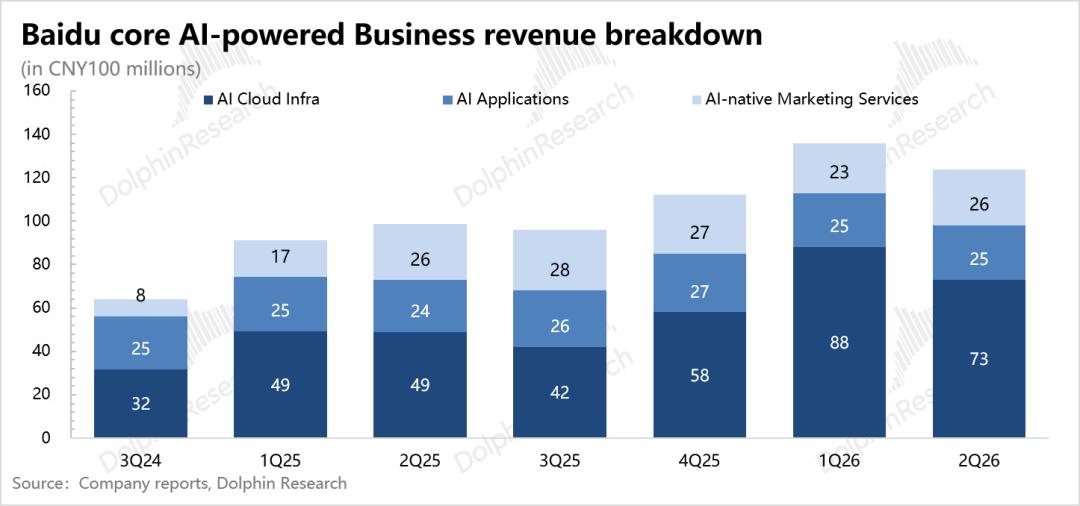
Baidu began to highlight the "AI business architecture" in Q3 last year, but the earliest benefit from this wave of computing power dividend can be traced back to the end of 2023, and the real GenAI cloud revenue volume increased in the second half of 2024 (accounting for more than 10% of cloud revenue).
Baidu's AI business is divided into three parts: AI cloud infrastructure, AI applications, and AI native marketing. The computing power dividend is mainly reflected in the branch of AI cloud infrastructure, which is further subdivided into three components: IaaS, MaaS and Kunlunxin (the part sold externally).
Among them, IaaS is the main revenue component of AI cloud. For the MaaS revenue model with higher gross profit margin of overseas cloud vendors, Baidu's current performance is not high, and its channel distribution capability is not as good as Alibaba and ByteDance.
But the advantages of Baidu AI Cloud are:
First, in terms of supply, ready-made GPU computing power and complete public cloud supporting services, this is because the computing power prepared for Ernie previously can be released for external lease after the self-developed model did not develop as expected, and the procurement of self-developed Kunlunxin also makes it easier to form AI cloud computing power;
Second, in terms of customer sources, compared with Alibaba and Douyin, its neutral position makes it easier for e-commerce companies such as Pinduoduo, short video platforms such as Kuaishou, and large game manufacturers such as miHoYo to choose Baidu as their cloud service provider. There are also some government and enterprise customers, such as the electric energy sector.
That is, the GPU cloud subscription revenue that Baidu has been emphasizing and disclosing has been accelerating quarter by quarter in the past year, showing the current high demand prosperity.
Baidu currently has 1GW of computing power, and it is expected to double it in the next 1-2 years, but it is not necessarily simply purchasing chips to build its own computing power. Instead, it flexibly adopts financial leasing and other methods to reduce short-term capital investment and optimize ROIC.
In the short and medium-term computing power dividend period, moderate expansion of computing power supply is expected to support the growth rate of cloud business.