The European air conditioning market is taking off, Midea, Xiaomi and TCL are making a huge splash at IFA, and Chinese homegrown technologies are delivering a dimensionality reduction strike.
On September 4, 2026, IFA 2026 (Internationale Funkausstellung Berlin) officially opened, attracting more than 1,900 exhibitors from 49 countries and regions. As one of the world's three major consumer electronics exhibitions, the theme of this year's IFA is "The Future is Now". The "Leitech IFA26 Reporting Team" dispatched by Leitech (ID: Leitech) has arrived at the scene in Berlin to deliver on-site, multi-dimensional and first-hand coverage of IFA 2026.
Image source: Leitech IFA Reporting Team
AI is still the unavoidable keyword at this year's IFA, as smartphones, TVs, computers, smart glasses and robots are all centered around AI. However, stepping into this year's exhibition pavilions, there is another category that may seem less eye-catching but is becoming increasingly worthy of attention: air conditioners.
Especially in Europe.
For a long period in the past, air conditioners were not even considered a genuine mass home appliance in Europe. The relatively mild climate, complex residential conditions, coupled with high energy costs and environmental protection concepts, have made people always remain cautious about installing air conditioners.
However, after consecutive years of high temperatures, with temperatures in many regions even exceeding 40℃ again this year, air conditioners are increasingly becoming a rigid demand for European households. Market research institution MarketsandMarkets predicts that the size of the European HVAC (Heating, Ventilation and Air Conditioning) market will grow from 36.4 billion US dollars in 2025 to 48.1 billion US dollars in 2030.
So what kind of air conditioners do European consumers need? How do traditional wall-mounted units adapt to Europe's energy system and residential environment? What if it is difficult to install units in rental properties and old buildings? Can the human body perception, fresh air and AI energy-saving technologies that have been iterated intensively in the Chinese market find new value in Europe?
The air conditioners showcased at this year's IFA have just provided several completely different answers.
Apart from functions, Europeans value "no-drilling installation" far more than other factors
Midea's first-generation PortaSplit entered the European market in the summer of 2024. By this year, it has evolved from a slightly alternative new product into a rare hit in the European air conditioning market.
It can be said that Midea PortaSplit has almost blazed a trail on its own, directly creating the new category of "mobile split air conditioner", and has also prompted a large number of brands to follow suit and launch mobile split air conditioners with similar designs in the European market.
At IFA 2026, although Midea's main offering in the mobile split air conditioner segment is still the current version of PortaSplit, the new generation of PortaSplit has also made its preliminary debut. It is introduced that its core upgrades include switching from R32 to the more environmentally friendly R290 refrigerant, as well as optimized drainage design and software control.
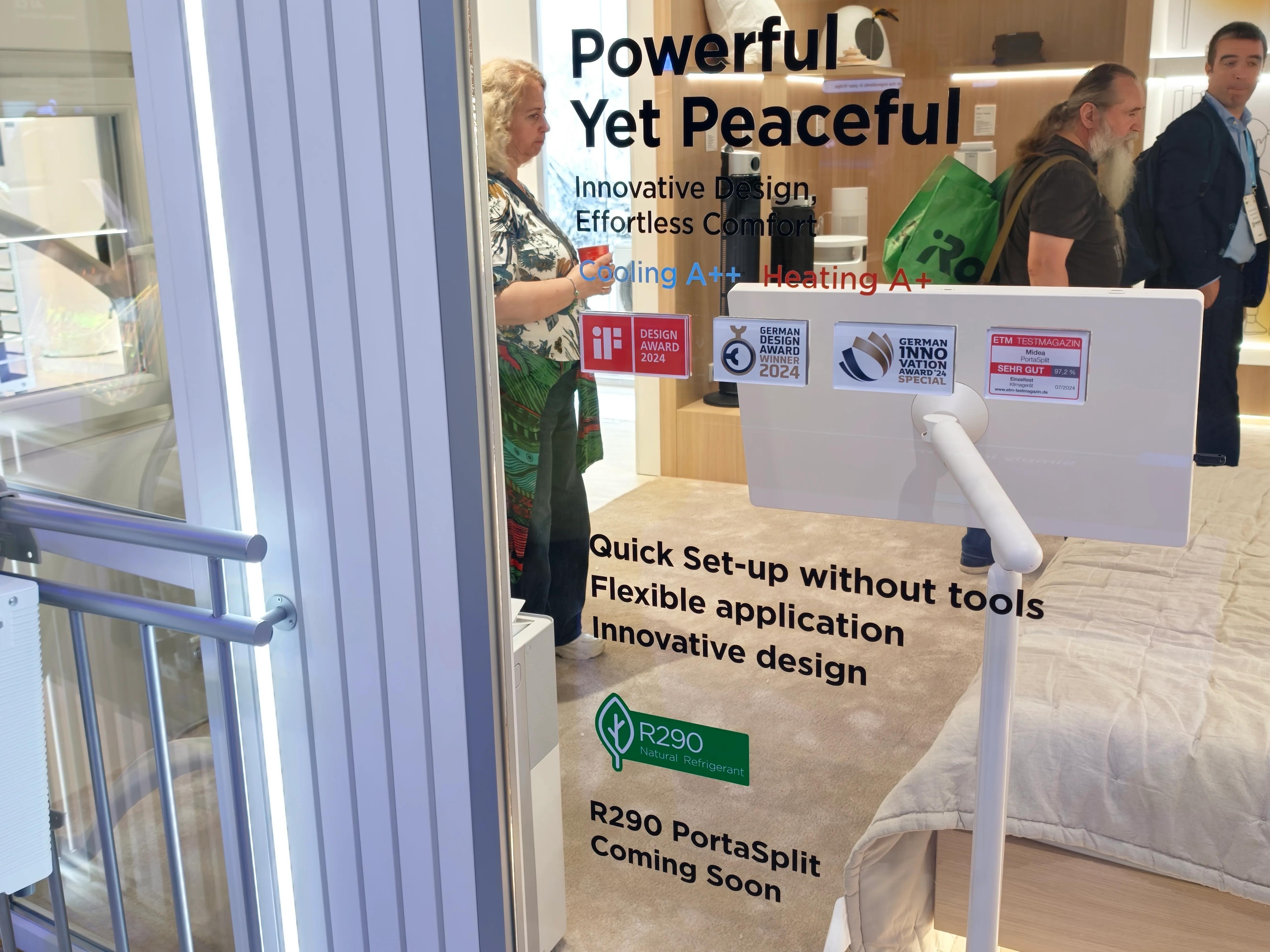
The new generation model has not been fully displayed, image source: Leitech IFA Reporting Team
It is worth mentioning that R290 is flammable, which imposes stricter requirements on refrigerant charging amount, sealing, leakage detection and overall safety design of the unit. One of the upgrades of the new-generation PortaSplit is adding a new leakage protection design for R290.
Even so, the current version of Midea PortaSplit still stands out uniquely among similar products.
In fact, many families in Europe do not refuse to install air conditioners, but it is really difficult to get them installed. Countries such as Germany, France and Italy have a large number of rental housing and historical buildings, where the exterior walls cannot be modified at will. Many apartments also involve requirements from property management, landlords and even historical building protection regulations. Even if installation is permitted, professional construction is another high threshold.
Xinhua News Agency mentioned in its interview with Midea's European team this summer that the installation cost of traditional split air conditioners in Europe can exceed 1000 euros, and people even have to wait in line for several weeks for installation during the peak summer season.
Of course, ordinary single-unit mobile air conditioners place the compressor indoors, and discharge hot air out of the window through a thick exhaust pipe. The noise stays in the room, the efficiency is not high, and negative pressure will be formed during the exhaust process, so that hot air from outside will re-enter the room through gaps in doors and windows.
But Midea has done a very clever thing: split the mobile air conditioner into two parts.
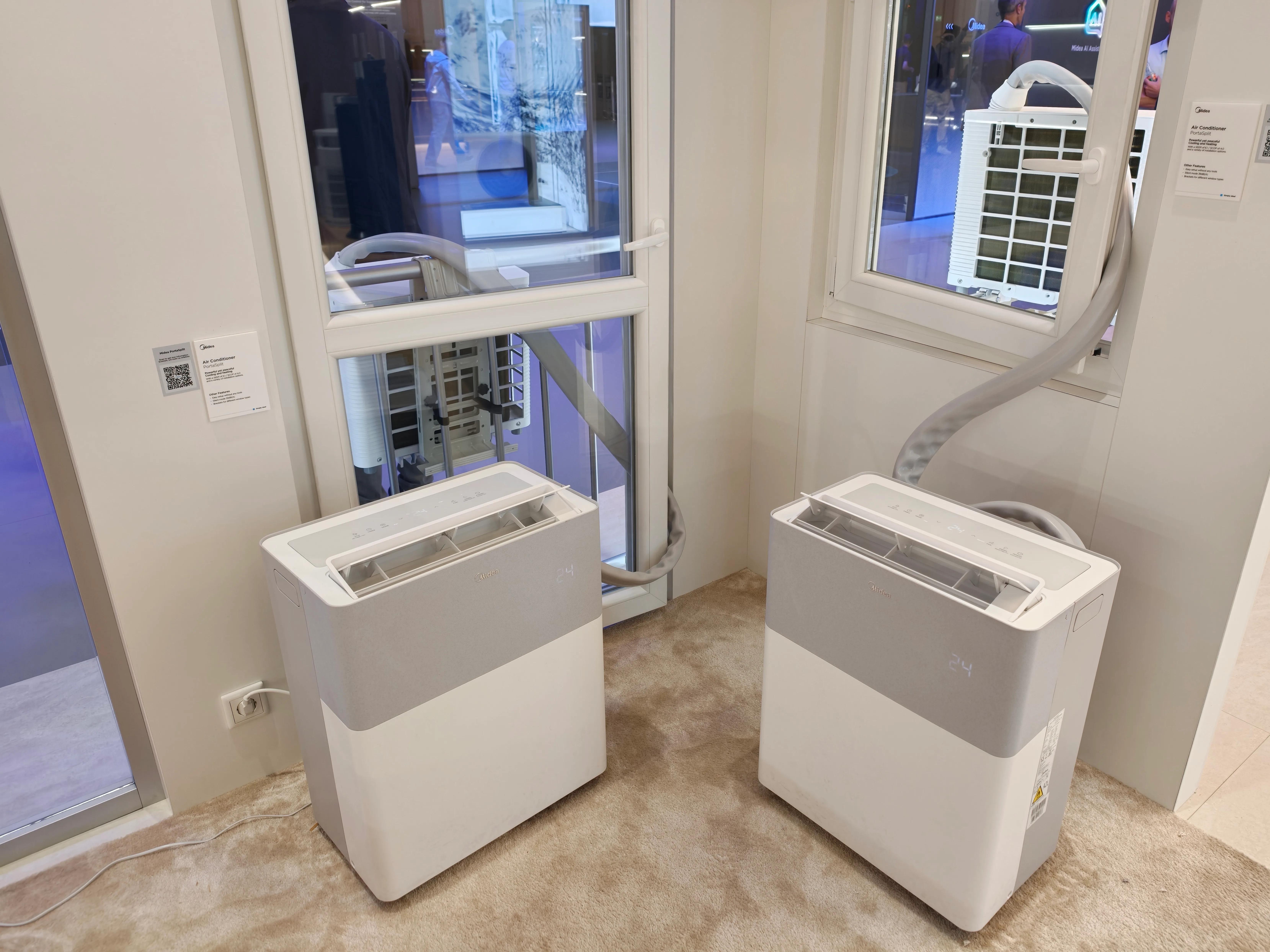
Currently available version, image source: Leitech IFA Reporting Team
The compressor and main heat source of PortaSplit are placed in the outdoor unit, while the indoor unit stays in the room, connected through a very thin connecting pipe that passes through the window. The outdoor unit can be directly hung on the bracket near the window or balcony, no need to drill holes in the wall, and no professional installers are required.
As for the new generation of PortaSplit, Midea has not disclosed more specific information. But considering that the current mainstream PortaSplit has a cooling capacity of 3.5kW, supports cooling, heating, dehumidification and air supply, reaches A++ energy efficiency rating for cooling, and the minimum indoor noise in silent mode is about 39dB(A), the new generation is likely to achieve further improvements.
But there is no doubt that the success of Midea PortaSplit can no longer be explained simply by "the weather is too hot". All air conditioner manufacturers in Europe have benefited from the heat wave this year, but not every air conditioner will make people drive hundreds of kilometers to buy it. The value of PortaSplit lies in that it has identified the real bottleneck that hinders users from popularizing air conditioners in Europe.
This is a point that Chinese home appliance companies often tend to ignore when expanding overseas.
Mature domestic products already have strong advantages in performance, energy efficiency and cost, and of course you can make business by selling them directly overseas. But what can truly form obvious product differentiation is often the in-depth understanding of local lifestyles.
PortaSplit itself is a product developed with the participation of Midea's German R&D center. Midea's European R&D team once revealed that it took three years to develop this unit, and the outdoor unit was finally reduced to below 10kg, so that ordinary adults can install it on their own:
Turn a originally small product form into a whole new product category.
For a highly mature category like air conditioners, this kind of innovation is actually very rare: the compressor is still the same compressor, the heat exchange still follows the same heat exchange principle, manufacturers just rethink thoroughly how European users can bring an air conditioner home easily.
For both cooling and heating, "energy saving" is far more important than in the Chinese market
Judging only from product forms, the new air conditioners launched by LG and Bosch at this year's IFA are actually very traditional - wall-mounted units.
In mature air conditioning markets such as China, Japan and South Korea, wall-mounted units are already extremely common home appliances. But in today's Europe, they correspond to an ongoing market change. This summer, many parts of Europe have once again encountered high temperatures close to or even exceeding 40℃, and air conditioners, which have long been on the edge of the home appliance market, are rapidly becoming a rigid demand.
However, the fact that Europeans are starting to buy air conditioners does not mean that the product logic of the Asian market can be directly copied. The DUALCOOL AI series air conditioner exhibited by LG this time is a very typical example.
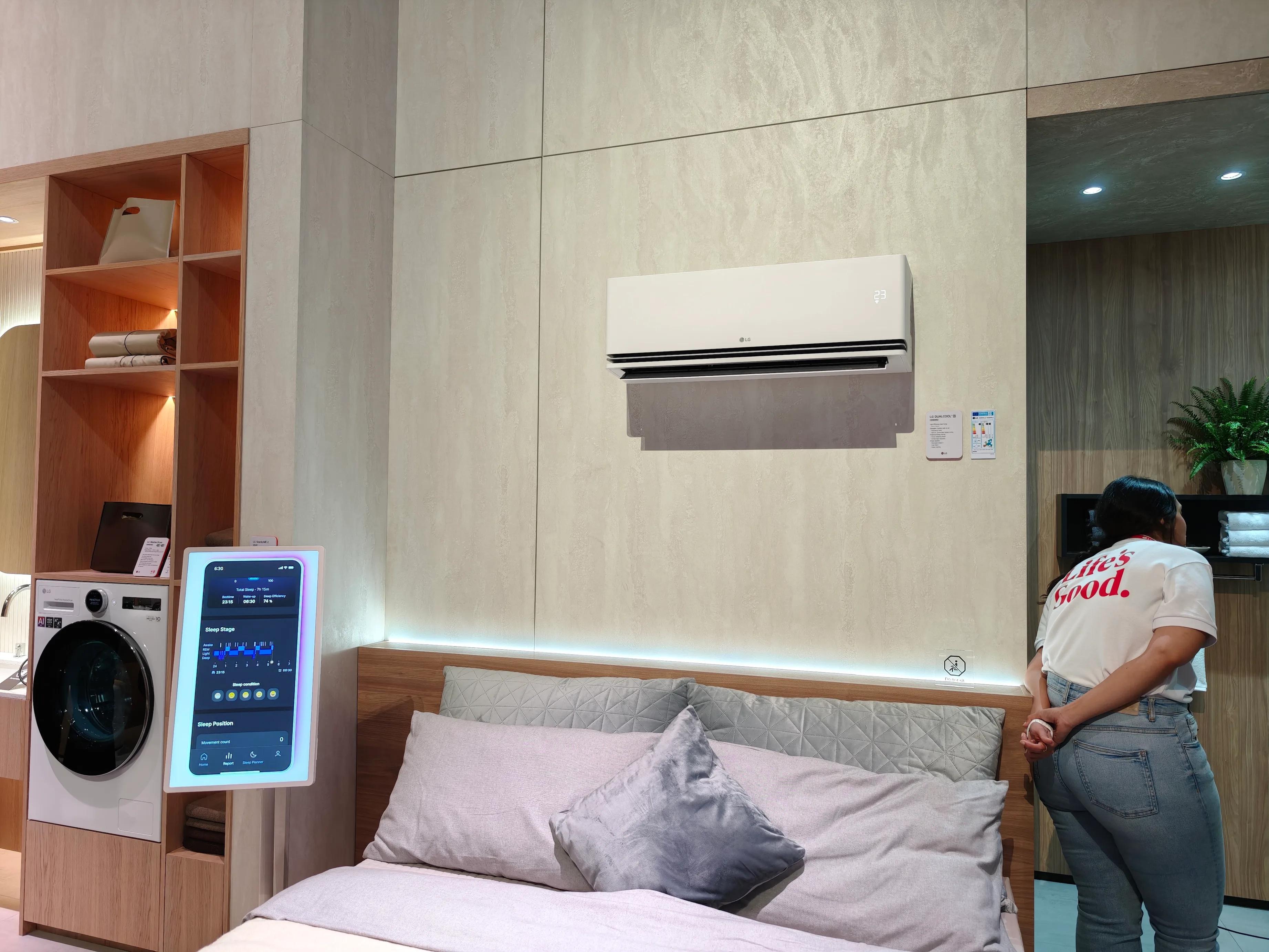
Image source: Leitech IFA Reporting Team
This is a wall-mounted heat pump air conditioner. DUALCOOL AI Air automatically adjusts the wind direction and air volume according to indoor temperature and humidity. After quickly reaching the set temperature, it switches to softer indirect air supply. When the human body sensor detects no one in the room, it will automatically enter the energy-saving mode.
Through the kW Manager on ThinQ, users can even directly set a power consumption quota for the air conditioner, so that the unit can operate within this preset range. When the window is opened or the room temperature changes suddenly, it will also actively adjust its operating status to avoid ineffective cooling.
Features such as human body detection, soft air flow, temperature and humidity joint control, and APP energy consumption management are not particularly new in the domestic Chinese air conditioning market. The really noteworthy part is how to recombine these technologies to better adapt to the needs of the European market.
In fact, one of the biggest resistances to air conditioning consumption in Europe at present is energy anxiety. High household electricity price is one aspect, and the long-standing consumption habits formed around energy conservation and carbon emission reduction in Europe also play a very important role.
In the past, many European families even regarded air conditioners as a kind of high-energy-consuming and unnecessary home appliance. Therefore, when air conditioners start to enter households, the first problem they face is energy saving.
That's why LG DUALCOOL AI puts great emphasis on details like "whether there is anyone in the room", "whether the window is open", and "how much electricity you plan to spend this month". The role of AI here is very practical, which is to minimize unnecessary waste.
Then there is Bosch.
Bosch launched the new Climate 6000iP at IFA 2026. It is the first single-split air conditioner of Bosch Home Comfort fully designed around the natural refrigerant R290, which can provide both cooling and heating. Specific models cover specifications such as 2.6kW and 3.5kW, among which the 2.6kW version achieves A+++ energy efficiency for cooling and A++ for heating.
R290 is essentially propane. It has a very low global warming potential, and is becoming an important refrigerant direction for the European heat pump and air conditioning industry. Including the new generation of Midea PortaSplit mentioned later, it has also been upgraded to use R290.
This design choice itself is very "European".
The European Union has been continuously tightening the regulations on fluorinated greenhouse gases, leaving less and less space for the use of traditional high-GWP refrigerants. This year, it has basically become an unavoidable trend for new products to be designed around natural refrigerants from the development stage.
It is worth noting that Bosch also showcased the Compress 8800i AW heat pump this year, as well as the home energy management solution that connects the heat pump with the Bosch Smart Home thermostat. In the first half of this year, the sales volume of heat pumps in Germany reached 194,500 units, a year-on-year increase of 40%. The German Heat Pump Association predicts that the annual sales volume can reach 400,000 units.
This means that in Bosch's system, air conditioners are not just temporary units for cooling in summer, Bosch is also building a complete home heating and cooling system around them.
This is also a very interesting difference between the European air conditioning market and the Chinese market.
When Chinese users talk about air conditioners, the first thing that comes to mind is still cooling, followed by heating; many families actually rely on floor heating, central heating or other heating equipment in winter. The European market already has a mature system of boilers, radiators and heat pumps. Now that summers are getting hotter, the new problem manufacturers need to solve is how to add "cooling" to the system while continuing to meet winter heating demands.
As a result, although both LG and Bosch are making wall-mounted units, what they are ultimately facing is a very European demand: an air conditioner that can serve the whole year.
Therefore, wall-mounted design, high efficiency and integrated cooling and heating are becoming several key words in the European market.
Technologies that are commonplace in the Chinese market can bring "dimensionality reduction strike" in Europe
Looking at Xiaomi and TCL, the direction of air conditioners at this year's IFA is a little different.
LG and Bosch are more focused on adapting to Europe's existing heating and cooling system, Midea has solved the unique installation problem in the European market, while Xiaomi and TCL are directly bringing the technologies that have been fully iterated and matured in the domestic Chinese air conditioning market to Europe.
Xiaomi is participating in IFA for the first time this year, and air conditioners are also an important part of Mijia's expansion of large home appliances in Europe.
The Mijia air conditioner exhibited by Xiaomi this time is equipped with a millimeter-wave radar, which can detect the position of people, even identify subtle movements, and then deliver air supply around the area where people are in the room, reducing the waste caused by continuous cooling in unoccupied areas.
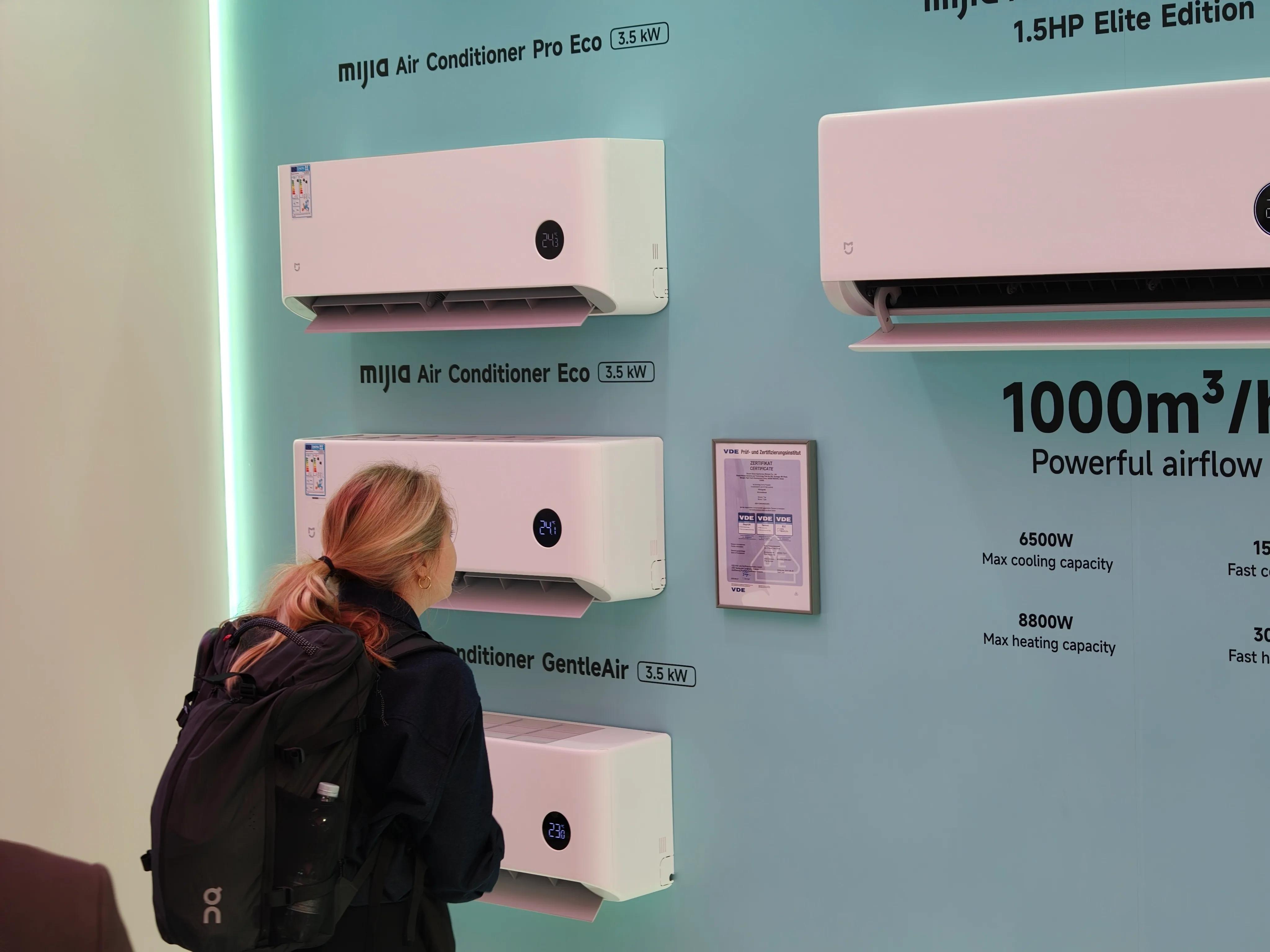
Image source: Leitech IFA Reporting Team
Millimeter-wave radar has been spreading rapidly in domestic smart home appliances in recent years, and it is more suitable for judging "whether people are still in the room" than traditional infrared human body sensors. When a person is sitting on the sofa watching TV or lying in bed sleeping, their body movements are very small, ordinary sensors may misjudge the room as empty, while millimeter-wave radar can identify tiny movements such as breathing and slight turning over.
Xiaomi also revealed earlier this year that its air conditioning business has jointly developed a dual millimeter-wave radar module with sensor manufacturers, which achieves 180° room coverage through two 24GHz radars, and has optimized the algorithm for multiple people, static states and micro-movements. Automatic temperature adjustment or shutdown when no one is in the room can bring energy-saving effect of more than 70%.
Of course, the 70% energy saving mentioned by Xiaomi is laboratory data under specific test conditions, but the product logic is valid.
The traditional operating object of air conditioners has always been the "room". When you set the temperature to 24℃, the unit will try its best to make the whole room close to 24℃. But with more accurate human body perception, the operating object is closer to people. Where people are, whether there is anyone, whether people are asleep, and how much people are active can all be gradually added to the control model of air conditioners.
Domestic consumers in China are already getting more and more familiar with these technologies. The competition in the domestic high-end air conditioning market in recent years has long gone beyond the stage of simply comparing cooling speed and