Zhipu gains a time edge.
Over the past three years, the large model industry has undergone at least several obvious shifts in core focus.
In the earliest stage, the market focused on the technical ceiling and imaginative potential. As long as a large model enterprise delivered a sufficiently powerful new model, it would complete its phased tasks.
Later, the evaluation criteria shifted to APIs. Models could no longer only demonstrate capabilities at launch events, but also need to be actually called by developers and integrated by enterprises. Beyond performance, the number of users, call volume and revenue scale have also begun to become important.
As model manufacturers gradually move towards IPO, the market can no longer wait: with revenue scale achieved, where will profits come from? How can large model enterprises capture greater profits in the AI industry?
The market's scrutiny is intensifying, and industry competition has moved from the early stage of technical imagination to the rigorous test of commercialized self-sustaining profitability.
As the "world's first large model listed company", Zhipu, after fully enjoying the valuation premium and financing advantages of the capital market, will inevitably first face more detailed scrutiny under the spotlight, and bear more expectations from capital and the industry.
This is an honor, but also a considerable pressure. The large model industry has not yet formed a mature path that can be followed, Zhipu has no ready-made answers to reuse, and the company needs to make judgments on the industry and place resource bets in advance. Of course, this also means taking risks.
This financial report, jokingly called a "technical report", also puts several choices Zhipu has made in models, commercialization and infrastructure in the past few years on the same table.
01
The end point of commercialization is not selling APIs
In the early stage of large model commercialization, open platforms and APIs were almost the most convenient path. APIs have a high degree of standardization, fast developer access, clear billing standards, and can continuously generate revenue per call, making it easier to scale up compared to localized deployment and project-based delivery.
However, the problems are also obvious. The market has long been worried that large model companies that only sell APIs will be squeezed by upstream computing power costs and downstream homogeneous competition at the same time, and eventually become "computing power wholesalers" with no pricing power.
Zhipu, which turned APIs into its main revenue source earlier than its peers, also needs to answer a question earlier: Can the business model of large model companies only stay at selling calls?
Zhipu gives a relatively clear four-stage path in its financial report: sell models, sell APIs, sell subscriptions, and finally sell task results.
These four stages roughly correspond to the evolution of the large model capability gradient: Chat delivers an answer at a time; Coding delivers a runnable piece of code; Co-work delivers a result that can be reviewed by professionals; Autonomous AI delivers a continuously running task.
"Selling task results" is also becoming a common judgment of the final commercialization destination for AI application enterprises. AI application enterprises listed on the Hong Kong stock market such as Deep Data and Marketin have also put forward similar visions.
For Zhipu, this path is not entirely a theoretical deduction on paper, and the company's business changes in the past few years have already confirmed it.
In the early stage, Zhipu's revenue came more from project-based delivery and subscription products. After that, with the continuous improvement of model capabilities, especially the increasing emphasis on Coding capabilities, APIs gradually took over as the main driver of revenue growth.
In the first half of 2026, Zhipu achieved revenue of 954 million yuan. Among them, revenue from the open platform and API business increased by more than 27 times year-on-year, contributing nearly 90% of total revenue, which has become the main business engine of the company.
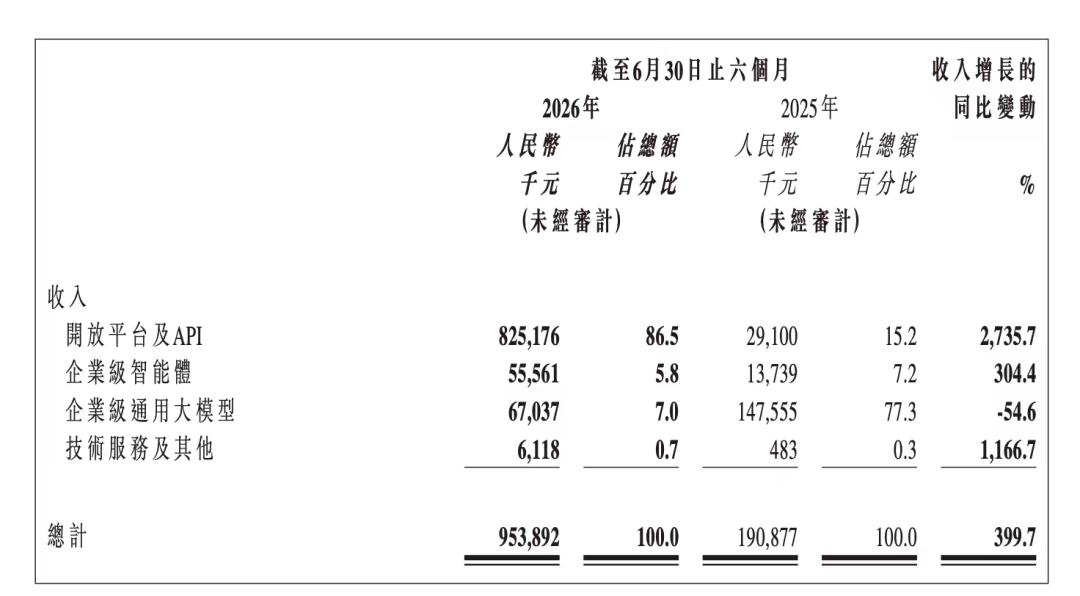
Behind this is the simultaneous increase in user scale and payment activity. As of August 2026, the number of users on Zhipu's MaaS platform has increased by 144% compared with the beginning of the year, and the number of paying daily active users has increased by 603% compared with the beginning of the year, further pushing the annualized scale of MaaS business calculated based on August revenue to reach 1.6 billion US dollars. The continuous growth of users, payment activity and revenue all indicate that model capabilities are being transformed into actual calls and scaled revenue.
If viewed in the four-stage path, Zhipu's current position is: The company has entered the stage where APIs are the main source of revenue, subscriptions have also begun to generate revenue, but there is still a long way to go before "selling task results".
From the perspective of model capabilities, Coding has become a relatively mature commercial scenario, cybersecurity has begun to enter the Co-work verification stage, and the legal and other professional fields are still in the early stage.
This means that before the new business model matures, APIs will not just be a short-term transitional stage. At least in the current period and for some time in the future, APIs will still be Zhipu's main source of revenue, and they also need to undertake the dual tasks of expanding revenue scale and improving profitability.
Therefore, the question Zhipu must answer next is:
Can APIs only expand revenue scale, or can they also generate profits?
02
Bet on AI Infra
This is not only a question that Zhipu needs to answer, but also a test that the entire large model industry will face sooner or later.
As of August 2026, the average price of Zhipu's APIs has risen by about 101%, achieving simultaneous growth in volume and price while revenue is growing rapidly. This at least shows that customers will not only choose the lowest-priced models. When model capabilities reach the SOTA level, the market is willing to pay a premium for higher intelligence.
Accordingly, the gross profit margin of Zhipu's open platform and API business rose to 24.6%, an increase of about 25 percentage points year-on-year.
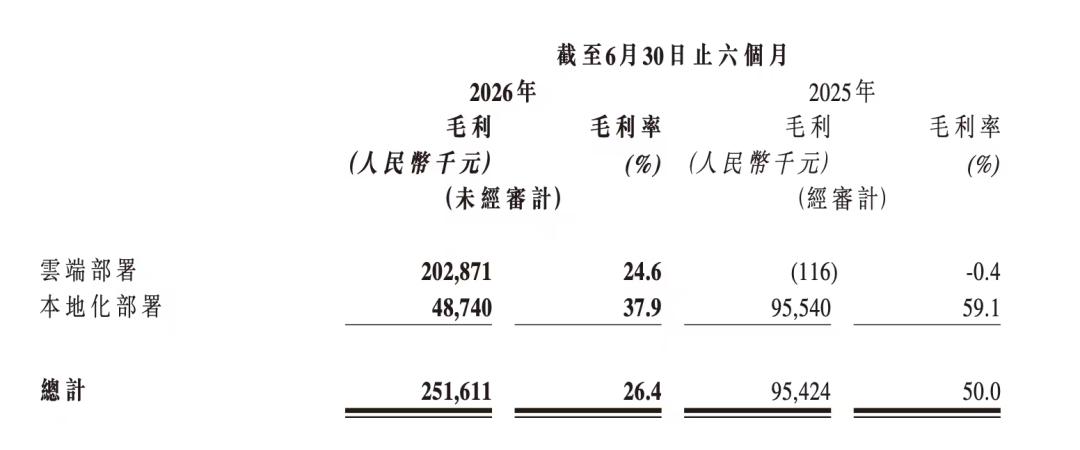
This financial report thus gives a phased affirmative answer: APIs are not necessarily a low-gross-margin business. As long as the model can create sufficient task value for customers, there is an opportunity to translate that value into pricing power.
But for the capital market, a gross profit margin of 24.6% is not yet "attractive enough". Whether compared with traditional software subscription businesses or mature internet platforms, this level is still relatively low. More importantly, the price premium formed by SOTA capabilities may not be maintained for a long time. After all, no company can guarantee that its models will always be ahead.
Therefore, after Zhipu took the lead in proving that APIs are not a low-price business, it must continue to answer a more difficult question: If the model no longer has a leading edge exclusively, what will be relied on to maintain profit margins?
For many large model companies that are still in the technology investment period, this question may be postponed for the time being; but Zhipu has gone public, and APIs have become the main source of revenue, so there is no room to avoid it.
Zhipu's solution is to adapt domestic chips through AI Infra, thereby continuously reducing Token costs.
This route is not a last-minute decision. Domestic chip adaptation and reasoning infrastructure construction both require a long cycle. Long before large-scale demand actually emerged, Zhipu had already invested engineering resources to complete technical route selection and infrastructure construction.
This is also a bet with no small cost. In the first half of 2026, Zhipu's R&D expenditure reached 2.131 billion yuan, a year-on-year increase of 33.6%. While continuing to promote model iteration, the company also needs to invest a large amount of engineering resources to build reasoning infrastructure and adapt domestic chips.
But the "Niulai" model and the underlying GLM-5.3-Flash provide a phased verification for this bet. Zhipu disclosed that the company has achieved large-scale reasoning on a cluster composed of more than 100,000 domestic chips, and the unit Token reasoning cost has dropped by 80% compared with the beginning of the year; the online service of GLM-5.3-Flash is also carried by this domestic computing power cluster.
Model capabilities create upward price space, and AI Infra pushes down delivery costs downward. The combination of the two forms the complete logic for API gross margin improvement, which also conforms to the "computing power multiplier" theory proposed by Zhipu.
For domestic computing power, Zhipu's achievement is also of great significance. Alibaba previously disclosed that self-developed chips have been deployed in cloud services and their proportion will continue to rise; Zhipu further illustrates from the operating perspective of a large model company that domestic chips can not only "run models", but also support large-scale reasoning and commercial operations.
03
Scaling has not stopped, but its focus is changing
AI Infra answers the question of how to reduce the reasoning cost of models, but to continuously create pricing power, it ultimately depends on whether model capabilities can continue to improve. Thus, the question returns to the most core main line of large model competition: How will Scaling continue?
In the past year, the industry has diverged on this issue: To continue improving model capabilities, should we expand the base model and pre-training scale, or invest more resources in post-training, reinforcement learning and task environments?
Zhipu was once labeled as a "post-training expert", which even made the outside world mistakenly think that it is weakening pre-training. But in fact, Zhipu bet on general base models from the very beginning, and the subsequent GLM-5.2 and GLM-5.3 were also continuously iterated on the same base. The emphasis on post-training is not a route shift, but with the evolution of models, resources are invested in the links with higher marginal returns at present.
Zhipu divided the improvement of model capabilities into four dimensions in its earnings call: base model scale, effective depth, training depth and task environment.
The base model scale determines the basic base of model knowledge and capabilities; effective depth determines whether the model can truly use computing power to solve problems; training depth is related to capability improvement in reinforcement learning and long-horizon tasks; the task environment determines whether the model can continuously learn from feedback close to the real world.
The early large model competition mainly focused on the first dimension. The logic is relatively straightforward: larger models, more data, higher computing volume, and capabilities usually improve accordingly.
But when the industry enters a more complex stage of reasoning and agents, simply increasing parameters is no longer enough to solve all problems. Whether the model can think for a longer time, can keep making trial and error in tasks, and has a sufficiently real and complex training environment, has begun to become a new capability bottleneck.
Therefore, future Scaling will no longer only expand the model horizontally, but also extend vertically and to the external environment at the same time.
GLM-5.3 can be regarded as Zhipu's verification of "training depth". With the same architecture, total parameters and activated parameters as GLM-5.2, GLM-5.3 mainly expands the long-horizon task environment and post-training scale, and the end-to-end task completion rate has increased by more than 50% as a result.
According to the plan, Zhipu will continue to promote the construction of the next-generation base model, long-horizon reinforcement learning, Loop Transformer and large-scale real task environment in the future, and explore Fully Self Training, that is, let the model participate more in generating training data, proposing tasks, verifying results and completing self-iteration.
If this direction can be established, large model training may gradually form a new closed loop: the model enters the real task environment, obtains feedback during execution, then improves capabilities through reinforcement learning and self-training, and finally handles longer and more complex tasks.
At that time, what determines the competitiveness of the model will no longer be just the parameter scale, but who has a higher-quality task environment, a more effective feedback mechanism, and a stronger computing power conversion efficiency, which also points to the essence of the "computing power multiplier": one end reduces reasoning costs, and the other end improves capability output.
04
Summary
What Zhipu's financial report really provides is not the conclusion that a large model enterprise has run through a high-profit model, but a phased answer handed over by a pioneer at a key node of commercialization.
If we connect Zhipu's development path over the past few years, we will see this trait of the company: Predict the industry direction in advance, place resource bets ahead of time, and then gradually deliver results through product implementation and operating data.
Early bets on general base models have brought sustainable iterative model capabilities today; decisive transformation from project-based system to MaaS/API has spurred the explosive growth of call volume and revenue; early investment in domestic computing power and reasoning Infra is directly reflected in the reduction of unit Token cost and the improvement of gross profit margin; and the directions laid out earlier such as Coding and Agent are also moving from capability demonstration to real use.
Zhipu's previous judgments on the industry are being reflected in operating results one by one.
Of course, in an emerging industry like large models where there is no mature coordinate system, every forward-looking judgment means taking risks for uncertainty. This pressure will still fall on Zhipu as the "pioneer". It cannot only tell the market where the industry may go in the future, but also take the lead in verifying that this route can move forward with revenue, gross profit margin and a sustainable business model.
Therefore, when observing Zhipu in the next stage, model rankings and revenue growth rates are of course important, but the key is whether three main lines can resonate: the model continues to create pricing power, AI Infra continuously releases cost space, and the business model further expands.
Only when these three lines truly converge can Zhipu truly seize the "time difference".