Stop pointlessly competing on tool proficiency! In an era where anyone can generate code in seconds, what exactly is left that makes you valuable?
Shen Translation is a translation and compilation team under 36Kr, focusing on technology, business, workplace, life and other fields, with a focus on introducing new technologies, new ideas and new trends from overseas.
Editor's Note: The golden age of being a specialized screw in the division of labor has completely ended. AI is eroding single technical barriers. In the next 10 years, only the "new Da Vincis" who can control tools with aesthetic judgment and master all fields with cross-disciplinary knowledge will survive. This article is translated and compiled.
Future humans will be divided into three types.
The gap between them will keep widening.
If you want to stand out in the next ten years, the most critical point is that you must never become the first or second type of person.
1) The Purists
"We are the group of unspoiled people."
They resist AI entirely, retreat to nature, and pursue a minimalist, screen-free life.
This kind of life was originally peaceful and tranquil, until they ran into anyone using technological products — at that point, they would develop an uncontrollable strong rejection, because the existence of the other party shook their identity recognition of this "new religion".
Looking at a purist, you can hardly tell whether they are acting out of their true inner beliefs, or just following the trend to be rebellious and look cool.
2) The Mechanized Automators
They outsource all their decisions to technology.
They are allergic to all resistance, and extremely addicted to so-called optimization. The moment their eyes leave the screen, they feel that they have lost a competition that exists only in their imagination. Every thought in their mind has to be processed through Claude.
They can no longer tell where AI ends and where life begins.
The vast majority of people think it's an either-or choice, and they have to pick a side.
But I have always liked to be different. Maybe this is a character flaw, it even sounds a little weird, but I enjoy it. Living a life that few people have stepped into is a very creative challenge; and I find that growth (along with the sense of meaning and fulfillment that comes with it) can never come from following the crowd.
I am convinced that both factions have gone astray.
The purists completely deny part of reality (that is, the progress of the external world), demonize it, and arbitrarily believe that even if they set priorities and make efforts, it is impossible to embrace it healthily.
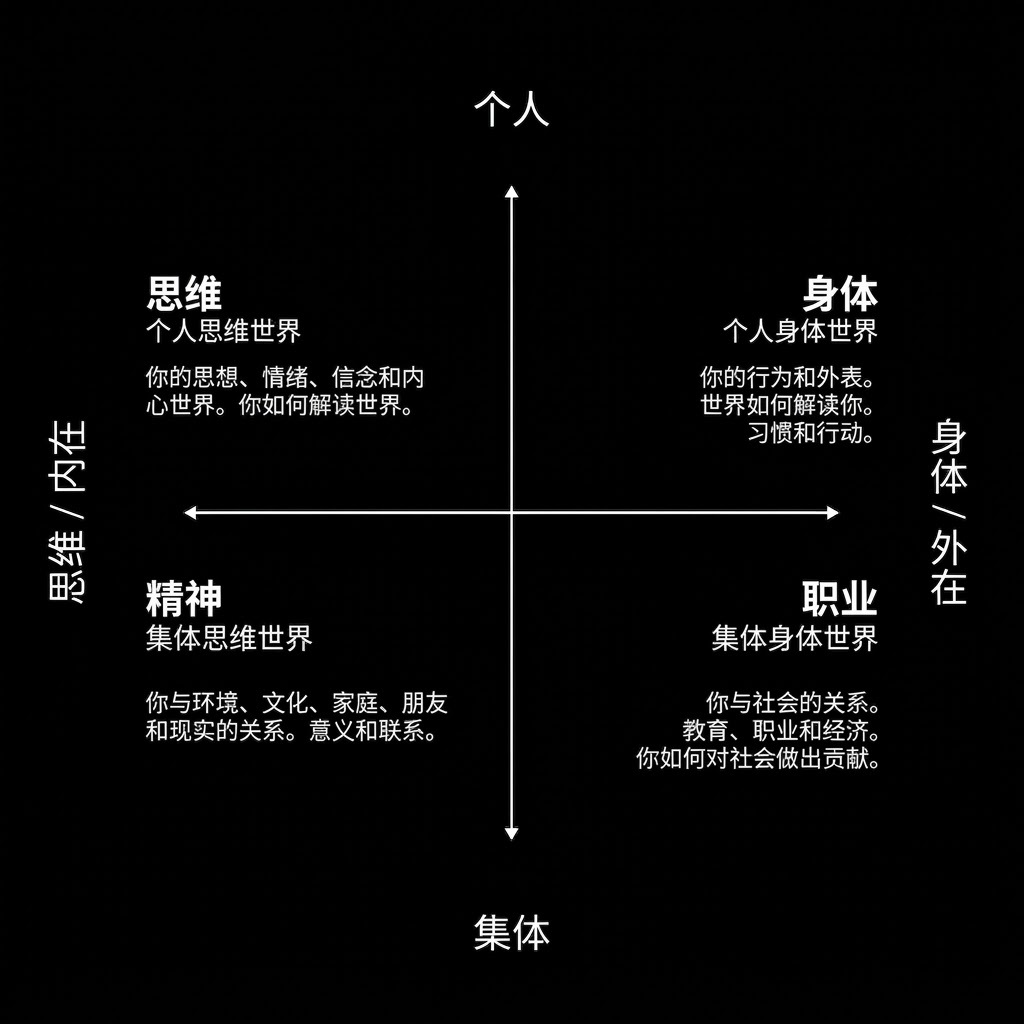
Reality is made up of four quadrants.
Just like the skill tree in video games.
As you gain experience and level up, you assign points in each quadrant. They are interconnected. You can try to maximize your financial returns, but if you make no progress in your mind, body or spirit... money can only take you so far. The most fruitful fruits of life are always reserved for those who have the courage to pursue continuous and all-round development in multiple fields.
The purists regard the inner world (mind and spirit) as the supreme truth, and reject the outer world.
This is destined to be a disaster.
No matter how high your ideological realm is, as long as you are weak, in poor health, and penniless — you will suffer unnecessary pain; and the solution to the dilemma is regarded by you as something evil, so you have no choice but to play the victim.
On the contrary, the mechanized automators go to the other extreme. They are obsessed with money and progress until their humanity is completely worn away.
However, there is a third option.
For people who lack independent thinking ability, this sounds absurd and impossible, but the future will eventually belong to those who develop in all directions.
The following is the way for you to break through and stand out in the next ten years:
The Digital Renaissance Man: Why Generalists Will Prevail in the AI Era
We are in the second Renaissance: verified results have replaced resumes, audiences have replaced employers, and aesthetic appreciation has replaced diploma endorsement.
The greatest tragedy of our time is that we are indoctrinated to believe that a "mechanized life" is the only path to success.
You are told to stick to one specific profession.
You are made to believe that dabbling in a wide range of fields is a character flaw.
Become a designer, a writer, an engineer, a marketer, a salesperson, or just find the highest-paying job you can get, because that's the only way to earn respect and live a decent life.
All of this seems reasonable, but now you feel that you are replaceable at any time.
Because humans are not born to live like this.
The modern concept of "job" has only existed for about 250 years.
Before that, the ideal personality was a free person who dabbled in a wide range of fields throughout his life (as opposed to slaves, who only did one specialized division of labor all their lives... sounds familiar, right?). Craftsmen, farmers and pirates were typical generalists, who knew how to control the overall operation instead of only being responsible for one link. They were both thinkers and doers, both artists and scientists, and they knew very well that to live a fulfilling life, one must not be limited to a single field of research.
When Leonardo da Vinci went to Verrocchio's workshop to learn painting, he came out with a mastery of anatomy, engineering, optics and bronze casting. No one ever told him that these were completely separate fields that had to be studied through their own certifications or diplomas.
In the Renaissance, no one cared about your so-called niche track. People only cared about what real skills you had.
In the industrial era, the factory model may not have been originally intended to destroy education, critical thinking, individual initiative and aesthetic taste, but it objectively caused this negative effect. It made us deviate from the ideal pursuit of the Renaissance. Education became assembly-line training rather than exploration and discovery. Employed labor and repetitive chores made us numb to the operation of the entire business closed loop, and eventually lost the experience and initiative to explore independently.
Sadly, we have become accustomed to this.
We are willing to accept linear career development instead of exponential leaps.
The public never even reflects on or questions it.
Now that AI is approaching, only those with an open mind (who do not blindly take sides to completely deny or fully embrace the next round of evolution) can rise with the trend.
Depending on the nature of the tasks, one person can now complete the workload that used to require a team of 10 to 50 people. One person can have access to all known information in the world. One person can have the free distribution channels of the entire social media.
If you are a true new Renaissance man, this is undoubtedly the best era — even though many people are trying their best to instill doomsday theories into you.
The mechanized and repetitive labor that made up our entire way of life in the past two centuries can now be handled by AI. People are extremely worried that AI will erode human thinking and alienate us into machines, but they fail to notice that they have been operating like machines all their lives.
For those who step into this second Renaissance, your mission is to anchor a core foundation, leverage AI to drive the overall operation, and focus your energy on taste, direction and judgment — because AI's output does not have an independent perspective. AI is, in the final analysis, just artificial intelligence, like a pool of clear water waiting for you to shape its outline.
Become a multi-dimensional, irreplaceable "collection of contradictions"
The most intriguing people are often combinations of contradictions.
Intellectuals with agile bodies; down-to-earth billionaires; spiritual warriors who focus on self-cultivation both physically and mentally.
When you cannot be easily put into a worldly label box, your life tends to be more wonderful.
The most attractive people in the future will surely move freely between the two extremes: pure creativity and pure high efficiency. They can seamlessly switch between retro life (staying away from screens, getting rid of urgency, and immersing themselves in enjoying life itself) and native AI life (using technology to break the impossibility of the past).
The sense of meaning and fulfillment never comes from the plain so-called "balanced life", but is bred in strong contrasts. If you feel happy all the time, you will not cherish happiness, you will take it for granted, and even to be honest, you will feel a little bored. You need stronger stimulation to experience the so-called happiness (this is why people are addicted to their mobile phones now — ordinary and peaceful life is too boring for them). But when you experience failure, struggle and suffering for the cause you care about, you can experience what real happiness is on the other side.
The people who eventually win will surely know how to control this tension and contrast. They can dive deep into work, and also relax and rest completely. They can not only burst out extremely focused energy in their core fields and lifelong careers, but also completely detach themselves and empty their minds afterwards — just like the most outstanding creative masters in the world.
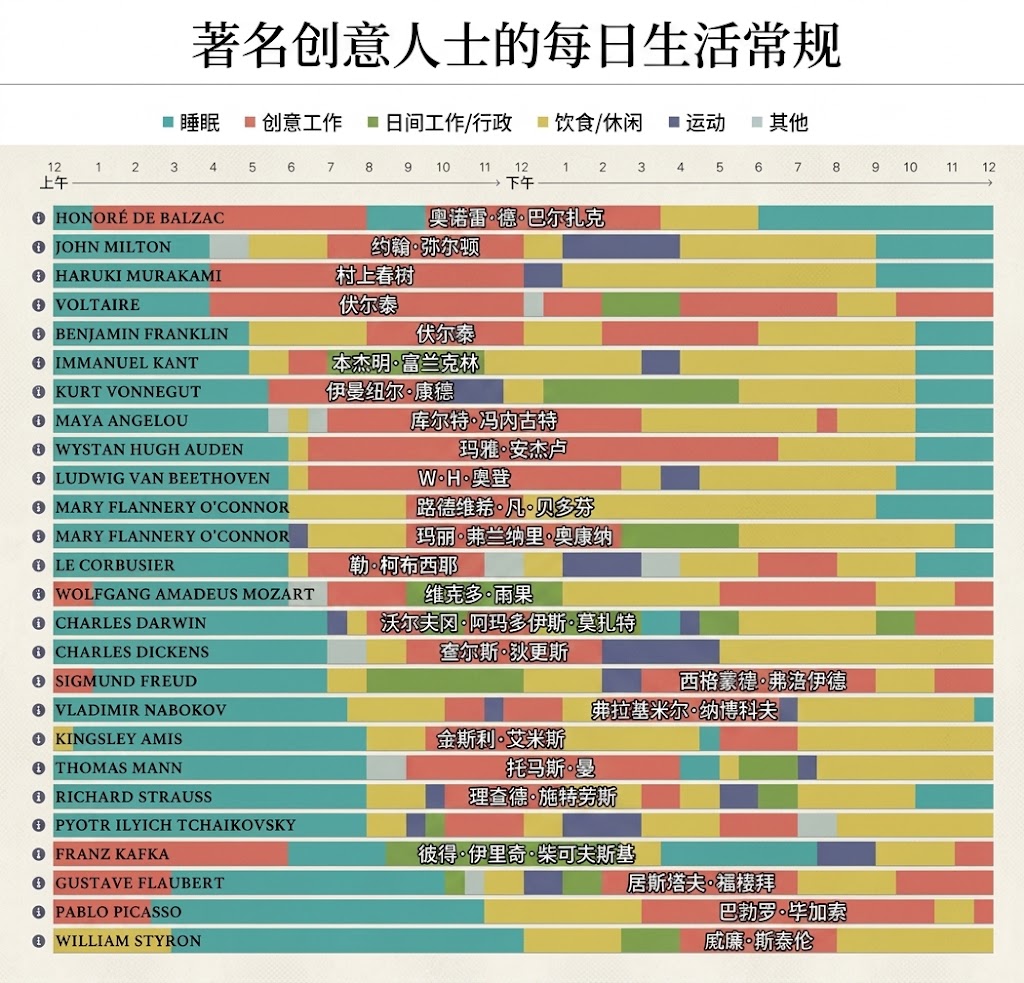
Charles Darwin wrote 19 books in his life.
Despite his rich works, his morning routine was surprisingly regular:
7:00 a.m. — take a short walk, then have breakfast.
8:00 - 9:30 a.m. — work in the study for the first phase, which is the most efficient time of his day.
9:30 - 10:30 a.m. — rest, read letters, and spend time with his family.
10:30 a.m. - noon — the second phase of work. At this point, Darwin considered that he had "completed a full day's decent work".
Afternoon — take the second walk of the day along the "Sandwalk", a gravel path about 400 meters long that he built specifically for meditation.
After lunch — read the newspaper, and rest with his eyes closed while his wife reads aloud to him.
4:00 p.m. — the third walk of the day, usually still pacing around the Sandwalk, occasionally with company.
Darwin's high-intensity creative work every day was divided into two periods, adding up to only about 3 hours.
I believe that the people who stand out in the future will also maintain a similar routine, but their output can match that of 10 to 20 people, and they can build a legacy career on their own.
They will build "one-person enterprises" (I will break this down in detail in subsequent articles).
There are nearly 7 billion people on this planet. I hope that one day, there will be nearly 7 billion companies in the world.
— Naval Ravikant
Before the advent of factories and industrialization, people always rested after finishing the work at hand, instead of working through a full 8-hour shift. Work followed the rhythm of the seasons, sunrise and sunset, and one's own energy level.
More importantly, you never gain your value through uniform standard courses or meaningless rote memorization.
You learn skills through hands-on practice.
You rise step by step from apprentice to journeyman and then to master in the workshop, by imitating the practices of experts, until you temper your own unique aesthetic taste and judgment criteria.
The problem now is exactly this:
How do you become a new Renaissance man?
How to become a Renaissance man in the digital age
Let go and try everything.
Become a writer, designer, marketer, filmmaker, fitness enthusiast, runner, or chase anything that your curiosity leads you to.
But gather all your concentration into one container.
Focus on one craft. Pick a core expertise that makes you famous, so that your multi-dimensional development will become a superpower that puts you ahead of others.
The specific action plan is as follows.
Choose your core craft to make yourself irreplaceable
At present, the vast majority of artists, writers and creators are rebelling against AI, just because they have tied their identity tightly to a single skill, a specific tool or a certain work process.
I don't care at all whether AI art counts as real art, or whether AI writing counts as real writing — this is a pointless waste of energy that will only prevent you from making achievements in reality (it does no good except complaining to get traffic and likes, and reinforcing a narrow identity that will be useless in the next few years).
You need a core foundation, but you have to choose it carefully.
Your core craft is exactly at the intersection of three things: what you love, your unique abilities, and the value that others are willing to pay for.
There are three levels to build an irreplaceable skill stack.
Level 1: The base of human insight.
Marketing, sales, writing, public speaking, psychology, etc. These are related to a deep understanding of the human attention mechanism, and the essence that people's perception of value is highly subjective and constantly changing with the world.
Anyone who aspires to succeed on their own must fully master this field.
This is the fundamental reason why "others are willing to pay for it".
Level 2: Obsession and unique interest in a vertical field.
Philosophy, fitness, design, programming, nutrition or any other category. These fields never die, they just keep evolving.
The cross-integration of multiple interests is your unique moat. A physically strong philosopher is far more valuable and attractive than an "armchair philosopher" who only talks about theories in the ivory tower without ever verifying them in person. People will leave the mediocre people behind and come straight to you.
This is the part where "what you love" and "your unique abilities" merge, and it is also the reason why others come to you for advice. The underlying insight into human nature can help you package these expertise in a very attractive way.
Level 3: Hard technical skills.
Email marketing tools, Photoshop, no-code website building, social media operation, writing specific code in front of the screen.
In the past, these were often regarded as top priorities, because mastering these tools took a lot of time and effort; but now AI can handle all of them easily. Never bet your entire future on your proficiency in a certain tool.
The trajectory of every technological change is the same: the mechanical and repetitive part of skills is replaced by automation, and the role of humans moves to a higher level. Scribes transitioned to editors, hand weavers transitioned to machine operators.
We'll talk more about this later.
How to become a highly competent super self-learner
School teaches you how to operate step by step within the established system.
This is understandable and necessary to some extent, but school will never teach you how to carve out your own path. Public schools are essentially sets of mechanisms for screening and disciplining obedience.
True education is a process of self-discovery.
It is the process of actively absorbing the nutrients you need to achieve the vision and goals you set for yourself, rather than blindly hoarding knowledge or memorizing facts just to get high scores in unrealistic exams.
Even more sadly, the vast majority of people stop learning completely as soon as they graduate.
Once they reach their twenties, the rest of their lives is just a repetition of the same day. They no longer take on any high-level creative projects that require unique knowledge to overcome.
So how do you learn efficiently?
The answer is to follow the "master-apprentice system".
The wonderful thing about the present is that as long as you open a book at hand, or open YouTube on your phone, you can directly find industry masters and guides.
I don't care if you use AI to gather information.
I don't care if you follow the advice of a certain YouTube expert completely.
What I really care about is: do you have a clear vision? Do you have firm goals? Are you moving towards your goals? And