MiniMax M3 "gains Saudi local 'citizenship' status", China's open-source model has secured a "national-level key client"
Over the past two years, the development of large language models has been almost a sprint race limited exclusively to China and the United States.
The US tech circle keeps a close eye on Chinese models, calculating how many percentage points the gap between open-source models and closed-source cutting-edge models remains; Chinese companies focus on chips, training costs and release speed, wondering how many months the gap can be narrowed down to. Both sides have their own cutting-edge models, computing power and complete internet industry, and have refined the competition down to decimal places.
Are countries outside the race track anxious?
Absolutely yes.
According to the latest update of the "Sovereign AI Index" by the Center for a New American Security (CNAS), as of the first half of 2026, 67 countries around the world have advanced 184 government-supported sovereign AI projects, with 41 new projects added only in the first half of this year, exceeding the total number of 2024. A growing number of countries want to join the AI race directly.
On September 3, Saudi Arabia presented a specific path.
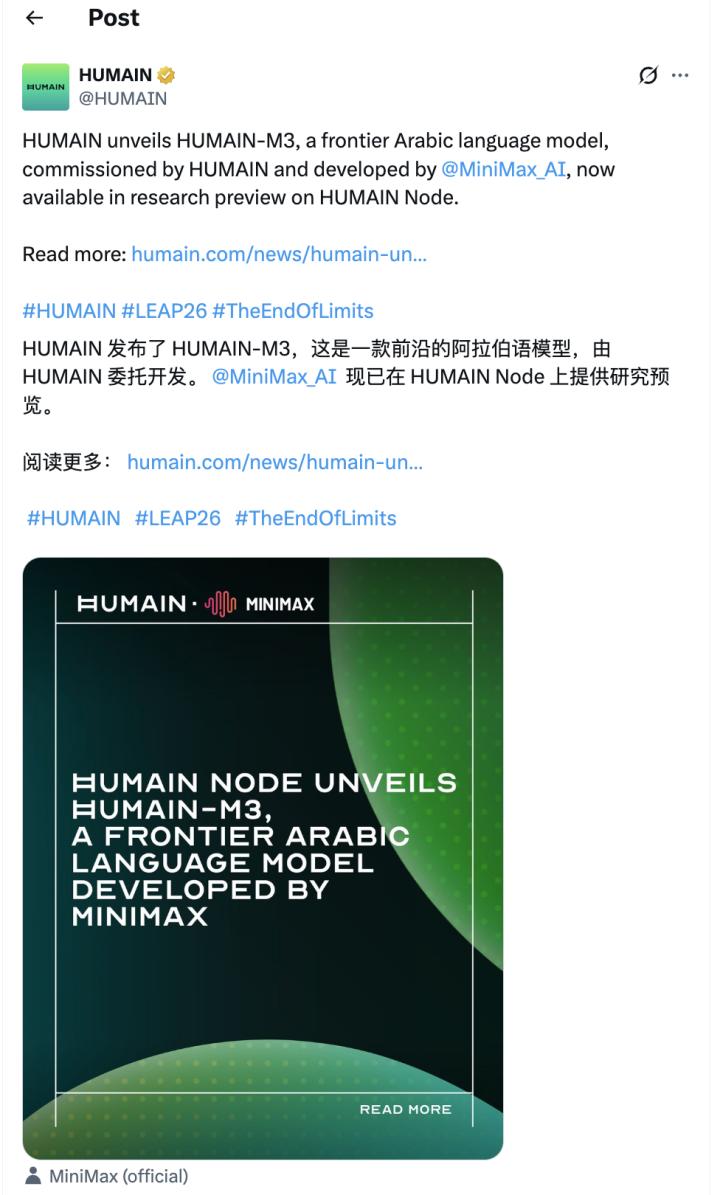
At LEAP 2026, HUMAIN, an AI company established by Saudi Arabia's Public Investment Fund, launched HUMAIN-M3, a cutting-edge model for the Arabic-speaking world. It outperforms GPT-5.6 Sol and Opus 5 in multiple public Arabic tests, is currently open for preview on HUMAIN Node, and plans to make its weights open to the public.
And its base model comes from China: MiniMax M3.
For many countries, this may be the most realistic path at the moment: leveraging open-source models that are increasingly close to the cutting-edge level of closed-source models, starting from a higher technical starting point, and building their own "sovereign AI" faster.
Few companies in the world can continuously train cutting-edge foundational models, but there are many countries that want to take AI into their own hands.
The magnitude gap between the two is bringing a newer and larger overseas market for Chinese open-source models.
1
"Countries" are becoming new customers of large language models
HUMAIN, the company that released HUMAIN-M3, has a rather special background.
It was established in May 2025 by Saudi Arabia's Public Investment Fund (PIF), and its chairman of the board is Mohammed bin Salman, the Crown Prince and Prime Minister of Saudi Arabia. Its business covers data centers, AI infrastructure and cloud, all the way to models and applications, and undertakes the role of building national-level AI capabilities for Saudi Arabia.
Saudi Arabia has capital, energy and government impetus, but its model team, training experience and software ecosystem need time to accumulate. For HUMAIN, the choice of technical starting point directly determines how fast its existing resources can be transformed into usable products.
HUMAIN-M3 embodies this speed.
Only three months have passed from the release of MiniMax M3 to the launch of HUMAIN-M3.
It is built on the MiniMax M3 series, follows the Mixture-of-Experts architecture, has a total parameter count of 428 billion, activates about 23 billion parameters for each Token processed, and uses more than 1 trillion Tokens of native Arabic content for continued training, with a focus on strengthening Arabic understanding and reasoning capabilities.
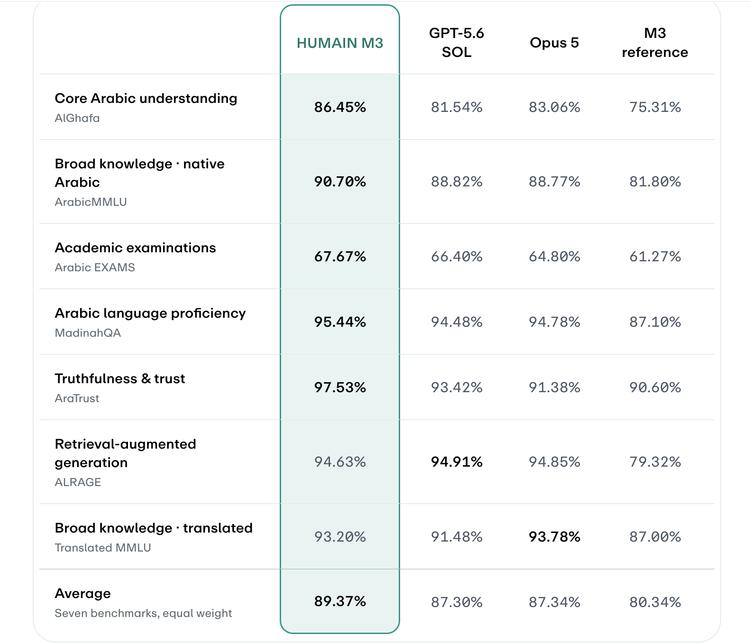
According to the seven public Arabic tests announced by HUMAIN, HUMAIN-M3 won first place in five of them, with an equal-weighted average score of 89.37%, 9.03 percentage points higher than the base M3 model, and also higher than 87.30% of GPT-5.6 SOL and 87.34% of Claude Opus 5.
It is worth noting that Saudi Arabia already had its own model ALLAM before, and the United Arab Emirates and Qatar have also launched corresponding Arabic models. The difference of HUMAIN-M3 lies in its path: with the help of MiniMax M3's existing general capabilities including native multi-modality, Agentic features and million-level context, it can quickly obtain a local model with cutting-edge intelligence level only through post-training optimization.
Faster, more powerful, and more adaptive.
The validity of this path stems from the fact that there are two different types of accumulation in model capabilities: general reasoning, multi-modality and tool usage can be reused across regions, while the cultural and knowledge environment behind the language still needs to be re-learned.
Taking Arabic-speaking regions as an example, in local practical scenarios, Modern Standard Arabic and various regional dialects have coexisted for a long time. Daily expressions also mix English, Latin letters and numbers, plus special religious, social norms, legal and historical contexts, all of which are areas that general models cannot cover for the time being.
In particular, when Agents start to search for information, call tools and execute tasks on behalf of users, local adaptation will directly affect whether they can find correct information, understand constraints and complete work. Language capability will directly evolve from a product experience issue to an execution capability issue.
South Korean scholars previously conducted an evaluation study: they constructed 400 test questions through K-BrowseComp, allowing AI to enter Korean websites and local information sources to continuously search and verify evidence. The results showed that the scores of global cutting-edge models on the manual verification set were only between 30% and 45.67%, with their capabilities greatly reduced.
In addition, more importantly, national-level projects also need to consider whether the model capabilities can be truly and continuously mastered by themselves.
Where the data is stored, on whose computing power the model runs, whether it can be updated independently, and whether the business can continue after the supplier adjusts its services, all these will affect the technical choice.
The Fable 5 export control turmoil is a typical example. It was released in June, and access was suspended a few days later due to the US government's export control order, and global supply was not restored until July. This turmoil lasted for less than three weeks, but it is enough to remind all countries that the access right of remote APIs may change in a short period of time along with the policies of suppliers and the model's country of origin.
The combination of requirements for local language performance, data location, deployment method and service continuity is making more and more countries start to look for open-source base models.
According to CNAS statistics, as of June this year, the number of sovereign AI model projects that use open-weight base models for local training has more than doubled compared with the end of 2024.
And open-source models are precisely China's home field.
Over the past two years, relying on continuous open sourcing, Chinese models have brought cutting-edge capabilities, cost advantages and developer ecosystems to overseas markets. When sovereign AI starts looking for technical base models that can be locally deployed, continuously trained and independently operated, Chinese open-source models like MiniMax M3 have naturally entered the selection list.
For Chinese open-source models, this is an important trend and opportunity: national-level customers are becoming new growth points.
2
From the perspective of MiniMax, the overseas expansion of Chinese open-source models is becoming "heavier"
However, being selected is only the beginning of cooperation. National-level platforms also need to connect the base model with local data, computing power, security requirements and industry systems, and carry out continuous updates.
The way Chinese open-source models expand overseas will also change accordingly.
In the early stage, open-source models mainly gained overseas attention through communities and leaderboards. The improvement of capabilities and the reduction of costs made developers willing to download the weights, deploy locally, or access APIs to integrate the models into their own products.
As the scale of usage expands, the next layer of problems emerges: can the model run efficiently on different hardware, can it be delivered stably through cloud platforms, and can it adapt to local data and business rules?
When it comes to sovereign AI, these requirements are all incorporated into the same construction project. Model competition has also extended from single capability to the entire chain of training, deployment and continuous services.
The so-called "heavier" overseas expansion lies right here: more infrastructure needs to be connected behind the model, both parties to the cooperation need to invest more engineering resources, and the delivery is extended from one-time access to continuous iteration.
Taking MiniMax as an example, its overseas moves are presenting this route faster and more steadily.
According to its performance announcement for the first half of 2026, MiniMax's products and services have covered more than 230 countries and regions. Beyond the coverage, what is more worthy of observation is the depth of its entry into overseas markets: from chip adaptation and hosted inference to local model development, cooperation is expanding along all links required for model operation.
First look at chips.
In July 2026, at RAISE, the largest AI summit in Europe, SambaNova, a Silicon Valley AI chip and infrastructure company, used its new-generation SN50 chip to run MiniMax M2.7. Verified by the independent evaluation agency Artificial Analysis, it achieved the fastest inference speed in the world.
SambaNova is an AI inference chip company headquartered in Silicon Valley, selected into the Forbes 2026 AI 50. Its solution adopts separated inference, which splits the two links of the model processing requests: NVIDIA GPU is responsible for reading and processing inputs, and SambaNova's self-developed RDU chip is responsible for generating outputs, allowing different hardware to undertake the tasks they are better at.
For enterprises, this means that they can retain their existing GPU clusters and then access new inference chips to improve output efficiency. Therefore, model adaptation is directly related to whether customers' existing computing power investment can be fully utilized and whether new deployment is cost-effective.
The cooperation between MiniMax and SambaNova has continued from M2.5 and M2.7 to M3: in August, M3 was launched on SambaCloud. This cross-generation cooperation shows that both parties are continuously handling the issues of model upgrade and hardware adaptation, and engineering experience is also accumulating accordingly.
Then look at the cloud and inference platforms.
Also in July, MiniMax reached an exclusive strategic cooperation with Nebius, an AI cloud infrastructure company, becoming the first open-source model launched on Nebius Token Factory in an exclusive cooperation mode. Nebius is one of the fastest-growing AI infrastructure companies at present, and its hosted inference platform Token Factory currently hosts more than 60 open-source models.
This type of platform undertakes another part of the work for models to enter the production environment: handing over deployment and operation to infrastructure service providers, so that more customers can directly use the model capabilities.
Hardware adaptation solves the operation efficiency, and the hosted platform expands the available scope. The two together lower the threshold for overseas customers to adopt the models.
On this basis, the emergence of HUMAIN has pushed MiniMax M3 one step further towards local model development, allowing local teams to further invest language data and training resources around the base model, so as to endow the model with capabilities for the local market.
Chips, cloud platforms and local models. Taking MiniMax as a sample, we can see that the overseas expansion of Chinese open-source models has expanded from a single model to a complete delivery system formed around the model.
Once this system is formed, the cooperative relationship will be deepened. Overseas partners invest computing power, data and development resources around the model, and model manufacturers need to continuously support adaptation and upgrading. Although replacing the base model is feasible, it also requires re-evaluation, training and deployment adjustment, so the model has more opportunities to stay in the customer's technical ecosystem.
For all Chinese open-source model manufacturers, this is a larger and more stable long-term growth space. Especially with the emergence of more sovereign AI projects, in the future, in addition to billing by Token, model adaptation, local deployment, inference optimization and long-term technical support may all become important sources of revenue for open-source manufacturers.
Although most sovereign AI projects today still cannot do without US companies: GPUs, servers, clouds and models often account for at least one layer. But the starting point for countries to build sovereign AI is precisely that they do not want to bet their entire system on a single country. The more the United States hopes that other countries will fully adopt its own technology stack, the more motivated they will be to find a second alternative.
This is also where the real value of Chinese open-source models lies.
In the past, the world measured Chinese open-source models through leaderboards. Now, some countries have begun to integrate them into their own AI base models.
From being noticed and called, to becoming the technical starting point of a national-level AI, this can better illustrate how far Chinese open-source models have come than any decimal place on the leaderboard.
This article is from the WeChat official account "Siliconist Pro", written by Huang Xiaoyi, and published with authorization from 36Kr.