Having closed a Series B financing of nearly 500 million yuan, the national defense AI enterprise incubated by the Chinese Academy of Sciences generates annual revenue of hundreds of millions of yuan | 36Kr Exclusive

This article is about 2100 words, with an estimated reading time of 4 minutes
Author 丨 OU Xue
Editor 丨 YUAN Silai
Hard Krypton learned that Zhongke Shitong Hengqi (Beijing) Technology Co., Ltd. (hereinafter referred to as "Zhongke Shitong Hengqi"), a smart decision-making infrastructure service provider for key sectors, recently announced the completion of its Series B financing of nearly 500 million yuan. This round of financing is jointly invested by institutions including Nanfang Demao Fund under China North Industries Group Corporation, Beijing Information Industry Fund, China Unicom Venture Capital, Houji Capital, Taiping Tech Innovation Fund, GF Xinde, and Xinneng Venture Capital, with existing shareholder Leli Capital increasing its stake for three consecutive times.
The funds raised in this round will be mainly used for the R&D of core AOS technologies, the upgrade of the "Shitong Lingjing" product system, the construction of industrial ecosystem and the expansion of key markets, so as to promote the replication of the company's solutions from high-trust scenarios such as national defense to key industries including telecom operators, finance, energy and power, and government governance.
Founded in 2016 and incubated by the Chinese Academy of Sciences, Zhongke Shitong Hengqi is a national-level key "Little Giant" enterprise specializing in special, refined and innovative technologies. With nearly 20 years of in-depth experience in ontology and intelligence, its products have been deployed in core businesses of national defense and multiple key sectors. The company's founder HUANG Yu holds a doctorate from the Aerospace Information Research Institute of the Chinese Academy of Sciences, and has won the first prize of the National Science and Technology Progress Award.
At present, the artificial intelligence industry is crossing a key watershed: large language models are enabling machines to "think" better and better, while Agents are allowing machines to start to "act". As AI evolves from content generation to participating in research and judgment, resource scheduling and task execution, what determines whether it can be integrated into core businesses is no longer only the model capability, but whether organizations can truly trust and entrust their businesses to it. Especially in the national defense sector, the requirements for AI are extremely strict: no hallucinations, clear permissions, and all decisions must be traceable in a white-box manner.
Zhongke Shitong Hengqi's understanding of this issue did not start from the upsurge of large language models. As early as 2003, founder HUANG Yu carried out ontology-related research at the Chinese Academy of Sciences. After the company was established in 2016, the team pushed this technical line from scientific research to engineering practice, and has long focused on trusted decision-making, ontology engineering and national defense intelligent applications.
Traditional large language models and Agents can answer and ask questions, but they often fail to understand the business logic of specific industries, and it is difficult for them to perform reliably within the boundary of permissions. The solution proposed by Zhongke Shitong Hengqi is AOS (Agentic Ontology Space).
HUANG Yu told Hard Krypton that he positions AOS as "a business semantics and trusted execution infrastructure oriented to agents". It does not replace large language models, but acts as a neutral kernel that enables different Agents to understand enterprise businesses based on the same set of business semantics.
The company draws on Palantir's paradigm of connecting data, business and actions with ontology, and at the same time combines the requirements of China's key industries in business processes, security systems, information technology application innovation environment and data sovereignty, to commit to building a trusted decision-making infrastructure for the intelligent era.
Specifically, AOS focuses on solving three core problems:
The first is business understanding capability: modeling the scattered data of enterprises and the experience and knowledge in experts' minds into a unified business space, so that Agents can face the same set of business objects and standards, and truly understand the business of the enterprise.
The second is complex problem solving capability: when the business is complex enough (for the customer marketing scenario: complex and accurate matching of hundreds of thousands of users, hundreds of rules and hundreds of products), AOS not only provides the general problem-solving capability of large language models, but also the exclusive problem-solving capability based on the enterprise's own data and rules.
The third is trusted action capability: integrating mechanisms such as fact basis, permission approval, risk control and error rollback into the kernel, so that every action of Agents can be recorded and traced.
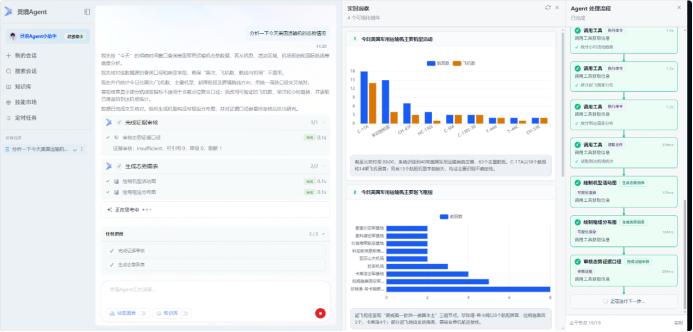
Schematic diagram of Lingjing Agent application (Source/Enterprise)
HUANG Yu explained with a metaphor: "We hope to enable AI to work with formal qualification like regular employees, which means that they have clear permissions for work, major events require approval, the whole process is recorded, results are traceable, and experience can be accumulated."
He summarized the value of AOS into a formula: Business Understanding Capability × Complex Problem Solving Capability × Trusted Action Capability. "Without any of the three capabilities, it is very difficult for AI to be actually implemented, or to be trusted and entrusted by enterprises."
Around AOS, the company has formed the "Shitong Lingjing" product system: Lingjing Huanyu connects multi-source data to build situational awareness, Lingjing Tiangong unifies business objects and rules for modeling, and Lingjing Agent is responsible for problem decomposition and trusted execution. The three parts collaborate to form an intelligent closed loop from perception to execution. The three types of products are driven by AOS in a unified manner, forming a closed loop of "Perception - Thinking - Execution - Evolution".
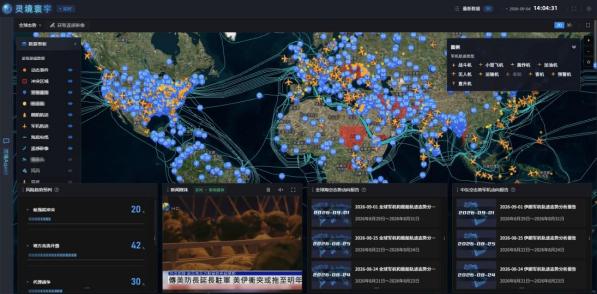
Schematic diagram of Lingjing Huanyu product application (Source/Enterprise)
At present, the company's products and solutions have delivered value in the core business scenarios of a large number of customers in key sectors such as national defense, telecom operators, energy, power and transportation, and have generated revenue of hundreds of millions of yuan, laying its position as the "champion in the niche track".
HUANG Yu revealed that the subsequent iteration of AOS will focus on three directions: lowering the threshold of business modeling, enhancing the capability of solving complex decision-making problems, and improving the trusted execution closed loop, so that AI in key businesses can not only complete tasks, but also get things done correctly and be traceable.
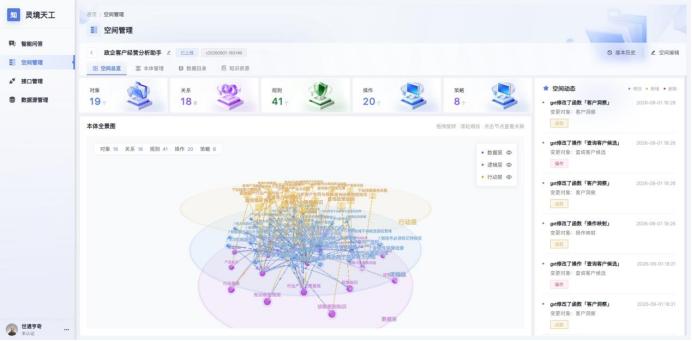
Schematic diagram of Lingjing Tiangong product (Source/Enterprise)
The following is an edited excerpt of the conversation between Hard Krypton and HUANG Yu, the founder of the company:
Hard Krypton: You started from sectors such as national defense. What is the consideration behind this path?
HUANG Yu: We believe national defense is the most suitable starting point. This sector has the highest requirements for the accuracy, professionalism, security and interpretability of AI among all industries. If our products can operate smoothly in the national defense scenario, it proves that they have withstood the strictest tests. We focus on intelligent decision-making, and have made deep polishing on interpretability and trusted execution, while completing a large number of adaptations for information technology application innovation environments, domestic business processes and security systems.
In addition, our positioning is an open and neutral platform. We do not replace large language models or original information systems, but help Agents understand business and enable information systems to have intelligent capabilities. This is a cooperative rather than competitive relationship with all parties in the industrial chain.
Hard Krypton: You mentioned that you are in the vacuum zone between "large language models" and "informatization". How to understand this specifically?
HUANG Yu: There are two types of players in the market. Large language model vendors focus on computing power and traffic entrances; traditional informatization vendors develop basic systems such as ERP and MES. There is a vacuum zone in between: large language models cannot understand specific businesses, and traditional vendors also face difficulties in intelligent upgrading.
Our AOS is right in this position. We model scattered data, expert knowledge and rule processes into a computable business space, so that Agents can truly understand what the business is, and integrate approval, audit and risk control into the kernel. In actual projects, customers often cooperate with us, large language model vendors and traditional vendors at the same time. After comparison, our solutions perform far better, because only we have solved both "business understanding" and "trusted execution" at the same time.
Hard Krypton: Is the expansion path from national defense to civilian sectors feasible?
HUANG Yu: National defense is our first growth curve, and we are expanding the second curve at the same time: telecom operators, power, energy and other scenarios. These scenarios share similar logic: massive data, complex rules, and great impact of decision-making.
Our strategy is to start from the national defense scenario with the highest threshold, polish our capabilities to the extreme, and then replicate our solutions in commercial scenarios in a dimensionality reduction way. This path is much easier than the reverse one. In the future, we hope to form a business structure of "half for military use and half for civilian use".