Meta's new model has staged a remarkable turnaround. Can AI finally make profits for Mark Zuckerberg?
Zuckerberg can finally breathe a sigh of relief.
After pouring in massive amounts of capital, Meta's AI model has finally caught up. The day before yesterday, Meta released its new model Muse Spark 1.3. On Artificial Analysis's Intelligence Index list, the public version scored 61 points, tying with GPT-5.6 Sol and Grok 4.6, only behind Claude Fable 5.1 and Claude Opus 5.
Zuckerberg was so delighted that he personally promoted the new model, stating that Muse Spark 1.3 delivers strong performance at a very affordable price.
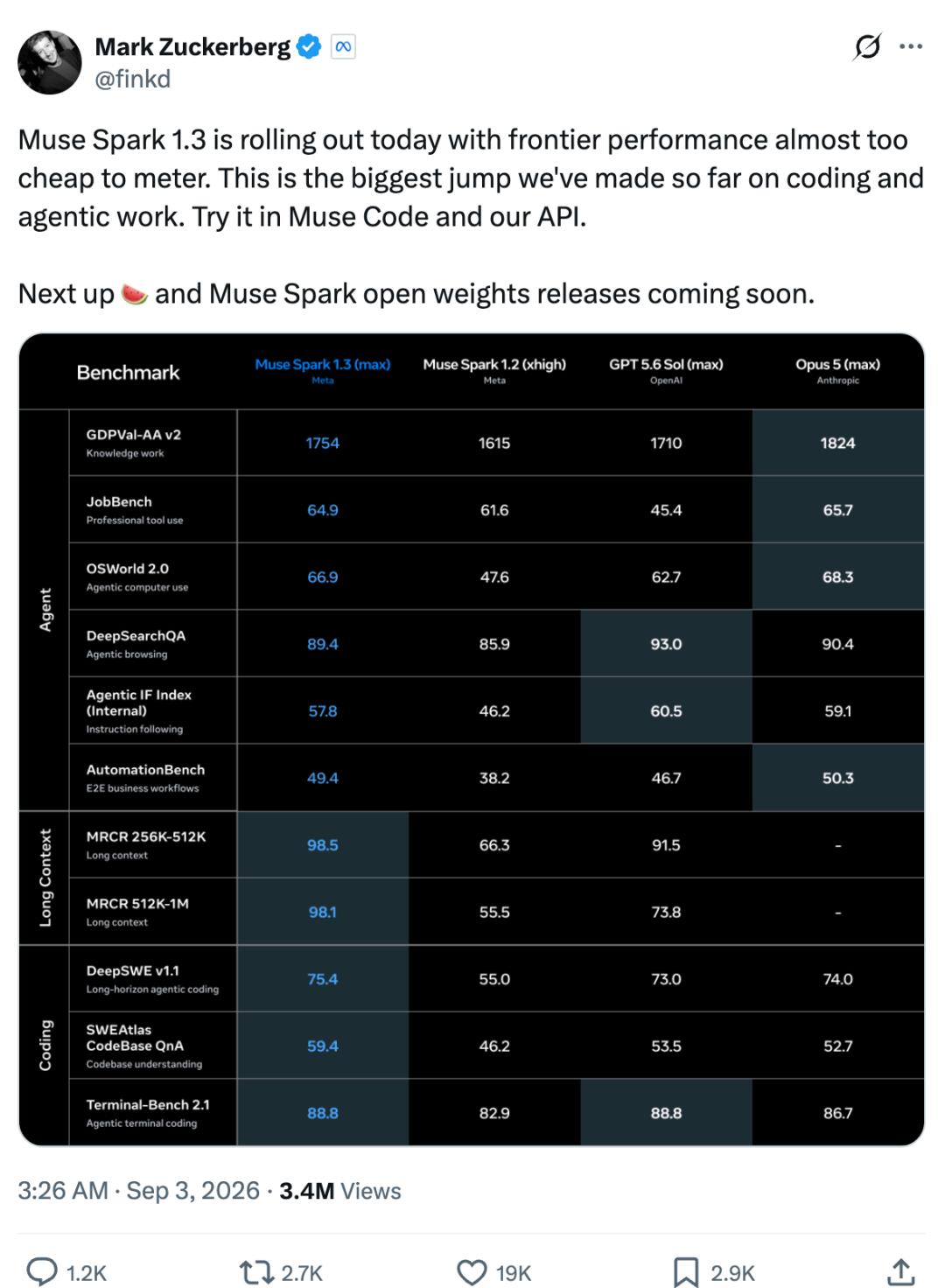
According to calculations by Artificial Analysis, to complete the same task, the cost of Muse Spark 1.3 is approximately $0.55, while the costs of Grok 4.6 and GPT-5.6 Sol in the same performance tier are about $0.94 and $0.95 respectively.
The capital market's concerns that Meta cannot recoup its huge investments are not unfounded. Over the past few years, Zuckerberg has spent money without hesitation in his vigorous effort to catch up with peers in the AI race.
Zuckerberg's AI bill has been piling up on the desktop
Mark Zuckerberg regards AI as a war that he absolutely cannot afford to lose.
First look at capital expenditure, which has surged from $39 billion in 2024 to $72.2 billion in 2025. This year, Meta directly announced a guidance of $130 billion to $145 billion. In just two years, the maximum capital expenditure figure has nearly quadrupled.
R&D expenses have also been climbing continuously. It reached $57.4 billion in 2025, a 31% increase compared to 2024. If we calculate the total R&D spending over the past 12 months, this figure has reached approximately $71.6 billion.
Meta's debt level is also on the rise. At the end of September last year, Meta's long-term debt was about $28.8 billion; by the end of June this year, it had reached $83.7 billion. In May alone this year, Meta issued approximately $24.9 billion in long-term bonds.
Moreover, Meta has spared no expense to recruit top talents in the AI field. For example, Meta acquired a 49% stake in Scale AI for $14.3 billion, directly bringing its founder Alexandr Wang on board. To poach Ruoming Pang, the head of Apple's foundation model team, Meta even offered a multi-year compensation package worth more than $200 million.
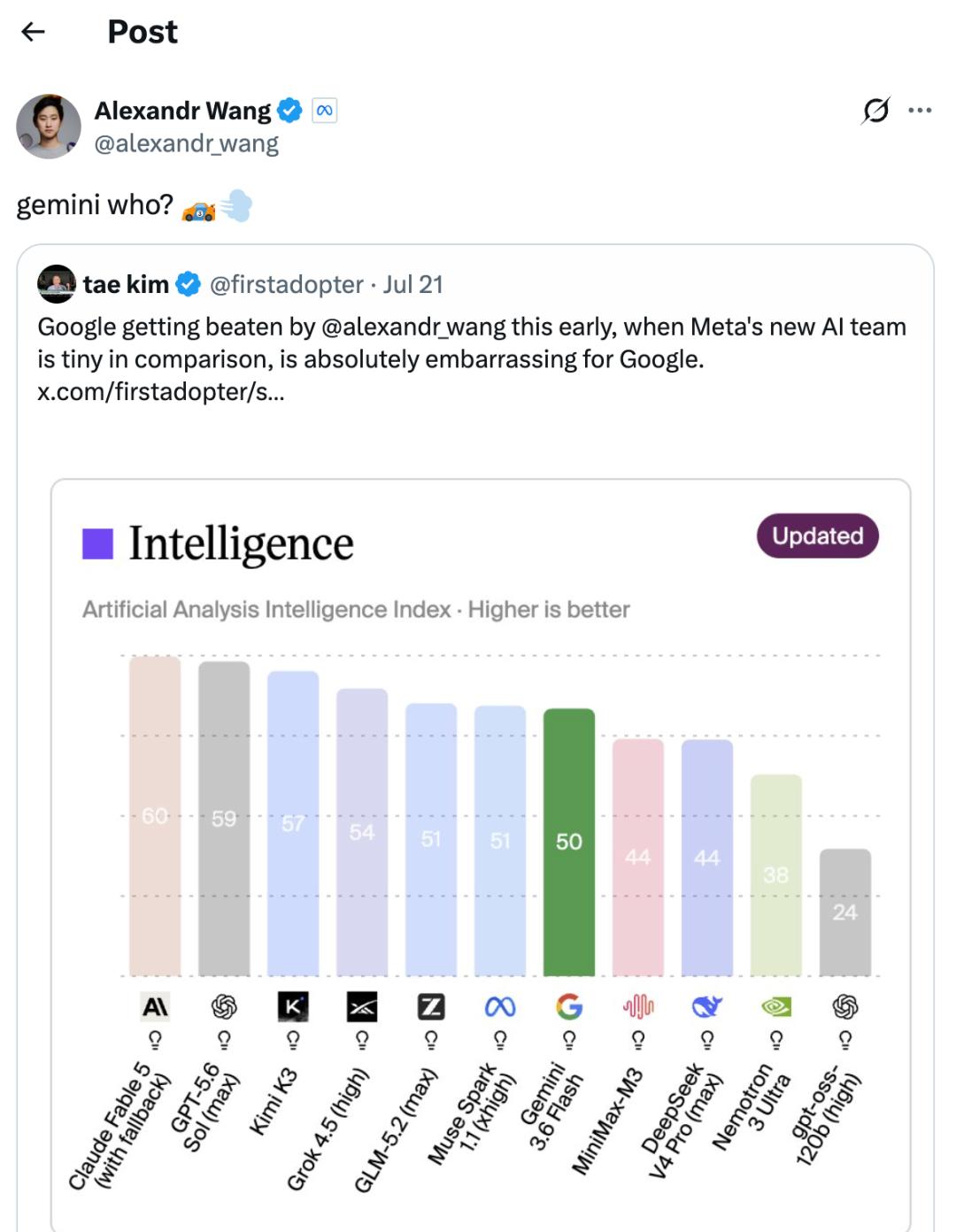
Therefore, the release of this new model is more or less a phased report card: it proves that not all the money invested has gone down the drain.
The new model follows the cost-effective route
Zuckerberg described Muse Spark 1.3 as "affordable". When people checked the price list, they found that the API price of Muse Spark 1.3 is $1.25 per million input Tokens and $4.25 per million output Tokens, which is basically the same as the previous version.
Doesn't that mean Zuckerberg is making unfounded remarks? The "affordability" he refers to does not mean a nominal price cut on the surface.
Meta has enabled the model to complete tasks with less cost, greatly improving cost performance. Official tests from Meta show that compared with Muse Spark 1.2, version 1.3 uses about 20% fewer tool calls in the coding workflow, and Token consumption drops by about 25%. Therefore, even if the unit price is exactly the same, the final total cost for the new model is much lower.
Of course, Meta's new model also provides a "floor price" option. The Contributor version of Muse Spark 1.3 directly lowers the price to $0.10 per million input Tokens and $0.20 per million output Tokens, which is almost free of charge.
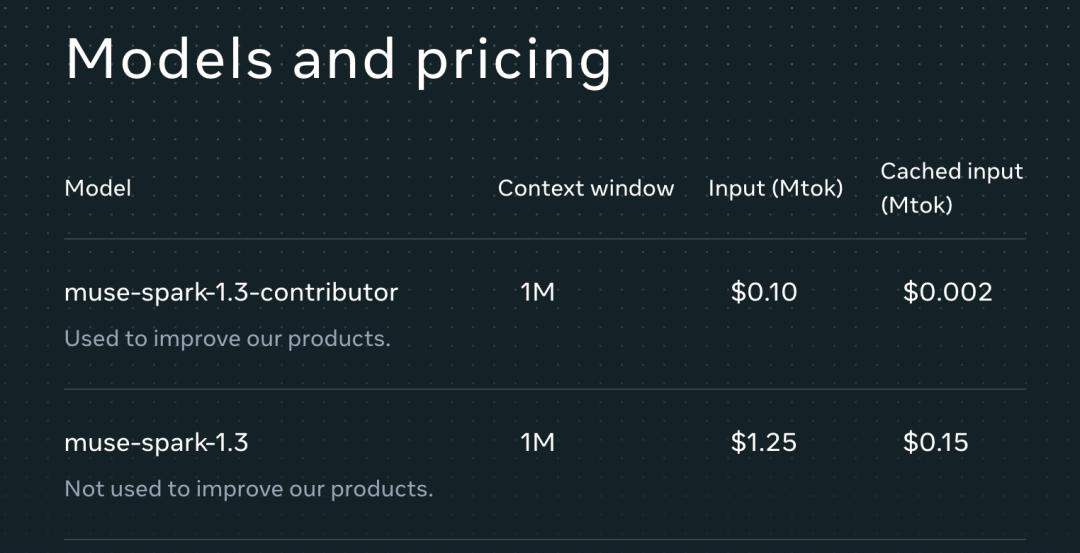
However, if you look closely, Zuckerberg has hidden a small condition: The Contributor version allows Meta to use invocation data to improve the model. While saving computing power, Meta can also obtain feedback to train the model. Zuckerberg has made a very clever calculation this time.
So this deal is very interesting: developers can use the model at an almost ultra-low price, and Meta obtains real-world usage feedback. Both sides get what they need.
Meta's largest customer for its AI business is itself
The stronger the model becomes, the happier Zuckerberg is. When the model itself is a commodity, the more competitive the product is, the more willing users are to use it.
However, Meta has different considerations from pure model companies. The reason why a stronger model can make Zuckerberg breathe a sigh of relief is that Meta finally has a more decent AI base, which can embed model capabilities into its own businesses.
For Meta, the model is for its own use first, and sold to external parties second. The more important task of the model is to improve its existing core business first.
Meta's main revenue comes from advertising. In the second quarter of this year, Meta's total revenue reached $60.8 billion, a year-on-year increase of 28%, of which advertising revenue was about $59.4 billion, a year-on-year increase of 27%. During the same period, ad impressions increased by 14%, and the average advertising price increased by 12%.
Of course, not all of these figures can be attributed to the contribution of AI, and Meta did not dare to claim that in its financial report. But various signs show that AI has begun to enter the core part of the advertising business.
In the second quarter of this year, Meta began to integrate large models into its ad retrieval system, allowing the model to understand both ad content and user preferences at the same time, and then judge which ads are more suitable for which users.
In early tests, only using large models to improve the understanding of user preferences increased Instagram's app event conversion by 1%. After further integrating with other models, Meta stated that Facebook ad clicks increased by 8.3%, and conversions increased by 15.7%.
Meta also has a more direct AI advertising tool called Advantage+. Advertisers only need to input products, budgets and goals, and this tool will be responsible for a series of work including audience targeting, budget allocation, ad delivery and ad material creation.
As of the second quarter of this year, Meta's AI-driven Advantage+ solution has reached an annual revenue run rate of over $75 billion, and more than 9 million small businesses use at least one of Meta's generative AI advertising creative tools.
Of course, this $75 billion cannot be regarded as additional AI revenue generated out of thin air for Meta. It is essentially still part of its advertising business. But this also proves that AI has begun to penetrate into Meta's most profitable business sector.
At this point, when you look at all the money Meta has invested, you will understand that Meta does not necessarily need to earn back the $130 billion by selling models. As long as the model makes the advertising system earn a little more, it has already started to help recoup the investment.
This is also the difference between application-layer companies like Meta and model companies like OpenAI. Meta allows the model to deliver more accurate ad placements, so advertisers are willing to spend a little more money, which can also be counted as part of AI's contribution.
This is why it is not easy to judge whether an application-layer company's AI investment is worthwhile. These funds are scattered in the original business, and it is difficult to separate them independently. But when added together, they constitute Meta's real AI return.
The invisible cycle has already started running
For Meta, AI is more like a brand new, more powerful engine. The engine itself can be sold for profit, but more importantly, it can be installed into the existing "car" to make the car run faster.
As a result, a very interesting cycle has emerged.
Advertisers are therefore willing to invest a little more money, and Meta's advertising revenue increases accordingly. Meta then invests part of this revenue into GPUs, data centers and talents, to continue training stronger models. The stronger models are then fed back into the advertising system to further improve recommendation, ad matching and delivery effects.
Meta now has top-tier models, sufficient capital, real scenarios with billions of users, and a mature commercial mechanism. Model companies need to first prove that AI can become a viable business, while Meta can first make AI a supercharger for its existing mature business.
For Meta, the profit margin of the model itself is not the only account to calculate. If the model is priced a little lower, developers will use it more; the more developers use it, the more real feedback will be obtained. Then the model will continue to be improved, and then integrated into products. Meta's products with billions of daily active users are also a huge real-world experimental field.
This cycle connecting models and products is more hidden, but its value is also higher.
Zuckerberg does not put all his eggs in one basket
Of course, the AI war is extremely capital-intensive, and Zuckerberg is also leaving himself a fallback option.
Meta has started to promote Meta Compute since July this year, exploring the possibility of externally supplying its AI infrastructure and computing power capabilities. Zuckerberg already revealed in May that if there is surplus computing power in the future, renting it out externally is definitely an option to consider.
Recently, Tencent also talked about a similar idea of computing power commercialization. Martin Lau said at Tencent's Q2 earnings call that the company will prioritize the use of computing power for its own models and AI applications, and only after meeting its own internal needs will it consider renting out the remaining surplus computing power.
Interestingly, the metaverse project that Zuckerberg previously spent huge sums of money on has also brought an unexpected surprise.
Back when Meta was developing the metaverse, most of the investment went to the Reality Labs division. This division was a huge loss hole, losing $19.2 billion in 2025 alone. However, the Ray-Ban smart glasses incubated by Reality Labs have unexpectedly become one of the most prominent AI hardware products nowadays. Millions of Ray-Ban Meta smart glasses have been sold so far, and AI has gradually become its core selling point.
Meta's invested funds have not been fully recouped yet, but at least it has found several paths that can generate visible returns. The models are getting stronger and can be sold externally. AI is integrated into existing businesses to boost profits. Surplus computing power can also be rented out. With the combination of hardware and AI, there are also clear signs of profitability.
However, having more cards in hand does not guarantee that Zuckerberg will win. Moreover, Meta's current spending rate is much faster than the realization speed of these returns. In the second quarter of this year, Meta's free cash flow plunged 91% year-on-year, a figure that still made Wall Street feel worried.
Meta has not yet fully sorted out the accounts of this hundred-billion-dollar level investment. But at least it can be seen that for application-layer companies like Meta, the value of AI has the opportunity to be transmitted from the model itself to existing business scenarios, and gradually be converted into actual returns. This is probably the most anticipated advantage for companies with mature businesses and strong user connectivity in the AI era.
This article is from the WeChat official account "Deep Flow Research Institute", written by Zhi Feng, published with authorization from 36Kr.