Huawei, Xiaomi and Apple are vying to enter the market, why have large-size foldable phones become so popular?
It was once thought that the wide-fold design was just a "unique product" created by Huawei. However, a growing number of mobile phone manufacturers are scrambling to enter this track.
Xiaomi has officially announced that it will hold a new product launch event on September 7, launching its first "medium-fold" mobile phone, the Xiaomi 18 Fold, whose inner and outer screens adopt the standard paper aspect ratio of approximately √2:1. Coincidentally, according to Bloomberg, Apple will also launch its first foldable-screen iPhone at the autumn new product launch event to be held on September 10, with a screen aspect ratio of about 4:3 when unfolded.
Not only Huawei, Xiaomi and Apple, supply chain sources show that smartphone manufacturers including vivo, OPPO and Honor have all started planning their respective wide-fold mobile phones, which are expected to be launched within this year and next year.
The current wide-fold products are quite similar to the large-fold mobile phones around 2020. At that time, driven by Samsung, smartphone manufacturers such as Huawei, Xiaomi and OPPO also intensively laid out large-fold mobile phones.
So here comes the question: It has been seven years since the birth of large-fold mobile phones, why have they failed to open up the market for so long? Why do smartphone manufacturers choose to bet on the wide-fold form? What changes will wide-fold mobile phones bring to the foldable screen market?
Seven Years After the Birth of Foldable Screens, Reaching the Growth Ceiling
As a new type of product, foldable-screen mobile phones showed extremely strong growth at the beginning of their birth. Data disclosed by IDC shows that from 2020 to 2022, the shipment volume of foldable-screen mobile phones in China increased from 470,000 units to 3.3 million units, with a compound annual growth rate of 164.98%.
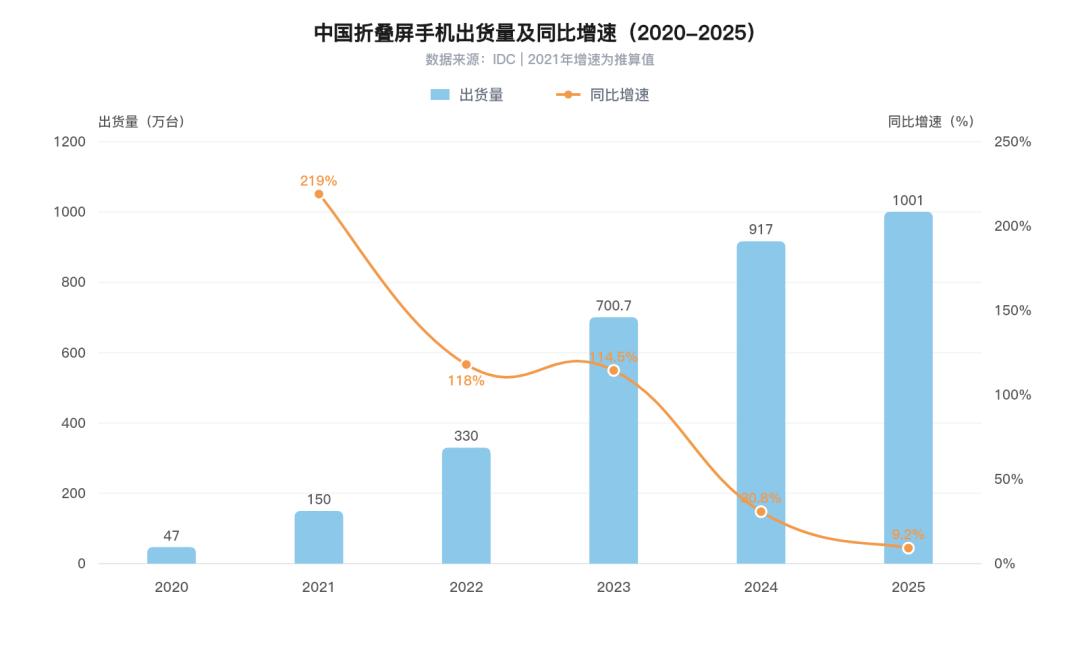
However, in recent years, the growth rate of the foldable-screen mobile phone market has gradually slowed down. From 2023 to 2025, the shipment volume of foldable-screen mobile phones in China rose from 7.007 million units to 10.01 million units, with a compound annual growth rate of only 19.52%.
Entering 2026, China's foldable-screen mobile phone market has even fallen into the mire of negative growth. According to Sandalwood's China e-commerce monitoring data, from January to July 2026, the sales volume and sales revenue of foldable-screen mobile phones fell by 10% and 9% year-on-year respectively.
Overall, although seven years have passed since its birth, foldable-screen mobile phones have not become mass products. In 2025, the shipment volume of foldable-screen mobile phones accounted for only 3.52% of China's total smartphone market.
The decline in the popularity of foldable-screen mobile phones is not due to slow product progress. In the past few years, smartphone manufacturers have made great efforts to improve the user experience of such products.
Source: OPPO
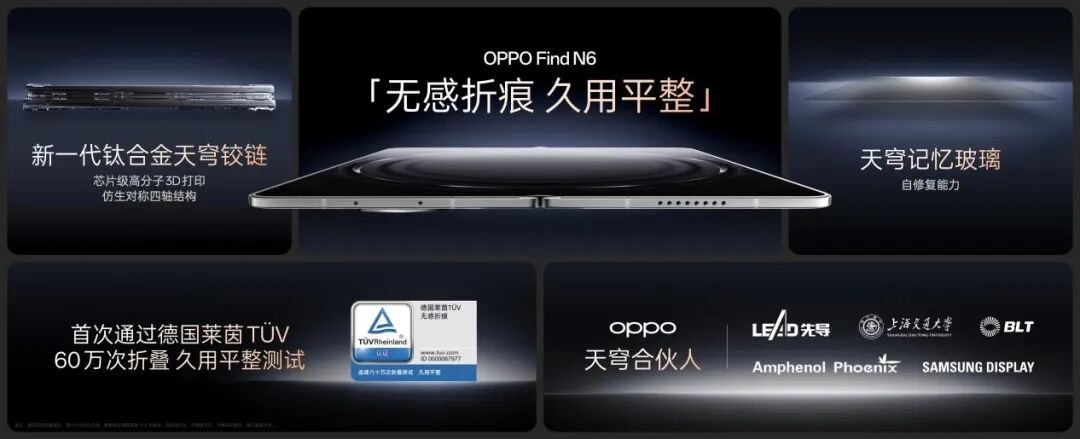
For example, to eliminate scratches, the OPPO Find N6 uses Dome Memory Glass, with bending deformation resistance increased by 338% and the chemical strengthening layer thickened by 148%. Paired with the new-generation titanium alloy Dome Hinge, the flatness of the hinge middle plate is increased by 75%, and it has passed the new-generation German Rhein TÜV Imperceptible Crease Certification.
According to the leak from digital blogger "Dingjiao Digital", even Apple, which has strong technical strength, the screen flatness of its upcoming first foldable-screen iPhone only reaches the level of the OPPO Find N6.
In addition to making every effort to eliminate screen creases, in recent years, smartphone manufacturers have also been committed to reducing the weight and thickness of foldable-screen mobile phones to improve portability.
Source: Honor
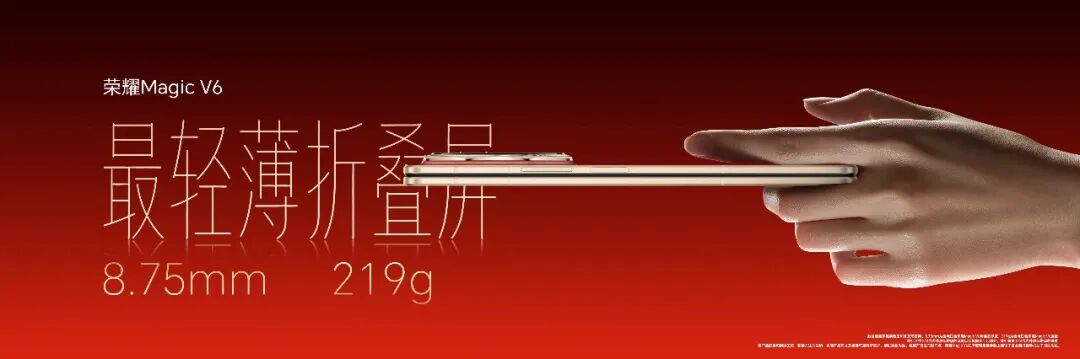
Take the Honor Magic V series as an example. The first-generation Magic V, launched in January 2022, has a folded thickness of 14.3mm and a minimum weight of 288g; the Magic V6, launched four years later, has a minimum thickness of 8.75mm in the folded state and a minimum weight of 219g, which is almost comparable to traditional bar phones.
Against the background of the rapid progress of hardware configurations, it is increasingly difficult for foldable-screen mobile phones to convince consumers to pay, which is largely due to the lag of the software ecosystem.
As is known to all, due to the complex variety of device models, the Android ecosystem has long had the problem of fragmentation. The special screen aspect ratio of foldable-screen mobile phones further amplifies the shortcomings of the Android ecosystem.
At present, the outer screen aspect ratio of most large-fold mobile phones is 21:9, and the inner screen aspect ratio after unfolding is close to 1:1. Since most bar phones also use narrow and long screens, the user experience of the outer screen of large-fold mobile phones is no different from that of traditional smartphones.
Source: Mr. He
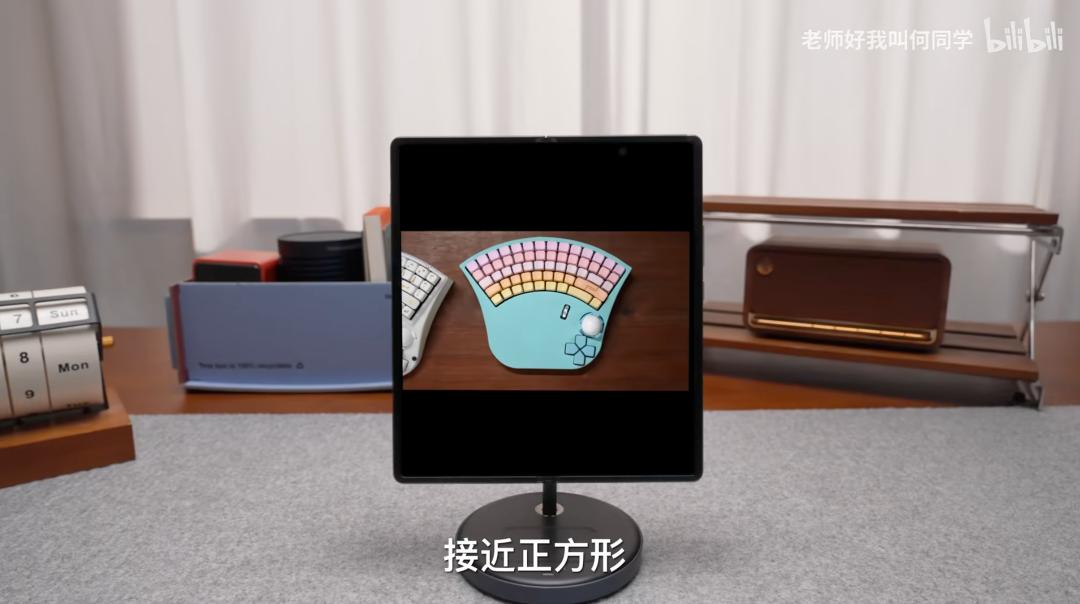
However, since few Android devices adopt a 1:1 screen aspect ratio, coupled with the low enthusiasm of developers for adaptation, it is difficult for users to obtain a "one plus one greater than two" user experience after unfolding the large-fold mobile phone. When watching videos, there will be large black borders at the top and bottom; when opening mini-programs, the UI is simply stretched and enlarged; when using shopping apps, the content is still displayed according to the logic of a single screen.
When reviewing the Honor Magic V6, digital blogger Mr. He commented: "The biggest problem with foldable screens is not that the inner screen is useless, but that you don't know whether it will become more user-friendly or less user-friendly after unfolding, and there is great uncertainty in the experience."
Considering that the selling price of foldable-screen mobile phones is much higher than that of traditional bar phones, if the inner screen experience is not good, consumers will naturally reflect on whether it is worth paying a higher cost for a larger screen.
Behind the Hot Sales of Huawei Pura X, Wide-fold Finds the Balance Point
When the growth rate of China's foldable-screen mobile phone industry is slowing down, the sales volume of the Huawei Pura X series has been rising steadily, making it a hit product.
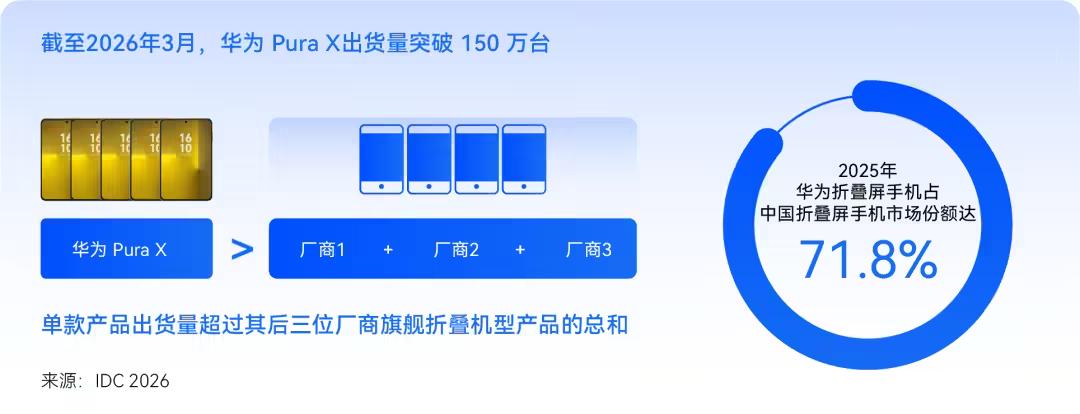
Source: IDC
IDC data shows that by the first anniversary of its launch in March 2026, the shipment volume of the Huawei Pura X series reached 1.5 million units, exceeding the total sales of the flagship foldable models of the following three manufacturers. Driven by this product, Huawei's market share of foldable-screen mobile phones in China's foldable-screen mobile phone market reached 71.8% in 2025.
The reason why the Huawei Pura X series can win market popularity is largely due to its unique screen aspect ratio. Taking the Huawei Pura X Max as an example, it no longer follows the narrow and long design language of large-fold mobile phones, but adopts a short and wide design with a screen aspect ratio of √2:1.

Source: Huawei
As is known to all, √2:1 is the standard ratio in the publishing industry, because this ratio has "self-similarity" — after folding along the long side, the ratio remains unchanged no matter how many times you fold it. The adoption of this ratio by foldable-screen mobile phones can not only ensure the unified experience of the inner and outer screens, but also bring a stronger sense of immersion when viewing content.
In fact, from the market perspective, small-screen tablets have fully proved that consumers have strong demand for wide-screen portable devices. According to statistics from Sandalwood, from January to July 2026, China's overall tablet market fell by 8%, but small-screen tablets under 9 inches increased by 22% year-on-year.
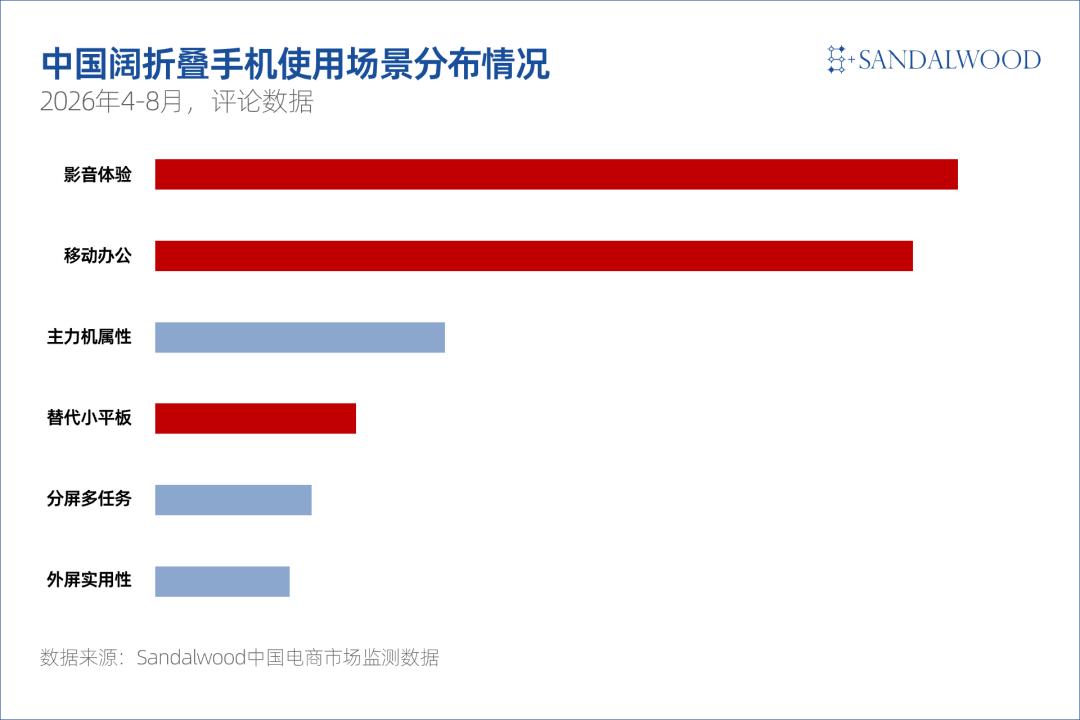
Source: Sandalwood
Wide-fold mobile phones with a √2:1 screen aspect ratio can not only attract some consumers who are interested in small-screen tablets, but also inherit the mature tablet ecosystem.
Since the screen aspect ratio of most tablets is 4:3 or 3:2, which is highly similar to that of wide-fold mobile phones, developers can make the software on the tablet adapt to wide-fold mobile phones through simple transplantation.
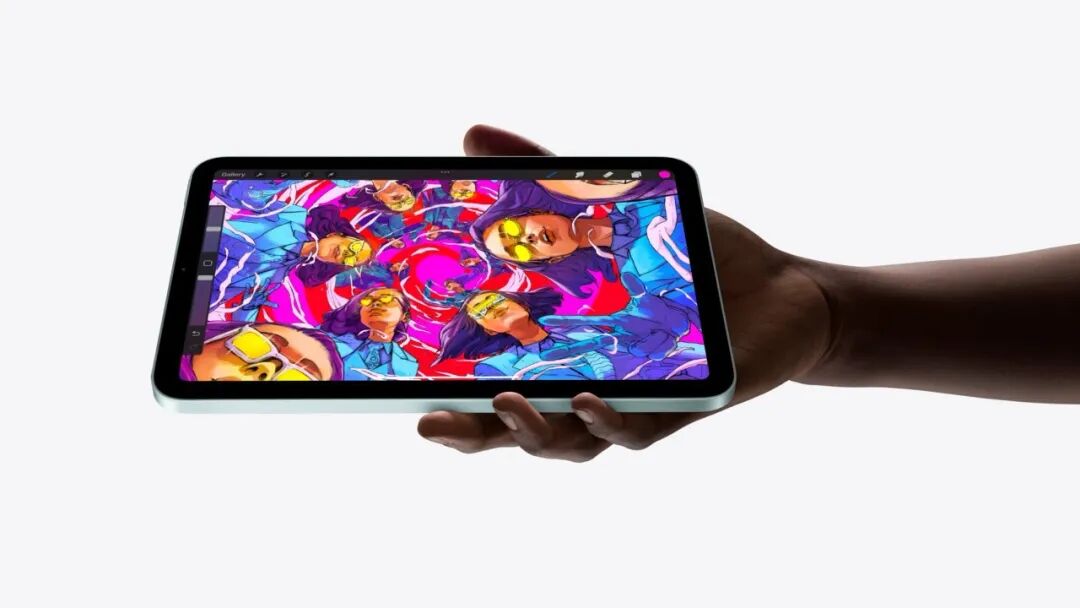
Source: Apple
This is also the core incentive for the foldable iPhone to adopt the "short and wide" design. Since its launch in 2010, most iPads have a screen aspect ratio of 4:3. Relying on the SwiftUI framework, a large number of App Store applications are naturally capable of cross-device self-adaptation. It can be said that before the birth of the foldable iPhone, the software ecosystem has been fully prepared.
Overall, the current wide-fold mobile phones are very similar to the tablets around 2010. At that time, iPad opened up a brand new incremental market between iPhone and Mac. Wide-fold mobile phones, between bar phones, large-fold phones and small tablets, find a balance point that combines portability, large-screen availability and main phone experience.
Wide-fold Not Only Changes Screen Aspect Ratio, But Also Rewrites the Evolution Logic of Foldable Screens
In June 2026, when introducing the Huawei Pura X Max, Yu Chengdong, Executive Director of Huawei, Director of the Product Investment Review Committee, and Chairman of Huawei Terminal BG, said: "Wide-fold products follow the design concept of 'born for content', and the core goal is to improve the practicality of foldable screens, so that people will be more willing to use them."
Yu Chengdong's remarks not only expound the design concept of the Huawei Pura X series, but also reveal to a certain extent that the underlying evolution logic of foldable-screen mobile phones has changed.
In the past seven years, smartphone manufacturers have been following the concept of "the larger the screen after unfolding, the better" to create large-fold products. Therefore, the competition among manufacturers has long centered on hardware indicators such as hinges, creases, lightness and thinness, reliability, and screen size.
The problem is that the progress of hardware cannot make up for the shortcomings of the software ecosystem. As mentioned above, due to the square aspect ratio after unfolding and the lack of ecological resources, it is difficult for large-fold mobile phones to significantly improve the user experience. Eventually, the huge inner screen has become a decoration.
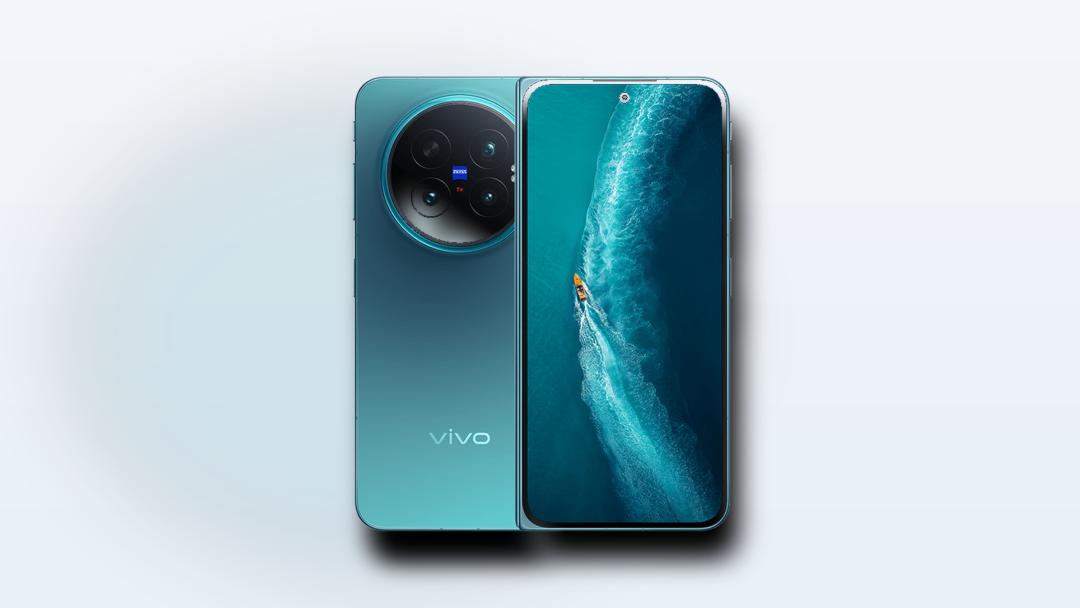
Source: vivo
At the vivo X Fold6 launch event held in June 2026, Huang Tao, Vice President of vivo, revealed that foldable-screen mobile phones are getting better, but the core usage mode is no different from that seven years ago. Therefore, the inner screen usage rate of many foldable-screen users is less than 30%, which is a great pity.
In contrast, wide-fold rewrites the underlying evolution logic of foldable-screen mobile phones — from pursuing "larger size" after unfolding, to first ensuring the user experience in the unfolded or folded state, and then using the foldable form to create incremental value.
Since it has found an appropriate balance between cost and benefit, if the thickness, weight and price can be continuously reduced in the future, wide-fold mobile phones may even break out of the relatively independent high-end niche market, no longer only competing with large-fold mobile phones, but also competing with ordinary flagship phones and small-screen tablets.
All in all, seven years after the birth of foldable-screen mobile phones, smartphone manufacturers are exploring wide-fold mobile phones unanimously. It is not so much active innovation as a helpless choice after large-fold mobile phones hit the growth bottleneck.
Learning from the lesson of large-fold mobile phones that "only have a large screen but poor experience", wide-fold mobile phones take the opposite approach: first determine the anchor point of user value, and then carry out foldable design, showing stronger competitiveness.
However, at the present stage, wide-fold mobile phones only prove that they have strong comparative advantages over large-fold mobile phones. Compared with bar phones or small-screen tablets, there are still certain shortcomings in terms of price, reliability and other aspects.
A typical example is Huawei. To cater to mass users, it has extended the wide-screen design of the Pura X series to the bar phone market, and launched the wide bar phone Huawei Pura X View.
It can be said that realizing the innovation of wide-fold form is only the first step for foldable-screen mobile phones to return to growth. In the future,