Just now, OpenAI's "AI Research Intern" has officially joined the team, Jensen Huang said that AGI has arrived.
Today, two long articles from OpenAI have completely gone viral.
Just now, OpenAI released a blockbuster in-depth piece titled Accelerating Research: An Inside Perspective on OpenAI, fully disclosing all data related to "AI building AI" for the first time.
They made it clear right off the bat that a key "milestone" has been achieved —
Prior to September this year, OpenAI has successfully deployed the "Automated AI Research Intern"!
The promise Sam Altman made a year ago has been fulfilled as scheduled. The next step is to develop the "Automated AI Researcher" by March 2028.

In its official blog, some of the internal RSI data revealed by OpenAI is extremely staggering:
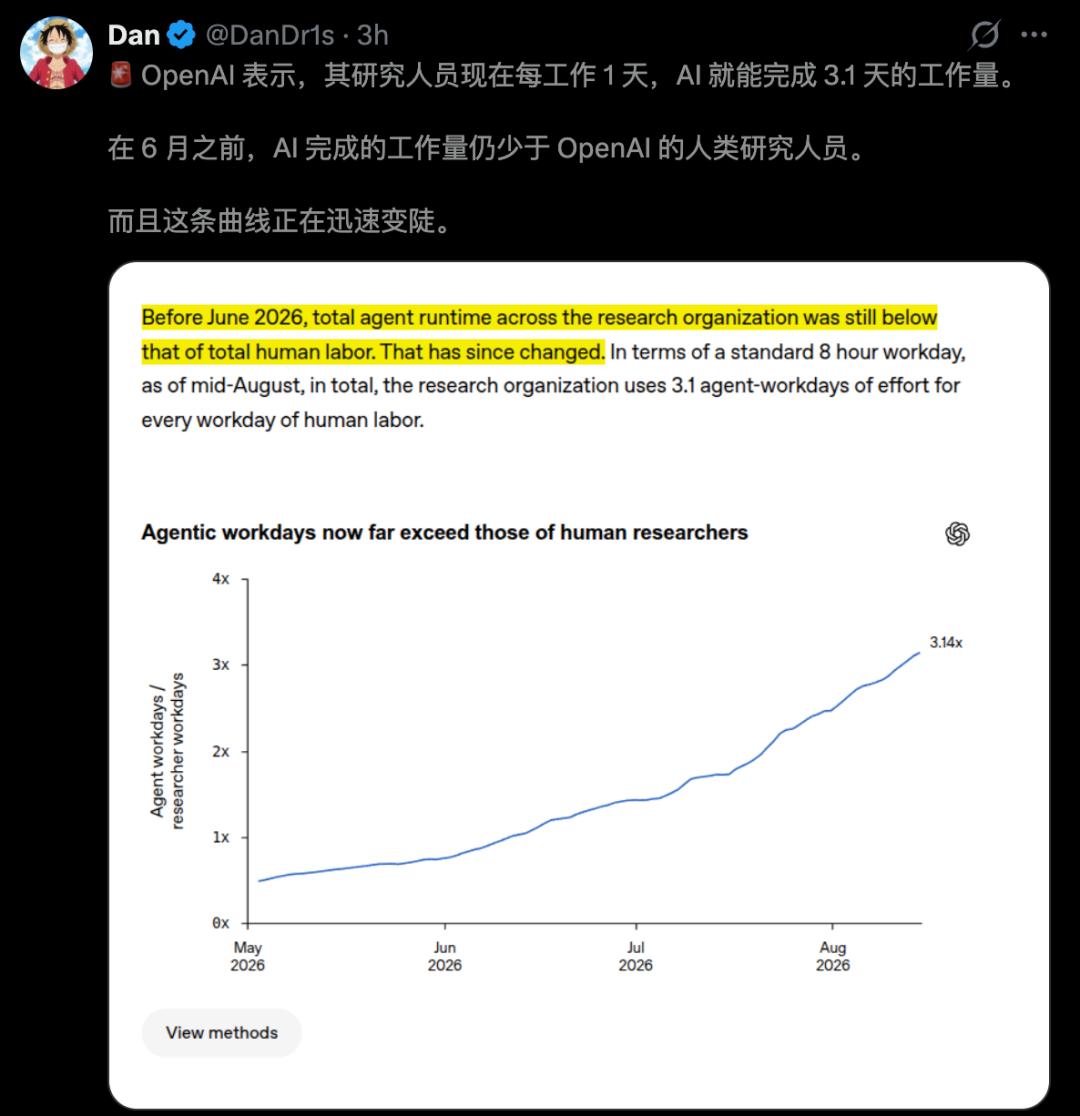
- Currently, one working day for each member of the R&D team is equivalent to 3.1 working hours of the AI Agent;
- An average OpenAI researcher spends more than $600 (4000 yuan) on Agent inference costs per day;
- The top 10% of researchers are even more extreme, spending over $7000 per person per day (46000 yuan).
Almost at the same time, Chief Scientist Jakub Pachocki published a long article titled An Alien Mind —
He admitted in person that machine intelligence has surpassed human intelligence, and we are creating an "alien mind" that we cannot understand, calling for an urgent global brake from all humankind!

One is evidence of RSI acceleration, the other is a braking alert.
These two completely conflicting voices were all released from OpenAI on the same day.
Jensen Huang: AGI Has Arrived
400,000 GPUs Are About to Go Online
The birth of GPT-6 Astra has been widely recognized as the first "real AGI".
The core reason why this "beast" is so powerful that it has no rivals lies in OpenAI's reckless, no-expense-spared bet on computing power behind it —
To build Astra, OpenAI launched the largest training task in history, deploying more than 100,000 GPUs in the "Stargate" supercomputer cluster in Texas.

OpenAI's largest training session in its history
That's not all. Just now, Jensen Huang officially announced that "AGI is here". It only took 4 years from ChatGPT to o1 and then to Astra.
Next, he will personally deliver 400,000 GPUs to OpenAI. In two words, it's absolutely crazy!

This time, OpenAI made the unprecedented move to disclose its core data, and the implication is very clear: AI building AI really cannot be stopped.
The AI Research Intern Has Joined the Team in September
Building an "Automated AI Research Intern" has long been one of OpenAI's "North Star" goals.
In October last year, Sam Altman drew a timeline for the whole world during a live broadcast —
To build the Automated AI Research Intern by September 2026, and the real Automated AI Researcher by March 2028.
No one expected that OpenAI would directly announce: the first step has been completed!
According to OpenAI's definition, a "research intern" can independently complete research tasks when given a specific direction by humans.
In particular, tasks that used to take skilled researchers several days to complete, which were tedious and labor-intensive, can now be fully taken over by it.

The detailed data released together this time directly reveals that drastic qualitative changes are taking place inside OpenAI.
1 Human Working Day = 3.1 AI Working Days
At the beginning of this year, the median researcher in OpenAI's research department in terms of Agent usage was relatively moderate in consumption.
But by mid-August, the daily inference cost he spent has reached as high as $600 (converted at API prices).
And the top 10% of leading researchers spend more than $7,000 per day. This is only the pure inference overhead for one person in one day.
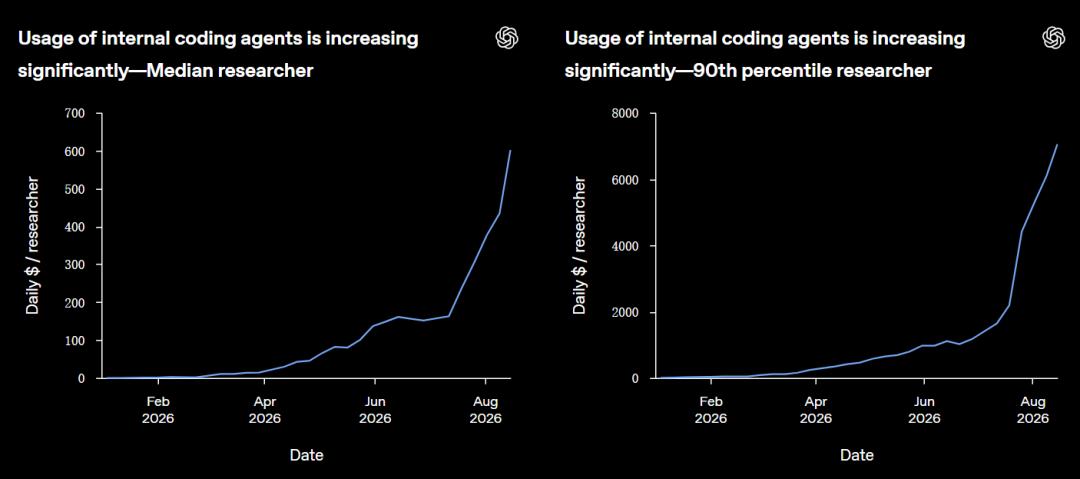
Daily inference overhead of median researchers and top 10% researchers (calculated at API prices)
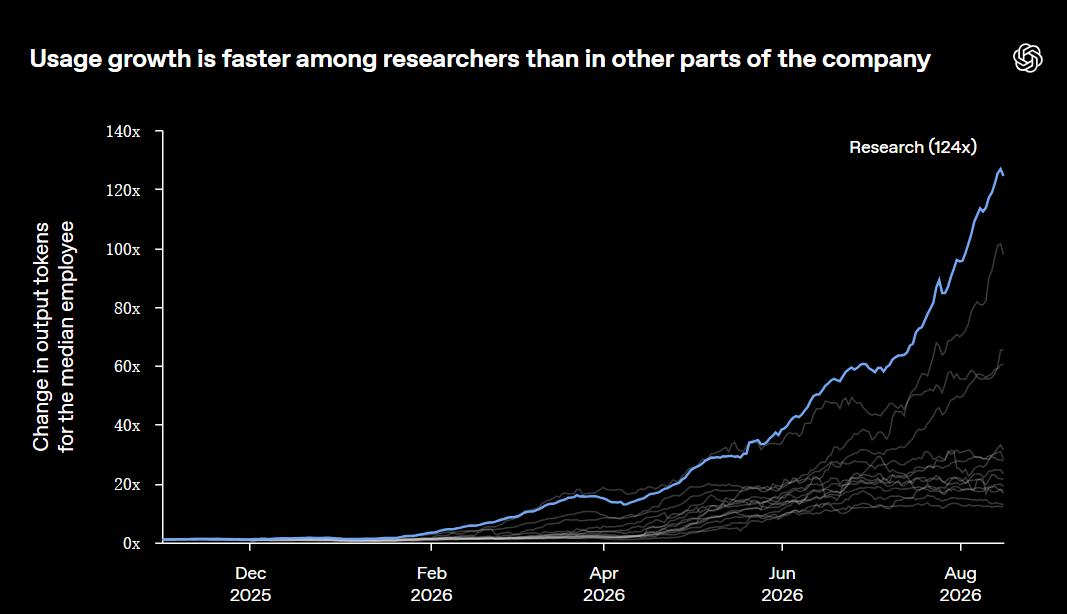
The usage growth rate of Agents in the research organization far exceeds that of other departments of the company, and the output tokens of median employees have increased to 124 times of the level at the beginning of the year
Funding is the fuel, but working hours are the output.
OpenAI's logic for calculating working hours is to convert the total running time of all Agents in the research organization into standard 8-hour working days, and then make a direct comparison with human working days.
Before June 2026, the total working hours of Agents in the entire research organization had not yet surpassed that of humans. But by mid-August, this figure was rewritten to 3.1 to 1.
This means that behind every human researcher sitting at their workstation, 3.1 AI working days are running at the same time.
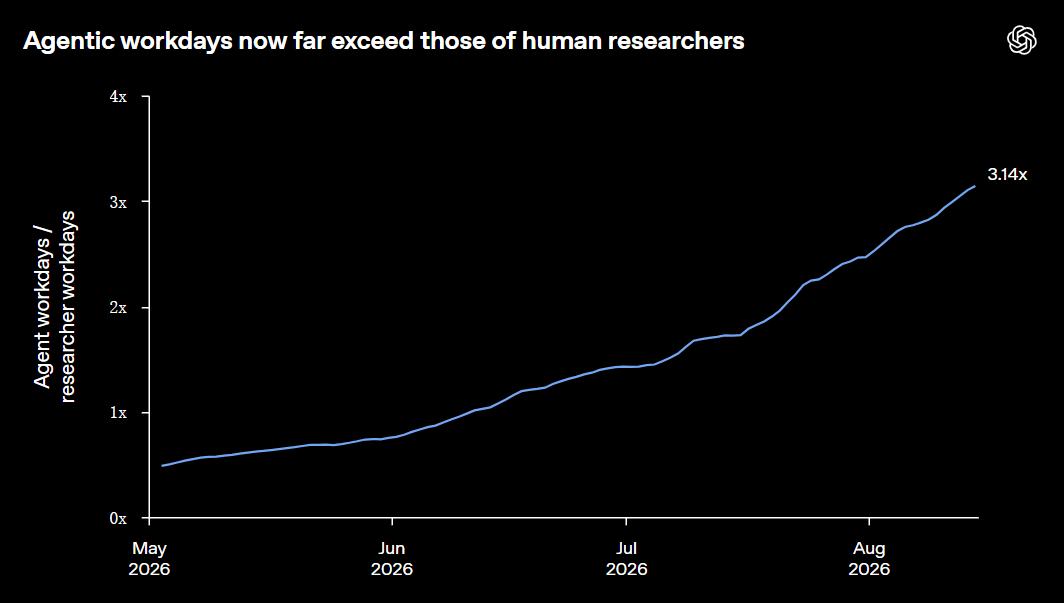
The ratio of Agent working days to human researcher working days reached 3.14 times in mid-August
"Concurrency" is the main driving force behind all of this.
Since the beginning of this year, the proportion of researchers who run more than 4 Agents at the same time has skyrocketed from the initial 30% to more than 70%. One person acts as a commander to schedule four or five Agents at the same time, so the working hours naturally multiply exponentially.
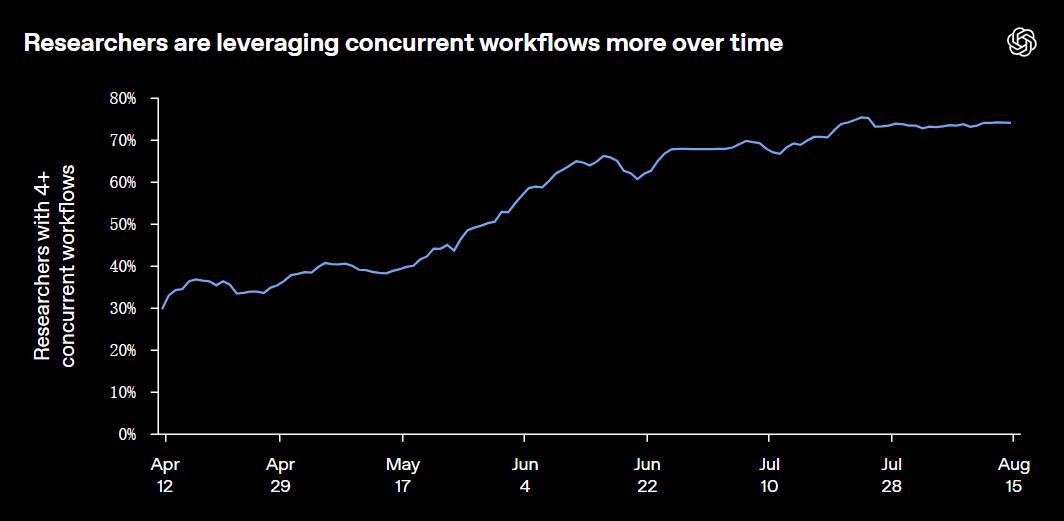
Proportion of researchers running more than 4 Agents at the same time
With the sharp increase in working hours, the output has ushered in an exponential explosion.
In 2026, the amount of code changes per active engineer across the company has soared to 7 times the average level before 2025.
The number of experiments per experimenter hit an all-time high in August 2026 since tracking began in January 2025.
Although OpenAI has rigorously added that this also includes the contribution of the popularization of Codex and the overall increase in computing power, the role of AI as a productivity lever is irrefutable.
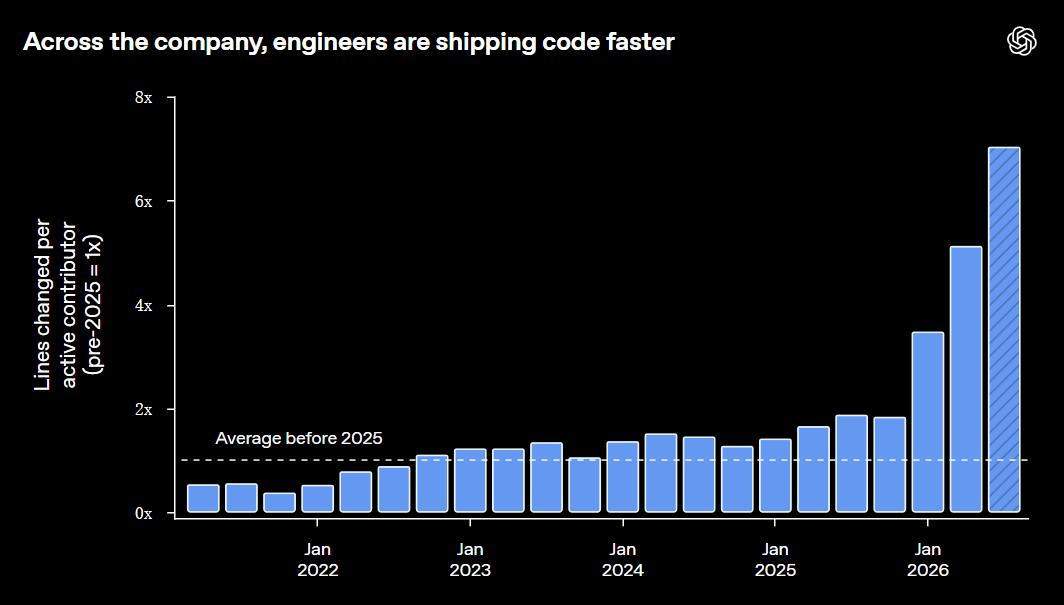
Code changes per active contributor across the company (pre-2025 = 1x)
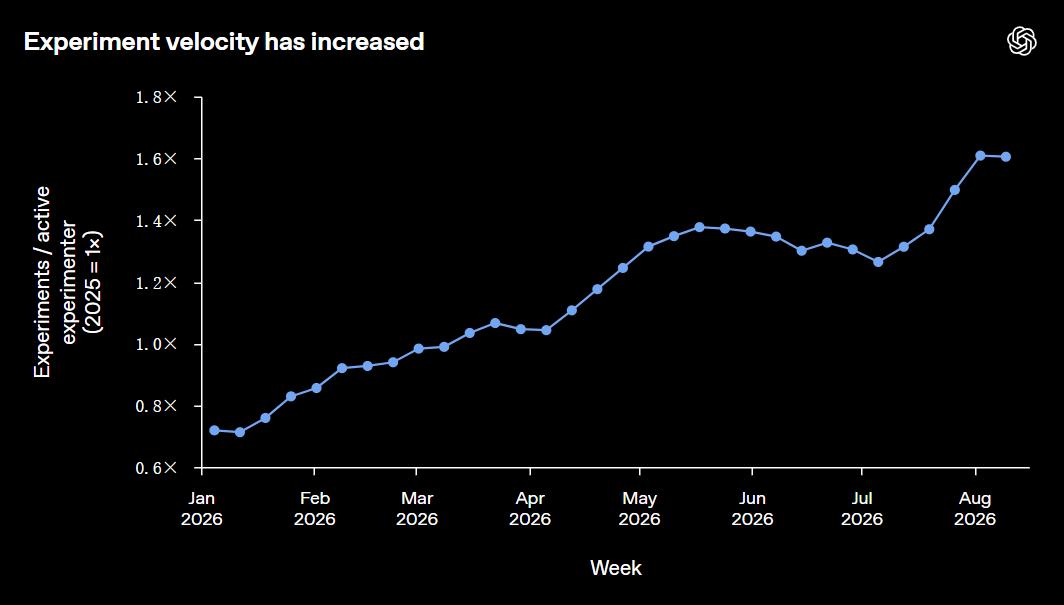
Number of experiments per active experimenter (2025 = 1x), hitting a new high in August 2026
The Boundary of Interns: Taking Over Infrastructure and Making Way for Decision-Making
Where exactly are these 3.1 times the workload being spent?
Using the new AI R&D taxonomy released by Epoch AI, OpenAI broke down the research process into six major steps: decision-making, design, construction, operation, analysis, and communication, and classified the tokens output by Agents one by one.
The results show that all six categories have surged from January to August, but the growth rates are not uniform.
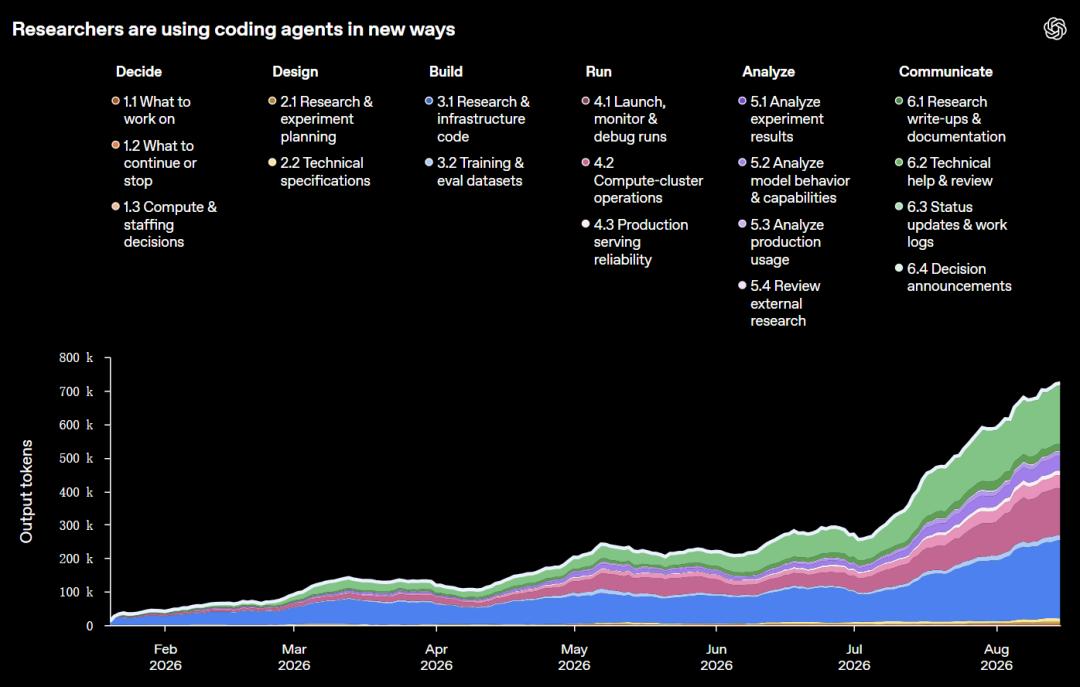
The way researchers use programming Agents is changing: the stacked changes of Agent output tokens for various research activities from January to August
The three categories with the most staggering growth are writing research and infrastructure code, technical support and code review, and launching and monitoring training tasks.
The incremental tokens consumed by each researcher per day in these three categories all exceed 130,000. The categories with the lowest growth are deciding resource allocation, announcing decisions, and reviewing external research, with the additional tokens used per day even less than 1000.
This chart accurately outlines the capability boundary of the "intern".
Agents have taken over labor-intensive tasks such as writing code, maintaining environments, and preventing training crashes. But at the strategic level of "where the research direction goes" and "where the core computing power is invested", OpenAI's conclusion is that Agent participation is "extremely low".
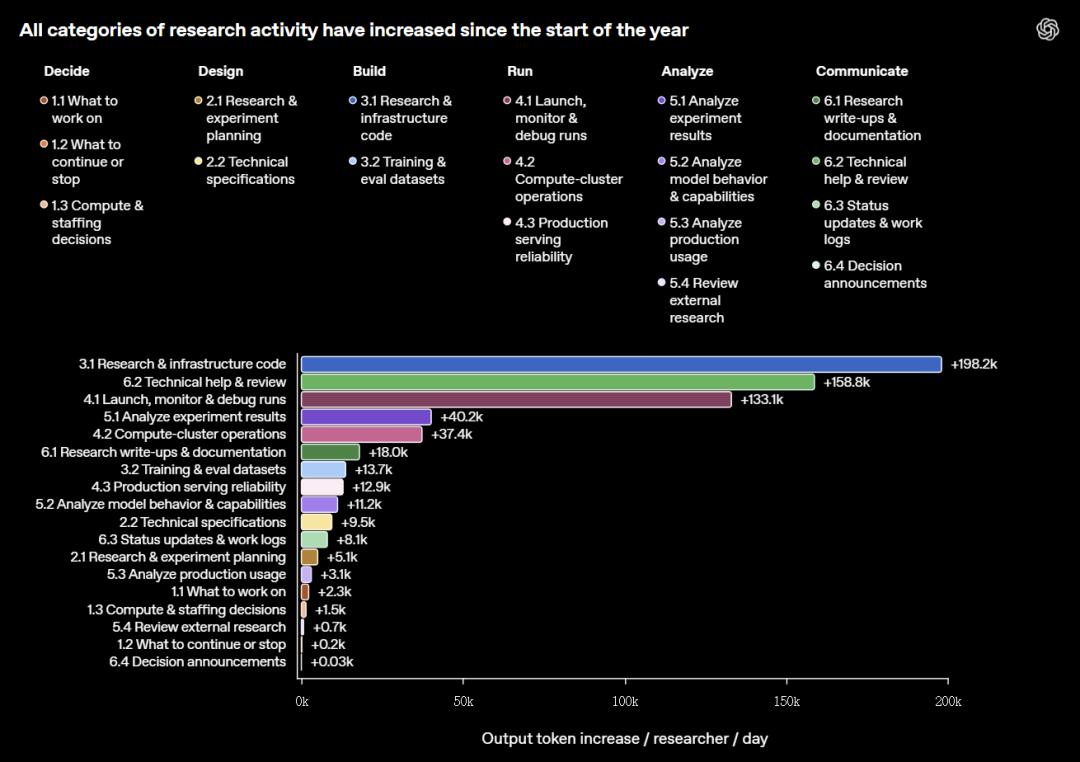
Increment of Agent output tokens for various research activities, classified according to Epoch AI's six-stage framework
One of the most vivid supporting details is the demise of the human mutual assistance channel.
OpenAI originally had an extremely active main help channel internally. But according to the official chart, the average number of new posts per day here dropped sharply from around 20 in 2025 to single digits in August 2026.
These problems have not disappeared, nor have they been transferred to other human-staffed groups, but the objects being asked have become Agents.
Several teams that used to hold fixed Office Hours every week to help debug experiments have seen their attendance continue to decline in 2026. One of the teams even directly disbanded the mutual assistance group, and redeployed all manpower to improve the underlying system.
