Why did I shut down the AI social product that I had devoted half a year of effort to?
Can one person independently build a successful C-end product with the help of AI? Taking an AI social mini-program as an experiment, the author of this article went through half a year of trial and error from "human search engine" to returning to traditional mutual selection, and finally revealed the deep dilemma of pure online social interaction. Success at the production level does not equal commercial success. AI can improve efficiency, but it cannot solve the core problem of two-way willingness.
I. Can one person plus AI really make a product successfully?
In the first half of this year, I have been exploring the boundaries of AI capabilities, and I also want to verify one thing: can one person, with the help of AI, independently complete a truly usable C-end product and finally realize commercialization.
I chose AI social networking. But this is not a project that starts from scratch with no foundation at all.
Over the past nearly five years, our company has been working on community products for young people and the campus market, serving more than 300,000 accumulated users. At present, we still have 20,000 to 30,000 daily active users and a high retention rate. Finding dates and making friends has always been a very strong demand among college students;
I myself have both product and full-stack development capabilities, and have accumulated rich experience in product operation and activity planning, so I can quickly implement ideas and adjust product directions without obstacles.
In other words, this project already has the basic cards required for social products - technology, traffic, user understanding, operation experience and business cognition. It is not a hasty attempt by a startup novice with zero resources. What about the results?
From the perspective of productivity, this attempt was actually successful.
With the help of AI, I completed the product design, system architecture and main development work of the mini-program on my own. In addition to the infrastructure such as account system, self-built AI search capability, instant messaging, notification reminder, member points and online payment;
We also successively launched functions such as AI recommendation, mutual liking selection, intelligent profile analysis, relationship test, and invitation fission. All of them have been operating stably online and have been tested by thousands of users.
In the past, this was already a medium-sized project that required at least a team of 5 to 6 people and continuous development for more than three months. Now, a person with relatively comprehensive capabilities can independently complete it with the help of AI.
"One person is equivalent to a whole team" is no longer just a publicity slogan. It is becoming a reality, and it will only become more and more common in the future.
But on the other hand, although the product was made, the business model was not validated successfully.
The mini-program was eventually suspended by us. The further I developed it, the lower my confidence in pure online social networking became. It's not that no one used the product from beginning to end - if that was the case, this project would not even be worth reviewing.

What really made me hesitate and devote myself to it for more than three months was that it once increased the next-day retention rate to more than 35%, had over 100 paying users shortly after launch, and later some users continued to log in and renew their subscriptions. These feedbacks once made me think that the core experience had been established, and the remaining problem might only be growth.

Unfortunately, after half a year, we gradually saw clearly: Having users, retention and paying users does not mean that a product can be operated sustainably. Success at the production level will not automatically translate into commercial success.
After years of development, pure online social networking has almost exhausted all possible optimizations for product mechanisms. Adding more functions may improve partial data, but it is difficult to break through the ceilings in supply and demand, trust, frequency and business.
If you want to achieve a breakthrough, you can't continue to follow the existing paradigm to make a "smarter online social software", but to cut into new social scenarios with higher complexity and higher thresholds.
In the following, I will fully review my experience in the past six months, hoping to help the majority of AI entrepreneurs.
II. The original ambition: to build a "human search engine"
Around October 2025, many products had already appeared in the AI social track: some focused on AI companionship, some cut into the dating and marriage field, and some tried to let AI act as agents for users to make calls and meet new friends.
As a product manager who has worked in the social product field for many years, what I wanted to do at that time was none of these, but a larger proposition: human search engine.
The starting point of this idea is very simple. In the past, we had Baidu for searching information, Taobao and JD for searching goods, but there has never been a real product for searching "people".
I thought at that time that this might not be because the demand did not exist, but because the complexity of human beings is far higher than that of information and goods. To build connections between people, we also need to solve problems such as the authenticity of profiles, identity trust, and the willingness of both parties. Before the emergence of AI, traditional technology was difficult to understand the complex needs of a person, and it was also difficult to describe and match another person accurately enough.
Since the last era gave birth to information search engines and commodity search engines, in the AI era, will "human search engine" also be a large enough proposition of the times?
At the same time, traditional social products have also begun to show signs of fatigue. Most products still rely on swiping left and right and profile card display, and users are gradually tired of social interaction that only focuses on appearance and personal display. Under the Matthew effect, the vast majority of attention is concentrated on a small number of users with outstanding conditions. I judged at that time that such products were entering a downward stage, and AI had the opportunity to redefine the way of finding people.
Our vision is: users no longer need to browse profiles repeatedly, but only need to describe what kind of person they want to know in one sentence like using a Chatbot, and AI can understand the demand and find more suitable targets from the user pool. After finding the right person and then establishing a connection, the efficiency will naturally be higher than that of traditional social software.
Focusing on this idea, we mainly developed two functions.
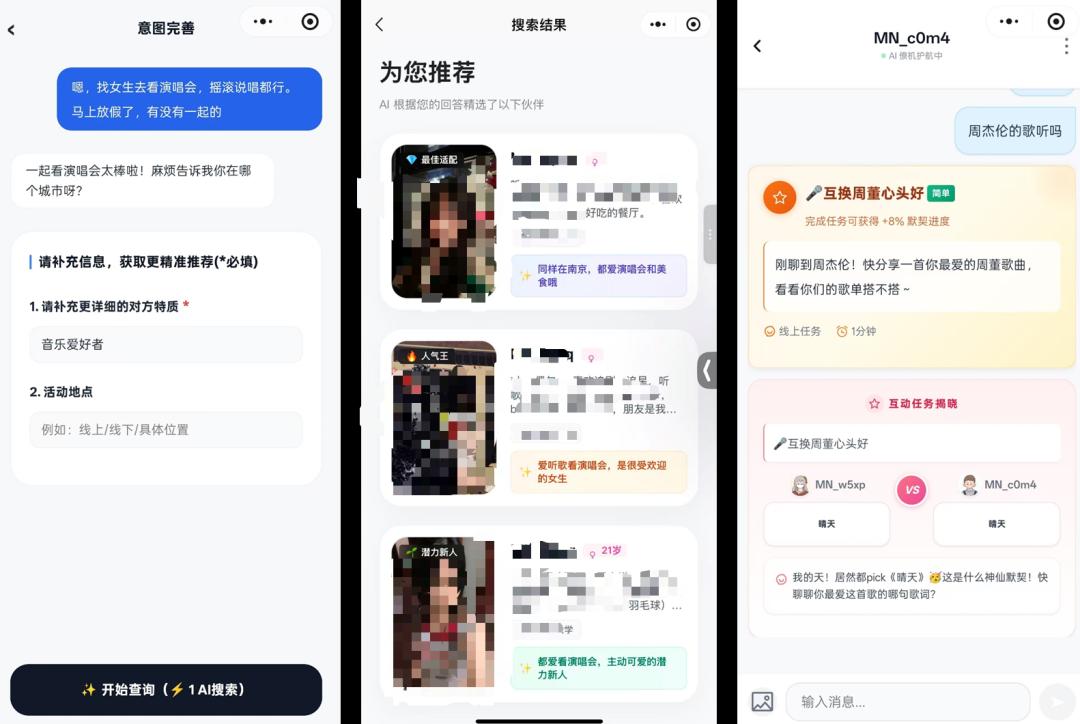
The first function is AI search. Users can directly describe their needs in the dialog box; if the information is insufficient, the system will guide them to supplement necessary conditions through continuous dialogue, and then perform retrieval according to the profiles of both parties. After finding someone they are interested in, users can send a greeting, and after the other party agrees, the two sides formally establish a friend relationship.
The second function is AI wingman. After the friend relationship is established, AI will extract the highly relevant content from the profiles of both parties, generate resonance reports, ice-breaking questions and interaction suggestions, and guide the two sides to exchange contact information or arrange offline activities at the right time.
From the perspective of product design, this logic was feasible at that time: AI first helps users find people, then helps two people get familiar with each other, from matching to the establishment of real connections.
But after running for a period of time, problems gradually emerged.
III. The search box finally turned into a wishing well
First of all, the vast majority of users who initiate searches and interactions are male. Secondly, regardless of gender, the search conditions are highly concentrated on a few external conditions, such as good-looking appearance, height of 180cm, etc. About 80% of the searches are looking for such people who are difficult to meet in real life, and even if they are met, they may not be interested in the searcher.
The search box seems to improve the efficiency of finding people, but in fact it can easily turn into a wishing well.
Users only need to describe their ideal partner, and AI will return results according to their wishes. This result is certainly attractive to the searcher, but social interaction is not a one-way choice. The fact that you want to know a person with excellent conditions does not mean that the other person also wants to know you; the other person may not only refuse, but this active connection may even become a disturbance.
This is also the most fundamental difference between "human search" and information search or commodity search.
Information will not refuse to be searched, and commodities do not need to choose consumers in turn, but people do. The search results for people must meet two sets of conditions at the same time: he meets my requirements, and I am also worth being known by him. If only the former is satisfied, no matter how accurate the matching is, it is useless.
Therefore, search is not a balanced form of social products. It naturally stands from the perspective of the initiator to solve "who I want to find", but does not solve the more important problem: "why should the other party choose me?"
The AI wingman also exposed similar problems. Whether two people are willing to chat does not mainly depend on whether AI provides a common topic, but on the first impression, and whether you are interested in getting to know the other person further after seeing their profile.
Especially in a pure online scenario, the information both sides have is very limited, and photos and personal profiles almost determine whether to start the conversation. AI can make two people who already have mutual affection chat more smoothly, but it is difficult to make a person who has no interest at all suddenly become interested because of a few ice-breaking questions.
In other words, the AI wingman optimizes the efficiency after the chat starts, but most relationships actually die before the chat starts.
At this point, the first phase of the mini-program was basically declared a failure. We originally thought that AI could simultaneously improve the efficiency of finding people and getting familiar with each other, but later found that the most difficult problem to solve in pure online social networking is not efficiency, but two-way willingness.
If this premise cannot be established, then the seemingly grand proposition of "human search engine" is difficult to be valid in the pure online social scenario.
IV. Return to traditional mutual selection: a "face-slapping" iteration
After confirming that the "human search engine" is not feasible, we did not continue to add functions to AI search and AI wingman, but re-studied the development history, product form and commercialization path of leading social products at home and abroad.
The final conclusion is somewhat frustrating: products like Tinder and Bumble have achieved an almost extreme balance between human nature, experience and commercialization in pure online social networking.
There is a hard-to-reverse chain for people to build relationships: you have to be interested first, then you are willing to chat; as you get to know each other better, the two sides may meet; with common experiences, the relationship can go deeper.
AI can improve the efficiency of some links, but it cannot change the sequence of relationship development.
The mutual selection mechanism seems simple, but it solves the two most important problems in social interaction at the same time: the right to choose and the pressure of rejection. Users can browse and express their interest at low cost without actively disturbing the other party; only when both parties make a choice, the relationship will continue to advance.
Turning photos and profiles into browsable cards seems to "commodify people", but it may be the way with the lowest understanding cost in pure online scenarios. Browsing itself is entertaining, and the threshold for expressing liking is low enough; once the mutual selection is successful, both sides have completed the most critical pre-screening.
The business model built on this mechanism is also straightforward. Rights such as membership, more exposure and "super like" do not sell a definite relationship, but more choices and the opportunity to approach the ideal partner.
After figuring this out, we admitted that our previous judgment was wrong.
Social products must respect people's choice habits and the objective order of relationship development. If the logic of AI search is not valid, we should admit it instead of continuing to add functions blindly just because the product has been developed.
Therefore, the second phase of the mini-program returned to the traditional two-way mutual selection.
This does not mean that the project has completely lost its commercial value. Although mutual selection itself is not new, and there have been many similar products for college students in China, we still have a practical advantage over ordinary entrepreneurial teams: we have accumulated campus users, promotion channels and operation experience.
One of the most important thresholds for campus social networking is trust. Users are willing to register because the participants come from nearby universities, their identities are relatively real, and there is a long-term operated campus community as the foundation behind the product.
So our judgment at that time was: even if we can't build a "human search engine", we still have the opportunity to make it a small but viable business. For example, first cover a university town, then expand to a city, and build a local social product dominated by college students with relatively reliable user quality.
After the product form was determined, we retained the core rules of mutual selection, but did not completely copy the traditional large pictures and left-right swiping, but added some interaction methods of AI products.
Users first describe their situation and preferences through dialogue, and AI recommends 3 to 5 people in the dialogue stream every day, showing the other person's photo, profile and recommendation reason through cards. Users can directly express their liking, and after both parties choose each other, a connection is established.
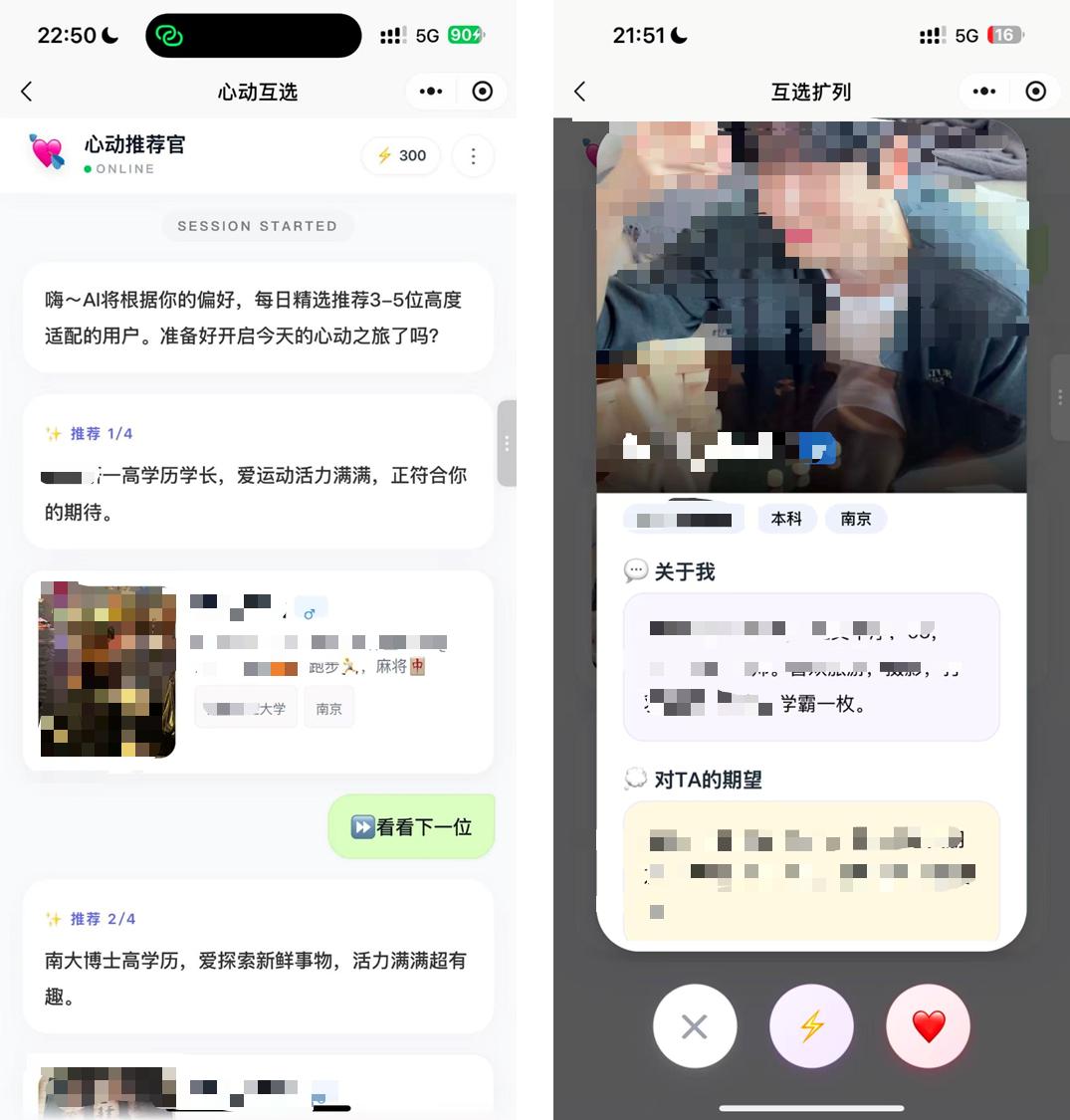
It has some changes in interaction, but the core mode has not changed, which is still "display - selection - mutual selection success". The purpose of this phase is also very clear: to verify whether the mutual selection product in the campus scenario is really used by people, and whether retention and payment can be realized.
The results after launch once surprised us very much.
Less than 12 hours after the concentrated promotion, the number of users who actively registered and completed their profiles quickly exceeded 100, and then membership and energy payment appeared. What surprised us even more was that without any recall or message reminder, the next-day retention rate of the product exceeded 35%.
At that time, we only recommended 3 to 5 people to users every day. After browsing them today, new people will appear tomorrow; and most of these users come from the same university town. The feeling of "being nearby" is more real than browsing strangers in other cities, and it is easier to generate motivation to continue using the product.
In the following days, some users logged in continuously, and mutual selection and payment began to appear one after another. At least from the data