Large models are advancing by leaps and bounds, yet AI applications are lacking in dynamism.
On the evening of August 26, MiniMax released its 2026 semi-annual performance report, which is MiniMax's first semi-annual report since its listing on the Hong Kong Stock Exchange.
In the first half of the year, MiniMax recorded revenue of 117 million US dollars, a year-on-year increase of 283.1%, exceeding its full-year 2025 revenue of 79 million US dollars in just six months. It posted a loss of 358 million US dollars during the period, narrowing 11% year on year. Overall, MiniMax's revenue performance exceeded market expectations, and one of the most critical changes is that its growth engine has successfully shifted from the C-end to the B-end, with open platforms and other AI-based enterprise services accounting for 63.4% of total revenue.
For a long time in the past, this large model unicorn has often been labeled by the outside world as a "C-end company".
This can be said to be a microcosm of the widening gap in commercial revenue between the model layer and the application layer. Over the past three years, the revenue of companies developing underlying models has risen to more than tens of billions of US dollars, but in the entire AI application industry, there are very few companies that actually generate revenue exceeding 100 million US dollars.
More critically, the number of independent applications labeled "AI-powered" in app stores is still growing, but the list of top-tier products with over a million monthly active users is constantly shrinking.
Behind this may be the shrinking development space of the entire intermediate application layer.
No AI Application Has Truly Captured Users
From a macro perspective, the endless emergence of AI applications has continuously expanded user capacity. As of March 2026, the overseas overall MAU has climbed to 1.837 billion, with an annual year-on-year growth rate of 84.70%; China has continuously served as the largest absolute increment engine driving the global activity growth. In March 2026, China's overall AI MAU strongly broke through the 851 million mark, with an annual year-on-year growth rate of 81.71% and a staggering quarterly growth rate of 51.38%.
AI is completing terminal penetration on a global scale at an unprecedented acceleration, and this penetration speed has exceeded that of the PC Internet and mobile Internet.
However, since the beginning of this year, a number of AI applications that were once highly sought after by capital have gradually exited the market. For example, OpenAI announced the discontinuation of the Sora video generator that had been online for only half a year, the AI model evaluation platform Yupp.ai also announced its shutdown, and in addition, Google began to scale back its internal AI application lines.
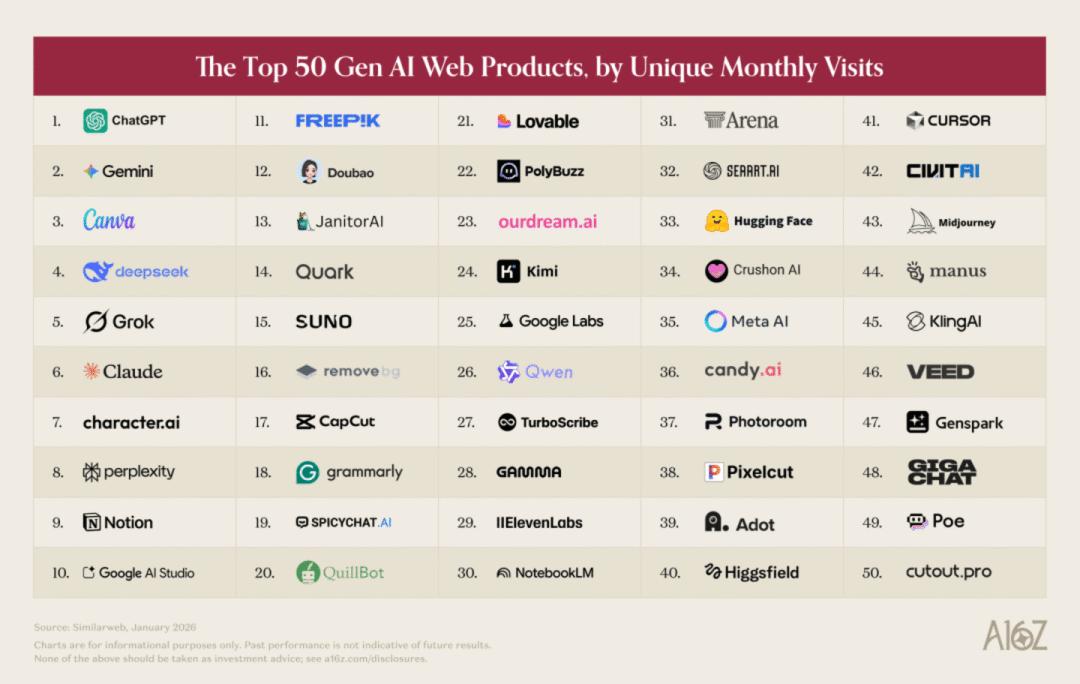
Looking further back, many of the first batch of viral application unicorns in the AI industry have stopped growing. The most typical representative is the AI image generation tool Midjourney. In the top 100 AI application list released by a16z, Midjourney's ranking dropped rapidly, falling from 8th on the initial list to 43rd; another example is Xingye under MiniMax, which had about 20,000 daily downloads on Apple devices before February 2025, but only about 7,000 downloads left by April.
Apart from user growth, a common staged contradiction faced by current AI application companies is that although the attractiveness of products has been verified, the path to convert it into a sustainable profit model is still unclear. Especially when comparing the commercial realization capabilities of the application layer and the model layer, the gap is extremely huge.
For the most intuitive example, Cursor, the top popular AI programming tool, achieved an annualized revenue of over 2 billion US dollars in 2025. It was established only three years ago, which is the fastest in B2B history, with revenue per capita exceeding any software company in Silicon Valley. Looking at OpenAI again, based on its current business performance, its annualized revenue has exceeded 400 billion US dollars, roughly doubling from the level of over 200 billion US dollars at the end of 2025.
It is already excellent for an AI application to reach revenue of over 100 million US dollars, while leading large models have long crossed the level of tens of billions of US dollars.
In the past, the industry's judgment on the application layer was that the penetration of AI applications and the emergence and evolution of AI agents would most likely become the mainstream of development, and traditional software and APP forms might disappear. But up to now, not only have real national-level AI applications not appeared, most AI applications have not shown a leap-forward and unique user experience far better than traditional APPs that can make users willing to migrate.
In the mobile Internet era, we can see that every successful and retained application has a unique interactive language, functional design or huge ecosystem. Especially for products that can be called national-level applications, they have successfully embedded in users' minds, become the "default option" to meet certain needs of users, and almost occupied the mobile phones of all netizens.
Current leading AI applications have a certain user base, but their influence is still insufficient.
The Application Layer Cannot Escape the "Technological Domination" of Underlying Models
With slow user growth, difficulty in revenue breakthrough, and the long absence of "national-level AI applications", why does the development of the AI application ecosystem seem to be shrinking?
According to the 6th edition of the top 100 AI application list released by a16z, a prominent change is that super applications are "annexing" vertical applications. In fact, more precisely, the super applications of underlying model enterprises are swallowing the original market of vertical applications in the application layer, making themselves a unified AI entrance.
For example, Midjourney, the AI image generation tool, initially attracted a large number of users with its powerful AI image generation function. However, as OpenAI, Google and other companies continue to release the capabilities of their continuously upgraded underlying models to the product level, the functions of ChatGPT, Gemini and other chatbot products continue to expand, and Midjourney's advantages are weakened. Just like in the mobile Internet era, vertical APPs target specific needs to expand user volume. Once comprehensive platforms enter this market, they will directly form a dimensionality reduction strike.
Jasper AI, the AI writing application, also declined in this way. The popularization of ChatGPT quickly turned "generating marketing copy" from the core selling point of an independent application into the basic capability of large models, so users no longer need to download a separate AI application.
It can be seen that the development space of the entire application layer has been squeezed: upstream model manufacturers master core capabilities, they can enter the application layer and release their capabilities at any time; downstream customers pay more attention to practical results, start to press prices, pursue effects and check ROI, while there are more and more optional suppliers.
Fundamentally, this is because most current AI applications have not built their own core competitiveness. What we see as a new application, the core capability behind it is still provided by leading large models such as Gemini, GPT or Claude.
This means that the usability of AI applications basically depends on how fast the underlying model is upgraded, and the initiative is almost entirely in the hands of others.
This is also why the iteration of leading AI applications is so fast. The data of the top 10 list of pioneer AI application downloads from Diandian Data shows that compared with April 2026, as many as 6 new applications entered the list in May, including ChatGPT, Piclux, AI Chat, Photo Video maker with music, Kling AI and Pivo AI; only 4 products including Refoto, Hailuo AI, VibeShort and Vidix have been on the list for two consecutive months.
In addition, industry surveys show that more than 70% of AI application users have changed their main AI tools at least three times in the past year, and most of the reasons for replacement are "heard that the new model has better effect" rather than "the new application solves problems that the old application cannot solve". This more intuitively illustrates the current situation that AI applications are constrained by underlying large models.
What's more unfavorable is that the development focus of the AI industry is leaving the application layer, completely shifting to the model layer, and to agents that may directly eliminate AI applications.
Capital Has Not Left the Application Layer, But Its Enthusiasm Is Fading
There is no doubt that the AI application market is still exploding.
According to data from Sensor Tower, the downloads of generative AI applications doubled year on year to 3.8 billion in 2025, and in-app purchase revenue nearly tripled, exceeding 5 billion US dollars. It can also be seen from the 6th edition of the generative AI consumer application list released by a16z that what have actually exited are a number of lightweight applications that package a single-point function into an independent product. Those application layer products embedded in high-frequency scenarios, occupying user entrances and entering real work flows are still surviving.
However, the AI application layer is entering a more brutal commercial screening period. In terms of the current commercial realization capability of AI applications, this is undoubtedly a severe test. The key is that it tests not only start-ups, but also the patience of capital.
In 2024, investment in the AI industry was ignited in the investment community, numerous AI applications flourished, they were also favored by investment institutions, and financing increased significantly. Taking the United States as an example, the tech media Techcrunch sorted out 39 American AI start-ups that received financing of 100 million US dollars, with a total financing amount of more than 24.4 billion US dollars. 23 of them were in the application layer, accounting for nearly 60%, while there were 7 companies in the model layer and 8 in the infrastructure layer respectively.
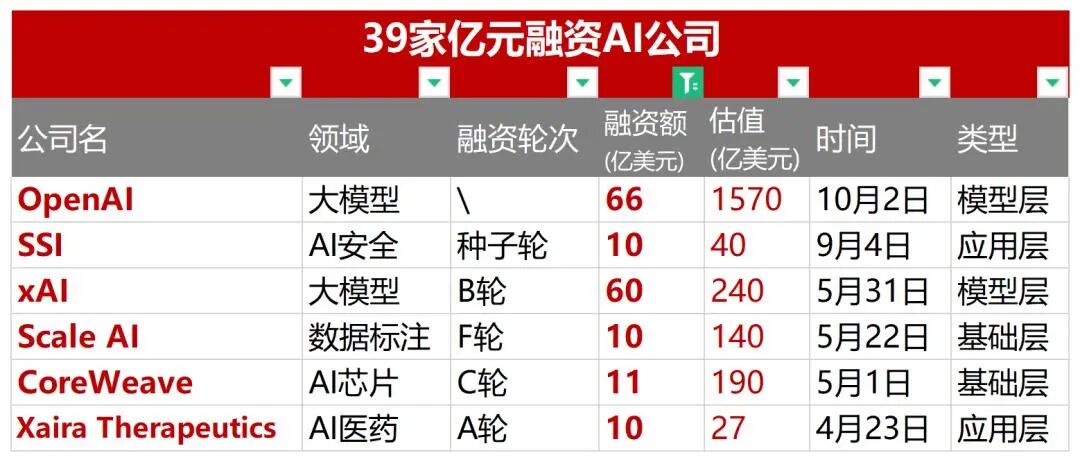
But now most hot money has flowed from the application layer to the pockets of AI infrastructure and large model players.
In the first half of this year, among the 5.1 trillion US dollar venture capital feast, 3.5 trillion US dollars flowed to the AI field, and the two giants OpenAI and Anthropic alone took 2.17 trillion US dollars. In China, large models are also the most attractive track for AI financing. According to data from IT Juzi, the total financing amount of China's large model track in the first half of 2026 reached 159.853 billion yuan, accounting for more than 52% of the total AI financing. The large model track not only has the highest total financing amount, but also the largest single financing scale, with an average single financing amount of 704 million yuan.
Financing in the application layer is shrinking. Report data cited by Economic Reference Daily shows that in the first 11 months of 2025, the number of AIGC financing events hit a new high, but the single financing amount dropped from 121 million yuan to 85 million yuan, shrinking by 30%.
"Shell-wrapping" applications have gradually gone to death. The remaining tool-type AI applications that occupy high-frequency or vertical scenarios have accumulated a large number of users, but the retention rate is still a big problem. More importantly, the huge cost of computing power and the slow pace of commercial realization have already created a contradiction. Once there is a lack of continuous capital inflow, these AI applications are likely to face the dilemma of running out of resources.
An investor who rejected an AI application entrepreneur said, "We no longer look at AI application startups at all." In his view, large models have moved towards general intelligence, and can become extremely powerful in any direction. A vertical Agent for a segmented direction that you spend a lot of effort on developing may only be a small function in the next iteration of the large model.
Some investors are still willing to look at related projects, but they are not willing to bet heavily.
Once, we thought that the emergence of large models would make the application layer explode at the earliest, reproducing the scene where mobile Internet applications changed the lives of the public. But now, AI applications have not shown disruptive value. Agents that "do things for users" may be a direction, but can users really rest assured to hand over their life and work to AI? This is a permanent question.
This article is from the WeChat official account "Silicon Carbon Variable", written by Hu Yidao, and published by 36Kr with authorization.